

Kashmir Singh is 70. He lives in a Gurugram housing society and wants one simple thing. He wants to walk in the society park with his wife. His resident welfare association said no.
The reason had nothing to do with rent, noise, or unpaid bills. Singh lives in the Economically Weaker Section (EWS) block of Mahindra Aura in Sector 110A. The RWA claimed that EWS flat owners have no right to the central park or the sports facilities.
On September 15, 2026, the District Registrar of Firms and Societies in Gurugram disagreed. The Registrar told the RWA to lift every restriction. A private conveyance clause, the order said, cannot override basic access to open spaces.
The case matters far beyond one society. Across Gurugram, Noida, Bengaluru and Mumbai, RWAs are drawing lines between big flats and small flats, owners and tenants, and payers and defaulters. So can a housing society actually restrict common area access? Here is what the law says, and what you can do about it.
What Happened at Mahindra Aura in Gurugram?
The Indian Express reported the dispute in detail. Mahindra Aura has 799 condominium units that sell for upwards of Rs 2.5 crore. Owners there pay about Rs 11,000 a month in common area maintenance (CAM) charges.
A separate block holds 141 EWS flats. These are 225 sq ft units allotted under state social housing rules. EWS residents pay Rs 705 a month as CAM.
About two years ago, the RWA put up a notice in the EWS tower. It cited clauses 18 and 20 of the conveyance deeds and said:
- EWS occupants have no right to common areas meant for the main complex
- EWS owners hold no membership rights in the RWA
- No power backup or parking entitlement applies to EWS units
- The RWA may restrict access for any EWS resident found in the park or sports areas
The RWA argues that the issue is money, not discrimination. It says the two blocks have separate maintenance arrangements and that the EWS block owes nearly Rs 7 lakh in dues. Singh says he is willing to pay.
This is not an isolated case. In Sector 67, Gurugram, the Department of Town and Country Planning gave the Ireo Victory Valley RWA 15 days to restore access for EWS flat owners. In Faridabad Sector 86, around 150 EWS residents have alleged they were kept out of parks and society elections.
Who Actually Owns the Common Areas of a Housing Society?
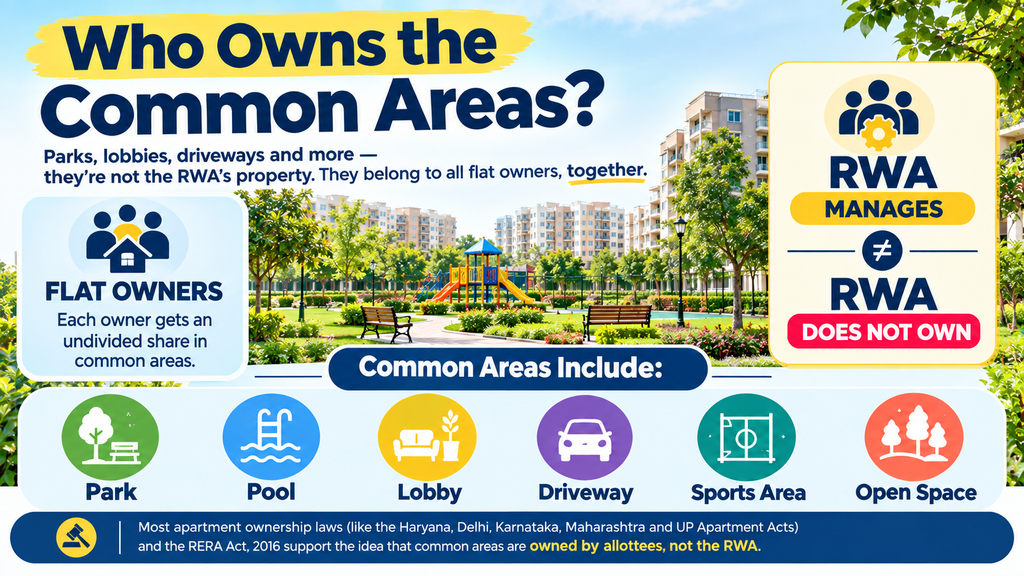
This is the question that decides most RWA disputes. The answer usually surprises committee members.
Common areas belong to all flat owners together
Most states have an apartment ownership law. Examples include the Haryana Apartment Ownership Act, 1983, the Delhi Apartment Ownership Act, 1986, the Karnataka Apartment Ownership Act, 1972, the Maharashtra Apartment Ownership Act, 1970, and the Uttar Pradesh Apartment Act, 2010.
These laws follow the same basic idea. Each flat comes with an undivided share in the common areas and facilities. Parks, lobbies, driveways, and open spaces are owned jointly. They are not the property of the RWA.
The Real Estate (Regulation and Development) Act, 2016 supports this. Section 17 requires the builder to hand over the common areas to the association of allottees. The RWA manages these spaces on behalf of every owner. It does not own them.
What a conveyance deed can and cannot take away
A sale deed or conveyance deed can define some things. It can allot a specific parking slot or set out the proportion of maintenance you pay. The difference between an agreement to sale and a sale deed matters here, because the final registered deed is what governs your rights.
However, a private clause has limits. It cannot give the RWA power to lock an owner out of open spaces that planning approvals created for the whole project. That is the core of the Gurugram Registrar's order.
What Can an RWA Regulate, and What Can It Not?
RWAs do have real powers. They must keep the society safe, clean, and solvent. The line falls between regulating use and denying access to a class of residents.
| RWA action | Generally allowed? | Why |
|---|---|---|
| Fixing gym or pool timings for everyone | Yes | A uniform rule for safety and upkeep |
| Requiring slot booking for the clubhouse | Yes | Applies equally to all residents |
| Closing a facility for repairs | Yes | Temporary and operational |
| Charging a separate fee for a paid amenity like a pool | Often, if approved by the general body | Must apply to every user on the same terms |
| Barring EWS or small flat owners from parks | No | Singles out a class of owners |
| Banning bachelors, pet owners or a community | No | Discriminatory and not backed by law |
| Cutting water or electricity over dues | No | Essential services cannot be used as leverage |
| Suing for recovery of unpaid maintenance | Yes | The proper legal route for dues |
Housing societies often try to ban certain groups outright. The rules on housing society bans on bachelors, pet owners and non-vegetarians follow the same logic. A society can make fair rules. It cannot pick favourites.
Do Tenants Have the Same Right to Society Amenities?
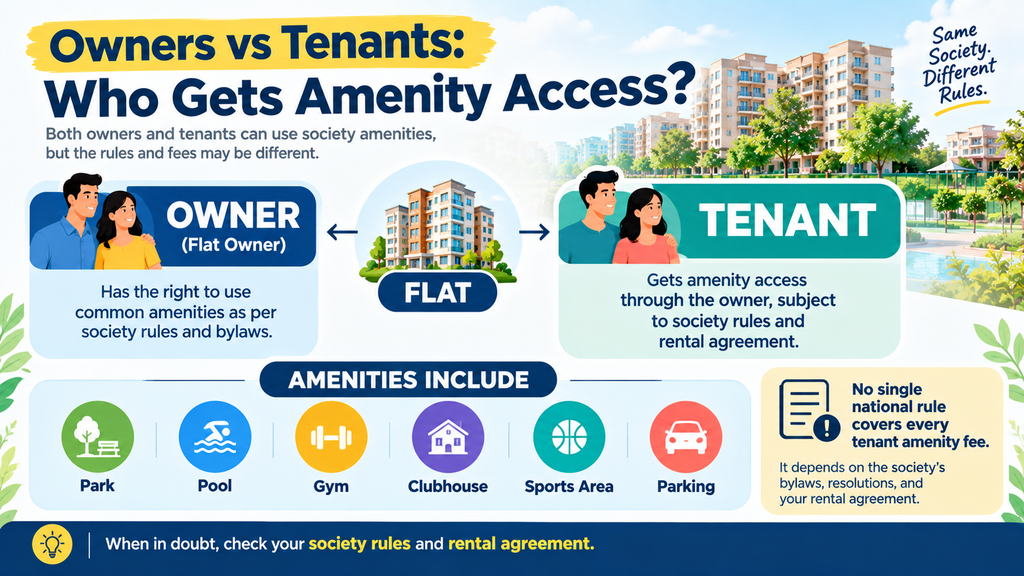
Tenants face a quieter version of this problem. In August 2026, tenants in several Noida high-rises reported being asked to pay extra monthly fees for gyms and pools, over and above their maintenance.
Where tenant rights come from
A tenant has no direct ownership share in the common areas. Their right flows from the owner. When an owner lets out a flat, the right to use the building's amenities normally travels with the flat to the occupant.
In practice, this means one set of users for each flat. If your tenant uses the pool, you as the owner usually cannot also use it at the same time. Some cooperative societies in Maharashtra have passed resolutions on exactly this point.
Can a society charge tenants extra for the gym or pool?
There is no single national rule. A general body resolution that charges every non-owner occupant a fair, uniform fee may survive a challenge. A fee that targets tenants only, with no link to real costs, is much weaker.
Tenants should check three things before they sign:
- Whether amenity charges are part of the CAM or billed separately
- Who pays the monthly maintenance under the rent agreement
- Whether the society's bye-laws allow separate tenant fees
The split between who pays for what between landlord and tenant should be written down. Oral promises rarely help in a dispute with the RWA.
Can an RWA Block Amenities Over Unpaid Maintenance?
This is the RWA's strongest argument, and it is partly valid. Maintenance dues fund security, lifts, cleaning, and the pool. A resident who does not pay is using services that others pay for.
Many society bye-laws allow the committee to suspend paid, non-essential amenities for defaulters after due notice. That can include the clubhouse, gym or pool. What the RWA cannot do is:
- Cut water, electricity, or lift access
- Block entry to the resident's own flat
- Punish a whole block for the dues of some residents
- Deny access to open spaces required by the approved layout plan
The correct route for unpaid dues is a demand notice and then a recovery claim. Collective punishment of an entire category of residents does not fit that route.
How to Challenge an Unfair RWA Restriction
If your RWA has blocked you from a park, gym, or other common facility, act in this order.
- Collect the paper trail. Keep the notice, WhatsApp messages, photos, and your latest maintenance receipts.
- Read your documents. Check your sale deed, the society bye-laws and, for tenants, your rent agreement.
- Write to the RWA. Send a written representation asking which bye-law allows the restriction. Ask for a reply within 15 days.
- Raise it at the general body meeting. Many restrictions are committee decisions that never had general body approval.
- Approach the right authority. Choose the forum based on your state and the type of society.
| Situation | Where to complain |
|---|---|
| RWA registered as a society in Haryana | District Registrar of Firms and Societies |
| Planning or layout violation in Haryana | DTCP enforcement wing, District Town Planner |
| Cooperative housing society in Maharashtra | Deputy Registrar of Cooperative Societies |
| Builder still managing the society | State RERA authority |
| Discrimination, harassment or blocked entry | Local police and the civil court |
| Deficiency in paid services | District Consumer Commission |
For Gurugram residents, the Mahindra Aura order shows the Registrar route can work quickly. Owners abroad can let a property manager in Gurugram keep dues, receipts, and society paperwork in order, so small issues do not grow into disputes.
What Should Landlords Put in the Rent Agreement?
Most tenant and RWA disputes start with a vague rent agreement. A good agreement settles these points upfront:
- Maintenance: Who pays the monthly CAM and any amenity fees
- Society rules: A clause that the tenant will follow registered bye-laws
- Amenity use: Whether the owner gives up amenity access during the tenancy
- Registration: The owner's duty to register the tenant with the RWA and complete police verification
- Dues on exit: How pending society charges are settled from the deposit
Terms like CAM, bye-laws, and NOC appear often in these documents. A clear rent agreement glossary helps both sides read the fine print. For stronger protection, compare an 11-month agreement with a registered rent agreement. A registered document carries more weight before any authority.
Gurugram landlords can draft and register an online rent agreement in Gurugram with these clauses built in. The broader Model Tenancy Act rules for each state also shape what a tenancy can and cannot include.
Conclusion
An RWA is a manager, not an owner. It can set timings, collect dues and enforce safety rules. It cannot split residents into first and second class by flat size, income group or tenancy.
The Gurugram order is a useful marker for every housing society in India. If your society has shut you out of a common space, start with paperwork, go through the general body, and then take it to the regulator.
Frequently Asked Questions
Can an RWA legally stop a flat owner from using the society park?
Generally, no. Apartment ownership laws give every flat owner an undivided share in common areas like parks and open spaces. An RWA manages these areas for all owners. It can regulate timings but cannot deny access to one group.
Do EWS flat owners in a private society have rights to common areas?
Yes. In September 2026, the Gurugram District Registrar ordered the Mahindra Aura RWA to lift restrictions on EWS residents. The order held that private conveyance clauses cannot override basic access to open spaces in the project.
Can a housing society charge tenants extra to use the gym or pool?
There is no single national rule. A fair, uniform fee approved by the general body may be valid. A fee that targets only tenants, without any link to actual running costs, is far easier to challenge before the Registrar.
Can the owner and tenant both use society amenities at the same time?
Usually not. Amenity rights attach to the flat, so they pass to the tenant during the tenancy. Many societies allow only the occupant to use the gym, pool, or clubhouse. Check your bye-laws and rent agreement.
Can an RWA cut water or electricity for unpaid maintenance?
No. Water, electricity, and lift access are essential services, and an RWA cannot use them to pressure defaulters. The proper route is a written demand notice followed by a recovery claim, not disconnection or blocking entry to the flat.
Where do I complain against an RWA in Gurugram?
Start with a written complaint to the District Registrar of Firms and Societies, Gurugram. For layout or planning violations, approach the District Town Planner's enforcement wing. If the builder still manages the society, you can file with Haryana RERA.
Can a conveyance deed take away my right to common areas?
A deed can define parking slots and your maintenance share. It cannot hand the RWA the power to lock you out of open spaces the approved layout created for all residents. The Gurugram Registrar applied this principle in September 2026.
Can an RWA suspend amenities if I have not paid maintenance?
Many bye-laws allow suspension of paid, non-essential amenities like the gym or clubhouse after notice. The RWA still cannot block your flat, cut essential services, or punish an entire block for dues owed by a few residents.
Do tenants need to register with the RWA?
Yes, most societies require tenant registration, copies of the rent agreement and police verification before move-in. The owner is usually responsible for completing this. Registration protects the tenant's access to amenities and avoids disputes with security at the gate.
What should a rent agreement say about society maintenance and amenities?
It should state who pays monthly CAM and amenity fees, whether the owner gives up amenity use, and how pending society dues are settled from the deposit. Clear clauses prevent most tenant and RWA disputes before they start.


0 Comments