

Walk through the lift lobby of any Mumbai, Delhi, Bengaluru, or Pune apartment complex, and you will find a version of the same notice board. "Bachelors not allowed." "Only vegetarian tenants." "No pets in the society." Signs of this kind have become so common that most Indians assume they carry the force of law. They do not.
Every year, thousands of unmarried professionals, dog owners, and non-vegetarian families face rejections that have zero legal standing. Some walk away and find another flat. Some argue with the security guard. A handful take the society to court, and the results are almost always the same. Housing societies, no matter how tightly organised, cannot override the Constitution, the Prevention of Cruelty to Animals Act, or the State Cooperative Societies Act. Yet the notices keep going up because most tenants and even most landlords are not sure where the law actually draws the line.
This guide walks through the three most contested bans, what the courts have said, what a society can legitimately regulate, and what to do if you are on the receiving end of an illegal rule.
Can a Housing Society Enforce These Bans?

No, not in most cases. A housing society in India cannot legally ban tenants on the ground that they are bachelors, non-vegetarians, or pet owners. Articles 14, 15, 19(1)(e), and 21 of the Constitution protect the right to equality, non-discrimination, freedom to reside, and personal liberty, all of which are violated by blanket bans of this kind. The Prevention of Cruelty to Animals Act, 1960, and Animal Welfare Board of India guidelines specifically prohibit pet bans by any housing society, even by majority vote. The Bombay High Court has repeatedly held that food choice is a matter of personal liberty. What a society can lawfully regulate is behaviour: nuisance, waste, noise, security formalities, and reasonable timings. What it cannot do is dictate who is allowed to live in a member's flat based on marital status, food preference, or the presence of a pet.
What Powers Does a Housing Society Actually Have?
A cooperative housing society in India is a body corporate registered under a state law, such as the Maharashtra Cooperative Societies Act, 1960, the Karnataka Cooperative Societies Act, 1959, or the Delhi Cooperative Societies Act, 2003. Its powers flow from three sources, in this order of authority.
- The Constitution of India, which sits above every other law
- Central and state statutes, including the relevant Cooperative Societies Act and the Prevention of Cruelty to Animals Act, 1960
- The society's registered bye-laws, framed under the parent Cooperative Societies Act
Bye-laws are the operational rulebook of the society, but they cannot override a statute, and no statute can override the Constitution. The moment a bye-law crosses that line, it becomes unenforceable, even if it has been passed unanimously by the general body. This is the single most important principle to understand, because most illegal society rules survive only because members assume a majority vote makes them binding.
A society's legitimate authority extends to maintenance collection, common area management, security, registration of new members, and enforcement of reasonable conduct rules. It does not extend to overriding fundamental rights or blocking a member from renting out their flat to a lawful tenant of their choice.
Can a Housing Society Ban Bachelors?
There is no law in India that permits housing societies to refuse tenancy to unmarried adults. Multiple constitutional protections apply.
Article 14 guarantees equality before the law. Discriminating against a person only because they are single is arbitrary and lacks a reasonable basis.
Article 19(1)(e) gives every Indian citizen the right to reside and settle in any part of the country. A society bye-law prohibiting bachelors directly restricts this right.
Article 21 protects personal liberty and dignity. Refusing housing based on marital status intrudes into private choices about relationships and lifestyle that the Supreme Court has repeatedly held to be constitutionally protected.
Under the Maharashtra Cooperative Societies Act, 1960, Section 154 B-7 specifically restricts the grounds on which a society can block a membership or tenancy transfer. In a 2024 ruling involving the Kendriya Vihar Co-operative Housing Society, the Bombay High Court struck down a general body resolution restricting transfers to certain categories of buyers. The Court held that societies cannot impose restrictions beyond what the Cooperative Societies Act and its bye-laws expressly authorise.
What a society can lawfully insist on is documentation, police verification, and behaviour standards. A properly drafted rent agreement captures the tenant's identity, address, employment, and background verification, which addresses the security concerns most societies claim to be worried about. What a society cannot insist on is that the tenant be married.
Individual landlords, acting as private owners, do have wider discretion than the society itself because private contracting is not directly bound by fundamental rights in the same way. A homeowner who personally prefers to rent to families is exercising a private choice. A society bye-law that blanket-bans bachelors is a collective rule enforced by a body corporate, and that is a very different legal object.
Can a Housing Society Ban Non-Vegetarian Tenants or Food?
The Bombay High Court, in the meat sale ban proceedings of 2015 and in observations made repeatedly since, has held that whether to be vegetarian or non-vegetarian is a matter of personal choice protected under Article 21 of the Constitution. That protection extends to the home. A housing society cannot restrict what a member cooks in their own kitchen or refuse tenancy to a non-vegetarian tenant.
The confusion here comes from the private-sale side. A society composed entirely of members from a particular community may prefer to sell flats only to members of that community, and courts have generally left individual sale transactions to private choice. But that is a very narrow exception. It does not extend to:
- Blocking a lawful sale that has already happened between a member and a buyer of a different food preference
- Preventing a member from renting their flat to a non-vegetarian tenant
- Restricting cooking or consumption of food inside the flat
- Imposing dining or cooking timing restrictions
- Charging non-vegetarian residents higher maintenance
If a society passes a resolution that a particular building or wing shall be vegetarian only, and enforces it against existing members or their tenants, that resolution is unenforceable. The remedy sits with the Registrar of Cooperative Societies, the cooperative court, or the writ jurisdiction of the High Court.
Can a Housing Society Ban Pets?
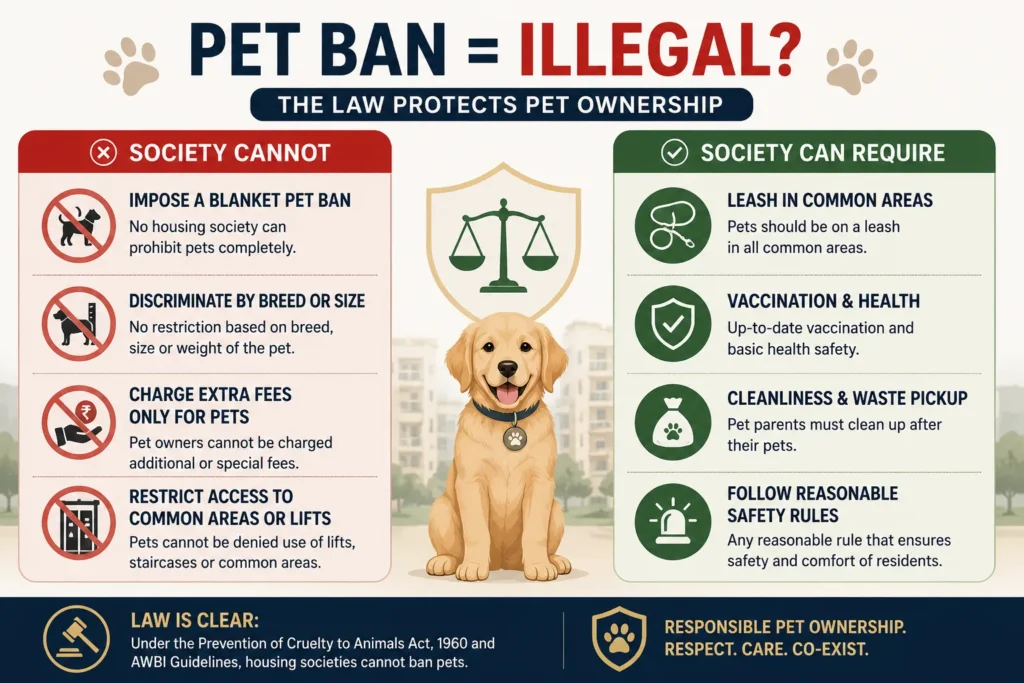
This is the area where the law is most emphatic. Housing societies in India cannot ban pets. The Animal Welfare Board of India has issued detailed guidelines under the Prevention of Cruelty to Animals Act, 1960, which state that no society bye-law or resolution can prohibit pet ownership, regardless of how many residents vote for it. Section 9(k) of the Act specifically empowers the AWBI to frame such rules.
The current position, reinforced by Supreme Court and multiple High Court rulings, is:
- Blanket bans on pets are illegal, even if passed by a majority vote
- Societies cannot restrict pets based on breed or size, including large breeds
- Pets cannot be barred from lifts, staircases, gardens, or other common areas
- No extra maintenance or "pet fee" can be levied on pet-owning residents
- Barking is not a valid ground for eviction or fine, unless it amounts to a persistent, documented nuisance
- Subtenants and licensees have the same right to keep pets as owners
What a society can lawfully require is compliance with reasonable safety and hygiene rules: leashing dogs in common areas, mandatory vaccinations, cleaning up after the pet, and cooperation with municipal pet licensing where the city, such as Mumbai under the Mumbai Municipal Corporation Act, requires one. It can also frame designated feeding spots for stray animals in line with the Animal Birth Control Rules, 2023.
A society that goes further and threatens eviction, imposes fines, or blocks lift access on pet grounds is acting outside the law and can be challenged before the Registrar of Cooperative Societies, a civil court, or the AWBI directly.
What Restrictions Are Legally Enforceable?
Not every society rule is illegal. Reasonable, behaviour-based, non-discriminatory conditions are within a society's power. Common lawful rules include:
- Registration of every tenant with the society office within a defined period after occupancy
- Police verification and submission of tenant documents, including a signed sample rent agreement
- Payment of a security or one-time move-in charge, as long as it applies uniformly to all tenants
- Reasonable timings for moving trucks, renovation work, and loud activities
- Guest register maintenance, visitor passes, and controlled entry
- Pet vaccination proof, leash rules, and waste management
- Nuisance-based penalties on any resident, tenant, or member for demonstrable and documented violations
- Compliance with municipal, fire, and building safety rules
The test is simple. Is the rule about behaviour, or about identity? Behaviour-based rules that apply equally to everyone are lawful. Identity-based rules that single out a category of people are not.
The Landlord's Rights vs the Society's Rights: Who Wins?
An owner of a flat in a cooperative housing society is a member of that society. As a member, they are bound by lawful bye-laws. As an owner, they have the right to rent, sell, or license their property to any lawful person, subject only to lawful conditions.
Under Section 154 B-7 of the Maharashtra Cooperative Societies Act, 1960, and similar provisions in other states, a society can restrict a transfer only on narrow grounds, such as pending dues from the transferring member. It cannot block a transfer or tenancy on the ground that the incoming person is single, non-vegetarian, or owns a pet. The Bombay High Court has struck down such restrictions repeatedly. A properly executed leave and licence or rent agreement, with police verification and society intimation completed, is a legally enforceable arrangement that a society cannot override.
For members drafting or renewing a tenancy, being aware of the common mistakes in rent agreements also helps close the gap that societies sometimes exploit to insist on additional conditions.
What to Do If Your Society Enforces an Illegal Ban
If a society issues a notice, imposes a fine, or blocks entry based on marital status, food preference, or pet ownership, the following steps preserve your rights.
- Ask for the resolution in writing. Demand a copy of the bye-law or general body resolution being enforced against you.
- Send a written reply. Cite the constitutional provisions and the relevant statute. Ask the society to withdraw the notice within a defined period, usually 15 days.
- Complain to the Registrar of Cooperative Societies. Every state has a Registrar who has the power to inquire into illegal bye-laws and resolutions.
- File a complaint with the AWBI in pet cases. The Board can issue directions to the society and the local authorities.
- Approach the Cooperative Court under the relevant section of the state Cooperative Societies Act for interim relief and permanent injunction.
- File a civil suit for injunction against illegal eviction or fine in the appropriate civil court.
- Consider a writ petition in the High Court where the society is acting in concert with a public authority or where the case involves a clear fundamental rights violation.
Most disputes settle at stage 2 or 3, because societies rarely have the legal position to defend such rules in a formal forum.
How Housewise Helps Owners Handle Society-Level Friction
Housewise coordinates rent agreement drafting, stamp duty payment, and, in Maharashtra, registration for property owners across 23 Indian cities. Where a member is renting out a flat inside a cooperative housing society, the agreement is drafted with correct tenant identification, police verification support, society intimation formats, and the standard behavioural clauses that address most society concerns without conceding to unlawful discrimination. For Maharashtra owners specifically, the Maharashtra online rent agreement registration workflow builds in society-facing documentation from the start, so a stubborn managing committee has fewer procedural excuses to block a lawful tenancy.
Frequently Asked Questions
Can a housing society ban bachelors in India?
No. No law in India allows a cooperative housing society to blanket-ban bachelors. Such a rule violates Articles 14, 19(1)(e), and 21 of the Constitution. The Bombay High Court and other High Courts have consistently struck down such bye-laws when challenged before them.
Can a housing society ban pets even if the majority votes for it?
No. Under Section 9(k) of the Prevention of Cruelty to Animals Act, 1960, and AWBI guidelines, no housing society can ban pets, regardless of the majority vote. Blanket bans, breed or size restrictions, and extra pet fees are all legally invalid.
Can a society refuse to allow non-vegetarian tenants?
No. Food choice is protected under Article 21 of the Constitution as part of personal liberty. A society cannot refuse tenancy, block cooking, or impose fines based on a resident's food preference. The Bombay High Court has repeatedly upheld this protection.
What is the legal difference between a landlord's choice and a society's rule?
An individual landlord's preference in selecting a tenant is a private choice. A society bye-law is a collective rule enforced by a body corporate under state law. Society rules must comply with the Constitution and the Cooperative Societies Act. Private choices have wider latitude.
Can a society charge extra maintenance for pet owners?
No. AWBI guidelines and multiple court rulings prohibit any additional charges or fees imposed on residents solely because they own pets. Uniform maintenance fees apply to every flat regardless of pet ownership, food preference, or the marital status of the occupants.
Can a housing society restrict a member from selling their flat to a non-vegetarian buyer?
Generally no. Under Section 154 B-7 of the Maharashtra Cooperative Societies Act and similar state laws, transfers can be restricted only on narrow grounds like pending dues. A blanket food-based restriction on transfers has been struck down by the Bombay High Court.
What can a housing society legally regulate?
Behaviour and safety, not identity. Societies can regulate maintenance dues, security formalities, guest registration, common area conduct, noise, waste, pet leashing, vaccination, moving timings, and renovation hours. All rules must apply uniformly and must not target specific categories of residents.
Where do I complain if my society is enforcing an illegal ban?
Start with a written notice to the society citing the relevant law. If unresolved, complain to the Registrar of Cooperative Societies of your state, file before the Cooperative Court, approach the AWBI for pet-related issues, or file a civil suit for injunction in appropriate cases.
Are these bans more common in some states than others?
Yes. Bans on bachelors, non-vegetarians, and pets are most reported in cosmopolitan cities like Mumbai, Pune, Bengaluru, and Delhi NCR, though the pattern varies by locality. The legal position, however, is the same across all Indian states under central law.
How does Housewise help landlords handle society objections?
Housewise drafts and stamps rent agreements across 23 Indian cities with correct tenant documentation, police verification support, and society intimation formats. This addresses most legitimate society concerns upfront and gives owners a clean paper trail to counter unlawful society objections.


0 Comments
Trackbacks/Pingbacks