
The argument almost always starts the same way. A tap starts leaking. The tenant calls the landlord. The landlord says a leaky tap is a tenant problem. The tenant says the pipes are old, and this is a plumbing job. Nobody wins, the leak keeps dripping, and by the time the tenant moves out, the deposit refund conversation has already turned sour.
Under the Model Tenancy Act (MTA) framework being adopted across Indian states in 2026, this argument now has a legal answer. The Act formally divides who pays for what between landlord and tenant, closing decades of ambiguity that led to millions of rental disputes every year.
This guide breaks down Landlord vs Tenant the exact split under the 2026 rules, category by category, so both parties know what they owe before the leak starts.
The Big Shift: What Changed in 2026
For most of India’s rental history, the split between landlord and tenant responsibilities lived only in the rent agreement. And because most agreements were 11-month templates with vague maintenance clauses, “who pays for what” became a matter of negotiation, personality, and staying power.
The Model Tenancy Act changed that. Sections 34 and 35 of the Act now specify a default maintenance split. If your rent agreement does not explicitly override the default, this is what the law now says applies.
The core principle is simple. Structural upkeep is the landlord’s responsibility. Day-to-day usage and minor repairs are the tenant’s. The Act enforces this by allocating specific tasks to each side, so ambiguity disappears.
The Clear Split: Structural vs Day-to-Day
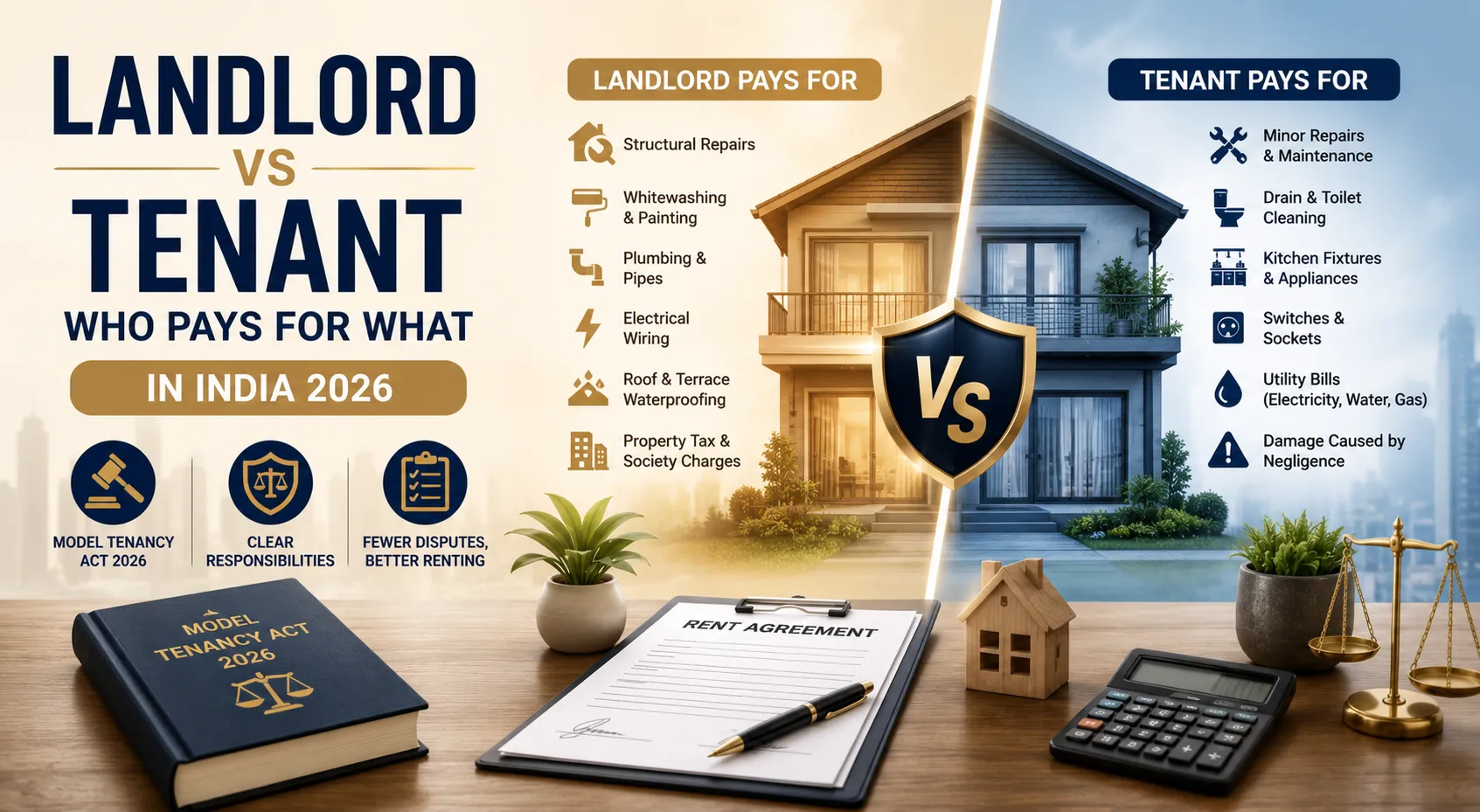
The MTA default assigns responsibilities as follows.
| Landlord Pays For | Tenant Pays For |
| Structural repairs (except tenant-caused damage) | Drain cleaning and toilet unclogging |
| External and internal whitewashing | Kitchen fixture repair and replacement |
| Painting of doors and windows | Switches and sockets |
| Change of plumbing pipes | Replacement of broken glass fixtures |
| Maintenance of electrical wiring | Garden and open space maintenance |
| Roof and terrace waterproofing | Minor wear-and-tear repairs |
| Common area upkeep | Damage caused by negligence |
| Society sinking fund contribution | Utility bills (electricity, water, gas) |
This default applies unless the rent agreement specifies something different. Even then, courts and Rent Tribunals treat any wholesale shift of structural responsibility onto the tenant as unenforceable.
Painting: The Single Most Disputed Item
Painting is where a large share of deposit disputes happens. The MTA now clarifies it.
- Interior whitewash and painting of doors and windows is the landlord’s responsibility at the start of the tenancy, and again at agreed intervals during long-term leases.
- Damage-related repainting (crayon marks, deep scratches, smoke stains from tenant use) is the tenant’s responsibility.
- End-of-tenancy repainting for normal wear is the landlord’s responsibility, not a valid deposit deduction.
The right rental agreement clause caps painting responsibility to areas with tenant-caused damage, requires photographic documentation of the pre-existing condition, and specifies that quotes be shared before deductions. Our guide on how to make a rent agreement walks through the exact clause structure.
Society Maintenance and Property Tax
This is the second-biggest area of confusion. Indian civil law and the MTA treat these as separate line items.
- Society maintenance charges are usually paid by the landlord in Maharashtra, Karnataka, and Tamil Nadu, but the rent agreement can shift them to the tenant. If shifted, they are typically capped at the monthly billed amount, not sinking fund or capital contributions.
- Property tax is always the landlord’s responsibility, since it is a charge on ownership, not occupation. No agreement clause can validly transfer this to the tenant.
- Sinking fund and capital contributions to the society (elevator replacement, painting of the building exterior, structural retrofits) are always the landlord’s responsibility.
Utility Bills: The Simple Rule
Utility bills follow usage, not ownership.
- Electricity, water, cooking gas, and internet are the tenant’s responsibility, based on actual meter readings during the tenancy.
- Water tanker refills, borewell power, and building-wide utility charges are typically split, with the tenant paying the pro-rata share for the tenanted period.
- Deposits paid to utility companies (electricity, water, LPG) remain with the landlord and are transferred back at tenancy end.
The rent agreement should list which utilities are metered separately and which are billed on society common bills, so the split is clear at signing.
Repairs Caused by Wear vs Damage
The distinction that trips up most tenants at exit is “reasonable wear and tear” versus “damage.”
- Reasonable wear and tear includes faded paint, minor scuff marks, worn taps, and small nail holes from picture hangings. These are the landlord’s costs to restore.
- Damage includes broken tiles, cracked cupboards, holes drilled without permission, stained walls, and appliances broken through negligence. These are the tenant’s costs to restore or reimburse.
The move-in condition report is what separates the two. A dated, signed report with photographs of every room fixes the baseline. Without it, most Rent Tribunals default to a “reasonable wear and tear” interpretation, tilting the outcome toward the tenant.
What Happens When the Landlord Refuses to Repair
If a landlord fails to carry out a structural repair (leaking roof, unsafe wiring, plumbing failure), the MTA gives the tenant a defined recovery path.
- Written notice. Tenant serves written notice, typically 30 days, specifying the repair required.
- Tenant-executed repair. If the landlord fails to act, the tenant can repair and deduct the actual cost from future rent, up to a specified monthly cap.
- Rent Tribunal escalation. If costs exceed the cap or the landlord disputes the deduction, the tenant can approach the Rent Tribunal for expedited resolution within 60 days.
This is a genuine shift in tenant power. Previously, the only option was a civil suit, which most tenants abandoned because of cost and duration.
What Happens When the Tenant Damages the Property
The MTA is equally clear on the other side. Tenants must not intentionally or negligently damage the premises. Where damage occurs, the tenant must notify the landlord as soon as possible.
- Cost recovery happens through deposit deduction with documented estimates and photographs, or through Rent Tribunal recovery if the deposit is insufficient.
- Repeated damage or refusal to repair can be grounds for landlord-initiated tenancy termination under the Act.
- Damage caused during a genuine emergency (fire from faulty wiring the tenant reported, or water damage from unrepaired pipes the tenant flagged) is not the tenant’s cost.
The tenant’s protection is the paper trail. Every repair request goes in writing. Every damage report is photographed and dated.
The Rental Agreement Clause Checklist
A well-drafted agreement pre-empts almost every dispute above. The clauses that matter:
- Maintenance split clause referencing MTA Sections 34 and 35 as the default, with any deviations specifically listed
- Society maintenance clause stating who pays, capped at the actual monthly bill
- Painting clause limiting tenant responsibility to damage-related repainting only
- Utility bill clause listing which meters the tenant pays for and which are shared
- Damage documentation clause requiring a move-in condition report signed by both parties
- Repair notice clause specifying the 30-day landlord response window and tenant deduction cap
- Deposit refund clause with a 30-day refund window and a photographic exit condition report
For a base template that already includes these clauses in a state-compliant format, see our online rent agreement service. For the difference between rent agreements and Maharashtra’s leave and licence structure, see the Leave and Licence vs Rent Agreement guide.
How Housewise Structures the Split for Managed Properties
Every property Housewise manages runs on a lawyer-vetted agreement that explicitly encodes the MTA maintenance split, plus a documented move-in condition report. This is the single biggest reason our tenancies close with clean deposit refunds and minimal disputes.
- For landlords, we handle structural repair coordination, society liaison, and property tax tracking so nothing is missed.
- For tenants, we route day-to-day repair requests through a single channel with defined response times.
- For NRI landlords, our NRI property management service means someone is physically inspecting the property, resolving repair disputes, and closing tenancies without requiring the owner to fly in. This is actively used by NRI landlords in Bangalore, Chennai, Gurugram, and Noida.
For a broader legal context on the MTA rollout that formalises all of the above, see our Model Tenancy Act guide. If your property is in Maharashtra, the Maharashtra rent agreement guide covers the state-specific overrides that apply under Section 55 of the Rent Control Act.
Conclusion
The old model of “figure it out when something breaks” is over. The 2026 rules give both landlords and tenants a defined split, backed by legal enforcement through Rent Tribunals with a 60-day resolution mandate. The winners are the parties who put the right clauses in the agreement upfront, document the property condition on move-in, and treat every repair request as a documented item rather than a phone call.
If you want your next tenancy to end with a clean deposit refund and no arguments, start with an agreement that already encodes the MTA split.
Frequently Asked Questions
Who pays for painting in a rented house in India?
Under the Model Tenancy Act, the landlord pays for interior whitewashing, painting of doors and windows, and end-of-tenancy repainting due to normal wear. The tenant only pays for repainting damage caused by their own use or negligence.
Is society maintenance the landlord’s or the tenant’s responsibility?
Under default MTA rules and Indian practice, society maintenance is the landlord’s responsibility. The rent agreement can shift it to the tenant, but sinking fund and capital contributions to the society always remain the landlord’s obligation.
Who pays property tax on a rented property?
Property tax is always the landlord’s responsibility, since it is a charge on ownership rather than occupation. No rent agreement clause can validly transfer property tax to the tenant, and courts routinely reject such clauses if disputed.
What repairs are the tenant responsible for under Indian law?
Tenants are responsible for drain cleaning, kitchen fixtures, switches and sockets, replacement of broken glass fixtures, garden maintenance, and any damage caused by negligence. Utility bills for electricity, water, and gas during the tenancy are also the tenant’s cost.
Who pays for plumbing repairs in a rental?
Structural plumbing, including pipe replacement, drainage systems, and water tanks, is the landlord’s responsibility. Day-to-day plumbing like unclogging drains, replacing washers, or fixing minor leaks caused by usage falls to the tenant under the MTA framework.
What happens if a landlord refuses to make structural repairs?
The tenant serves a written notice giving 30 days. If unresolved, the tenant can repair and deduct the cost from future rent within a monthly cap. Beyond the cap, the Rent Tribunal offers a 60-day resolution.
Can a landlord deduct end-of-tenancy painting from the deposit?
Only if the painting is due to tenant-caused damage documented against the move-in condition report. Blanket end-of-tenancy repainting charges for normal wear are legally challengeable and typically rejected by consumer forums and Rent Tribunals.
Who pays for a broken geyser or air conditioner in a rented flat?
If installed by the landlord and included in the rent, structural repair or replacement due to failure is the landlord’s cost. Damage caused by tenant misuse or repairs from routine usage typically falls to the tenant, based on the agreement.
Is the tenant liable if property damage happens during an emergency?
Damage caused during a genuine emergency, such as fire from faulty wiring that the tenant had reported, is not the tenant’s responsibility. The tenant must have documented the underlying issue in writing to the landlord before the emergency for this protection to apply.
Can Housewise manage the repair split for my rented property?
Yes. Housewise manages residential rentals across 22+ Indian cities using MTA-compliant agreements, documented condition reports, and a single-channel repair coordination workflow. This structure minimises disputes and protects both landlord and tenant interests throughout the tenancy.


0 Comments