

For most of the last decade, India's housing story was told through the affordable segment. Government schemes, interest subsidies, and developer launches all pointed toward homes below Rs 50 lakh. In 2026, the numbers tell a very different story.
According to JLL's report for the first half of 2026, sales of homes priced between Rs 1.5 crore and Rs 3 crore across India's top seven cities jumped 58% year on year to about 51,231 units, making it the fastest-growing price band in the country. Homes above Rs 1 crore now make up about 71% of sales, up from 62% a year earlier. At the other end, sales of homes priced between Rs 50 lakh and Rs 1 crore fell about 20%, and homes below Rs 50 lakh fell about 32%.
Overall sales grew only 3% in H1 2026 to about 1,38,382 units. So this is not a broad boom. It is a shift in who is buying and what they are buying. This guide unpacks why premium housing pulled away from the rest of the market, which cities are leading, the role of NRIs and HNIs, the warning signs in the data, and what it means for buyers, investors, and owners who plan to rent out premium homes.
Quick Answer: Why Are Premium Home Sales Surging in 2026?
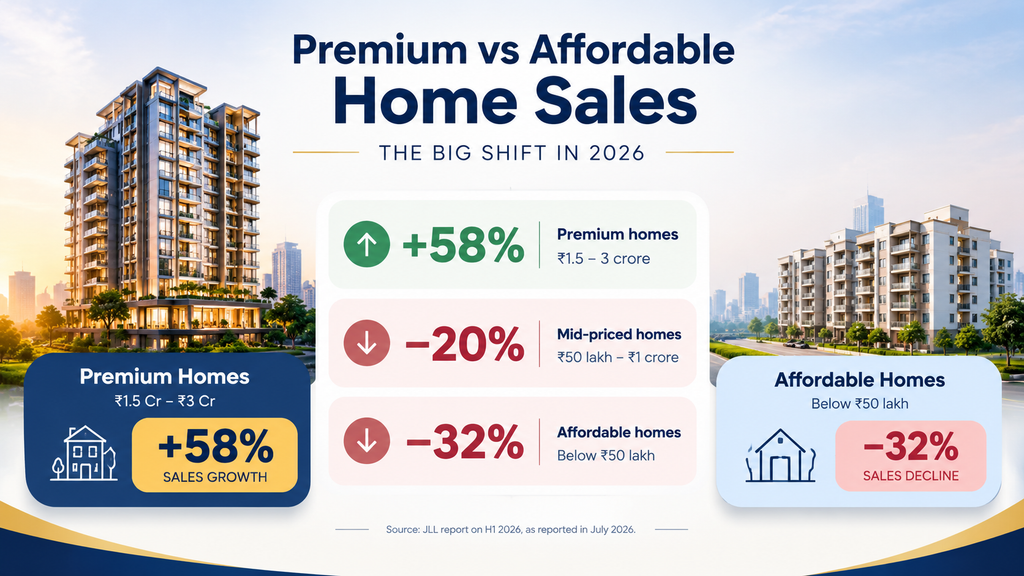
Premium home sales in the Rs 1.5 to 3 crore band jumped 58% in H1 2026, per JLL, because rising household incomes, wealth created through equity markets and business ownership, demand for larger homes, and a preference for established developers pushed buyers up the price ladder. Developers reinforced the trend by shifting launches toward higher-margin premium projects as land and construction costs rose, shrinking the supply of lower-priced homes. Lower home loan rates after the RBI's cuts through 2025 helped higher-income buyers finance larger tickets, and NRI and HNI demand added further support. The shift is concentrated: overall sales grew only 3%, while sales below Rs 1 crore fell sharply, and Anarock data shows unsold inventory climbing above 6 lakh units with buyers becoming more selective in later quarters.
The Numbers Behind the Shift
The H1 2026 data from JLL shows a clear tilt toward the top of the market.
| Metric (Top 7 Cities, H1 2026) | Figure | Change |
|---|---|---|
| Total sales | About 1,38,382 units | Up 3% YoY |
| New launches | About 1,68,507 units | Up 9% YoY |
| Rs 1.5 to 3 crore sales | About 51,231 units | Up 58% YoY |
| Share of sales above Rs 1 crore | About 71% | Up from 62% |
| Share of sales below Rs 1 crore | About 28% | Down from 39% |
| Rs 50 lakh to 1 crore sales | Not stated | Down about 20% |
| Below Rs 50 lakh sales | Not stated | Down about 32% |
Source: JLL report on H1 2026, as reported in July 2026. Some coverage describes the fastest-growing band as Rs 1 to 3 crore; the 58% growth figure is consistent across reports.
Anarock's quarterly data adds context on supply. In Q2 2026, about 25% of new launches in the top seven cities were priced between Rs 1.5 crore and Rs 2.5 crore, and another 22% were above Rs 2.5 crore. Homes below Rs 40 lakh made up only about 6% of new supply. In NCR, about 61% of new supply was priced above Rs 1.5 crore.
Five Reasons Premium Homes Pulled Ahead
1. Rising Incomes at the Top
JLL points to rising household incomes, particularly among senior professionals, founders, and business owners. The gains in the past few years have been strongest in higher income brackets, which translates directly into demand for larger, better-located homes.
2. Wealth From Equity and Business Ownership
A long run in equity markets created substantial paper and realised wealth for investors, ESOP holders, and promoters. Part of that money has moved into property, often as an upgrade from an existing home or as a second home.
3. Demand for Larger, Better Homes
The post-pandemic preference for bigger homes, study rooms, and better amenities has not faded. Buyers trading up from a 2BHK to a 3BHK or 4BHK in a gated project naturally land in the Rs 1.5 to 3 crore band in most metros.
4. Preference for Established Developers
Buyers burned by stalled projects in the last decade now strongly prefer listed and branded developers with delivery records. Those developers mostly build in the premium segment, which concentrates demand there.
5. Easier Financing for Higher-Income Buyers
The RBI cut the repo rate by 125 basis points through 2025 to 5.25%, pulling home loan rates for strong borrowers down to around 7.1 to 7.65%. Higher-income borrowers with strong credit scores benefit most, making larger loans easier to service.
The Supply Side: Developers Followed the Margins
Demand is only half the story. JLL notes that developers deliberately shifted their pipelines toward premium projects, where margins are higher and demand has held up. Rising land prices and construction costs make low-ticket homes harder to deliver profitably in metro locations, so affordable supply has shrunk.
This creates a self-reinforcing loop. Fewer affordable launches mean fewer affordable sales, while more premium launches meet a ready pool of upgrading buyers. Part of the fall in sub-Rs 1 crore sales is simply a lack of new supply, not only weaker demand.
Which Cities Are Leading?
- Bengaluru. About 35,017 units sold in H1 2026, up 16%, with the highest supply at about 48,748 launches.
- Chennai. The fastest sales growth in H1 2026, up about 27%.
- Delhi NCR. Sales up about 7%, with Anarock reporting average prices up 12 to 13% year on year and a heavy tilt of new supply above Rs 1.5 crore.
- Mumbai, Pune, Hyderabad, Kolkata. Sales declined in H1 2026 per JLL, though Anarock's Q3 2026 data showed Hyderabad bouncing back with the highest annual sales growth at 15% and MMR sales up 5%.
Bengaluru, Mumbai, Pune, and Delhi NCR together accounted for about 76% of H1 2026 sales.
Where Do NRIs and HNIs Fit In?
NRIs have been a steady source of premium demand. A weaker rupee over the past couple of years increases the purchasing power of overseas earnings, and many NRIs prefer branded projects in Bengaluru, Pune, Hyderabad, Gurugram, and Mumbai suburbs, both as future homes and as rental investments. HNIs and family offices have added further demand in the luxury tiers, often buying multiple units in the same project.
Policy changes in 2026 also make it slightly easier to transact. From 1 October 2026, resident individual and HUF buyers purchasing from NRI sellers can deposit TDS using their PAN instead of applying for a TAN, which smooths resale transactions involving NRI owners.
The Warning Signs in the Data
Premium demand is real, but the data also shows strain.
- Overall growth is thin. Total sales grew only 3% in H1 2026. Anarock reported Q2 2026 sales down 6% to about 90,715 units, the lowest quarterly figure since early 2023, partly linked to the Middle East conflict's impact on sentiment.
- Inventory is building. Anarock reported unsold inventory in the top seven cities above 6.16 lakh units at the end of June 2026 and above 6.3 lakh units by Q3, up about 12% year on year.
- Price growth is slowing. Average prices rose about 7% year on year, but quarterly appreciation slowed to around 1% in Q2.
- Buyers are turning selective. Anarock chairman Anuj Puri has noted that buyers will likely stay selective due to higher prices and rising affordability concerns.
The affordable segment's decline also raises a broader question about how sustainable a market is when most of its growth comes from the top end.
What This Means for Buyers and Investors
For end users. Premium homes in established projects offer better construction, amenities, and resale liquidity. But negotiate hard. With inventory rising, developers have more room to offer payment plans, upgrades, or price concessions than they did in 2023 and 2024.
For investors. Premium homes appreciate well in strong micro-markets, but rental yields are usually lower, often in the 2 to 3% range in metros, because rents do not rise in proportion to prices. An investment case built on rental income alone rarely works at this price level. It works when combined with capital appreciation and disciplined management.
For NRIs. Premium homes bought as a future base back home often sit empty for years. Letting them out through a properly structured rent agreement and a reliable manager protects the asset and generates income in the meantime.
The Rental Side of Premium Housing
Premium tenants, usually senior professionals, expats, and corporate leases, expect quick maintenance, clear documentation, and professional dealings. Owners who get this right enjoy longer tenancies and fewer vacancies. Owners who do not often see premium flats sit empty for months.
The basics matter even more at this price point: correct stamp duty and registration, a clear deposit and maintenance clause, choosing between a lease and a leave and licence structure, and avoiding the common mistakes in rent agreements that lead to disputes with high-value tenants.
How Housewise Helps Premium Home Owners
Housewise provides end-to-end property management across 23 Indian cities, including tenant search and screening for premium homes, rent agreements, rent follow-ups, inspections, and maintenance. For NRIs and HNIs who have bought premium homes in Bengaluru, Pune, Hyderabad, Gurugram, Mumbai, or Chennai, Housewise keeps the property occupied, documented, and in good condition, so the home earns while it appreciates.
Frequently Asked Questions
Selling a property in India from abroad? Housewise runs the whole sale for you, from pricing and buyer checks to TDS and registration. See our property sale service, or work out what reaches you with our NRI property sale calculator.
Why did Rs 1.5 to 3 crore home sales jump 58% in 2026?
JLL attributes the jump to rising incomes, wealth from equity and businesses, demand for larger homes, preference for established developers, and better financing for higher-income buyers. Developers also shifted launches toward premium projects, shrinking affordable supply.
How many homes were sold in India's top seven cities in H1 2026?
JLL reported about 1,38,382 units sold in the top seven cities in H1 2026, up 3% year on year. New launches rose 9% to about 1,68,507 units, with the Rs 1.5 to 3 crore band growing fastest.
What share of home sales is now above Rs 1 crore?
About 71% of sales in H1 2026 were homes priced above Rs 1 crore, up from 62% a year earlier, according to JLL. Homes below Rs 1 crore fell to about 28% of sales from 39%.
Are affordable home sales falling in 2026?
Yes. JLL data shows sales of homes priced Rs 50 lakh to Rs 1 crore fell about 20%, and homes below Rs 50 lakh fell about 32% in H1 2026, partly because developers launched far fewer affordable projects.
Which city leads premium housing sales in 2026?
Bengaluru led H1 2026 with about 35,017 units sold, up 16%, and the highest new supply. Chennai recorded the fastest growth at about 27%, while NCR saw strong price appreciation and a heavy premium supply tilt.
Are NRIs driving the premium housing boom?
NRIs are an important support, especially in Bengaluru, Pune, Hyderabad, Gurugram, and Mumbai suburbs, helped by a weaker rupee boosting overseas purchasing power. But domestic income growth and equity-driven wealth are the main drivers.
Is the premium housing boom sustainable?
Demand is real, but warning signs exist. Overall sales grew just 3% in H1 2026, Anarock reported unsold inventory above 6.3 lakh units by Q3, and quarterly price growth has slowed. Buyers are becoming more selective.
What are rental yields on premium homes in India?
Premium homes in metros typically yield 2 to 3% gross, because rents rise more slowly than prices. Investment returns depend more on capital appreciation, so careful location choice and professional management matter.
Is 2026 a good time to buy a premium home?
With rising inventory and slowing quarterly price growth, buyers have more negotiating power than in 2023 and 2024. Focus on established developers, strong micro-markets, and payment plans, and negotiate on price, upgrades, or charges.
How does Housewise help owners of premium homes?
Housewise manages premium rental properties across 23 Indian cities, covering tenant screening, rent agreements, rent follow-ups, inspections, and maintenance, so NRI and HNI owners keep homes occupied and well maintained while they appreciate.


0 Comments