

Budget 2026 carried two announcements that NRI WhatsApp groups have been discussing ever since. The first was a cut in Tax Collected at Source on several outward remittances, bringing education, medical, and overseas tour payments down to a flat 2%. The second was a doubling of the individual limit for NRIs and other Persons Resident Outside India investing in listed Indian companies, from 5% to 10%, with the aggregate cap rising from 10% to 24%.
Both changes are real and both matter. But a surprising number of NRIs have walked away with the wrong idea about what the TCS cut actually covers. The most common confusion is this: TCS is not charged on money you send into India. It is charged on money that leaves India. If you are wiring dollars, dirhams, or pounds to your NRE or NRO account, no TCS applies, before or after Budget 2026.
So who does the TCS cut actually help? Mostly your family in India, returning NRIs who have become residents again, and anyone in India paying for a child's foreign education or a parent's treatment abroad. This guide sorts out what changed on 1 April 2026, who it applies to, what the higher investment limits really unlock, and where NRIs with Indian property and rental income fit into the picture.
Quick Answer: What Changed for NRIs in 2026?
From 1 April 2026, under Section 394 of the Income-tax Act, 2025, TCS on remittances abroad for education and medical treatment was cut from 5% to 2% on amounts above Rs 10 lakh a year. Education funded by a qualifying education loan is now fully exempt. Overseas tour packages attract a flat 2% with no threshold, replacing the earlier 5% and 20% slabs. Other LRS remittances, such as investments and gifts abroad, still attract 20% above Rs 10 lakh. None of this applies to money NRIs send into India, which carries no TCS at all. Separately, Budget 2026 raised the limit for an individual Person Resident Outside India investing in a listed Indian company under the Portfolio Investment Scheme from 5% to 10%, and the aggregate limit for all such investors from 10% to 24%.
First, Clear Up the Biggest Myth: TCS Is on Outward Money
Tax Collected at Source under the Liberalised Remittance Scheme is collected by your bank or authorised dealer when a resident individual sends money out of India. It was introduced to create a tax trail on large foreign spends. It has never applied to inward remittances.
That means:
- An NRI sending salary savings from Dubai to an NRE account in India pays no TCS
- An NRI sending money to parents' resident savings account in India pays no TCS
- Money credited to an NRO account from abroad attracts no TCS
- Buying property in India with funds remitted from abroad attracts no TCS on the remittance
Where TCS does matter for NRI families is the reverse journey. When a resident parent in India pays a university in Canada for a grandchild, funds treatment in Singapore, or books an international tour through an Indian agent, TCS kicks in. When an NRI returns to India and becomes resident again, every outward transfer they make under LRS follows these rules too.
The New TCS Rates Under LRS From 1 April 2026
| Purpose of Remittance | Threshold per Year | Rate Up to 31 Mar 2026 | Rate From 1 Apr 2026 |
|---|---|---|---|
| Education, self-funded | Rs 10 lakh | 5% above threshold | 2% above threshold |
| Education, funded by qualifying education loan | Rs 10 lakh | 0.5% above threshold | Nil |
| Medical treatment abroad | Rs 10 lakh | 5% above threshold | 2% above threshold |
| Overseas tour package | No threshold | 5% up to Rs 10 lakh, 20% above | Flat 2% |
| Other purposes (investment, gifts, deposits abroad) | Rs 10 lakh | 20% above threshold | 20% above threshold (unchanged) |
Three practical points:
- The Rs 10 lakh threshold is cumulative across all LRS purposes for one individual in a financial year, not per purpose
- TCS is not a final tax. It shows up in Form 26AS and can be adjusted against your income tax or claimed as a refund when you file your return
- For education loans, tell your bank at the time of remittance that the payment is loan-funded, or it may collect 2% by default
What the TCS Cut Means for an NRI Family in Practice
Take a common case. An NRI in the United States has a daughter studying in the UK, and the tuition is being paid by the NRI's resident father in Pune out of his Indian savings. Annual fees and living costs come to Rs 30 lakh.
Under the old regime, TCS on the Rs 20 lakh above the threshold was 5%, or Rs 1 lakh, blocked until the grandfather filed his ITR. From April 2026, TCS on the same amount is 2%, or Rs 40,000. The cash blocked with the tax department drops by Rs 60,000. If the payment is funded by a qualifying education loan, the TCS is nil.
The same logic applies to resident parents funding medical treatment abroad, and to families booking group holidays abroad through Indian tour operators, where the flat 2% on tour packages is a meaningful saving on high-value trips that used to hit the 20% slab.
What About NRIs Sending Money Out of India?
This is where NRIs need to be careful, because two very different channels exist.
NRE account to abroad. Funds in an NRE account are freely repatriable. Transfers back abroad are not LRS remittances, and TCS under LRS does not apply.
NRO account to abroad. NRIs can repatriate up to USD 1 million per financial year from NRO balances, including rental income, sale proceeds of property, and other Indian income. This facility is separate from LRS, which is meant for resident individuals. It requires Form 15CA and, above the prescribed limit, a chartered accountant's certificate in Form 15CB confirming that tax has been paid. Banks generally do not collect LRS TCS on NRO repatriation, but the paperwork is stricter.
Returning NRIs. Once you return to India and become resident, your outward remittances fall under LRS. A returning NRI moving Rs 50 lakh back to a foreign brokerage account for investment will face 20% TCS on the amount above Rs 10 lakh, which is a big cash flow hit even though it is adjustable later.
The New NRI Investment Limits: 5% to 10% and 10% to 24%
The second Budget 2026 change matters more for NRIs who invest in Indian equities.
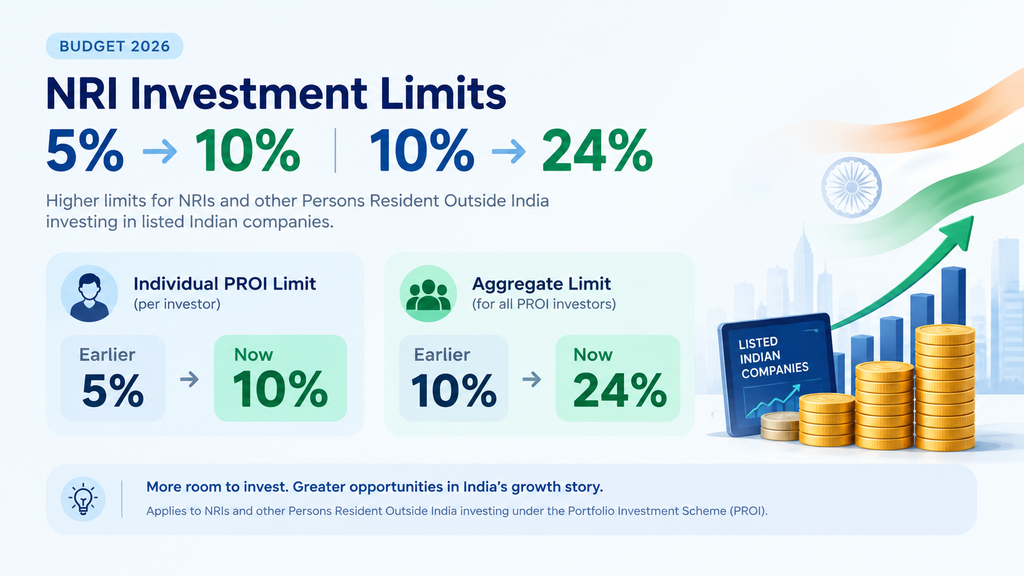
Under the Portfolio Investment Scheme, NRIs and other Persons Resident Outside India can buy and sell shares of listed Indian companies through a designated bank account. Before Budget 2026:
- An individual PROI could hold up to 5% of a listed company's paid-up capital
- All PROIs together were capped at 10% in a single company
After Budget 2026:
- An individual PROI can hold up to 10%
- The aggregate cap for all PROIs is 24%
For most retail NRI investors, the individual cap was never binding, because few hold anywhere near 5% of a listed company. The bigger change is the aggregate cap. Many mid-cap and small-cap companies used to hit the 10% NRI ceiling, which forced banks to block further NRI purchases in those stocks. Lifting the cap to 24% opens up a wider set of companies to NRI buying. The Budget also announced simplification of FEMA rules on non-debt instruments, with specific changes to follow through notifications.
Check with your PIS bank for the date your account reflects the new limits, since implementation runs through RBI and FEMA notifications rather than the Finance Act itself.
Other Budget 2026 Changes NRIs Should Know
- PAN instead of TAN for property buyers. From 1 October 2026, resident individuals and HUFs buying property from an NRI can deposit and report TDS using their PAN through Form 141, instead of applying for a TAN. This makes NRI property sales easier to close.
- New Income-tax Act in force. The Income-tax Act, 2025 took effect on 1 April 2026. Familiar sections have new numbers, and TCS now sits under Section 394.
- Small foreign asset relief. A one-time scheme gives immunity from prosecution for undisclosed non-immovable foreign assets below Rs 20 lakh, relevant mainly to returning NRIs.
- Updated returns. Returns can now be updated even after reassessment proceedings, with an additional tax payment.
Where Indian Property Fits In
For most NRIs, the largest Indian asset is property, and the largest recurring Indian income is rent. None of the Budget 2026 TCS changes alter how that income is taxed. Rent paid to an NRI landlord still attracts TDS under the Section 195 framework at about 31.2% effective, deposited by the tenant, credited to your NRO account, and repatriable within the USD 1 million limit after Form 15CA and 15CB.
What makes the money flow smoothly is clean paperwork at the start. A properly drafted rent agreement that records your NRO account, PAN, and TDS responsibility, with correct stamp duty paid, saves months of reconciliation when your CA prepares Form 15CB. NRIs choosing between a lease and a leave and licence structure should also factor in how easily they can recover possession from abroad if needed.
How Housewise Helps NRI Owners
Housewise manages rental properties for NRIs across 23 Indian cities, covering tenant search, verification, rent agreements, rent paid by the tenant straight into your NRO account, and coordination with tenants on TDS deposits so the credit actually appears in your Form 26AS. That paper trail is what your CA needs to certify repatriation without delays. NRIs weighing whether end-to-end property management is worth it usually find the biggest value is not rent collection itself, but avoiding the TDS mismatches and missing documents that block money from leaving India. Owners setting up a tenancy for the first time can also steer clear of the common mistakes in rent agreements that cause disputes later.
Frequently Asked Questions
Do NRIs pay TCS when sending money to India?
No. TCS under the Liberalised Remittance Scheme applies only to money sent out of India by resident individuals. Remittances from abroad into NRE, NRO, or a family member's resident account in India attract no TCS, before or after Budget 2026.
What is the new TCS rate on education remittances from 2026?
From 1 April 2026, TCS on self-funded education remittances is 2% on the amount above Rs 10 lakh a year, down from 5%. Education remittances funded by a qualifying education loan are now fully exempt from TCS.
What is the TCS rate on overseas tour packages after Budget 2026?
Overseas tour packages now attract a flat 2% TCS with no threshold. Earlier, the rate was 5% up to Rs 10 lakh and 20% above it. The change took effect from 1 April 2026 under Section 394 of the Income-tax Act, 2025.
Did Budget 2026 change TCS on investments or gifts abroad?
No. Remittances for investment, gifts, or deposits abroad under LRS still attract 20% TCS on the amount above Rs 10 lakh a year. Only education, medical treatment, and overseas tour packages saw rate cuts in Budget 2026.
Is TCS a final tax or can it be recovered?
TCS is not a final tax. It appears in the remitter's Form 26AS and can be adjusted against income tax payable or claimed as a refund when filing the return. The cost is the cash blocked until the refund or adjustment.
Does TCS apply when NRIs repatriate money from an NRO account?
TCS is not a final tax. It appears in the remitter's Form 26AS and can be adjusted against income tax payable or claimed as a refund when filing the return. The cost is the cash blocked until the refund or adjustment.
What are the new NRI investment limits in listed Indian companies?
Under the Portfolio Investment Scheme, the individual limit for a Person Resident Outside India rose from 5% to 10% of a listed company's capital. The aggregate limit for all such investors in one company rose from 10% to 24%.
How does the higher aggregate cap help NRI investors?
Many mid-cap and small-cap stocks hit the old 10% aggregate NRI ceiling, which blocked further NRI purchases through PIS accounts. Raising the cap to 24% opens many of these companies to NRI buying again, once banks update their limits.
Does the TCS cut affect tax on rental income for NRI landlords?
No. Rent paid to NRI landlords still attracts TDS under the Section 195 framework, deducted by the tenant and credited to the NRO account. The Budget 2026 TCS cuts apply only to outward remittances by residents.
How does Housewise help NRIs with rental income and repatriation?
Housewise manages NRI rental properties across 23 Indian cities, with agreements that record NRO accounts and TDS responsibility, rent follow-ups, and tenant coordination on TDS deposits. This gives your CA a clean trail for Form 15CB and smooth repatriation.


0 Comments