

For most of the last two decades, Indian property investment meant one of eight cities: Mumbai, Delhi NCR, Bengaluru, Pune, Hyderabad, Chennai, Kolkata, and Ahmedabad. In 2026, that map is redrawing itself.
A September 2026 report by CII and Knight Frank India found that residential prices in 11 emerging tier-2 markets rose 63% between 2021 and 2026, compared with 42% across the top eight cities over the same period. Over the longer 2016 to 2026 window, these 11 markets grew prices at an average of 8% a year, twice the 4% recorded by the top eight. A July 2026 CRISIL study of 10 major tier-2 cities found residential demand growing at a 14% compound annual rate between FY2021 and FY2026, with Nagpur, Lucknow, and Coimbatore growing close to 20%.
The reasons are clear. Metro prices have run far ahead of incomes, metro rental yields have compressed to 2 to 3%, and government infrastructure spending has pushed expressways, airports, metros, and industrial corridors deep into cities that were once considered secondary. Listed developers like Godrej Properties, Sobha, and Phoenix Mills are expanding into these markets, and NRIs are increasingly buying in their hometowns rather than in Bengaluru or Gurugram.
This guide ranks the tier-2 cities drawing the most investor attention in 2026, explains what is driving demand in each, and lays out the risks that the brochures leave out.
Which Tier-2 Cities Are Best to Invest in 2026?
Based on 2026 data from CRISIL, CII and Knight Frank, and a leading property portal, the tier-2 cities drawing the strongest investor interest are Lucknow, Nagpur, Coimbatore, Indore, Jaipur, the Chandigarh Tricity (Chandigarh, Mohali, Panchkula, Zirakpur), Kochi, Visakhapatnam, Goa, and Bhubaneswar. Lucknow, Nagpur, and Coimbatore lead on demand growth at close to 20% a year. Indore and Lucknow lead the premium shift, with over 20% of active supply priced above Rs 2 crore. Jaipur and Nagpur stay the most affordable, with over 75% of supply below Rs 75 lakh. The common drivers are infrastructure spending, IT and manufacturing jobs, return migration, and lower entry prices than metros. The main risks are 15 to 20 months of unsold inventory in many markets, thinner resale liquidity, and affordability pressure where ticket sizes have crossed Rs 1 crore.
Why Investors Are Looking Beyond the Metros
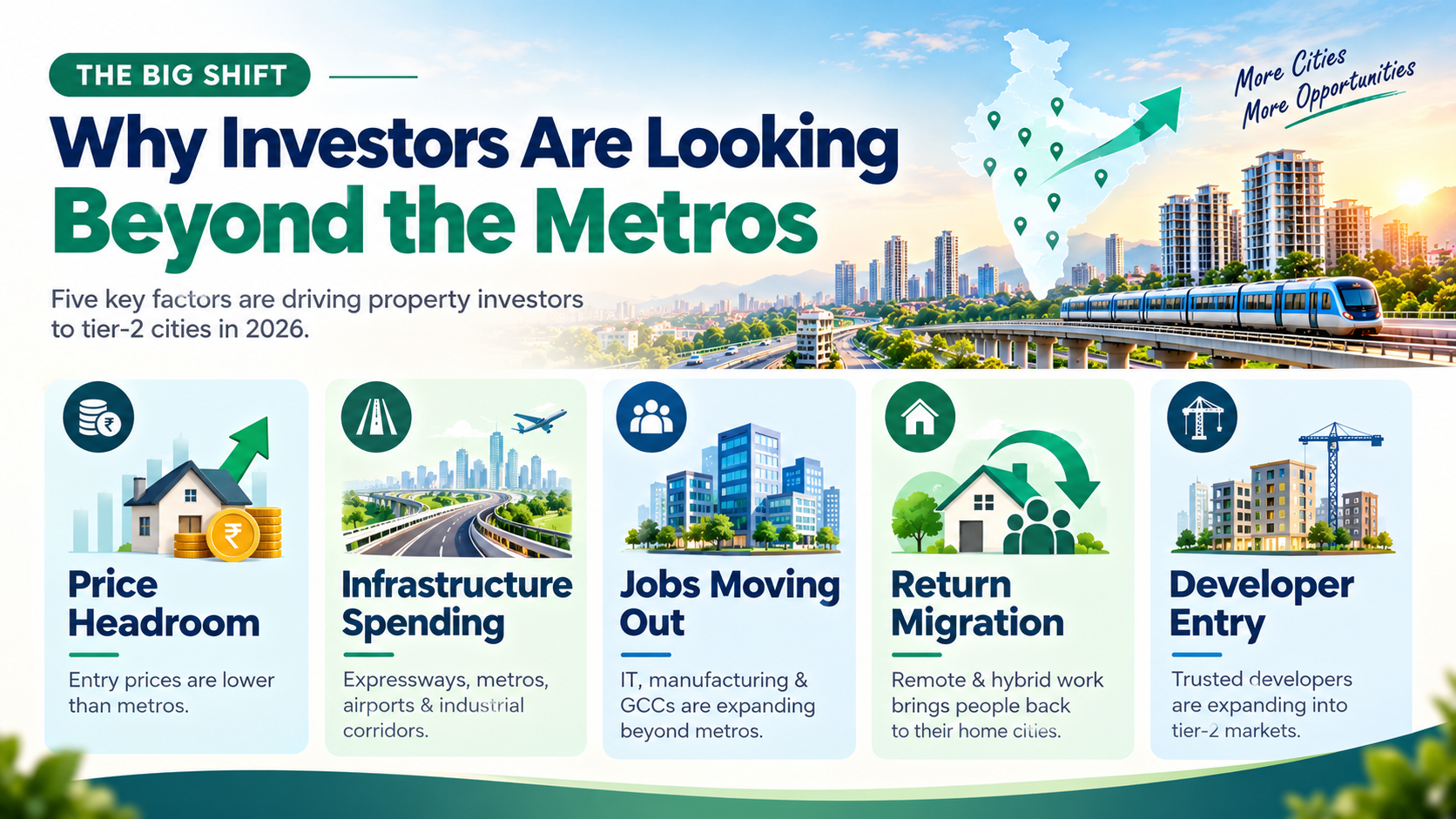
Five shifts explain the move.
- Price headroom. Entry prices in most tier-2 cities remain well below metro levels, even after recent gains, which leaves more room for appreciation.
- Infrastructure spending. Government infrastructure spending rose from 39% of total capital expenditure in FY15 to 55% in FY26, according to the CII and Knight Frank report, with a three-year public-private pipeline of 852 projects worth about Rs 17 lakh crore.
- Jobs moving out. IT parks, global capability centres, warehousing, and manufacturing clusters are spreading into tier-2 cities, creating rental demand from young professionals.
- Return migration. Remote and hybrid work has allowed many professionals to move back to their home cities, buying larger homes than they could afford in metros.
- Developer entry. Large listed developers bring better construction and delivery records, which makes tier-2 projects easier to trust.
The CII and Knight Frank report also projects that cities outside the top eight will grow their population by 28.2% over the coming decades, against 8.7% for the top eight.
The Ranked List: Top 10 Tier-2 Cities for 2026
This ranking weighs demand growth, price momentum, infrastructure pipeline, rental demand, and affordability. It is an editorial ranking built on the published data, not a single index.
1. Lucknow
Lucknow sits near the top on almost every measure. CRISIL found residential demand growing at nearly 20% a year from FY2021 to FY2026, and average prices now exceed Rs 10,000 per sq ft. Over 20% of active supply is priced above Rs 2 crore, showing a strong premium shift. Expressway connectivity, an expanding IT and services base, and steady government employment support demand. Some market reports also point to rental demand growing 8 to 10% a year.
Watch out for: Ticket sizes above Rs 1 crore are narrowing the buyer pool, which can slow resale.
2. Nagpur
Nagpur is the standout mid-income story. Demand grew close to 20% a year, and over 75% of supply is priced below Rs 75 lakh, keeping it accessible. The Samruddhi Mahamarg expressway to Mumbai, the MIHAN logistics and aviation hub, and the city's metro network have made it a central India logistics base. Nagpur also led retail home loan disbursement growth among tier-2 cities.
Watch out for: Appreciation is steady rather than spectacular, so it suits long-term holders.
3. Coimbatore
Coimbatore combines manufacturing depth, a growing IT and engineering services sector, and strong education institutions. CRISIL recorded demand growth near 20% a year, with average prices crossing Rs 10,000 per sq ft. Buyers here often use home loans for self-construction and resale homes, a sign of an owner-driven market with genuine end-user demand.
Watch out for: Rising prices mean entry yields are no longer as attractive as five years ago.
4. Indore
Indore has become Madhya Pradesh's commercial and IT hub, consistently ranked among India's cleanest cities, with a metro now under operation on its first stretch and an expanding industrial belt around Pithampur. Over 20% of active supply is priced above Rs 2 crore, and Indore led home loan disbursement growth. IT expansion and entrepreneurial wealth are pushing the premium segment.
Watch out for: CRISIL flags that ticket sizes above Rs 1 crore have narrowed the buyer pool.
5. Jaipur
Jaipur offers one of the more affordable entry points, with over 75% of supply priced below Rs 75 lakh, and a mix of tourism, manufacturing, and services employment. Connectivity to the Delhi-Mumbai Expressway and planned metro expansion add long-term support. It also led to home loan disbursement growth.
Watch out for: Large peripheral plotted developments vary widely in quality and title clarity.
6. Chandigarh Tricity
Chandigarh, Mohali, Panchkula, and Zirakpur together form one of North India's most liveable urban regions. A leading property portal has noted that premium localities here are nearly at par with key Delhi NCR markets. Mohali's IT and startup growth, the international airport, and Chandigarh's planned infrastructure drive demand, while Zirakpur and Panchkula offer lower entry points. Landlords here should get the paperwork right from day one, starting with an online rent agreement in Panchkula or the wider Tricity.
Watch out for: Chandigarh proper has limited new supply, pushing growth to the periphery.
7. Kochi
Kochi benefits from Infopark and the IT sector, the Kochi Metro and Water Metro, a major port, and a large Gulf NRI diaspora that buys back home. A leading property portal placed premium Kochi localities close to metro-level pricing. Demand from NRI families and returning professionals keeps the luxury and mid-premium segments active.
Watch out for: Land is scarce, and coastal regulation zones restrict development in some areas.
8. Visakhapatnam
Visakhapatnam is drawing attention on the back of data centre and technology investments, port-led industry, and an upcoming greenfield airport at Bhogapuram. It is one of the 11 emerging markets in the CII and Knight Frank study.
Watch out for: Much of the growth is announcement-driven, so timelines need tracking.
9. Goa
Goa offers some of the highest rental yields in the country. A leading property portal reported yields reaching about 8% in parts of Goa, against 2 to 3% in metros, driven by holiday and second-home demand, helped by the Mopa airport. North Goa capital values are among the highest of any tier-2 market.
Watch out for: Short-term rental supply has surged. AirDNA data reported in July 2026 showed Goa's short-stay revenues falling about 14% year on year even as listings grew. Yield assumptions based on Airbnb income need stress-testing.
10. Bhubaneswar
Bhubaneswar has strong administrative and IT employment and average prices that now exceed Rs 10,000 per sq ft, per CRISIL. It is part of both the CRISIL and the CII and Knight Frank lists.
Watch out for: CRISIL flags relatively higher unsold inventory, which can cap near-term price growth.
Tier-2 Cities at a Glance
| City | Key Demand Driver | Market Profile (2026) | Main Caution |
|---|---|---|---|
| Lucknow | Services, government, expressways | Demand near 20% CAGR, premium shift | Narrowing buyer pool above Rs 1 crore |
| Nagpur | Logistics, MIHAN, Samruddhi Mahamarg | Demand near 20% CAGR, 75%+ supply below Rs 75 lakh | Slower appreciation |
| Coimbatore | Manufacturing, IT, education | Demand near 20% CAGR, prices above Rs 10,000/sq ft | Lower entry yields |
| Indore | IT, industry, metro | 20%+ supply above Rs 2 crore | Affordability at top end |
| Jaipur | Tourism, manufacturing, expressway | 75%+ supply below Rs 75 lakh | Peripheral title risk |
| Chandigarh Tricity | IT, airport, planned city | Premium pockets near NCR pricing | Limited core supply |
| Kochi | IT, port, NRI diaspora | Premium near metro pricing | Land scarcity |
| Visakhapatnam | Data centres, port, new airport | Early-stage growth | Execution timelines |
| Goa | Tourism, second homes | High rental yields in pockets | Short-stay oversupply |
| Bhubaneswar | Administration, IT | Prices above Rs 10,000/sq ft | Higher unsold inventory |
Sources: CRISIL Housing Hotspots (July 2026), CII and Knight Frank India (September 2026), a leading property portal.
The Risks Investors Underestimate in Tier-2 Markets
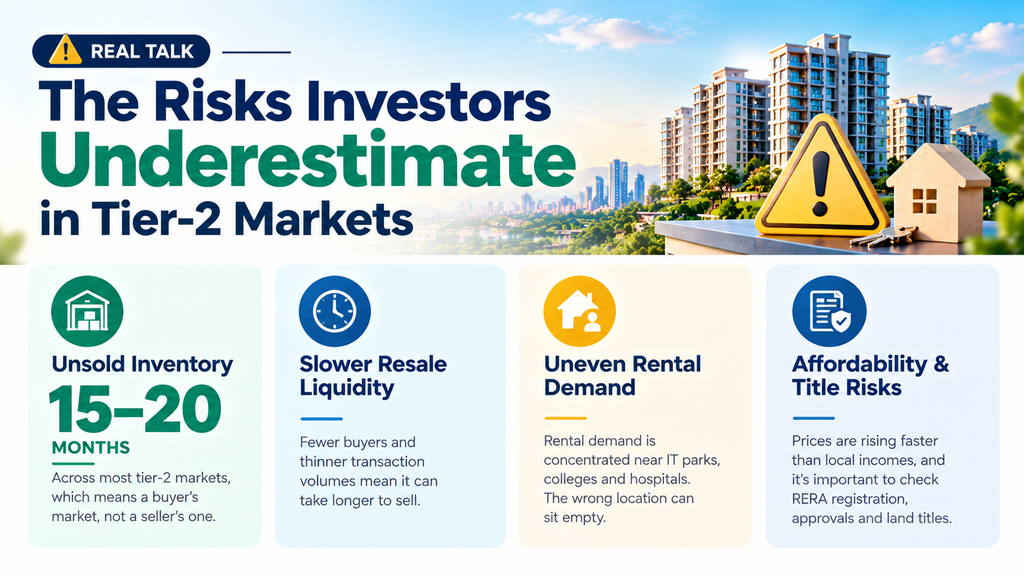
Tier-2 growth is real, but the risks are different from metros.
- Unsold inventory. CRISIL puts unsold inventory at around 15 to 20 months of sales across most tier-2 markets. That is a buyer's market, not a seller's one.
- Resale liquidity. Fewer buyers and thinner transaction volumes mean selling can take longer, especially for premium units.
- Rental depth. Rental demand is concentrated near IT parks, colleges, and hospitals. A flat on the wrong side of the city may sit empty.
- Affordability ceiling. CRISIL warns that affordability could become a challenge in select markets as prices rise faster than local incomes.
- Developer and title risk. Always check RERA registration, approvals, and the land title chain, especially for plotted and peripheral projects.
How to Approach a Tier-2 Investment
- Pick the micro-market, not just the city. Proximity to jobs, transit, and schools drives both rent and resale.
- Prefer RERA-registered projects from developers with delivery records.
- Check rental demand before buying. Speak to local brokers and look at actual tenant profiles.
- Model returns on long-term rent, not optimistic short-stay income.
- Plan management before possession, especially if you live in another city or abroad.
Owning a Tier-2 Property From Another City
Most tier-2 investors do not live in the city they invest in. They are metro professionals buying in their hometown, or NRIs buying close to family. That makes local management the difference between a yielding asset and an empty flat.
A properly drafted rent agreement with the right stamp duty, a careful choice between a lease and a leave and licence structure, and avoiding the common mistakes in rent agreements all matter more when you cannot drop by to sort out problems in person.
How Housewise Helps
Housewise provides end-to-end property management across 23 Indian cities, including the Chandigarh Tricity, covering tenant search and verification, rent agreements, rent follow-ups, inspections, and maintenance. For investors and NRIs buying in a city they do not live in, Housewise keeps the property let, documented, and maintained, so a tier-2 investment earns rent while it appreciates.
Frequently Asked Questions
Which tier-2 cities are best for property investment in 2026?
Lucknow, Nagpur, Coimbatore, Indore, Jaipur, the Chandigarh Tricity, Kochi, Visakhapatnam, Goa, and Bhubaneswar draw the most investor interest. Lucknow, Nagpur, and Coimbatore lead on demand growth, according to CRISIL's July 2026 study.
How much have tier-2 property prices grown recently?
A CII and Knight Frank India report found prices in 11 emerging tier-2 markets rose 63% between 2021 and 2026, against 42% in the top eight cities. From 2016 to 2026, they averaged 8% annual growth.
Why are investors shifting to tier-2 cities?
Lower entry prices, rising infrastructure spending, IT and manufacturing jobs moving out of metros, return migration, and better developer presence. Metro rental yields of 2 to 3% have also pushed investors to look for better value elsewhere.
Which tier-2 city is most affordable for investment in 2026?
Jaipur, Nagpur, Nashik, and Vadodara stand out, with over 75% of supply priced below Rs 75 lakh, according to CRISIL. These markets are driven by manufacturing and mid-income demand rather than premium buyers.
Are rental yields higher in tier-2 cities than metros?
Often, but it varies by locality. Metro yields are typically 2 to 3%. Some tier-2 pockets do better, and a leading property portal reported yields near 8% in parts of Goa. Yields depend heavily on proximity to jobs and colleges.
What are the biggest risks of investing in tier-2 cities?
Unsold inventory of around 15 to 20 months in many markets, slower resale, uneven rental demand across localities, rising affordability pressure in premium segments, and title or approval risks in some peripheral projects.
Is Goa still a good investment given high rental yields?
Goa offers strong long-term rental and second-home demand, but short-stay supply has surged. AirDNA data showed Goa's short-stay revenues falling about 14% in the year to June 2026, so model returns on conservative assumptions.
Should NRIs invest in tier-2 cities in 2026?
Many NRIs buy in hometowns like Lucknow, Kochi, Jaipur, or Chandigarh Tricity for family and future use. It works well if the micro-market has rental demand and the property is professionally managed while they are abroad.
How do I choose the right locality within a tier-2 city?
Focus on proximity to IT parks, industrial zones, colleges, hospitals, and transit. Check RERA registration, developer track record, existing rents, and resale activity. The micro-market matters more than the city name.
How does Housewise help investors in tier-2 cities?
Housewise manages rental properties across 23 Indian cities, including the Chandigarh Tricity, handling tenant search, verification, agreements, rent follow-ups, and maintenance. This helps investors and NRIs keep properties let and well maintained without being in the city.


0 Comments