
Quick answer: Tenant police verification means the landlord shares the tenant's identity and address details with the local police before or at move-in. Most cities make it compulsory through orders under Section 163 of the BNSS, 2023. Skipping it can lead to a case under Section 223 of the BNS, 2023, with up to 6 months in jail or a Rs 2,500 fine.
Key takeaways
- The landlord, not the tenant, is responsible for filing the tenant police verification.
- Most state and city police forces now accept the form online through a citizen portal or app.
- From 1 July 2024, IPC Section 188 and CrPC Section 144 were replaced by BNS Section 223 and BNSS Section 163.
- Police in cities like Pune booked landlords in bulk for skipping verification in 2026.
On 8 August 2026, Pune police booked 113 landlords and PG operators in a single drive. Their mistake was simple. They had let out rooms and flats without signing rent agreements and without sending tenant details to the local police station. Most of them probably thought tenant police verification was a formality nobody checks.
It is not. Police commissioners in most Indian cities issue standing orders that make tenant verification compulsory, and those orders carry criminal penalties. The process itself is quick and mostly online. This post covers who must file, how to do it, what it costs, and what happens if you skip it.
What is Tenant Police Verification?
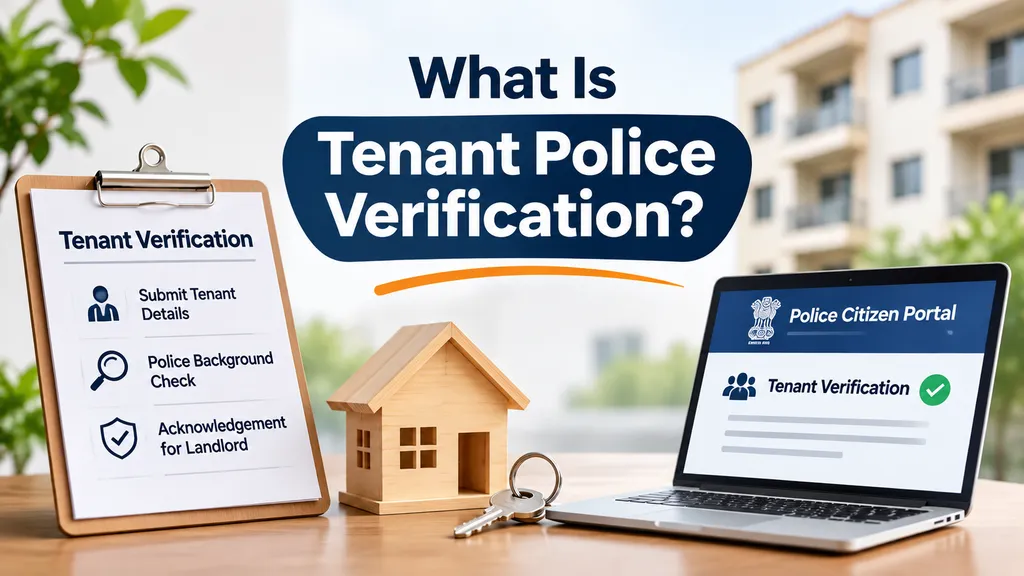
Tenant police verification is the process of submitting a tenant's identity, address, and background details to the local police so they can check for criminal records or pending cases.
- The landlord fills in a form with details of the tenant and every adult occupant
- The police run a records check and, in some cases, visit the address
- The landlord keeps an acknowledgement as proof of filing
It protects the landlord, the neighbours, and the housing society. If a tenant later turns out to be wanted in a case, a landlord with a filed verification is in a far stronger position than one who never reported them.
Is Tenant Police Verification Mandatory?
In most cities, yes. There is no single national tenant verification law. Instead, police commissioners and district magistrates issue orders under Section 163 of the Bharatiya Nagarik Suraksha Sanhita, 2023 (BNSS), which replaced Section 144 of the CrPC. These orders require landlords to report tenant details within a set time.
Breaking such an order is an offence under Section 223 of the Bharatiya Nyaya Sanhita, 2023 (BNS), which replaced Section 188 of the IPC.
Old vs New law since 1 July 2024
| Point | Before 1 July 2024 | From 1 July 2024 |
|---|---|---|
| Power to issue verification orders | CrPC Section 144 | BNSS Section 163 |
| Offence for disobeying the order | IPC Section 188 | BNS Section 223 |
| Basic penalty | Up to 1 month jail or Rs 200 fine | Up to 6 months' jail or Rs 2,500 fine, or both |
| If disobedience causes danger or harm | Up to 6 months' jail or Rs 1,000 fine | Up to 1 year jail or Rs 5,000 fine, or both |
Orders are usually reissued every few months, so in practice they apply continuously in cities like Delhi, Mumbai, Thane, Pune, Noida, Gurugram, Hyderabad, Chennai, Kolkata, and Ahmedabad.
Who Must File Tenant Verification: Landlord or Tenant?
The landlord must file. The order is addressed to owners and to anyone who lets out premises, including:
- Individual landlords renting a flat, floor, or room
- PG and hostel operators
- Property managers or agents acting for an owner
- Employers housing staff, including domestic workers in many cities
The tenant's job is to share the correct documents on time. In practice, many tenants fill the form themselves on the landlord's login, but the legal responsibility stays with the owner.
The same logic applies to paperwork in general. A written agreement protects the owner far more than a handshake, whichever format fits: a leave and licence or rent agreement.
How Do You Do Tenant Police Verification Online?
The exact screens differ by state, but the flow is the same almost everywhere.
- Sign the rent agreement first. Many portals ask for the agreement date, term, and rent.
- Open the state police citizen portal or app. Register with a mobile number and verify the OTP.
- Choose tenant verification under citizen services.
- Enter landlord details, including name, address, phone, and ID.
- Enter tenant details, including permanent address, workplace, and previous address.
- Add every adult occupant who will live in the property.
- Upload documents such as photo ID, address proof, and a recent photograph.
- Submit and save the acknowledgement or request number.
- Track the status online. Some police stations call or visit to confirm details.
If the online option is down or not available in your area, the same form can be submitted at the local police station, which then gives a stamped copy.
Worked example: Rakesh lets out his flat in Noida
Rakesh owns a 2BHK in Noida Sector 62 and signs an 11-month rent agreement with a young couple on 1 March. He completes the verification form on the UP Police citizen portal the same evening, adds both adults, uploads their Aadhaar cards and photos, and saves the request number.
Two weeks later, the local police station calls to confirm the tenants' workplace. The verification is marked complete. When police run a society-wide check in June, Rakesh shows the acknowledgement on his phone, and nothing more is needed.
Which Portal Do You Use in Each State?
Most police forces now run tenant verification through an online citizen service. Portal names and links change often, so confirm the current one on your state police website.
| State or City | Where to File Online | Offline Option |
|---|---|---|
| Delhi | Delhi Police citizen services portal and app | Local police station |
| Maharashtra (Mumbai, Thane, Pune) | Maharashtra Police citizen portal | Local police station |
| Uttar Pradesh (Noida, Ghaziabad) | UP Police citizen portal and UPCOP app | Local police station |
| Haryana (Gurugram) | Haryana Police citizen services portal | Local police station |
| Karnataka (Bengaluru) | Karnataka State Police citizen services | Local police station |
| Telangana (Hyderabad) | Telangana State Police citizen services | Local police station |
| Tamil Nadu (Chennai) | Tamil Nadu Police citizen portal | Local police station |
| West Bengal (Kolkata) | Kolkata Police citizen services | Local police station |
| Gujarat (Ahmedabad) | Gujarat Police citizen portal | Local police station |
What Documents Are Needed for Tenant Verification?

Documents checklist
- Tenant's photo ID, such as Aadhaar card, passport, voter ID, or driving licence
- Tenant's permanent address proof
- One recent passport-size photograph of each adult occupant
- Employer or college details, with ID card if available
- Previous address and references, if the form asks for them
- Landlord's ID and address proof of the rented property
- Copy of the signed rent agreement, where the portal asks for it
Foreign nationals need an extra step. Landlords hosting a foreigner must also inform the immigration authorities through Form C, usually within 24 hours of arrival.
How Much Does Tenant Police Verification Cost and How Long Does It Take?
Online tenant verification is free in most states. Some police forces charge a small fee for a character certificate or verification report, which is a separate service.
Timelines vary by city and police station workload:
| Stage | Typical Time |
|---|---|
| Online form submission | 15 to 30 minutes |
| Acknowledgement or request number | Instant |
| Police records check | A few days to a few weeks |
| Physical visit, if any | Depends on the police station |
The key point is that the filing must happen on time, usually before or right at move-in. The police check can finish later.
What Happens If a Landlord Skips Tenant Verification?
- Criminal case. Police can register a case under BNS Section 223 for disobeying the order.
- Penalty. Up to 6 months in jail, a fine of up to Rs 2,500, or both. If the lapse leads to danger or harm, up to 1 year or Rs 5,000.
- Drives and raids. Police in Pune, Nagpur, Jammu, and several Punjab cities ran tenant verification drives in 2025 and 2026, booking landlords in groups.
- Questions during investigations. An owner who never reported a tenant faces hard questions if that tenant is later linked to a crime.
- Society trouble. Many housing societies now refuse move-in without a copy of the verification acknowledgement.
Common Mistakes in Tenant Police Verification
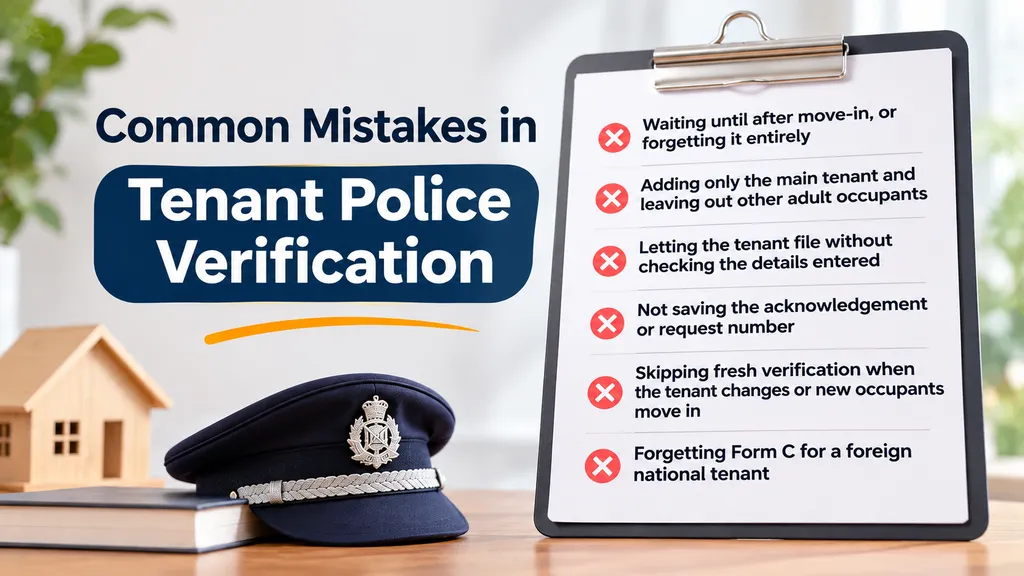
- Waiting until after move-in, or forgetting it entirely
- Adding only the main tenant and leaving out other adult occupants
- Letting the tenant file without checking the details entered
- Not saving the acknowledgement or request number
- Skipping fresh verification when the tenant changes or new occupants move in
- Forgetting Form C for a foreign national tenant
Many of these slips start with weak paperwork at the agreement stage, the same way the most common mistakes in rent agreements cause disputes later.
How Does Verification Fit With the Rent Agreement?
Police verification and the rent agreement work as a pair. The agreement records the terms, and the verification records who is living in the property. Police portals and housing societies increasingly ask for both.
A well-drafted agreement should name every adult occupant, state the permitted use, and bar subletting without consent. Ready-made sample rent agreements already carry these clauses, so the details in the police form match the agreement word for word.
Conclusion
Housewise's online rent agreement service prepares the signed agreement that police portals and housing societies ask for, with occupant and use clauses in place. Owners who live away can hand the whole tenancy to Housewise property management services, which cover tenant onboarding, screening, and documentation, and NRIs can use the dedicated NRI property management services.
Hand over tenant onboarding and paperwork with the Housewise end-to-end property management service.
FAQs
Is tenant police verification mandatory in India?
In most cities, yes. Police commissioners issue orders under Section 163 of the BNSS, 2023, requiring landlords to report tenant details. Disobeying the order is an offence under Section 223 of the BNS, 2023, with jail, a fine, or both.
Who is responsible for tenant police verification?
The landlord is legally responsible. The order applies to owners, PG operators, agents, and anyone who lets out premises. Tenants must share correct documents, but if verification is not filed, the case is registered against the landlord.
What is the penalty for skipping tenant police verification in 2026?
Under BNS Section 223, the penalty is up to 6 months in jail, a fine of up to Rs 2,500, or both. If the lapse causes danger or harm, it rises to 1 year in jail or Rs 5,000.
Can I do tenant police verification online?
Yes. Most states let landlords file through the state police citizen portal or app. You register with a mobile number, enter landlord and tenant details, upload ID and photos, and save the acknowledgement number for your records.
What documents are needed for tenant verification?
You need the tenant's photo ID and permanent address proof, recent photos of every adult occupant, employer or college details, the landlord's ID, and property address proof. Some portals also ask for a copy of the signed rent agreement.
How much does tenant police verification cost?
Online tenant verification is free in most states. Some police forces charge a small fee for a separate character certificate or verification report. Paying a middleman is not required, since the online form takes only a short time to complete.
How long does tenant police verification take?
Filing online takes 15 to 30 minutes, and the acknowledgement is instant. The police background check can take from a few days to a few weeks, depending on the city and how busy the local police station is.
Do I need police verification for an 11-month rent agreement?
Yes. Verification depends on who occupies the property, not on the length of the agreement. Short, long, registered, or notarised agreements all need the tenant reported to the police under the local order.
What changed when BNS Section 223 replaced IPC Section 188?
From 1 July 2024, BNS Section 223 replaced IPC Section 188, and BNSS Section 163 replaced CrPC Section 144. The basic penalty for disobeying a verification order rose from 1 month or Rs 200 to 6 months or Rs 2,500.
How does Housewise help with tenant verification?
Housewise drafts the rent agreement that police portals and housing societies ask for, with occupant and use clauses in place. Its property management team handles tenant onboarding and documentation for owners who live in another city or abroad.


0 Comments