

Your possession date is confirmed. The builder has the keys ready. Everything is set. There is just one problem. You are sitting in Toronto. Or Dubai. Or somewhere in the US. And flying to India just to collect a set of keys is not happening right now.
So the question becomes: can someone else do this for you?
The answer is yes. Under Indian law, a property owner can legally authorise a representative to take possession on their behalf. But here is the thing most people miss. The how matters enormously. A badly drafted authorisation can open doors to risks you did not sign up for. This guide covers exactly what you need to know before handing over that authority to anyone.
Is It Legally Valid for Someone Else to Take Possession on Your Behalf?
Yes. Completely valid. Indian law explicitly allows a property owner to authorise another person to act on their behalf through a document called a Power of Attorney (POA). When a valid POA holder takes possession of your property, Indian courts treat that as possession by you, the true owner.
Think of it like authorising someone to collect a parcel from the post office. You are still the owner of that parcel. The person collecting it is simply acting as your hands.
The key phrase here is valid POA. The representative must have a legally executed, properly registered document that clearly gives them authority to accept possession. Without that, the entire arrangement sits on shaky legal ground.
Types of Power of Attorney Used for Property Possession in India
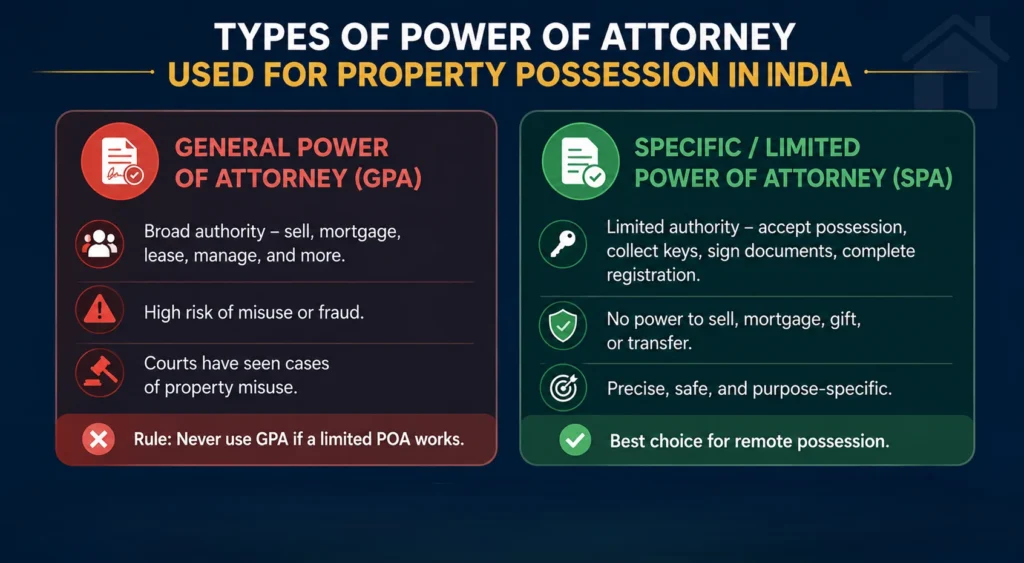
Not all POAs are the same. There are two main types used in property transactions. Using the wrong one is where most NRIs get into trouble.
General Power of Attorney (GPA)
A General Power of Attorney gives your representative broad authority. We are talking about the power to sell, mortgage, lease, manage, and essentially do anything with the property that you yourself could do.
It is the nuclear option. And it is almost always the wrong choice when all you need is for someone to collect keys and sign a possession letter.
The risk is real. A relative you trusted completely today might face financial pressure two years from now. A GPA gives them the legal ability to mortgage your property or even enter into a sale agreement without your knowledge. Courts have seen this happen. It is not hypothetical.
Rule of thumb: never use a GPA for something a limited POA can handle.
Specific / Limited Power of Attorney (SPA)
This is the right instrument for remote possession. An SPA restricts your representative’s authority to a clearly defined set of actions.
For property possession, that means: accepting the possession letter, collecting the keys, signing the inventory list, and completing the registration formalities. Nothing more.
You can even include explicit clauses that say: “The attorney holder is not authorised to sell, mortgage, gift, or transfer this property in any manner.” That single sentence acts as a legal firewall.
An SPA is precise. It is like giving someone a key to your mailbox, not the master key to your entire house.
How to Create and Execute a POA from Abroad
This is where many NRIs get stuck. Creating a valid POA while you are outside India involves a few specific steps. Skip any one of them and the document may not hold up.
Step 1: Get it drafted by a lawyer: Do not download a template off the internet. A qualified property lawyer in India should draft the SPA, ensuring it covers the right scope, uses appropriate legal language, and is enforceable under Indian law.
Step 2: Get it notarised in your country of residence: Once you have the draft, sign it in front of a Notary Public in the country where you currently live.
Step 3: Get it apostilled or attested: If your country is a signatory to the Hague Convention (the US, UK, Canada, Australia, UAE, and many others are), the document needs an apostille stamp. If your country is not part of the Hague Convention, you will need attestation from the Indian Embassy or Consulate instead.
Step 4: Send the original to India: Courier the original signed, notarised, and apostilled document to your representative or lawyer in India.
Step 5: Register it at the Sub-Registrar’s office: This is non-negotiable. For a POA to be legally enforceable in Indian property transactions, it must be registered at the Sub-Registrar’s office in the jurisdiction where the property is located.
The entire process typically takes two to three weeks. Factor that into your timeline well before possession day.
What Your Representative Must Do at the Time of Possession
Possession day is not just about collecting a set of keys. It is a documentation exercise. Every paper signed that day creates a legal record. Here is exactly what your representative needs to do:
- Sign the possession letter issued by the builder. This is the primary document confirming that possession has been handed over.
- Collect the keys and sign the key handover receipt. Keep a copy.
- Sign the inventory list documenting the condition of fittings, fixtures, and common areas at the time of handover.
- Verify the Occupancy Certificate (OC) or Completion Certificate. A builder handing over possession without an OC is a red flag. Your representative should not sign anything until this is confirmed.
- Do a snag inspection. Walk through the unit. Check walls, plumbing, electrical points, windows, doors. Document anything that is not right before signing.
- Obtain the society NOC or any no-dues certificate from the developer.
- Ensure utility meters are transferred to your name. Electricity, gas, and water connections should be in the owner’s name from day one.
Each of these steps creates a paper trail. That paper trail is what protects you if a dispute arises later.
What to Check in the POA Before Handing Over Authority
Before you finalise any POA, review these elements carefully with your lawyer:
Clear identification of the representative: Full legal name, address, and a relationship description if applicable. Vague identification causes problems.
Specific scope of authority: The document must spell out what your representative can do. “Take possession of flat number X, sign the possession letter, collect keys, sign the inventory, complete registration” is specific. “Handle all property matters” is not.
Explicit exclusions: State what the representative cannot do. No power to sell. No power to mortgage. No power to lease or sublease. Write it out clearly.
Validity period: Do not leave the POA open-ended. Set a specific date of expiry. Six months from execution is usually sufficient for possession purposes.
Revocation clause: Include a clause that states you retain the right to revoke the POA at any time by written notice. This is standard, but worth confirming.
Always have this document reviewed by a qualified property lawyer before execution. This is not the place to cut corners.
Risks of Giving Possession Authority to the Wrong Person
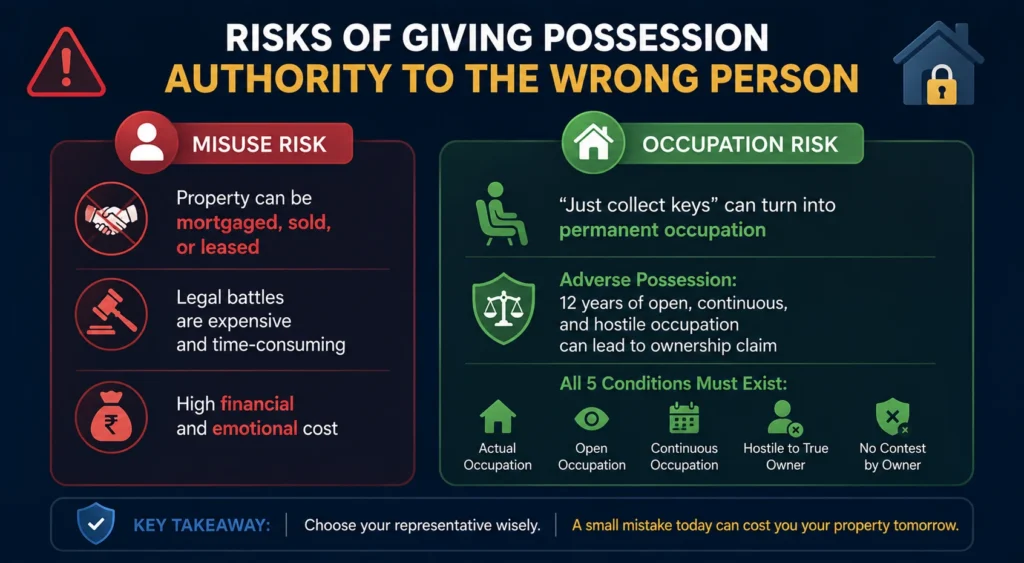
Let us talk about the uncomfortable part.
NRIs often default to asking a sibling, a parent, or a childhood friend to handle possession. That trust is understandable. But here is the problem: trust and legal safeguards are not the same thing.
The misuse risk: A broad GPA in the wrong hands can result in the property being mortgaged, sold, or leased without your knowledge. Even if you eventually win a legal case to undo the transaction, the process is expensive, time-consuming, and deeply stressful.
The occupation risk: What if the friend you asked to “just collect the keys” moves in temporarily? And then temporary becomes permanent? And then they start paying the maintenance bills in their own name?
This is where adverse possession enters the picture.
Adverse possession is a legal doctrine under Indian law. It says that if someone occupies a property continuously, openly, and without contest for 12 years, they may acquire the right to claim ownership over it. All five conditions must be present simultaneously: actual occupation, open occupation, continuous occupation, occupation hostile to the true owner’s interests, and no contest from the true owner during that period.
This is not a common outcome. But it is a real legal risk. An NRI who buys a flat, hands it over to a relative, and then loses touch with the property for over a decade is creating the conditions for exactly this scenario.
The solution is not paranoia. It is clear legal documentation upfront, combined with a structured property management arrangement to maintain ongoing oversight.
Proof of Valid Possession When You Are Abroad
Once possession has been taken on your behalf, you need to retain the right documentation as proof. This matters if any dispute ever arises.
The documents you should keep copies of include the signed possession letter, the key handover receipt, the inventory list signed by your representative, the snag inspection report, and if applicable, a panchnama (a formal document witnessed and signed by multiple parties confirming the condition of the property at handover).
Video and photo evidence is underutilised but extremely valuable. Ask your representative to shoot a walkthrough video of the entire flat at the time of possession. Time-stamped. It costs nothing and is hard to dispute later.
Store these documents in a secure cloud folder. Not just on a phone that can break.
How a Property Management Company Can Act as Your Representative
Here is something worth considering. Friends and family are not professionally trained for this. They may not know what to check in an OC. They may not spot a defect in the electrical wiring. They may not know that a missing society NOC can create problems later.
A professional property management company changes that equation.
When you authorise a company like Housewise to act as your representative, you are not relying on goodwill. You are engaging a team that handles possessions regularly, knows what to check, knows what to sign, knows what to push back on with the builder, and documents everything systematically.
The SPA in this case goes to a company, not an individual. There is no ambiguity about occupation. There is a formal scope of work. And at the end of possession day, you get a documented handover report with photos, observations, and confirmation that everything is in order.
For NRIs managing Indian real estate from thousands of kilometres away, that kind of professional accountability is not a luxury. It is practical risk management.
Conclusion
So here is the bottom line.
Yes, someone else can legally take possession of your property in India while you are abroad. It is done all the time. But it has to be done correctly.
Use an SPA, not a GPA. Keep the scope of authority narrow and specific. Get it notarised, apostilled, and registered before possession day. Make sure your representative signs every document they are supposed to sign. And keep copies of everything.
The risks are not inevitable. They are avoidable. The difference between a smooth remote possession and a painful legal dispute is almost always in the paperwork done beforehand.
If you would rather not rely on a friend or family member for something this important, Housewise handles the entire possession process on the ground. We act as your authorised representative, inspect the property, complete all documentation, and hand you a clean, verified report. All without you needing to board a single flight.
Frequently Asked Questions
Can someone else legally take property possession on your behalf in India?
Yes. Under Indian law, a property owner can authorise a representative to take possession through a registered Power of Attorney. Possession taken by a valid POA holder is legally treated as possession by the true owner.
What are the three types of possession in Indian law?
In the context of property law, possession is generally categorised as actual possession (physical occupation of the property), constructive possession (legal right to the property without physical occupation), and adverse possession (uncontested long-term occupation that can lead to ownership claims over time).
What is the 12-year rule of land in India?
Under the Limitation Act, a person who has been in continuous, open, and uncontested possession of a property for 12 years may acquire legal rights over it through adverse possession. This is why NRIs must ensure their property is not left in the hands of an unauthorised occupant for an extended period.
What to do if someone illegally occupies your land?
You can file a complaint with the local police, approach a civil court for an injunction or eviction order, or file a criminal complaint under relevant IPC sections. NRIs should engage a local property lawyer immediately. Do not delay, as delay works against you.
What are the 5 requirements for adverse possession in India?
Occupation must be actual, open, continuous, hostile to the true owner, and uncontested for the statutory period. Typically 12 years for private land. All five conditions must be present at the same time.
Can a non-resident hold property in India?
Yes. NRIs and OCIs can legally hold residential and commercial property in India. They are, however, restricted from purchasing agricultural land, plantation property, or farmhouses unless inherited or gifted.


0 Comments