

The rent versus buy debate has never really been settled in India, but 2026 is the first year in half a decade where the arithmetic actually favours a fresh look. The Reserve Bank of India has cut the repo rate by 125 basis points through 2025, bringing it to 5.25%. Home loan rates that sat at 9 to 9.5% in early 2024 are now available at 7.10 to 7.65% for borrowers with a strong CIBIL score. Bank of Baroda's headline rate has touched 6.85%.
At the same time, property prices in the big metros have kept climbing. Bengaluru's tech corridors added 15% appreciation last year. Delhi-NCR and Mumbai clocked 10 to 12%. Rental yields have not moved at anything close to the same pace, and in most metros still sit between 2.5 and 4% of property value. When rent runs at 3% and a home loan costs 7.5%, the classic buy versus rent math tilts sharply in one direction, or the other, depending on which numbers you weight.
This guide walks through the actual 2026 numbers, city by city, and lays out when buying wins, when renting wins, and how to decide without falling for the emotional pull of either side.
Should You Rent or Buy in India in 2026?
Rent if you plan to stay in one place for less than five to seven years, if you live in a metro where the price-to-rent ratio is above 250x, or if you have the discipline to invest the down payment and monthly savings in equity mutual funds. Buy if you have a stable long-term job or business, a horizon of seven years or more, are planning for children and school stability, or live in a Tier 2 or Tier 3 city where the ratio drops below 200x. In 2026, the maths shifts a little more in favour of buying because home loan rates are at multi-year lows, but the metro price-to-rent gap remains wide enough that renting-and-investing still beats buying for a large share of urban salaried Indians.
The 2026 Reality: What Actually Changed in India's Housing Market

Three big shifts define the current environment.
Home loans are cheaper: The repo rate at 5.25% is the lowest since the pandemic period. Most new floating-rate home loans are linked to external benchmarks like EBLR or RLLR, which means rate cuts pass through within one or two reset cycles. A borrower with a 750+ CIBIL score can now access loans between 7.10 and 7.65% at public sector banks. A Rs 50 lakh loan at 7.10% has an EMI of about Rs 39,066 for 20 years, compared to Rs 43,391 at 8.5% just eighteen months ago. That is Rs 10.38 lakh saved over the loan tenure.
Property prices are still rising, but unevenly: Delhi-NCR and Bengaluru continue to show 10 to 12% annual appreciation. Mumbai's prime areas trade at Rs 15,000 to Rs 25,000 per sqft. Gurugram is up 10%. Noida is up 6 to 7%. Tier 2 cities like Pune and Ahmedabad, while cheaper on the sticker price, are showing stronger yield economics because rents there have caught up faster than metro rents.
Rental yields have not caught up: Delhi's average rental yield sits at 2.79%. Bengaluru is between 3 and 4.5%. Mumbai is often below 3%. Tier 2 markets like Pune and Ahmedabad offer 3.5 to 4.2%. The gap between what a property earns as rent and what it costs to service a home loan on it is the single most important number in this debate.
The Rent vs Buy Math That Actually Works
Three lenses do the real work here.
Price-to-rent ratio: Divide the property's market price by the annual rent for the same or a comparable home. Below 150x, buying is usually the better call. Between 150x and 250x is a grey zone that depends on your horizon. Above 250x, renting almost always wins financially. A Rs 1.2 crore flat renting at Rs 35,000 per month has annual rent of Rs 4.2 lakh, giving a ratio of about 286x. Mumbai routinely crosses 350x in premium pockets.
The 5% rule: Add roughly 1% for property tax and maintenance, 1% for opportunity cost of the down payment, and 3% for the cost of capital or mortgage interest. That is 5% of the property value per year as the true cost of owning. If the annual rent for a comparable property is less than 5% of the buying price, renting wins on pure financials. A Rs 1 crore property under this rule costs about Rs 5 lakh a year or Rs 41,667 a month. If you can rent it for Rs 25,000 to Rs 30,000, the case for buying weakens.
Break-even year: The EMI is fixed for the loan tenure while rent tends to escalate 5 to 10% a year. Investment returns on the invested down payment compound at 10 to 12% for equity mutual funds. Running these three variables together shows the crossover year at which buying becomes more valuable than renting-plus-investing. For most Indian metros in 2026, that year is between 7 and 12 years.
A Real Example: Rs 1 Crore Property in an Indian Metro
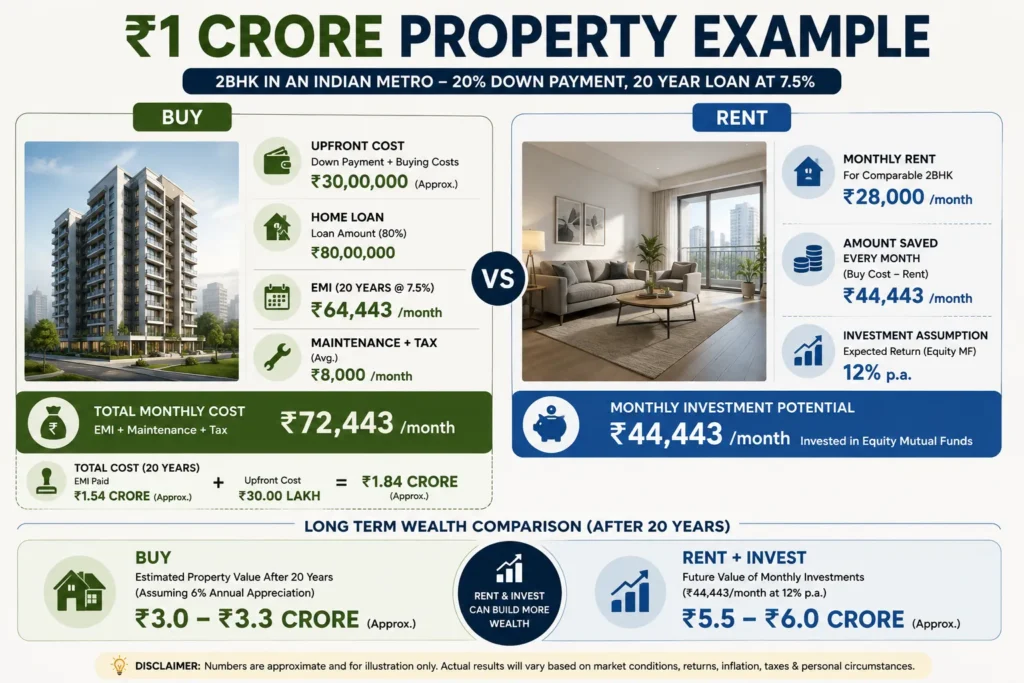
Take a Rs 1 crore 2BHK in a decent metro suburb. Assume 20% down payment, 80% home loan at 7.5% for 20 years, and monthly rent of Rs 28,000 for a comparable flat.
- Down payment plus buying costs (stamp duty, registration, brokerage, interiors): about Rs 30 lakh upfront
- EMI on Rs 80 lakh at 7.5% for 20 years: about Rs 64,443 per month
- Maintenance and property tax: about Rs 8,000 per month
- Total monthly outflow for the buyer: about Rs 72,443
- Monthly rent for the same flat: Rs 28,000
- Monthly savings if renting: about Rs 44,443
- Rs 30 lakh not invested in down payment, invested in equity at 12% CAGR for 20 years: about Rs 2.89 crore
- Add monthly savings of Rs 44,443 invested at 12% for 20 years: about Rs 4.4 crore
- Combined renter's wealth after 20 years, minus rent paid: roughly Rs 5.5 to 6 crore
The buyer's outcome depends on property appreciation. At 6% CAGR, the Rs 1 crore flat is worth about Rs 3.2 crore in 20 years. Net of the Rs 1.55 crore in total EMIs paid, the buyer is at roughly Rs 3 crore in net wealth attached to a single asset. At 8% appreciation, the buyer catches up. At 10%, the buyer wins. In practice, most Indian metros have averaged 3 to 7% annual price growth over long stretches, which puts the maths closer to the renter's favour for pure financial return.
City-by-City Rent vs Buy Snapshot (2026)
| City | Typical property price (2BHK) | Monthly rent | Rental yield | Price-to-rent ratio | Directional call |
|---|---|---|---|---|---|
| Mumbai (suburbs) | Rs 1.5 to 2.5 crore | Rs 40,000 to Rs 60,000 | 2.5% to 3% | 280x to 380x | Rent, unless 10+ years |
| Bengaluru | Rs 85 lakh to 1.2 crore | Rs 30,000 to Rs 45,000 | 3.5% to 4.5% | 200x to 280x | Balanced |
| Delhi NCR | Rs 90 lakh to 1.5 crore | Rs 28,000 to Rs 45,000 | 2.5% to 3.5% | 280x to 380x | Rent, unless long horizon |
| Pune | Rs 60 lakh to 90 lakh | Rs 22,000 to Rs 32,000 | 3.5% to 4.2% | 220x to 260x | Balanced to Buy |
| Hyderabad | Rs 70 lakh to 1 crore | Rs 25,000 to Rs 38,000 | 3.5% to 4% | 240x to 270x | Balanced |
| Chennai | Rs 65 lakh to 90 lakh | Rs 22,000 to Rs 32,000 | 3.5% to 4% | 220x to 260x | Balanced |
| Ahmedabad | Rs 45 lakh to 70 lakh | Rs 18,000 to Rs 28,000 | 4% to 4.5% | 180x to 220x | Buy |
| Kolkata | Rs 50 lakh to 75 lakh | Rs 18,000 to Rs 25,000 | 3.5% to 4% | 220x to 260x | Balanced |
Micro-market variation within each city can be significant. Central Bengaluru behaves very differently from a peripheral Whitefield extension. Central Mumbai bears no resemblance to Palghar. Always run the math on the specific property, not the city average.
The Hidden Costs of Buying That Change Everything
Sticker price is the least of a home buyer's costs. The full stack in 2026 looks like this.
- Stamp duty and registration: 5% to 7% of property value, varying by state. Housewise's detailed stamp duty breakdown covers the state-wise rates.
- GST on under-construction properties: 5% for affordable housing, 12% for others. Ready-to-move properties are exempt.
- Home loan processing fees: 0.5% to 1% of loan amount, often waived during festive campaigns.
- Legal and documentation fees: Rs 15,000 to Rs 50,000, higher for resale.
- Brokerage: 1% to 2% of property value, typically negotiable.
- Interior fitout: Rs 8 to 15 lakh for a 2BHK, easily more if premium.
- Society maintenance: Rs 2 to 4 per sqft per month.
- Property tax: 0.5% to 1% of ratable value annually.
- Property insurance: Rs 4,000 to Rs 10,000 a year.
- Prepayment charges on fixed-rate loans: usually 2 to 4%; nil on floating-rate loans.
Add these up on a Rs 1 crore property and total buying cost hits Rs 1.15 to Rs 1.25 crore in year one, before a single EMI is paid.
Tax Benefits: What Buyers Actually Get in 2026
The old tax regime remains the friend of home buyers.
- Section 24(b): Deduction of up to Rs 2 lakh per year on home loan interest for self-occupied property, with no limit for let-out property (subject to overall Rs 2 lakh loss set-off cap).
- Section 80C: Deduction of up to Rs 1.5 lakh on principal repayment, within the overall 80C basket that includes PPF, ELSS, and life insurance.
- Section 80EE and 80EEA: Additional interest deduction for eligible first-time buyers under earlier windows, some now sunset.
- PMAY Credit Linked Subsidy: Up to Rs 2.67 lakh subsidy for eligible first-time buyers, credited directly to the loan account.
Under the new tax regime, most of these benefits fall away for self-occupied homes. This is why many salaried buyers who moved to the new regime for lower slab rates lose the effective home-loan advantage, and why the choice of tax regime itself now feeds directly into the rent versus buy decision.
When Renting Wins in 2026
Renting is the smarter call in these situations.
- Your job requires mobility across cities or geographies
- You plan to stay in the current city for less than five to seven years
- The local price-to-rent ratio is above 250x, as in Mumbai or central Delhi
- Your down payment savings can be invested with discipline in equity mutual funds at 10 to 12% CAGR
- You value flexibility to shift neighbourhoods as family or income situation changes
- You are still building your emergency fund or paying down high-cost debt
A well-drafted rent agreement with correct stamp duty, registered where the state requires it, protects the renter's tenure and deposit through the years the analysis says to stay put.
When Buying Wins in 2026
Buying makes the stronger case in these situations.
- You have a stable job, business, or professional practice and a horizon of seven years or more
- You are in a Tier 2 or Tier 3 city with price-to-rent ratio under 200x
- School stability, community roots, and family space are priorities
- You have the financial cushion to cover down payment plus one year of EMIs even in a career disruption
- You are in the old tax regime and can fully use Section 24(b) and 80C deductions
- You have already built an equity portfolio and are diversifying into real estate
Buying without meeting most of these conditions is a leveraged bet, not an investment.
The Middle Path: Rent Where You Live, Buy Where It Makes Sense
Increasing numbers of urban Indians are choosing a hybrid strategy. Rent a flat close to work in a high price-to-rent metro like Mumbai or Bengaluru, while buying an investment property in a Tier 2 city or a family town where the ratio is more attractive. The investment property is then let out on a long-term rent agreement, sometimes as a leave and licence where state law makes that the natural instrument. The rental income services part of the EMI, tax benefits under Section 24(b) are unlimited for let-out property, and the family retains flexibility on where to live.
This strategy has been the quiet default for many NRI investors for years, and is now increasingly common among domestic salaried buyers too. Housewise has documented the specific pitfalls that trip up this approach in its guide to common mistakes in rent agreements that owners of let-out property should avoid.
How Housewise Helps
Housewise manages residential rental properties for owners across 23 Indian cities, whether the owner is renting out a primary home while relocating, or building a portfolio of investment homes in different cities. Every property is onboarded with a professionally drafted rent agreement, verified tenant onboarding, correct stamp duty and registration, monthly rent follow-ups, and periodic renewals. For owners weighing whether the maths favours holding, renting out, or selling a property, this end-to-end coordination makes the "rent it and invest elsewhere" side of the buy versus rent debate genuinely executable.
Frequently Asked Questions
Is it better to rent or buy a home in India in 2026?
It depends on your horizon and city. Rent if you plan to stay under seven years or live in a metro where the price-to-rent ratio exceeds 250x. Buy if you have a longer horizon and live in a Tier 2 city with a lower ratio.
What is a good price-to-rent ratio for buying a home in India?
under 150x strongly favours buying. Between 150x and 250x is a grey zone that depends on your horizon and investment discipline. Above 250x favours renting-and-investing. Mumbai and central Delhi often exceed 350x, while Ahmedabad and smaller cities sit closer to 180x.
What is the current home loan interest rate in India in 2026?
Home loan rates in 2026 start at 6.85% at Bank of Baroda and 7.10 to 7.65% at most public sector banks for borrowers with a CIBIL score above 750. Rates are floating and linked to the RBI repo rate, currently at 5.25%.
How much down payment is typically needed to buy a home in India?
Most banks fund up to 80% of the property value for loans below Rs 30 lakh and 75% for larger loans. Down payment sits at 20 to 25% of the price. Add stamp duty, registration, brokerage, and interior costs and total upfront outflow reaches 30%.
What tax benefits do home buyers get in India in 2026?
Under the old tax regime, Section 24(b) allows up to Rs 2 lakh deduction on home loan interest, Section 80C up to Rs 1.5 lakh on principal, and PMAY offers up to Rs 2.67 lakh in subsidy. Most benefits fall away under the new regime.
What are the hidden costs of buying a home in India?
Stamp duty and registration of 5 to 7%, GST of 5 to 12% on under-construction properties, processing fees, legal costs, brokerage, interior fitout of Rs 8 to 15 lakh, society maintenance, property tax, and insurance. Buying costs add 15 to 25% to sticker price.
Can renting-and-investing really beat buying financially?
Yes, in metros where price-to-rent ratios exceed 250x. If the renter invests the down payment and monthly EMI-rent gap in equity funds at 10 to 12% CAGR for 20 years, the combined portfolio often exceeds the home value, even after appreciation.
What is the break-even year for buying vs renting in India?
The break-even year is typically between five and twelve years for most Indian metros in 2026. Below this, renting is financially better; beyond it, buying starts to win. It depends on assumed rent escalation, home price appreciation, and the investment return on the down payment.
Is it a good time to buy a home in India in 2026?
For long-term buyers with stable income, yes. Home loan rates are at multi-year lows following the RBI's 125 basis point cut through 2025. However, high metro price-to-rent ratios mean short-horizon buyers may still lose compared to renting and investing the difference.
How does Housewise help owners after they buy a property to rent out?
Housewise manages residential rentals across 23 Indian cities, handling rent agreement drafting, stamp duty and registration, tenant verification, rent follow-ups, and periodic renewals. This makes the "rent it out and invest elsewhere" strategy fully executable without the owner managing tenants directly.
.


0 Comments