

Every salaried professional in Bengaluru's Sarjapur Road, Mumbai's Powai, Delhi's Gurugram, Hyderabad's Gachibowli, or Pune's Hinjewadi who pays rent above Rs 50,000 a month has a quiet, unaddressed tax liability sitting on their file. It is not the HRA claim, which they usually get right. It is Section 194-IB, the Income Tax provision that turns the tenant into a tax deductor the moment monthly rent crosses that threshold.
The rule has been in place since June 2017. It applies to individuals and Hindu Undivided Families, not just businesses. It requires a once-a-year TDS deduction, deposit through Form 26QC, and issuance of Form 16C to the landlord. Yet, year after year, the Income Tax Department's compliance data shows the same pattern. A large share of eligible tenants simply does not file Form 26QC, often because they do not know they are supposed to, and sometimes because they assume their HR team handles everything through the HRA declaration.
The gap matters because interest, late fees, and penalties start accruing the day after the deposit deadline. For a tenant paying Rs 75,000 a month, the TDS exposure is around Rs 18,000 a year. Missing it for three years adds up to notice-triggering amounts. This guide walks through what Section 194-IB actually requires, the 2% rate that has applied since October 2024, when to deduct, how to file, and what the penalties look like if compliance was missed.
Who Needs to Deduct TDS Under Section 194-IB?
Any individual or Hindu Undivided Family paying rent above Rs 50,000 per month to a resident landlord must deduct TDS at 2% under Section 194-IB of the Income Tax Act. The 2% rate took effect on 1 October 2024, replacing the earlier 5% under the Finance (No. 2) Act, 2024. The tenant does not need a TAN. Deduction is a one-time annual event, done in the last month of the tenancy or the last month of the financial year, whichever is earlier. The TDS is deposited through Form 26QC within 30 days of the end of the month of deduction, and Form 16C must be issued to the landlord as proof. If the landlord does not have a PAN, the rate shoots up to 20% under Section 206AA, capped at the rent payable in the last month. This rule does not apply if the landlord is an NRI (Section 195 applies instead) or if the tenant is subject to tax audit under Section 44AB (Section 194-I applies at 10%).
What Section 194-IB Actually Says
Section 194-IB was inserted by the Finance Act, 2017, effective 1 June 2017. It fills the gap that Section 194-I had always left open. Section 194-I requires businesses and tax-audit-covered individuals to deduct TDS on rent above Rs 2,40,000 per year, at 10%. Below that threshold, Section 194-I was silent. Section 194-IB brought all individual and HUF tenants paying monthly rent above Rs 50,000 (annual Rs 6,00,000) into the TDS net, regardless of whether they ran a business or filed under tax audit.
The provision has four defining features:
- Applies to any individual or HUF paying rent above Rs 50,000 per month
- Does not require the tenant to obtain a TAN
- Requires only a single deduction per financial year, not monthly
- Operates through PAN-based Form 26QC, similar to Form 26QB for property purchases
The design was deliberate. Salaried tenants were paying substantial rent to landlords who were often not declaring the full income. Making the tenant deduct even a small percentage created a cross-verification trail and widened the tax base, without burdening tenants with the TAN application and quarterly return filing that Section 194-I imposes.
Who Has to Deduct and Who Does Not
Not every tenant with a high rent is covered. The scope is narrower than most people assume.
Covered under Section 194-IB:
- Individuals and HUFs paying monthly rent above Rs 50,000
- Residential and commercial rent both qualify
- Rent paid for land, building, machinery, plant, equipment, furniture, or fittings is included
- Applies even if the tenant is a salaried employee with no business income
Not covered:
- Individuals and HUFs subject to tax audit under Section 44AB (Section 194-I applies instead, at 10%)
- Tenants paying rent to a non-resident landlord (Section 195 applies, at approximately 31.2% effective)
- Tenants paying rent of Rs 50,000 or less per month
- Partnerships, LLPs, and companies (Section 194-I applies at 10%)
The last point catches a common misreading. If a company rents an apartment and reimburses an employee's rent, Section 194-I at 10% applies to the company's deduction. Section 194-IB is specifically for individuals and HUFs paying rent from their own pocket.
The 2% Rate: What Changed in October 2024
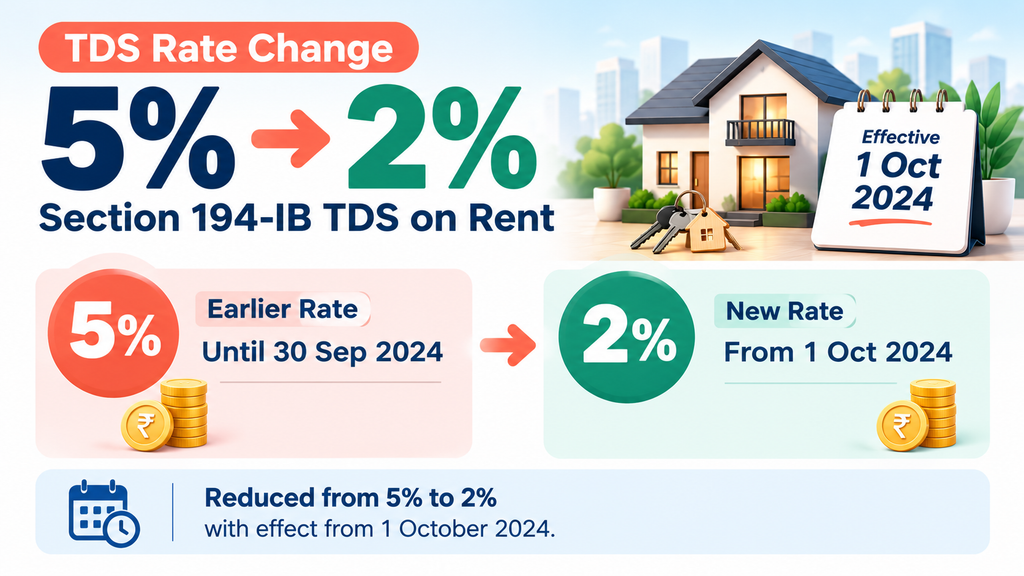
Until 30 September 2024, Section 194-IB operated at a 5% TDS rate. The Finance (No. 2) Act, 2024, reduced it to 2% with effect from 1 October 2024. For tenants whose rent spans the two periods in a single financial year, the deduction is proportional: 5% on rent for months before 1 October 2024 and 2% from October 2024 onward.
From April 2026, the Income-tax Act, 1961, has been replaced by the Income-tax Act, 2025. Section 194-IB has been consolidated into Section 393 of the new Act, but the substantive rules, the Rs 50,000 threshold, and the 2% rate all continue unchanged. For practical purposes, tenants and tax consultants still refer to it as Section 194-IB in day-to-day usage.
When and How to Deduct: The Once-a-Year Trigger
The timing of the deduction is where tenants get tripped up most often. Section 194-IB does not require monthly deduction. It requires a single deduction once in the financial year, calculated on the total rent paid for the year.
The deduction trigger is the earlier of:
- The last month of the tenancy, if the tenant vacates mid-year
- The last month of the financial year (March), if the tenancy continues beyond 31 March
The TDS is calculated on the full year's rent, not just one month's. If annual rent is Rs 9,00,000, the TDS at 2% is Rs 18,000. The tenant deducts this amount from the final rent payment and credits only the net to the landlord.
Where the tenant vacates mid-year, say in November, the full-year TDS up to that point is calculated and deducted from the November rent. If the November rent itself is lower than the TDS due, the deduction is capped at that month's rent, and the balance stays with the landlord to settle at the time of ITR filing.
Form 26QC and Form 16C: The Compliance Documents
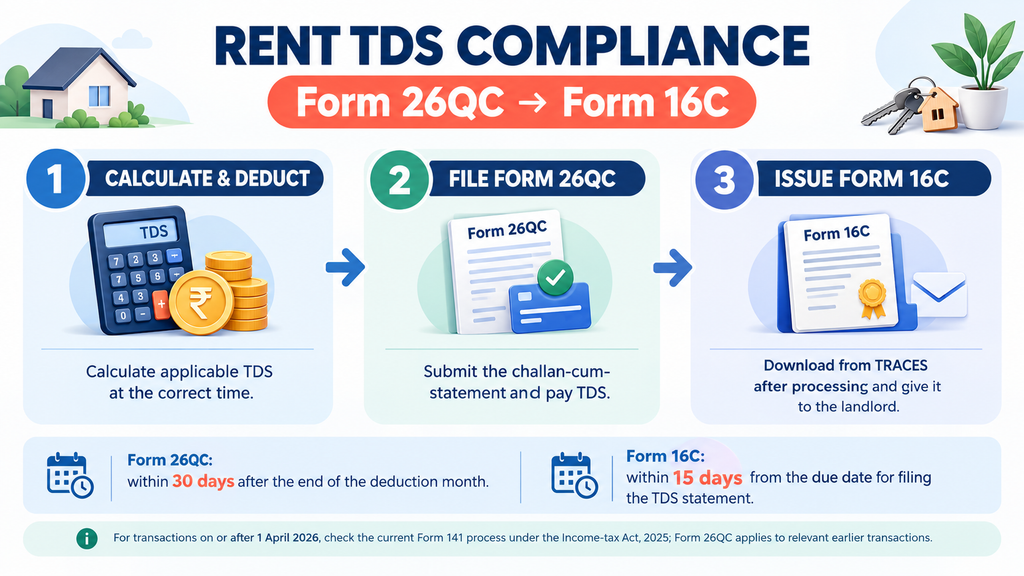
Once deducted, the TDS is deposited through Form 26QC, a PAN-based challan-cum-statement available on the Income Tax portal.
Form 26QC captures:
- PAN and address of the tenant and the landlord
- Property address
- Period of tenancy
- Total rent paid for the financial year
- TDS rate and amount
- Last month's rent and TDS calculation
The deadline is 30 days from the end of the month in which the deduction was made. For a deduction made in March, the deadline is 30 April. For a deduction made in November on tenancy exit, the deadline is 30 December.
After filing Form 26QC, the tenant must issue Form 16C to the landlord as the official TDS certificate. Form 16C is generated from the TRACES portal within 15 days of the Form 26QC filing. This is the document the landlord uses to claim credit for the TDS when filing their ITR.
For tenants onboarding a new tenancy where this obligation might apply, a cleanly drafted rent agreement that captures the landlord's PAN and bank details up front removes most of the friction later.
The No-PAN Problem: When TDS Becomes 20%
Section 206AA of the Income Tax Act kicks in when the landlord has not provided a valid PAN. In that case:
- TDS rate rises from 2% to 20%
- The 20% rate is capped at the amount of rent payable in the last month of the tenancy or the financial year
- The landlord cannot claim credit for the TDS, since no PAN exists on which to credit it
- The tenant still has to deposit the TDS
The capping provision protects tenants from a mathematically impossible deduction. If annual rent is Rs 9,00,000 and the landlord has no PAN, the theoretical 20% TDS would be Rs 1,80,000, far more than any single month's rent. The law caps the deduction at the last month's rent of Rs 75,000.
In practice, if a landlord refuses to share PAN, the tenant should insist on it before signing, or walk away. Deducting 20% destroys the landlord's cash flow and almost always leads to disputes that could have been prevented at the agreement stage.
What Happens If You Forget: Interest, Late Fees, and Penalties
| Default | Provision | Charge |
|---|---|---|
| Failure to deduct TDS | Section 201(1A) | Interest at 1% per month from the date deductible until actually deducted |
| Failure to deposit after deduction | Section 201(1A) | Interest at 1.5% per month from the date deducted until actually paid |
| Late filing of Form 26QC | Section 234E | Rs 200 per day of delay, capped at the amount of TDS |
| Non-filing of Form 26QC | Section 271H | Penalty of Rs 10,000 to Rs 1,00,000 at the Assessing Officer's discretion |
| Non-issuance of Form 16C | Section 272A(2)(g) | Penalty of Rs 100 per day of delay |
The late fee under Section 234E is strict and automatic. For a tenant who missed the deadline by 60 days with a TDS liability of Rs 18,000, the late fee is Rs 12,000. The interest under Section 201(1A) runs separately, and the penalty under Section 271H can be levied in addition.
194-IB vs 194-I vs 195: Which Section Applies to You?
| Scenario | Applicable Section | Rate | Threshold |
|---|---|---|---|
| Individual or HUF paying rent above Rs 50,000/month to a resident landlord | 194-IB | 2% | Rs 50,000/month |
| Business, company, firm, or audit-covered individual paying rent to resident landlord | 194-I | 10% | Rs 2,40,000/year |
| Any tenant paying rent to NRI landlord | 195 | ~31.2% | Nil (from first rupee) |
| Individual paying rent of Rs 50,000 or less to resident landlord | None | No TDS | Below threshold |
Picking the right section is important because the compliance mechanisms differ. Section 194-I requires a TAN, quarterly Form 26Q filings, and Form 16A issuance. Section 194-IB uses PAN, annual Form 26QC, and Form 16C. Section 195 historically required TAN and Form 27Q, though from October 2026, resident individual and HUF buyers of property from NRIs can use PAN through Form 141.
Step-by-Step Compliance Walkthrough
For a salaried tenant paying Rs 75,000 a month to a resident landlord, the sequence looks like this.
- Confirm the landlord is a resident and holds a valid PAN at the start of the tenancy.
- Capture landlord details in the rent agreement: PAN, address, bank account for rent credits.
- Track monthly rent payments through bank transfer or UPI for a clean paper trail.
- Identify the deduction trigger: vacating the property or 1 March of the financial year.
- Calculate TDS at 2% on the total annual rent. For Rs 9 lakh annual rent, the TDS is Rs 18,000.
- Deduct TDS from the final rent payment and credit only the net to the landlord.
- Log in to the Income Tax portal and file Form 26QC within 30 days.
- Pay the TDS through net banking or UPI linked to the Form 26QC challan.
- Download Form 16C from TRACES within 15 days of Form 26QC filing.
- Issue Form 16C to the landlord as the TDS certificate.
Most tenants complete the process in under 30 minutes once they do it the first time.
Common Mistakes Salaried Tenants Make
- Assuming HR handles it through the HRA declaration. HR handles HRA, not Section 194-IB TDS. These are different compliances.
- Deducting monthly instead of annually. The deduction is a single annual event.
- Missing the 30-day deposit deadline, triggering the Section 234E late fee.
- Not collecting the landlord's PAN upfront, leading to the 20% rate at year-end.
- Forgetting that NRI landlords require Section 195 compliance at 31.2%, not Section 194-IB.
- Not issuing Form 16C to the landlord, which prevents them from claiming TDS credit and often sours the relationship.
- Treating a company-provided rental allowance as an employer deduction. The tenant is the deductor under the law, not the employer.
Owners of leased properties can head off most of these issues at the agreement stage. A professionally drafted sample rent agreement that captures PAN, bank account, and signed KYC removes the ambiguity, and avoiding the standard common mistakes in rent agreements protects both sides from disputes later.
How Housewise Helps
Housewise coordinates rent agreement drafting, stamp duty payment, and registration for property owners across 23 Indian cities, with the specific details that make downstream TDS compliance easy for tenants: landlord PAN capture, banking channel payment terms, and clean per-month rent entries that make Form 26QC calculations straightforward at year-end. Owners weighing a full lease against a leave and licence structure get help picking the right instrument, with the tax implications factored in from day one.
Frequently Asked Questions
Who has to deduct TDS under Section 194-IB?
Any resident individual or Hindu Undivided Family paying rent above Rs 50,000 per month to a resident landlord. This covers salaried tenants, self-employed professionals, and HUFs. It does not apply to tenants under tax audit (Section 194-I) or those paying rent to NRIs (Section 195).
What is the current TDS rate under Section 194-IB?
2%, reduced from 5% with effect from 1 October 2024 under the Finance (No. 2) Act, 2024. The 2% rate applies to the full annual rent at the time of deduction. It was retained when Section 194-IB became Section 393 of the Income-tax Act, 2025.
When do I need to deduct TDS as a tenant?
Only once a year. The deduction is made in the last month of the tenancy if you vacate mid-year, or in the last month of the financial year if the tenancy continues beyond 31 March. Monthly deduction is not required under Section 194-IB.
Do I need a TAN to deduct TDS on rent?
No. Section 194-IB specifically allows individuals and HUFs to deposit TDS using their PAN through Form 26QC. This is one of the main differences from Section 194-I, which applies to businesses and requires a TAN plus quarterly Form 26Q filings.
What is Form 26QC?
Form 26QC is a PAN-based challan-cum-statement filed on the Income Tax portal to deposit TDS deducted under Section 194-IB. It must be filed within 30 days of the end of the month of deduction and captures tenant, landlord, property, and rent details.
What is Form 16C and when must I issue it?
Form 16C is the TDS certificate issued by the tenant to the landlord. It is downloaded from the TRACES portal within 15 days of filing Form 26QC. The landlord uses Form 16C to claim credit for the TDS when filing their ITR.
What happens if my landlord does not have a PAN?
Under Section 206AA, the TDS rate rises from 2% to 20%, capped at the amount of rent payable in the last month of the tenancy. Insist on the landlord's PAN before signing the agreement, since the 20% deduction effectively destroys the landlord's cash flow.
What are the penalties for missing Section 194-IB compliance?
Section 234E imposes Rs 200 per day late fee, capped at the TDS amount. Section 201(1A) adds interest at 1 to 1.5% per month. Section 271H allows a penalty of Rs 10,000 to Rs 1,00,000. All three can be levied together.
Does Section 194-IB apply to rent paid to NRI landlords?
No. For NRI landlords, Section 195 applies at approximately 31.2% effective rate, with no Rs 50,000 threshold. From 1 October 2026, resident individuals and HUFs can use PAN through Form 141 for Section 195 TDS, under CBDT Notification 121/2026.
How does Housewise help with TDS-compliant rent agreements?
Housewise drafts and stamps rent agreements across 23 Indian cities with correct landlord PAN capture, banking channel payment terms, and rent breakup. This gives salaried tenants a clean paper trail for annual Form 26QC filing and Form 16C issuance.


0 Comments