

For nearly a decade, Airbnb offered NRI homeowners a tempting proposition. Turn an empty flat in Mumbai, Bengaluru, or Goa into a short-term rental and earn 25 to 40 percent more than the conventional lease would pay. Payments came in dollars-equivalent through Airbnb's system, occupancy risk sat with the platform, and the property manager on the ground handled cleaning and turnover. For an owner sitting in Dubai, London, or Toronto, the maths looked good.
That premium is now fading. Fresh data from AirDNA, covering the year ending 30 June 2026 and published by Mint, shows short-term rental listings in Indian cities have surged 21 to 72 percent, but revenues have not kept pace. Prime holiday markets like Goa, Jaipur, Udaipur, Varanasi, and Jodhpur are in outright revenue decline. Average daily rates in Mumbai fell 6.5 percent and in Jodhpur crashed 43 percent. Airbnb's new single-fee model, in force from October 2025, has pushed the full 15.5 percent platform fee onto hosts, forcing many to raise prices 10 to 12 percent and further eroding competitiveness.
For NRI owners, the calculus is more complex than for resident hosts, because the tax and compliance rules under Section 195, FEMA, GST, and the Airbnb platform's own TCS deduction all bite differently. This guide walks through the actual returns in 2026, the tax picture from top to bottom, and where the answer lands for NRIs.
Is Airbnb Still Worth It for NRIs in 2026?
For most NRI owners in 2026, long-term conventional rentals are now the safer and often more profitable choice. Airbnb still commands a 32.4 percent premium in Tier 1 cities with limited tourism where corporate demand fills gaps, but that premium collapses to 6.7 percent in Tier 2 and 3 cities and turns negative in oversupplied holiday markets like Goa and Jaipur. NRI landlords also face Section 195 TDS at roughly 31.2 percent on all rental income, GST at 12 to 18 percent on short-term stays, and a 1 percent Airbnb-side TCS deduction under Section 194-O. Once operating costs, platform fees, and compliance overhead are added, most NRI-owned homes yield more from a well-managed long-term tenant than from a short-term listing. Airbnb still makes sense for owners with premium urban assets, active management, and a differentiated experience. For everyone else, the case has weakened.
What Changed in India's Short-Term Rental Market in 2026
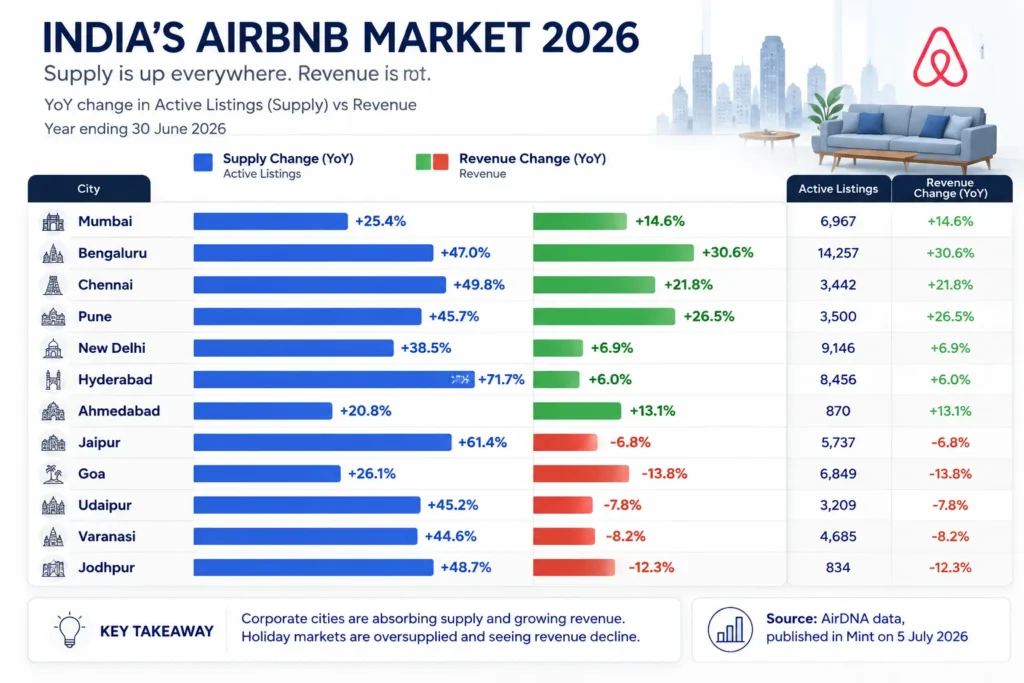
The oversupply story is now visible in numbers. Between mid-2025 and mid-2026, active short-term listings on Airbnb, Vrbo, and Booking.com moved as follows across major Indian markets.
| City | Active listings | Supply change (YoY) | Revenue change (YoY) |
|---|---|---|---|
| Mumbai | 6,967 | +25.4% | +14.6% |
| Bengaluru | 14,257 | +47.0% | +30.6% |
| Chennai | 3,442 | +49.8% | +21.8% |
| Pune | 3,500 | +45.7% | +26.5% |
| New Delhi | 9,146 | +38.5% | +6.9% |
| Hyderabad | 8,456 | +71.7% | +6.0% |
| Ahmedabad | 870 | +20.8% | +13.1% |
| Jaipur | 5,737 | +61.4% | -6.8% |
| Goa | 6,849 | +26.1% | -13.8% |
| Udaipur | 3,209 | +45.2% | -7.8% |
| Varanasi | 4,685 | +44.6% | -8.2% |
| Jodhpur | 834 | +48.7% | -12.3% |
Source: AirDNA data, published in Mint on 5 July 2026.
Two patterns stand out. First, in the Tier 1 corporate cities of Bengaluru, Chennai, and Pune, revenue growth is still outpacing supply growth, which means the market can absorb new listings. Second, in holiday markets where supply has raced ahead of demand, revenues are falling. Goa's supply grew 26 percent while revenues dropped almost 14 percent. Jaipur, Udaipur, and Jodhpur tell the same story in different accents.
The New Airbnb Economics: Why the Rental Premium Is Fading
Three shifts explain the collapsing premium.
Supply saturation: Between the post-COVID revenge travel wave of 2022 and 2023, new hosts flooded into Airbnb. Sembhiprabha Eswaraikumar, an Airbnb adviser cited in the Mint article, observed that prime markets are now saturated. The days when just being listed guaranteed bookings are over.
Platform fee restructure: From October 2025, Airbnb mandated a single-fee model similar to Booking.com. The host now pays the full 15.5 percent platform fee instead of the earlier split-fee model where the guest bore the majority. Most hosts have responded by raising nightly prices 10 to 12 percent, which further compresses their competitiveness against hotels and conventional rentals.
Operating cost inflation: Cleaning, laundry, key handovers, guest support, restocking, and platform commissions add up to 25 to 40 percent of gross booking value. For a Rs 4,000 per night listing, the take-home per night after all costs sits closer to Rs 2,400 to Rs 2,800, before tax.
The clearest illustration of the yield problem is actress Parul Gulati's case, referenced in the Mint reporting. She bought a two-bedroom villa in Nerul, Goa for Rs 3.1 crore in 2021, expected to charge Rs 40,000 to Rs 45,000 per night, and now charges around Rs 11,000, generating Rs 15 to 16 lakh a year. That works out to a 3.3 percent gross yield before tax and platform fees, which is meaningfully lower than a bank fixed deposit.
Short-Term vs Long-Term Rentals: A Direct Comparison for NRIs

For an NRI owner deciding what to do with a Bengaluru 2BHK, a Goa villa, or a South Delhi flat, the trade-offs look like this.
| Factor | Short-Term (Airbnb) | Long-Term Rental |
|---|---|---|
| Gross yield potential | 6% to 10% in strong markets | 2.5% to 4% depending on city |
| Revenue certainty | Highly variable, seasonal | Fixed monthly rent |
| Vacancy risk | High, 30% to 50% depending on market | Low, once tenant onboarded |
| Operating cost load | 25% to 40% of gross | 5% to 10% of gross |
| Platform/management fees | Airbnb 15.5% plus local property manager | Property manager 5% to 10% |
| Tax classification | Often business income if services provided | House property income |
| GST applicability | 12% or 18% depending on tariff | Exempt for residential use |
| TDS rate on rental income to NRI | Section 195 at approximately 31.2% | Section 195 at approximately 31.2% |
| Compliance touchpoints per year | Monthly GST returns, income tax, GST audit | Annual TDS reconciliation, income tax |
| Management effort | Constant remote oversight required | Passive after tenant onboarded |
Long-term rentals lose on headline yield but win on nearly every other axis: predictability, tax simplicity, and management burden. For NRI owners without a trusted local operator, that shift often outweighs the yield differential.
Tax Rules for NRI Rental Income in 2026
Rental income earned by an NRI from Indian property is taxable in India, whether the property is let out short-term or long-term. Two heads of income can apply.
Income from House Property: The default classification for long-term residential rentals. NRIs get the standard 30 percent deduction under Section 24(a) for repairs and maintenance, plus deduction of interest paid on any home loan under Section 24(b). Property tax paid to the municipal corporation is also deductible.
Profits and Gains of Business or Profession: Applies where the owner provides substantial services alongside the accommodation, such as housekeeping, meals, and concierge, which is the pattern for most Airbnb operations. Under this classification, the 30 percent standard deduction is not available, but actual expenses including platform fees, cleaning, utilities, insurance, and property management fees can be claimed against income. This is often the more accurate classification for active short-term hosting.
NRIs must file an Indian income tax return using ITR-2 or ITR-3 depending on the income classification, disclose all Indian rental income, and reconcile the TDS credited to their PAN through Form 26AS.
TDS on Rent Paid to NRI Landlords: Section 195 Explained
This is where NRI compliance departs sharply from resident compliance. A resident landlord's tenant deducts TDS under Section 194IB at 2 percent only if monthly rent exceeds Rs 50,000. An NRI landlord's tenant deducts TDS under Section 195 at the full applicable rate, from the very first rupee of rent, regardless of amount.
The tenant's obligations under Section 195 are:
- Obtain a TAN under Form 49B before deducting any TDS
- Deduct 30 percent plus applicable surcharge plus 4 percent Health and Education Cess on the gross rent, giving an effective rate of approximately 31.2 percent for basic slabs and higher for larger amounts
- Deposit the TDS via Challan ITNS 281 within seven days of the following month
- File Form 27Q every quarter reporting the deduction
- Issue Form 16A to the NRI landlord as TDS proof
- Ensure the landlord's PAN is quoted, failing which TDS jumps to 30 percent minimum under Section 206AA regardless
The NRI landlord can apply to the Assessing Officer under Section 197 for a lower TDS certificate if their actual tax liability is lower than 31.2 percent, which is often the case for owners with home loan interest deductions. Getting the Section 197 certificate before the tenant starts deducting can materially improve cash flow.
GST on Short-Term Rentals: What NRI Hosts Need to Know
Short-term rentals through Airbnb, Vrbo, and Booking.com are treated as accommodation services under GST, not as house property rent. The current 2026 rate structure is:
- Rs 7,500 per night or less: 12 percent GST
- Above Rs 7,500 per night: 18 percent GST
Registration becomes mandatory once aggregate turnover from all Indian business income crosses Rs 20 lakh in a financial year, or Rs 10 lakh in special category states. Airbnb, as an e-commerce operator, also deducts 1 percent TCS under Section 194-O of the Income Tax Act on the gross booking value, which the host can adjust against final tax liability.
An NRI host running multiple Airbnbs across cities is very likely to cross the Rs 20 lakh threshold and needs to register through a resident authorised representative for GST compliance. This adds monthly GSTR-1, GSTR-3B, and annual GSTR-9 filings on top of the income tax return.
Long-term residential rent stays fully outside GST when the tenant is an individual using it as a home, which removes an entire compliance stack for NRI owners choosing the conventional route.
FEMA and NRO Account Rules for Rental Income
All rental income earned by an NRI from Indian property must be credited to a Non-Resident Ordinary (NRO) bank account under the Foreign Exchange Management Act, 1999. Direct credit to an NRE or FCNR account is not permitted for rent.
Repatriation of NRO funds abroad is capped at USD 1 million per financial year, and requires:
- Chartered Accountant certification in Form 15CB
- Filing of Form 15CA online with the Income Tax Department
- Confirmation that all applicable Indian taxes have been paid or provided for
- Bank-level compliance with the outward remittance rules
Structured properly, this framework works smoothly. The trouble usually starts when rent is deposited into the wrong account type, when TDS is not deducted, or when the tenant fails to file Form 27Q, and the CA cannot certify Form 15CB.
The Practical Verdict for NRIs in 2026
The evidence points to a clear default. For most NRI owners in 2026, a professionally managed long-term rental beats a self-run or lightly-managed Airbnb on risk-adjusted returns.
Airbnb still wins in three narrow cases:
- Premium urban assets in Bengaluru, Pune, Chennai, or Mumbai with strong corporate demand and low tourism dependence
- Owners who can commit to genuine differentiation through design, experience, or concierge services
- Properties where a full-service, on-ground operator handles guest management with quantified performance data
For the majority of NRI-owned homes, particularly in oversupplied holiday markets, a well-structured long-term rental with a professional rent agreement, verified tenant, and correct stamp duty delivers a steadier and simpler return. Shilpa Ralhi, quoted in the Mint article, put it plainly after shifting her Dehradun property from Airbnb back to conventional rental: renting is a stable, dependable source of income without having to put extra effort to stand out.
Housewise manages residential properties for NRI owners across 23 Indian cities and handles the full compliance stack that most owners cannot execute remotely. That includes rent agreement drafting on state-appropriate stamp paper, tenant background verification, police intimation, Maharashtra online rent agreement registration where applicable, coordination of Section 195 TDS deduction by the tenant, and periodic renewals. For NRIs who have looked at their Airbnb yield after the October 2025 platform fee change and want to switch to a stable long-term arrangement, Housewise handles the transition end to end. Owners drafting or renewing agreements can also avoid the pitfalls listed in the guide to common mistakes in rent agreements, and NRIs weighing a full lease against a leave and licence structure get help picking the right instrument for their city and profile.
Frequently Asked Questions
Is Airbnb still profitable for NRI property owners in India in 2026?
It depends on the city. Tier 1 corporate markets like Bengaluru, Pune, and Chennai still show a 32.4 percent premium over conventional rentals. In Tier 2 and 3 cities, the premium falls to 6.7 percent, and in oversupplied holiday markets like Goa, revenues are declining.
What TDS applies on rent paid to an NRI landlord?
Section 195 of the Income Tax Act applies. TDS is 30 percent plus applicable surcharge plus 4 percent Health and Education Cess, effectively around 31.2 percent for basic slabs. There is no Rs 50,000 monthly threshold that applies for resident landlords under Section 194IB.
Does the tenant need a TAN to deduct TDS on NRI rent?
Yes. The tenant must obtain a TAN by filing Form 49B before deducting any TDS under Section 195. Without a TAN, TDS cannot be deposited or reported through Form 27Q, which is the mandatory quarterly return for NRI payments.
Is GST applicable on Airbnb income earned by NRIs?
Yes, once aggregate annual turnover crosses Rs 20 lakh. GST applies at 12 percent for tariffs up to Rs 7,500 per night and 18 percent above. NRI hosts must register through a resident authorised representative and file monthly GSTR-1 and GSTR-3B returns.
Does Airbnb deduct any tax at the platform level?
Yes. Airbnb, as an e-commerce operator, deducts 1 percent TCS under Section 194-O on the gross booking value. This is reflected in the host's Form 26AS and can be adjusted against final income tax liability at the time of filing the return.
Can an NRI owner claim deductions on rental income?
Yes. For house property income, a standard 30 percent deduction is available under Section 24(a), plus home loan interest under Section 24(b). For short-term rentals classified as business income, actual expenses like platform fees, cleaning, and management fees are deductible.
Which account should NRI rental income be credited to?
Rental income earned in India must be credited to a Non-Resident Ordinary (NRO) account. Credit to NRE or FCNR accounts is not permitted for rent. Repatriation from NRO to overseas accounts is capped at USD 1 million per financial year with CA certification.
Can an NRI apply for a lower TDS certificate under Section 197?
Yes. NRIs can apply to the Assessing Officer under Section 197 for a lower or nil TDS certificate if actual tax liability is below 31.2 percent, which is common for owners claiming home loan interest deductions. The certificate is issued property-wise and tenant-wise.
What is the difference in tax treatment between short-term and long-term rentals?
Long-term residential rent is house property income, exempt from GST, with standard 30 percent deduction. Short-term rental with services is typically business income, subject to GST at 12 or 18 percent, without standard deduction but with actual expenses allowed.
How does Housewise support NRI owners with rental compliance?
Housewise manages residential properties for NRIs across 23 Indian cities, handling rent agreement drafting, tenant verification, Section 195 TDS coordination, registration, and periodic renewals. This gives NRI owners a compliant, professionally documented long-term rental without remote management burden.


0 Comments