

In Vastu Shastra, the main door of a home is not just an entry point. It is called mukha, the mouth of the house, the aperture through which prana or life energy enters, settles, and shapes the destiny of everyone who lives inside. Whether you take the tradition literally or read it as a language for good design, the belief that the front door decides a home's fortune has held remarkably steady in Indian households across centuries.
The choice of direction, in that sense, is treated as consequential. A north-facing main door is said to open onto Kubera's treasury. An east-facing door welcomes the rising sun and Indra's blessings. The northeast is considered the most spiritually potent orientation of all. And on the other side of the compass, a south-west facing door is believed to invite Rahu's shadow, financial instability, and health drain. Whether the connection is metaphysical, energetic, or simply architectural intuition wrapped in myth, most Indian buyers and renters continue to check the direction of the front door before signing on the dotted line.
This guide walks through what Vastu Shastra says about main door directions, which ones are considered auspicious, which are considered inauspicious, how to check the direction of your own front door, and what remedies traditional practitioners recommend when the direction is not ideal.
What Is the Best Main Door Direction According to Vastu?
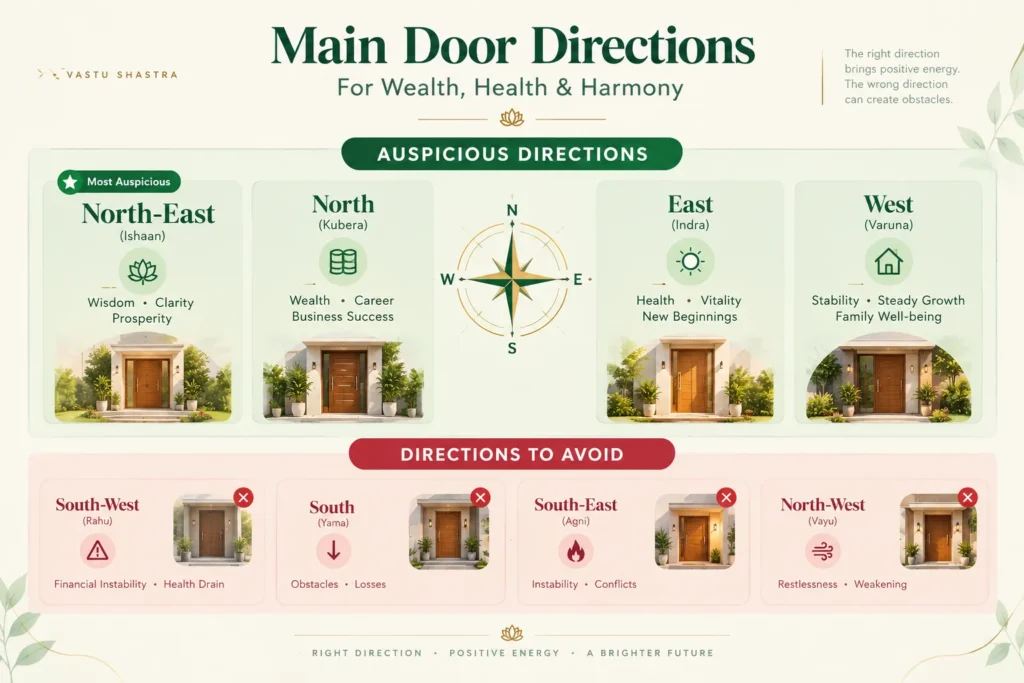
The four most auspicious main door directions in Vastu Shastra are North-East, North, East, and West, in that order. North-East is considered the most spiritually powerful, associated with wisdom, clarity, and prosperity. North is the direction of Kubera, the god of wealth, and is especially recommended for business owners and salaried professionals. East, ruled by Indra and the rising sun, brings health, vitality, and new beginnings. West, associated with Varuna and Saturn, offers steady, grounded household energy. The four directions to avoid are South-West (Rahu, considered the worst), South, South-East (fire element, unstable), and North-West (air element, neutral to weakening). If your main door is in an inauspicious direction, Vastu prescribes specific remedies including copper pyramids, yantras, Ganesha or Hanuman placements, auspicious symbols like Om and Swastika, and colour or nameplate corrections that traditional consultants believe can rebalance the energy.
Why the Main Door Is Central to Vastu Shastra
Vastu Shastra is India's traditional system of spatial design, drawing on directional energy, elemental balance, and cosmic geometry. Within this framework, the main door plays an outsized role for three reasons.
It is the primary energy inlet. Prana, or life force, is believed to enter and leave through the main door. A door facing an auspicious direction channels beneficial energy inward. A door in an inauspicious direction is believed to draw unstable, negative, or scattered energy into the home.
It sets the tone for every other room. The direction of the main door influences how the rest of the home's Vastu is calculated. The placement of the kitchen, master bedroom, pooja room, and even the toilet is decided in relation to the entry.
It carries symbolic weight. In Hindu tradition, the dwaar is considered sacred. Torans of mango and ashoka leaves, Ganesha and Lakshmi images, kalashas, and rangoli patterns are all rooted in the idea that the threshold is a spiritual boundary.
Modern architects often note that many Vastu rules also happen to be sound climate and lighting design for the Indian subcontinent. An east-facing door catches morning light. A north-facing door avoids the harsh afternoon sun. The traditions layer belief on top of climate wisdom, and the two are difficult to separate.
The Best Main Door Directions for Wealth and Prosperity
North-East: The Most Auspicious Direction
The north-east, or Ishaan, is ruled by Jupiter, the planet of wisdom and expansion. This is considered the most spiritually potent zone in the entire Vastu grid. A main door in the north-east is believed to bring clarity, prosperity, and abundance, and is particularly recommended for families with young children, professionals in knowledge-driven fields, and homes that also serve as spiritual practice spaces.
North: The Direction of Kubera
The north is presided over by Kubera, the guardian of wealth. A north-facing main door is regarded as one of the strongest orientations for financial growth, career opportunities, and business success. Within the north wall, the fifth Pada, known as Soma or the Kubera Pada, is considered the single most auspicious spot for placing the door.
East: The Rising Sun Direction
An east-facing main door aligns with the sunrise, is ruled by Indra, and is associated with health, vitality, and new beginnings. Vastu recommends placing the door in the centre of the east wall. If placement in the north-east corner is unavoidable, a gap of about six inches between the door and the wall is suggested to preserve the direction's energy balance.
West: Stable and Steady
The west, ruled by Saturn and Varuna, is considered neutral to moderately favourable. A west-facing main door is thought to produce stable household energy, steady financial growth, and dependable career progress. Within the west wall, the Pushpdant Pada (W4) is linked to Kubera's vehicle and is particularly associated with financial prosperity, while the Sugreev Pada (W3) is another positive placement.
Main Door Directions to Avoid
South-West: The Direction of Rahu
The south-west, or Nairutya, is ruled by Rahu and is universally considered the least auspicious direction for a main door in Vastu Shastra. Traditional texts link a south-west entrance to financial instability, health issues, family discord, and career stagnation. The specific worst Padas here are Pitra, Mrigha, and Gandharva. If unavoidable, this direction requires the strongest set of remedies.
South: Traditionally Inauspicious
The south, ruled by Yama, is traditionally treated as inauspicious for main doors. Some Padas within the south wall are considered acceptable with corrective measures, but a south-facing entrance is generally avoided in classical Vastu practice.
North-West: Neutral to Weakening
The north-west, or Vayavya, is governed by the air element and the moon. It is considered neutral rather than outright negative. It does not carry the same wealth pull as the north or the vitality of the east. The worst Padas here are Asura, Sosha, and Papyakshama.
South-East: The Fire Element
The south-east, or Agneya, is ruled by Venus (Shukra) and the fire element. A main door in this direction is believed to create unstable energy, conflict within the family, and health issues linked to inflammation. Anil and Akash are the specific inauspicious Padas within this direction.
Main Door Directions at a Glance
| Direction | Ruling Deity or Element | Vastu Rating | Best For |
|---|---|---|---|
| North-East | Jupiter, Ishaan | Most auspicious | Wisdom, spirituality, overall growth |
| North | Kubera | Highly auspicious | Wealth, business, career |
| East | Indra, rising sun | Highly auspicious | Health, new beginnings, family |
| West | Varuna, Saturn | Neutral to positive | Stability, steady income |
| North-West | Air, moon | Neutral to weak | Acceptable with remedies |
| South-East | Venus, fire | Inauspicious | Avoid, else use fire-balancing remedies |
| South | Yama | Generally inauspicious | Avoid, else use grounding remedies |
| South-West | Rahu | Most inauspicious | Avoid, strongest remedies needed |
How to Check Your Main Door Direction Correctly
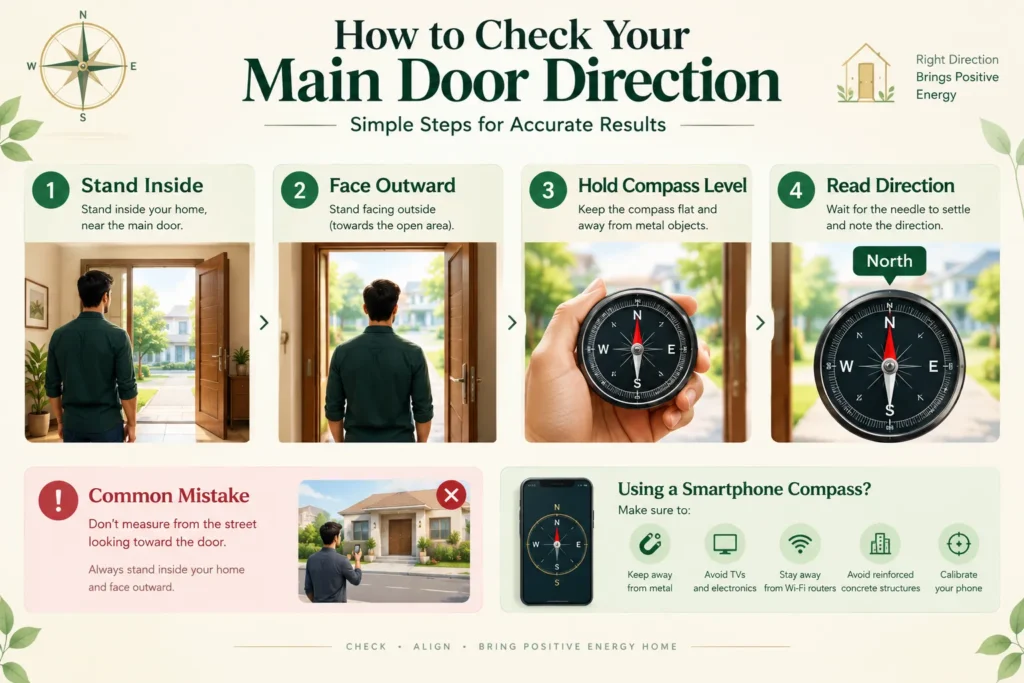
The direction of your main door is measured from the inside looking out, not from the street looking in. This is the single most common mistake people make when they self-diagnose their home's Vastu.
- Stand just inside the main door, facing outward
- Hold a compass level in your palm, away from any metal or magnets
- Wait for the needle to settle
- The direction the compass points is the direction your main door faces
For a north-facing house, when you stand inside the doorway facing out, the compass needle should point ahead of you at north. Some people confuse the direction the house faces with the direction the main door opens onto, but in Vastu, only the direction of the door itself matters.
For those who use smartphone compass apps, calibrate the phone by moving it in a figure-eight pattern before taking the reading, and step away from Wi-Fi routers, television sets, and reinforced concrete pillars, all of which distort the reading.
Understanding the 32-Pada System
Traditional Vastu divides each wall of the house into eight Padas, giving 32 possible main door positions in total. Not every Pada within an auspicious direction is favourable, and some Padas within an inauspicious direction can be tolerable. The system is granular, and a full assessment usually requires a Vastu consultant.
The most favourable Padas are:
- North wall: N3 (Mukhya), N4 (Bhallat), N5 (Soma or Kubera)
- East wall: E3 (Jayanta), E4 (Indra)
- West wall: W3 (Sugreev), W4 (Pushpdant)
The most unfavourable Padas are:
- South-West wall: Pitra, Mrigha, Gandharva
- North-West wall: Asura, Sosha, Papyakshama
- South-East wall: Anil, Akash
When buying or renting, a Vastu-aware buyer typically checks both the compass direction and the Pada. In most modern flats, exact Pada calibration is difficult because interior walls and layouts are fixed by the developer. This is why remedies are so widely used.
Common Main Door Vastu Doshas and Their Remedies
If your main door is in a less-than-ideal direction, traditional Vastu practitioners suggest a layered set of remedies.
For a south-west entrance: Place a heavy stone Ganesha idol just inside the door facing outward, install copper Vastu pyramids on the door frame, use deep grounding colours (brown, burgundy, charcoal), and establish a Kubera yantra in the north-east corner of the home to counterbalance the drain.
For a south entrance: Paint the door in bold red or maroon, place trishul or Om symbols on both sides, use red curtains near the entrance, and avoid a water tank or borewell directly in front of the house.
For a south-east entrance: Use brown, orange, or silver door colours, avoid black or dark blue, install three copper pyramids on the door frame, and place a Siddha Shukra Yantra to appease Venus.
For a north-west entrance: Keep the entrance impeccably clean and well-lit, place auspicious symbols like Swastika and Om on either side, and use a solid metal nameplate to anchor the air element.
Universal enhancements that apply to any direction include a clean and clutter-free threshold, a fresh toran of mango or ashoka leaves, a nameplate at eye level on the right side as you enter, good lighting, and no shoe racks or dustbins directly at the entry.
Design and Placement Tips for a Vastu-Compliant Main Door
The direction is the headline, but the details also matter.
- The main door should be the biggest and grandest door in the house
- It should open inward and swing clockwise
- Avoid placing it directly opposite another door, especially the main gate, as this causes energy to escape
- No mirror should face the main door
- The threshold should have a slight elevation (a marble or wooden lintel) to prevent energy from slipping out
- Wooden doors are considered ideal; metal doors are acceptable but glass is discouraged
- The nameplate goes on the right side of the door as you exit
- Doorbell should be pleasant, not shrill
Vastu in the Real World: Buying, Renting, and Making Peace with Imperfection
Very few homes in India today are perfectly Vastu-compliant. Modern apartment complexes are laid out for FSI, parking, and view, not for cardinal alignment. Rentals rarely match every principle. Even self-built homes get compromised by plot orientation, road access, and municipal setbacks.
The practical approach that most families settle on is a three-step filter. First, check the direction of the main door, and prefer north, east, or north-east where available. Second, avoid south-west outright unless remedies are non-negotiable. Third, if a home is otherwise perfect on location, price, and layout, use traditional remedies to rebalance the entrance rather than walking away.
For tenants who want to lock in a good property before someone else does, a professionally drafted rent agreement with correct stamp duty and registration protects the tenancy while the family adjusts the interiors to their Vastu preferences.
How Housewise Helps
Housewise coordinates rent agreement drafting, stamp duty payment, and, in Maharashtra, registration for property owners and tenants across 23 Indian cities. Whether the tenant is moving into a north-facing flat that ticks every Vastu box, or a south-west facing property where remedies will do the balancing work, Housewise handles the paperwork side so families can focus on the design and energy side of their new home. Owners drafting an agreement for the first time can also avoid the common mistakes in rent agreements that create friction later, and those weighing a full lease against a leave and licence structure get help picking the right instrument for their city and profile.
Frequently Asked Questions
Which is the best direction for the main door as per Vastu?
North-East is considered the most auspicious, followed by North, East, and West. North-East is ruled by Jupiter and brings wisdom and clarity. North is Kubera's direction and invites wealth. East, ruled by the rising sun, brings health and new beginnings.
Is a south-facing main door bad in Vastu?
The south is traditionally considered inauspicious in classical Vastu because it is ruled by Yama. However, specific Padas within the south wall are acceptable with corrective measures like red door colour, Om symbols, and trishul placement. Full replacement is rarely necessary if remedies are used.
Which is the worst main door direction as per Vastu?
The South-West or Nairutya direction, ruled by Rahu, is considered the most inauspicious main door direction. It is believed to invite financial instability, health drain, and family discord. The Pitra, Mrigha, and Gandharva Padas within this zone are the most problematic.
Can Vastu doshas of the main door be fixed with remedies?
Yes. Traditional remedies include copper Vastu pyramids, Kubera and Siddha Shukra yantras, Ganesha or Hanuman idols, Om and Swastika symbols, colour corrections, and fresh torans. Most Vastu consultants prescribe a layered approach depending on the direction and severity.
How do I check the direction of my main door?
Stand just inside the main door facing outward and use a compass. The direction the compass needle points is the direction your main door faces. Move away from metal objects, TVs, and reinforced pillars to avoid distorted readings, especially with smartphone compass apps.
What is the 32-Pada system in Vastu?
Vastu divides each of the four walls into eight Padas, giving 32 possible main door positions. Some Padas within an auspicious direction are inauspicious, and vice versa. Auspicious Padas include Mukhya, Bhallat, Soma (Kubera), Jayanta, Indra, Sugreev, and Pushpdant.
Should the main door open inward or outward as per Vastu?
The main door should always open inward and swing clockwise. This is believed to draw positive energy into the home rather than push it out. An anticlockwise or outward-opening door is considered a Vastu defect that can be corrected with a Vastu pyramid or yantra.
What colour should the main door be as per Vastu?
The colour depends on direction. North doors work well in green or blue, east in brown or beige, west in white or silver, south in red or maroon. South-east benefits from brown or orange. South-west needs grounding colours like burgundy or charcoal.
Is it bad if two main doors face each other in Vastu?
Yes. If the main door is directly opposite another door, especially the entrance gate or a rear door, energy is believed to flow straight through and escape without settling in the home. A Vastu pyramid or curtain is the standard remedy.
Does Housewise help buyers or renters check main door direction?
Housewise is a property management service and does not directly consult on Vastu, but many clients evaluate the main door direction themselves during property visits. Housewise handles rent agreement drafting, stamp duty, and, in Maharashtra, registration once the buyer or tenant has finalised the home.


0 Comments