

Every month, somewhere in urban India, the same scene plays out. A tenant is a few weeks late on rent. The landlord's WhatsApp messages start turning aggressive. Then one evening the tenant returns from work to find the lock changed, the electricity meter switched off, or the belongings piled outside on the landing. Sometimes it happens without a word. Sometimes it comes after a shouting match. Often the landlord genuinely believes they are within their rights, because after all, the tenant hasn't paid.
They are not. Under Indian law, a landlord cannot lock out a tenant, seize their belongings, cut off water or electricity, or physically remove them from the property, no matter how many months of rent are unpaid. The only person who can order a tenant out is a court. Any attempt by a landlord to bypass that process is not just a civil wrong. It is a criminal offence under the Bharatiya Nyaya Sanhita, 2023, and it exposes the landlord to arrest, prosecution, restoration orders, and monetary damages, all while the unpaid rent still hangs in the air.
This guide walks through what the law actually says about landlord self-help, why even a defaulting tenant is treated as being in lawful possession, the specific criminal and civil remedies available, and the step-by-step actions a tenant should take if they walk home to a changed lock.
Can a Landlord Legally Lock You Out?
No. A landlord in India cannot legally lock out a tenant, seize the tenant's belongings, or cut off essential services like water and electricity to force the tenant out, regardless of how much rent is owed. Every state's rent laws, the Transfer of Property Act, 1882, and the Specific Relief Act, 1963, treat the tenant as being in lawful possession until a court order says otherwise. A landlord who resorts to lockouts or seizure commits multiple offences under the Bharatiya Nyaya Sanhita, 2023, including house trespass under Section 329, criminal intimidation under Section 351, mischief under Section 324, and potentially wrongful confinement under Section 126. The tenant can file an immediate police complaint, a summary suit for restoration of possession under Section 6 of the Specific Relief Act within six months of dispossession, and a separate civil suit for damages. The Supreme Court in Krishna Ram Mahale v. Shobha Venkat Rao (1989) crystallised the principle in one line: no one can take the law into his own hands, however good his title may be.
The Foundational Principle: Even a Defaulting Tenant Is Lawfully in Possession
The most misunderstood idea in Indian rental law is that non-payment of rent somehow ends the tenancy automatically. It does not. A tenant remains in lawful possession of the property until the tenancy is legally terminated through the process laid out in the Transfer of Property Act, 1882, the applicable state Rent Control Act, or the Model Tenancy Act, 2021, in states that have adopted it.
Non-payment of rent is a valid ground for eviction. It is not a valid ground for self-help. The landlord's remedy is to serve a notice, wait out the cure period, file a suit, obtain a court decree, and then execute that decree through the bailiff, all with court supervision. The gap between what the landlord is entitled to (recovery of possession through court) and what the landlord tries (locking the door themselves) is the gap that turns a lawful eviction case into a criminal complaint against the landlord.
The Supreme Court has held repeatedly that even a tenant whose lease has expired continues to enjoy juridical possession until legally evicted. The point is not the strength of the landlord's title. The point is the process.
The Criminal Side: What the Bharatiya Nyaya Sanhita Says
When a landlord changes the lock, seizes belongings, or forces entry into a rented property, multiple criminal provisions get triggered simultaneously under the Bharatiya Nyaya Sanhita, 2023, which replaced the Indian Penal Code from July 2024.
- Section 329 (House trespass): Entering a dwelling with intent to intimidate, insult, or annoy the occupant is an offence. A landlord entering the rented flat without consent to change locks or remove belongings squarely falls within this section.
- Section 351 (Criminal intimidation): Threatening a tenant with injury, property damage, or loss of livelihood to force them to vacate qualifies as criminal intimidation.
- Section 324 (Mischief): Damaging property, cutting an electricity connection, breaking a lock, or destroying belongings can each constitute mischief.
- Section 126 (Wrongful confinement): If the tenant is locked inside the premises, prevented from leaving, or blocked from re-entering their own residence, wrongful confinement charges become available.
- Section 115 (Voluntarily causing hurt): In cases where the landlord's actions escalate to physical injury, this section adds further criminal liability.
Police complaints on these grounds can lead to registration of an FIR, arrest, and prosecution. Under the Bharatiya Nagarik Suraksha Sanhita, 2023, the police are required to register a complaint disclosing a cognisable offence, and refusal to do so is itself actionable through a magistrate's directions under Section 175(3) BNSS.
The Civil Side: Section 6 of the Specific Relief Act, 1963
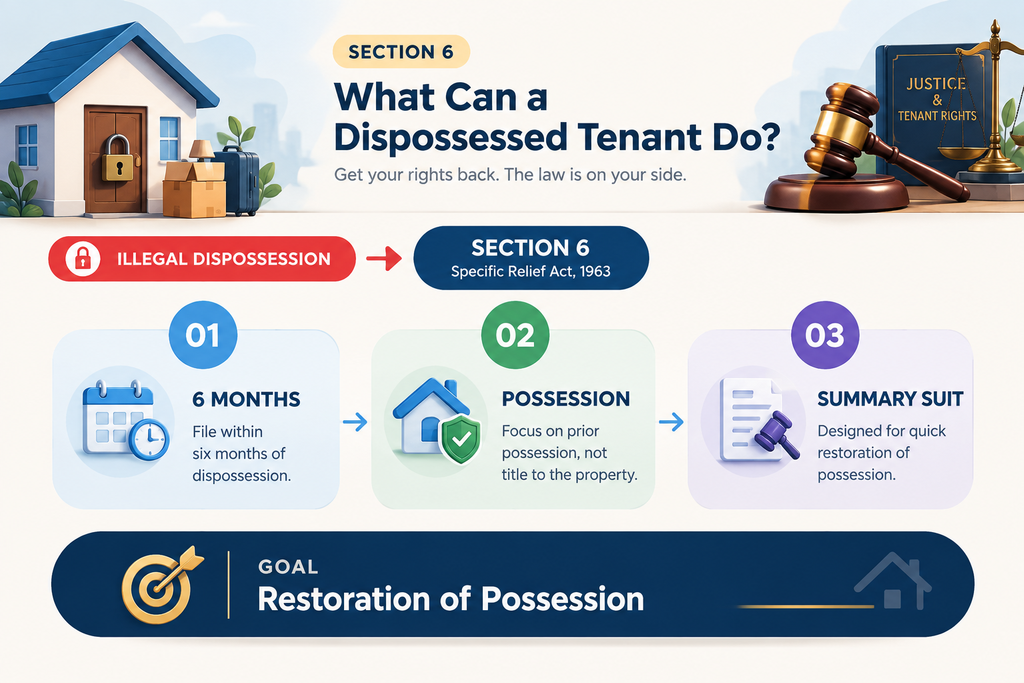
The civil remedy for illegal dispossession is one of the most powerful tools available to any tenant in India, and it is remarkably underused because most tenants have never heard of it.
Section 6 of the Specific Relief Act, 1963 allows any person who has been dispossessed of immovable property without their consent and without due process of law to file a summary suit for restoration of possession. The suit has three unique features:
- The plaintiff does not need to prove title. Only possession and dispossession need to be shown.
- The suit must be filed within six months of the dispossession.
- No appeal lies from a decree passed under Section 6, and no review is allowed, making it faster than ordinary civil litigation.
This is a summary proceeding. The court's only concern is whether the plaintiff was in settled possession within six months of the suit and was dispossessed without due process. Once those two facts are established, restoration of possession follows almost automatically.
Alongside a Section 6 suit, tenants can pursue a regular civil suit under Section 5 of the Specific Relief Act for full recovery based on title, and a separate suit for damages covering rent lost, business interruption, damaged belongings, and mental harassment.
What Constitutes Illegal Self-Help by a Landlord
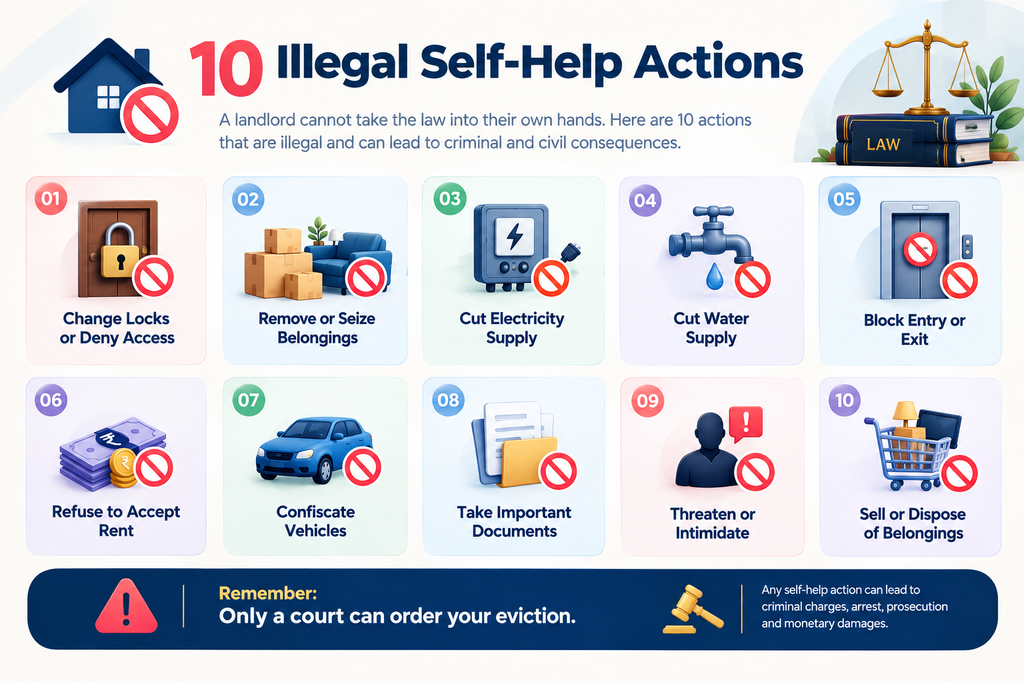
Every one of the following actions is unlawful when done unilaterally by a landlord, regardless of unpaid rent or other tenant defaults.
- Changing the lock on the main door
- Removing the tenant's belongings from the premises
- Cutting off electricity, water, gas, or cable connections
- Blocking access to lifts, parking, or common areas as a pressure tactic
- Preventing entry through security guards or hired muscle
- Refusing to accept tendered rent to build an eviction case
- Confiscating vehicles, furniture, appliances, or personal documents
- Physically threatening the tenant or the tenant's family
- Posting a notice on the door declaring the tenancy terminated
- Selling or auctioning off the tenant's belongings to recover unpaid rent
None of these confer legal rights on the landlord. All of them expose the landlord to criminal prosecution and civil damages.
The Only Legal Route: How a Landlord Actually Evicts for Unpaid Rent
For a landlord genuinely dealing with a defaulting tenant, the lawful process has clear stages.
- Serve a formal notice under Section 106 of the Transfer of Property Act, 1882. For month-to-month tenancies, a 15-day notice is standard. Notice must be in writing, sent through registered post or a lawyer, and must specify the default and demand for cure.
- Allow the cure period to expire. If the tenant clears the arrears within the notice period, the eviction ground disappears.
- File an eviction petition. The forum depends on the applicable law: the Rent Controller under a state Rent Control Act, the Rent Authority under the Model Tenancy Act (in states that have adopted it), or the civil court where no rent control regime applies.
- Attend hearings and obtain a decree. The court examines evidence, hears both sides, and passes an order.
- Execute the decree through court process. Only the court bailiff can lawfully take possession. The landlord cannot execute the decree personally.
A well-drafted rent agreement with a clear notice clause, rent escalation formula, and default consequences reduces disputes at every stage of this process and gives the landlord a clean paper trail if litigation becomes necessary.
What to Do If Your Landlord Locks You Out or Seizes Your Belongings
Speed and documentation matter more than anything else in the first 24 hours.
- Do not break the lock yourself. Even as the lawful tenant, forcing entry can turn into a criminal case against you and complicates your later Section 6 suit.
- Document everything on your phone. Photograph the changed lock, the belongings outside, the meter that has been switched off. Record any conversation with the landlord. Save every WhatsApp and SMS thread.
- File a written police complaint immediately. Go to the nearest police station and file a written complaint under the applicable Bharatiya Nyaya Sanhita sections. Ask for a copy stamped and signed with the DD number.
- Send a legal notice to the landlord. A lawyer's notice within 48 hours demanding restoration of possession, return of belongings, and reconnection of services strengthens the record.
- File a Section 6 suit within six months. The summary suit for restoration of possession is the fastest civil remedy and does not require you to prove ownership, only prior possession.
- Approach the Rent Authority. In states that have adopted the Model Tenancy Act, 2021, the Rent Authority can issue immediate orders for restoration and reconnection of essential services.
- Escalate to the magistrate under Section 175(3) BNSS if the police refuse to register your FIR.
Documentation Every Tenant Should Have Ready
The tenant who wins these cases quickly is almost always the tenant who has the paper trail. Before a dispute ever arises, the following documents should be filed neatly in one place.
- Signed rent agreement, ideally registered where required, with stamp duty paid
- Every monthly rent receipt or bank transfer confirmation
- Deposit payment receipt
- Society intimation letter or police verification acknowledgment
- All WhatsApp, SMS, and email exchanges with the landlord
- Photographs of the property at move-in and periodically thereafter
- Utility bills in the tenant's name where applicable
- Copies of any prior legal notices exchanged
Owners drafting agreements in the first place can avoid the common mistakes in rent agreements that leave gaps around notice periods, deposit refund terms, and eviction grounds, all of which tend to be exploited by whichever side breaks the deal first.
Landmark Cases Every Tenant Should Know
Three Supreme Court decisions shape the current position on illegal dispossession.
- Krishna Ram Mahale v. Shobha Venkat Rao, AIR 1989 SC 2097. The Court held that no one can take the law into his own hands, however good his title. Even a tenant whose lease has expired remains protected under Section 6 of the Specific Relief Act until formally evicted through court process.
- Yeshwant v. Jagdish (1968). The Court defined "due course of law" as requiring an opportunity to be heard, to present evidence, and to defend one's rights before any judgment affecting property, liberty, or life.
- East India Hotels Ltd. v. Syndicate Bank (1992). Section 6 exists specifically to prevent forcible dispossession and to keep property disputes out of physical confrontation.
The right to shelter itself has been read into Article 21 of the Constitution in Olga Tellis v. Bombay Municipal Corporation (1985), which anchors the entire framework in fundamental rights.
State-Specific Variations and the Model Tenancy Act
Rent laws in India vary by state. The Maharashtra Rent Control Act, 1999, the Delhi Rent Control Act, 1958, the Karnataka Rent Act, 1999, and the Tamil Nadu Regulation of Rights and Responsibilities of Landlords and Tenants Act, 2017, each specify their own grounds for eviction, notice periods, and forums.
The Model Tenancy Act, 2021, adopted so far by Andhra Pradesh, Tamil Nadu, and Uttar Pradesh, adds explicit protections: written agreements are mandatory, a Rent Authority handles disputes within defined timelines, landlords cannot cut off essential supplies to force a tenant out, and eviction must be routed through a Rent Court rather than a civil court. For tenants in these states, the enforcement route is faster and clearer.
A properly executed leave and licence or rent agreement, with correct stamp duty and registration where applicable, forms the foundation for either side to enforce their rights when things go wrong.
How Housewise Helps
Housewise coordinates rent agreement drafting, stamp duty payment, and, in Maharashtra, registration for property owners across 23 Indian cities, and structures every tenancy so that the landlord never has a reason to consider illegal self-help. That includes clear notice clauses, well-defined default consequences, verified tenant documentation, and a full paper trail that stands up in court if eviction becomes necessary. For owners who find themselves facing a genuine default, Housewise's approach is to route the recovery through the correct legal channels from day one, protecting the landlord's rights without exposing them to criminal liability under the Bharatiya Nyaya Sanhita.
Frequently Asked Questions
Can a landlord change the lock on a rented flat if the tenant hasn't paid rent?
No. Changing the lock without a court order is illegal in India regardless of unpaid rent. It amounts to house trespass under Section 329 of the Bharatiya Nyaya Sanhita, 2023. The tenant can file an FIR and a Section 6 suit for restoration of possession.
Can a landlord cut off electricity or water to force a tenant out?
No. Cutting off essential services to pressure a tenant into vacating is illegal across India. It amounts to mischief under Section 324 of the Bharatiya Nyaya Sanhita and creates civil liability for damages. The Model Tenancy Act, 2021 explicitly prohibits such conduct.
Can a landlord seize a tenant's belongings for unpaid rent?
No. Indian law does not allow a landlord to seize, confiscate, or dispose of a tenant's belongings for unpaid rent under any circumstances. The proper route is to recover arrears through a court decree. Any seizure exposes the landlord to criminal charges and civil damages.
What is Section 6 of the Specific Relief Act, 1963?
Section 6 allows a person dispossessed of immovable property without consent and without due process to file a summary suit for restoration of possession, within six months. The plaintiff need not prove title, only prior possession, and no appeal lies from the decree.
How does a landlord legally evict a tenant for non-payment of rent?
By serving a written notice under Section 106 of the Transfer of Property Act, allowing the cure period, filing an eviction petition before the Rent Controller or civil court, obtaining a decree after hearing, and executing possession through the court bailiff. Self-help is illegal.
What should I do first if my landlord locks me out?
Do not break the lock yourself. Photograph and document the scene, save all communications, then file a written police complaint under the relevant BNS sections. Send a lawyer's notice to the landlord within 48 hours and file a Section 6 suit for restoration of possession.
Can the police refuse to register my complaint against the landlord?
No, not if the complaint discloses a cognisable offence like house trespass or criminal intimidation. If the police refuse, you can approach the magistrate under Section 175(3) of the Bharatiya Nagarik Suraksha Sanhita, 2023, who can direct the police to register the FIR and investigate.
Does the Model Tenancy Act make a difference for illegal evictions?
Yes, in states that have adopted it. Andhra Pradesh, Tamil Nadu, and Uttar Pradesh now have Rent Authorities that can pass quick orders for restoration of possession and reconnection of essential services. The Act explicitly bans cutting off water, electricity, or gas.
Can I claim damages from a landlord who locked me out illegally?
Yes. Beyond restoration of possession under Section 6, you can file a separate civil suit for damages covering lost rent-free days, business disruption, damaged belongings, medical costs, and mental harassment. Courts routinely award damages where the illegal act is documented, and the loss is quantified.
How does Housewise protect landlords from ending up in these situations?
Housewise drafts and stamps rent agreements across 23 Indian cities with clear notice clauses, default consequences, and verified tenant documentation. This gives owners a clean paper trail for lawful eviction where required, without any self-help that would expose them to criminal liability.


0 Comments