

Nearly every homebuyer's nightmare unfolds the same way. The booking is smooth. The site visit is impressive. The brochure lists a possession date and a swimming pool. Then the delays begin. Emails go unanswered. Site visits reveal a stalled tower. And when the buyer finally asks for a refund or an explanation, the sales team either disappears or offers a new possession date that keeps slipping every quarter.
Before 2016, this cycle usually ended in an expensive, years-long civil suit or a helpless silence. The Real Estate (Regulation and Development) Act, 2016, changed that. Every state now has a Real Estate Regulatory Authority with a defined 60-day timeline to decide complaints, powers to order refunds with interest, and the authority to freeze builder accounts, cancel project registrations, and impose penalties running to crores.
By 2026, the process has matured. Filing is fully online in most states. Hearings are conducted through video conferencing by default. And thanks to MahaRERA's December 2024 sweep, which issued show-cause notices to 10,773 lapsed projects and froze bank accounts of 1,950, builders are taking these authorities far more seriously than they did in the early years. This guide walks you through the exact process to file a RERA complaint in 2026, the forms, fees, documents, timelines, and the common mistakes that weaken otherwise strong cases.
How Do You File a RERA Complaint in 2026?
Filing a RERA complaint in 2026 is a five-step process. First, verify the builder's project registration on your state RERA portal. Second, decide the forum: Form M goes to the Regulatory Authority for directions and enforcement under Section 31, while Form N goes to the Adjudicating Officer for compensation claims under Section 71. Third, register as a complainant on the state RERA portal, upload your allotment letter, builder-buyer agreement, payment receipts, and KYC. Fourth, pay the state-specific fee, which ranges from Rs 1,000 in most states to Rs 5,000 in Maharashtra. Fifth, attend the hearing, usually via video conferencing, and receive the order within 60 days of admission. The Authority can order refunds with interest, direct possession, impose penalties, and in serious cases, cancel the project's registration entirely.
What Is a RERA Complaint and When Should You File One?
A RERA complaint is a formal application filed under Section 31 of the Real Estate (Regulation and Development) Act, 2016, seeking directions, enforcement, or compensation from the state Real Estate Regulatory Authority or its Adjudicating Officer. It is not a grievance letter. Once admitted, it triggers a statutory process with defined timelines and enforceable orders.
You should consider filing a RERA complaint if any of the following apply:
- The builder has delayed possession beyond the date in the agreement or the RERA-registered timeline
- Approved plans, layouts, or specifications have been changed without your written consent
- Promised amenities have not been delivered, or common areas are missing
- Structural defects have surfaced within five years of possession, and the builder is refusing to fix them
- The project is not registered with RERA, or the registration has lapsed
- The builder is charging amounts not mentioned in the agreement, or is refusing a legitimate refund
- The builder has misrepresented the project through advertisements, brochures, or sample flats
Not every dispute needs a RERA complaint. Minor delays that fall within the buffer period stated in the agreement, or issues that can be resolved through direct communication, are better handled without formal proceedings. But once a builder starts ignoring written notices or missing agreed timelines, RERA is designed exactly for that situation.
Who Can File a Complaint Under RERA?
Section 31 uses the phrase "any aggrieved person," and courts have interpreted this broadly. The following categories can file:
- Individual allottees and homebuyers
- Groups of allottees filing a joint complaint against the same project
- Registered real estate agents against promoters
- Promoters against non-cooperating allottees
- Legal heirs of a deceased allottee, with proper documentation
- NRI buyers, either directly or through a Power of Attorney holder
Even someone holding only a booking receipt without a formal agreement can file, though the case is stronger with a signed builder-buyer agreement.
Form M vs Form N: Which One Should You Use?
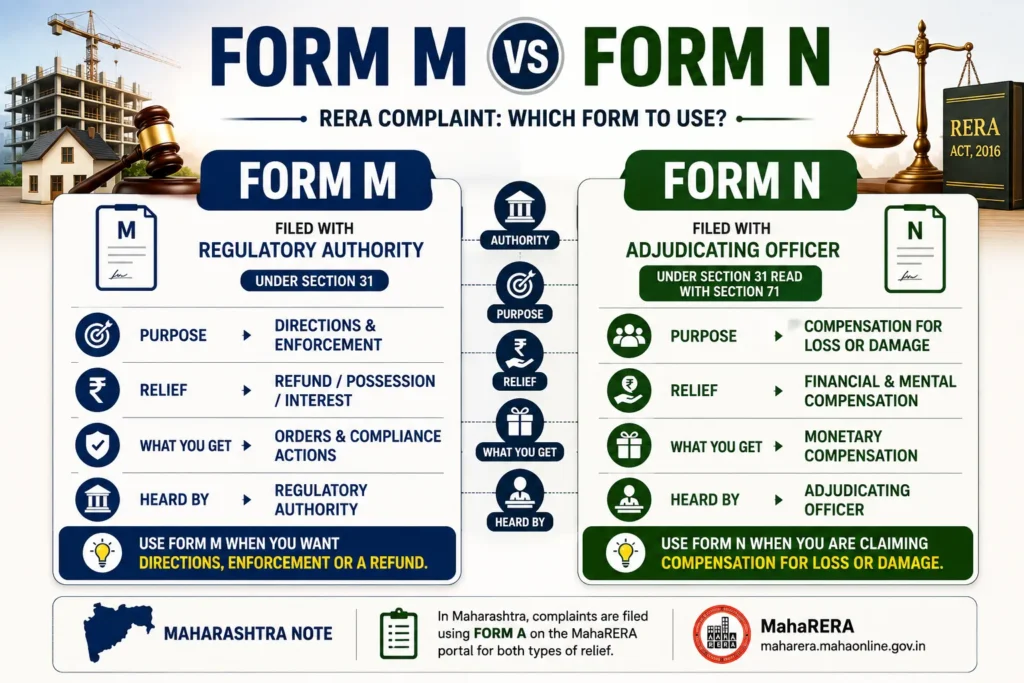
This is the most common point of confusion, and it is the choice that decides where your complaint gets heard.
Form M is filed with the Regulatory Authority under Section 31. Use this when you want directions, project enforcement, cancellation of registration, or a refund order under Section 18. Typical Form M complaints include delayed possession refunds, deviation from approved plans, and non-compliance with RERA registration conditions.
Form N is filed with the Adjudicating Officer under Section 31 read with Section 71. Use this when you are claiming compensation for financial or mental loss caused by the builder's breach. Form N is the correct forum where the primary relief is monetary damages beyond the statutory refund and interest.
MahaRERA operates a slightly different system. Under Rule 6 of the Maharashtra RERA Rules, complaints are filed through a combined Form A on the MahaRERA portal, and the Authority routes the matter to the appropriate forum internally.
In Newtech Promoters and Developers Pvt. Ltd. v. State of Uttar Pradesh (2021), the Supreme Court clarified that the Adjudicating Officer's jurisdiction is limited to compensation claims under Section 71, while all refund, interest, and directional orders fall within the Authority's jurisdiction under Section 31. Filing the wrong form does not usually kill a complaint, but it can add weeks to the timeline.
Documents You Need Before You Start
The complaint is only as strong as the documents supporting it. Prepare a scanned digital copy of each of the following before you log into the portal:
- Allotment letter issued by the promoter at booking
- Signed builder-buyer agreement or agreement for sale, with all annexures
- Payment receipts and bank statements covering every transfer to the builder
- Project's RERA registration number and its current status on the state portal
- PAN and Aadhaar of the complainant
- Latest correspondence with the builder, including any legal notices already served
- Photographs or site visit reports where structural defects or missing amenities are alleged
- Power of Attorney and Vakalatnama, if a representative or lawyer is filing on your behalf
- Bank account details for refund credit, if you are seeking a refund
Incomplete documentation is the single biggest reason for adjournments. Getting this pack ready before you start the online filing keeps the process to a single sitting.
How to File a RERA Complaint Step-by-Step in 2026
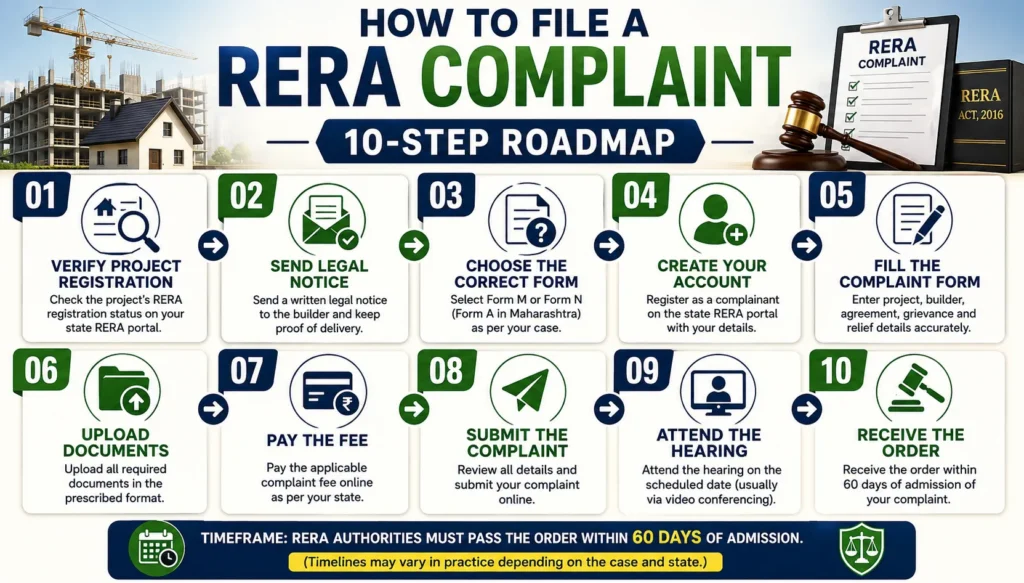
The exact interface varies by state, but the flow is broadly the same across MahaRERA, UP RERA, K RERA, HR RERA, and other state authorities.
- Verify the project's RERA registration: Search the state RERA portal for the project name or registration number. Note the current registration status, expiry date, and quarterly progress reports.
- Send a written legal notice to the builder: Not mandatory under RERA, but a notice served 15 to 30 days before filing strengthens the record and sometimes resolves the matter without a complaint.
- Choose the correct form: Form M for directions and refund, Form N for compensation. In Maharashtra, use Form A.
- Create a complainant account on the state RERA portal: You will need a valid mobile number, email address, PAN, and Aadhaar for OTP-based verification.
- Fill out the complaint form: Enter your details, project details, builder details, facts of the case, and the relief you are seeking. Keep the narration factual and chronological.
- Upload the supporting documents: File size limits vary by state, so keep individual files under 5 MB where possible.
- Pay the filing fee: Payment is online through NEFT, RTGS, debit card, credit card, or UPI. Save the receipt.
- Submit and note the complaint number: You will receive an email and portal notification with the case number, which you should quote in all future correspondence.
- Attend the hearing: As of 2026, most states default to video conferencing hearings. You will receive a link on the registered email at least 48 hours in advance.
- Receive the order: The Authority is required to dispose of the complaint within 60 days of admission, though practical timelines vary.
If you are dissatisfied with the order, you have 60 days to file an appeal before the Real Estate Appellate Tribunal in Form O, with a fee of typically Rs 5,000.
RERA Complaint Fees State-Wise (2026)
| State Authority | Complaint filing fee | Appellate Tribunal fee |
|---|---|---|
| MahaRERA (Maharashtra) | Rs 5,000 | Rs 5,000 |
| Karnataka RERA | Rs 1,000 | Rs 5,000 |
| UP RERA | Rs 1,000 | Rs 5,000 |
| MP RERA | Rs 1,000 | Rs 5,000 |
| Haryana RERA | Rs 1,000 | Rs 5,000 |
| Delhi RERA | Rs 1,000 | Rs 5,000 |
| Tamil Nadu RERA | Rs 1,000 | Rs 5,000 |
| Telangana RERA | Rs 1,000 | Rs 5,000 |
Always verify the fee on your state RERA portal before payment, since some states periodically revise the amount through notification.
What Orders Can RERA Pass Against a Builder?
The Authority and the Adjudicating Officer together have wide powers under the Act. Typical orders include:
- Refund of the full amount paid, with interest at the RERA-notified rate (usually SBI MCLR plus 2%)
- Direction to complete construction and deliver possession by a specified date
- Compensation for financial loss, mental harassment, or opportunity cost
- Cancellation or revocation of the project's RERA registration
- Freezing of the builder's bank accounts through the state authority's coordination with banks
- Penalty up to 10% of the estimated project cost for non-registration, and up to 5% for false information
- Additional 10% penalty plus imprisonment up to three years for continued violation
- Daily penalty on the builder for non-compliance with the final order
The 60-day statutory timeline for disposal is real, though densely-loaded state authorities like MahaRERA sometimes take longer. Even so, the average RERA disposal is dramatically faster than a civil suit, which can take years.
Common Mistakes That Weaken Your Complaint
Even well-founded cases lose ground through avoidable errors.
- Filing the wrong form: Form M and Form N have different jurisdictions. Get this right upfront.
- Vague chronology: Complaints without dated events are harder for the Authority to adjudicate quickly.
- Missing payment proofs: Every transfer to the builder should be linked to a receipt or bank statement.
- Ignoring the project's registration status: If the project is not registered under RERA, some remedies still apply, but the case shifts in character.
- Skipping the legal notice: Not mandatory, but it is often the fastest resolution route.
- Filing individually when a joint complaint would work better: Group complaints from allottees of the same project carry greater weight and share costs.
- Overstating claims: Ask for what you can prove. Exaggerated claims invite tough scrutiny.
- Missing the appeal window: Sixty days from the Authority's order is the outer limit for approaching the Appellate Tribunal.
Once possession is delivered and the property is ready to be let out or managed, a well-drafted rent agreement with correct stamp duty and registration closes the loop on the buyer-to-owner transition and avoids a second cycle of disputes with tenants.
How Housewise Helps Post-Possession
Housewise focuses on the phase that starts once your builder hands over possession and the RERA proceedings are complete. That includes rent agreement drafting, tenant onboarding, leave and licence registration where applicable, and end-to-end property management across 23 Indian cities. For owners who have just fought through a RERA case and now want a clean, professionally documented lease to a paying tenant, Housewise handles registration coordination, police verification, and periodic renewals so that the fresh possession does not become the start of a fresh dispute. Owners drafting their first rental arrangement can also review the common mistakes in rent agreements list before signing.
Frequently Asked Questions
Can I file a RERA complaint against an unregistered project?
Yes. Filing a complaint against an unregistered project is a strong ground under Section 3 of the RERA Act, 2016. The Authority can impose a penalty of up to 10% of the estimated project cost and direct the builder to register immediately.
What is the difference between Form M and Form N?
Form M is filed with the Regulatory Authority under Section 31 for directions, refund, and enforcement. Form N is filed with the Adjudicating Officer under Section 71 for compensation claims. Filing the wrong form can delay the case but does not usually cause dismissal.
How much does it cost to file a RERA complaint in 2026?
The fee ranges from Rs 1,000 in most states like Karnataka, UP, Delhi, and Madhya Pradesh, to Rs 5,000 in Maharashtra under MahaRERA. Appeals to the Real Estate Appellate Tribunal typically cost Rs 5,000. Always verify the current fee on your state RERA portal.
How long does a RERA complaint take to resolve?
Section 29 of the RERA Act mandates disposal within 60 days of admission, though busy authorities like MahaRERA sometimes take longer. In practice, most cases are decided within four to six months, far faster than a civil suit.
Can NRIs file a RERA complaint from abroad?
Yes. NRIs can file directly through the state RERA portal or through a Power of Attorney holder in India. Video conferencing hearings, which are now the default in 2026, have made it far easier for NRI complainants to attend proceedings without travelling.
What documents are essential for a RERA complaint?
The core set includes the allotment letter, builder-buyer agreement, all payment receipts, PAN and Aadhaar, the project's RERA registration number, correspondence with the builder, and photographs of any structural defects. Missing payment proofs weakens the case more than any other omission.
Can I claim interest on delayed possession under RERA?
Yes. Section 18 of the RERA Act, 2016 entitles you to a refund with interest at the RERA-notified rate, typically SBI MCLR plus 2%, if the builder fails to deliver possession by the agreed date. Interest runs from the date of default.
Can a group of buyers file a joint RERA complaint?
Yes. Joint complaints from multiple allottees of the same project are permitted and often carry more weight than individual filings. The fee is shared, the documentation overlap reduces individual burden, and the authority can pass a single order affecting all complainants together.
What if the builder ignores the RERA order?
The Authority can impose a daily penalty for non-compliance, freeze bank accounts, cancel the project's registration, and initiate criminal proceedings under Section 59, which can lead to imprisonment of up to three years. Non-compliance is treated seriously in the current 2026 enforcement climate.
How does Housewise help homebuyers after RERA proceedings end?
Housewise handles the post-possession phase across 23 Indian cities. This includes rent agreement drafting, tenant onboarding, leave and licence registration where applicable, and end-to-end property management, so the fresh possession does not become the start of a fresh landlord-tenant dispute.


0 Comments