

When choosing a property management company in India, look for end-to-end services covering tenant sourcing, rent collection, inspections, and maintenance. Verify they have a local on-ground team in your city, transparent pricing with a written fee schedule, a strong tenant screening process, and a clear contract with exit clauses. For NRIs especially, a digital reporting platform is non-negotiable.
What Does a Property Management Company Actually Do?
Think of a property broker as a matchmaker. They find you a tenant, collect their fee, and disappear. A property management company is more like a long-term partner. They stay involved through the entire tenancy.
A full-service property management company handles tenant sourcing and background screening, police verification, rent agreement drafting and registration, monthly rent collection, periodic property inspections, maintenance coordination, and tenant exit and handover.
That is the full lifecycle. But not every company offers all of it. Some only find tenants. Some only collect rent. They still call themselves property managers. That gap is exactly what this guide helps you spot.
Key Things to Look for When Choosing a Property Management Company in India
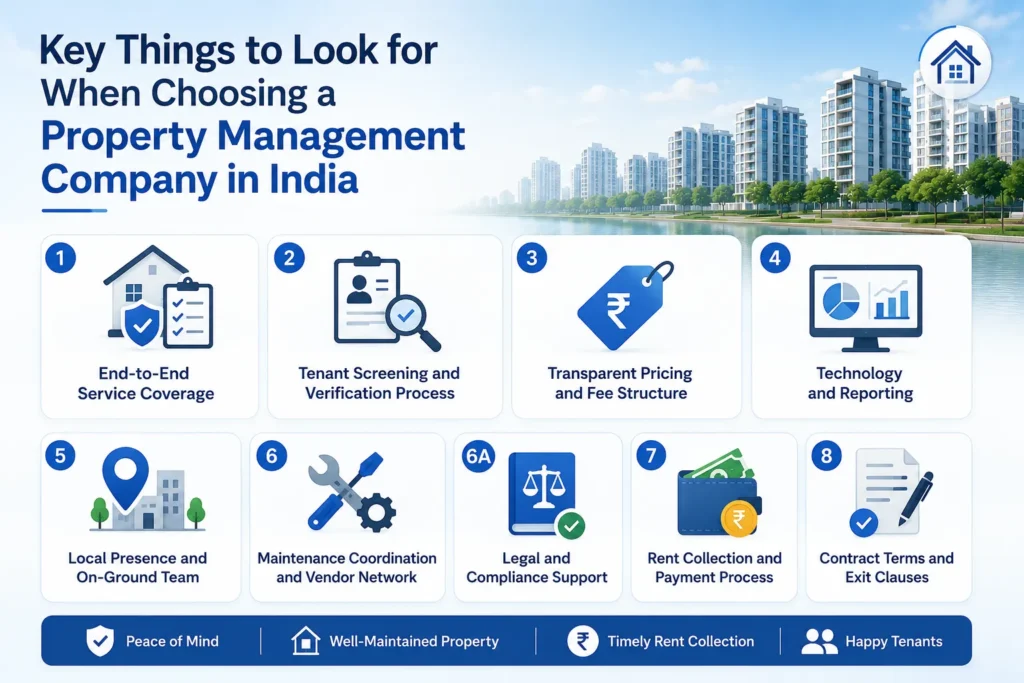
1. End-to-End Service Coverage
The first question to ask any property manager is simple. What exactly is included?
A genuine company should cover everything from finding the tenant to managing their exit. Not just one or two services. If a company only handles rent collection but charges you separately for inspections, tenant sourcing, agreement registration, and maintenance coordination you are not getting property management. You are getting a subscription to a billing machine.
Ask them to give you a written list of every service included in the base fee. Then ask what is charged separately. The answer will tell you everything.
2. Tenant Screening and Verification Process
Your tenant is the single biggest variable in your rental experience. A bad tenant means unpaid rent, property damage, legal headaches, and months of stress.
A credible property management company should have a structured tenant screening process that may include employment verification, identity checks, reference checks, background verification, and police verification where applicable. The exact process may vary by city and tenant profile, but there should always be a documented screening framework in place.
Ask specifically: What does your screening process look like? And what happens if a screened tenant stops paying rent?
If they stumble on that second question, take note.
3. Transparent Pricing and Fee Structure
Pricing in Indian property management is all over the place. Some companies charge one month’s rent for tenant placement. Others charge a percentage of annual rent for ongoing management typically between 0.5 and 1.25 months rent per year depending on the service scope.
The hidden fee problem is real. Some companies quote a low monthly fee and then charge separately for every inspection, every agreement renewal, every maintenance visit. By the end of the year, you have paid far more than you expected.
Always ask for a complete written fee schedule before signing anything. If they are reluctant to put it in writing, that is your answer.
4. Technology and Reporting
You should not have to call your property manager every month just to find out if your rent came in. A modern property management company provides owner dashboards, digital rent tracking, inspection reports with photos, and maintenance logs.
This matters for everyone. But for NRIs managing property from the UK, US, Canada, or Australia, it is not a nice-to-have. It is the difference between peace of mind and constant anxiety.
Ask: How will you keep me informed? What does a typical monthly update look like?
5. Local Presence and On-Ground Team
This one is non-negotiable.
A company that manages your Mumbai flat from a Delhi office cannot respond to a plumbing emergency at 9 PM. They cannot conduct a proper move-in inspection. They cannot build a relationship with your housing society.
Verify that the company has an actual physical team in the city where your property sits. Not a partner, not an affiliate, not a call centre. A real team that can show up.
6. Maintenance Coordination and Vendor Network
Maintenance is where the trust gets tested.
Ask whether the company has a vetted vendor network. Ask whether they get your approval before raising any work order. Ask whether there is a supervision fee on top of the vendor’s actual cost.
A transparent property management company will show you how their maintenance workflow operates. They will not execute repairs and then send you a bill. Owner approval before any significant work is the standard you should demand.
6A. Legal and Compliance Support
Property management involves more than tenants and maintenance. Documentation matters too.
Ask whether the company assists with rent agreements, police verification, tenant KYC collection, society documentation, and local compliance requirements. Administrative mistakes can create unnecessary disputes and delays later.
A good property manager should have a clearly defined process for handling documentation and compliance requirements relevant to your city and property type.
7. Rent Collection and Payment Process
Here is a question most landlords forget to ask. Does the rent come to me directly from the tenant, or does it pass through your company’s account first?
A credible company should not pool tenant rent in a shared company account before forwarding it to owners. That creates unnecessary delays and unnecessary risk. Ask for the exact payment timeline: when does the tenant pay, and when does the money reach your account?
8. Contract Terms and Exit Clauses
Read the contract. Slowly.
Look at the lock-in period. Look at the notice period if you want to exit. Look at how the company handles prolonged vacancies and what support they provide if a tenant is not found within a reasonable period. Look at the liability clauses.
Contracts with long lock-ins, no performance guarantees, and vague termination terms are a red flag. A good company is confident enough in their service that they do not need to trap you.
Red Flags to Watch for When Choosing a Property Manager in India
This is the section most landlords wish they had read before signing.
No physical presence in your city. If they cannot show up at your property, they cannot manage it.
Verbal-only service commitments. If it is not in writing, it does not exist.
Large upfront fees without a clear scope of work or written agreement. Make sure you understand exactly what services are being provided and when fees become payable.
No written contract. An informal arrangement protects no one especially not you.
No references or verifiable track record. Ask for at least two or three landlord references. If they cannot provide them, move on.
Rent is held in the company’s account. Your rent should reach you directly and promptly.
Pressure to sign quickly. A legitimate company will give you time to review. Anyone pushing you to sign today is hiding something.
Questions to Ask a Property Management Company Before Signing
Go into every evaluation conversation with these questions ready:
- How long have you been operating in this city specifically?
- How many properties do you currently manage?
- What is your average vacancy period between tenants?
- Walk me through your tenant screening process.
- What does your inspection report look like can you show me a sample?
- How are maintenance decisions approved? Do you need my sign-off before spending?
- How and when is rent transferred to me?
- What happens if a tenant defaults on rent?
- What is your notice period if I want to terminate the contract?
- Can you provide references from two or three current landlord clients?
Print this list. Use it.
How Much Do Property Management Companies Charge in India?
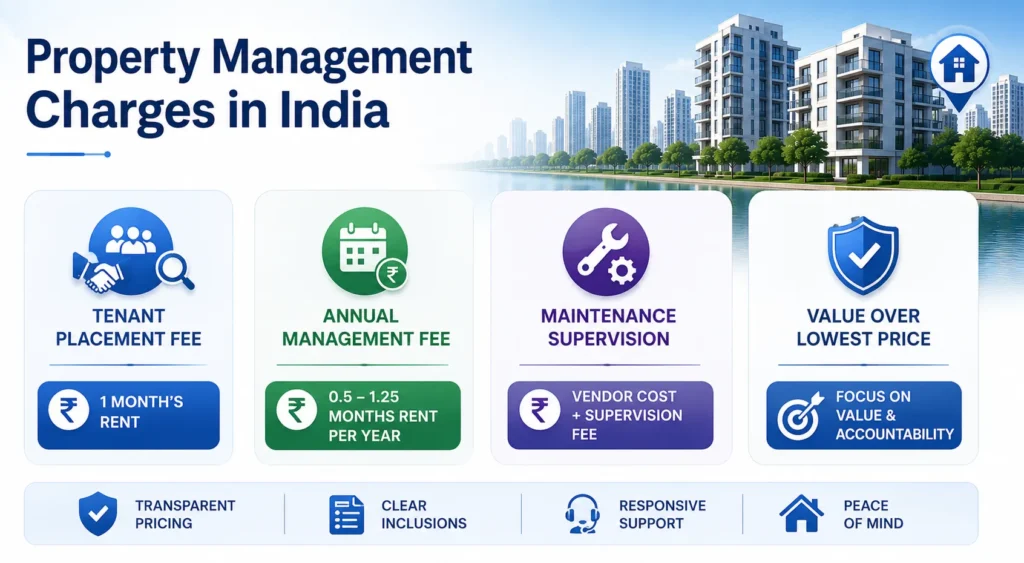
Pricing varies by city, property type, and what is actually included. But here is a general framework to work with.
Tenant placement fee: Typically one month’s rent. This covers sourcing, screening, verification, and agreement registration.
Annual management fee: Usually 0.5 to 1.25 months rent per year, depending on the scope of ongoing services rent collection, inspections, tenant coordination.
Maintenance supervision: Usually charged separately. Expect vendor cost plus a supervision fee. Some property management companies charge a fixed percentage on maintenance work, while others use different pricing structures. Always ask for the exact supervision fee in writing before approving any work.
The cheapest option is rarely the best option. What matters is what is actually included and how accountable the company is when things go wrong.
Always ask for a complete written fee schedule. If they quote verbally only, ask again in writing.
NRI Reporting and Financial Documentation
If you live overseas, ask what financial records and reports the company provides throughout the year.
Monthly rent statements, maintenance expense records, tenant documentation, and inspection reports can all become important when tracking rental performance and preparing tax filings. The more organised the reporting system, the easier it becomes to manage your property remotely.
This is especially important for NRIs who may need rental income records for compliance, accounting, or reporting purposes in more than one country.
City-Specific Considerations When Choosing a Property Manager
Property management needs are not the same across India. What works in Bengaluru does not automatically apply in Chennai. Here is what to focus on in each city.
What to Look for in a Property Management Company in Mumbai
Mumbai operates under Maharashtra’s Leave and License framework. Your property manager must be fluent in this agreement drafting, notarisation, and registration under Maharashtra law.
Mumbai also means society coordination. If your flat is in a housing society, your manager needs to handle NOC requests, maintenance payments, and society communication. Ask specifically whether they have experience managing properties in your building type a high-rise CHS operates very differently from a standalone building.
High tenant turnover in Mumbai also demands efficient re-letting processes. Ask about their average vacancy fill time.
What to Look for in a Property Management Company in Pune
Pune’s rental market is dominated by IT professionals many of whom come with corporate housing allowances and expect professional management. A company that cannot communicate smoothly with HR teams and handle corporate agreement formats will lose tenants fast.
Frequent agreement renewals are standard in Pune. Your property manager should have a streamlined renewal process so there is no gap in documentation.
Ask specifically about vacancy periods in the IT corridors Hinjewadi, Kharadi, Baner, and Viman Nagar. A manager without strong networks there will leave your flat sitting empty longer than necessary.
What to Look for in a Property Management Company in Chennai
Chennai has one of India’s largest Tamil diaspora communities. A significant share of the rental properties in premium localities are NRI-owned. Your property manager must be experienced in managing remotely with no physical access to the owner regular reporting, digital approvals, and proactive communication are essential.
Chennai’s northeast monsoon (October to December) brings heavy, sustained rainfall. Roof leaks, waterproofing issues, and drainage problems are common. Ask whether the company has a monsoon maintenance checklist and whether they conduct pre-monsoon inspections.
What to Look for in a Property Management Company in Hyderabad
Most premium rental stock in Hyderabad sits inside gated communities in HITEC City, Gachibowli, and Financial District. Managing these properties requires active coordination with gated community management offices maintenance dues, vehicle passes, visitor access, and move-in/move-out clearances.
Hyderabad’s infrastructure is also developing rapidly. New corridors are emerging. Ask whether the company has an active network in the specific micro-market where your property is located not just broad Hyderabad coverage.
What to Look for in a Property Management Company in Bengaluru
Bengaluru’s rental market is spread across multiple IT clusters Whitefield, Electronic City, Sarjapur Road, Hebbal, and Koramangala. A company that only has strong coverage in one or two of these areas cannot serve you well if your property is in another.
Corporate and short-term tenants are common in Bengaluru. Your manager should be comfortable handling shorter lease cycles and corporate agreement formats.
Vacancy fill time is a critical question here. Some Bengaluru corridors have high supply and softening demand. Ask specifically: What was your average vacancy fill time in this area over the last 12 months?
Conclusion
Choosing a property management company in India is one of the most consequential decisions an NRI or out-of-city landlord makes. The right company protects your investment, ensures consistent rental income, and genuinely takes the management burden off your plate. The wrong one creates more problems than it solves and often, by the time you realise it, the damage is already done.
Before you sign with anyone, run through the core criteria. End-to-end services. Transparent, written pricing. A physical on-ground team in your city. A rigorous tenant screening process. Direct rent payment to you. And a contract that is clear, fair, and has an exit clause you can actually use.
Housewise operates across 23 Indian cities with a full on-ground team, a digital platform built for remote property owners, and end-to-end property management services designed specifically for NRIs and non-resident landlords. Landlords evaluating property management options may consider comparing Housewise alongside other providers based on service scope, local presence, pricing transparency, reporting capabilities, and overall fit for their requirements.
Frequently Asked Questions
How do I choose the best property management company in India?
Look for a company that offers end-to-end services covering tenant screening, rent collection, inspections, and maintenance not just one or two of these. Verify they have a local on-ground team in your city, transparent pricing in writing, a strong tenant screening process, and a clear contract with exit clauses. Ask for references from current landlord clients and verify their track record before signing.
How much do property managers charge in India?
In India, tenant placement typically costs around one month’s rent. Ongoing annual management fees range from 0.5 to 1.25 months rent depending on services included. Maintenance work is usually charged separately at vendor cost plus a supervision fee. Always ask for a complete written fee schedule to avoid surprise charges.
What are red flags when choosing a property manager?
No physical presence in your city, verbal-only commitments, upfront fees before any service, no written contract, reluctance to pay rent directly to the owner, and pressure to sign quickly. A credible company will be transparent about its processes, pricing, and contract terms from day one.
What is the difference between a property broker and a property management company?
A property broker handles a one-time transaction finding a tenant or buyer and their involvement ends there. A property management company takes ongoing responsibility for the property through tenant management, rent collection, maintenance, inspections, and legal compliance throughout the tenancy and beyond.
Can NRIs use a property management company to manage their Indian property remotely?
Yes. A good property management company handles everything on the ground tenant sourcing, rent agreement registration, rent collection, inspections, and maintenance so NRIs do not need to travel to India to manage their property. Look specifically for companies with technology platforms that provide remote visibility and regular owner reporting.


0 Comments