

Rent used to be one of the simpler line items in an Indian household or business budget. The landlord sent a WhatsApp message with the bank details. The tenant transferred the money. Nobody thought twice about tax on the rent itself. Then GST arrived in 2017, and rent slowly became one of the most confusing entries in the compliance book.
Two amendments in particular have reshaped the picture. In July 2022, the government made residential rent taxable when the tenant is a GST-registered business. In October 2024, the 54th GST Council extended the same logic to commercial rent from unregistered landlords. Between these two changes, the number of people who now owe GST on rent, either as landlords or as tenants, has expanded quietly, and most of them still do not know it.
This guide breaks down the current rules for 2026 in plain language. It covers who pays GST on rent, how much, who is exempt, when the reverse charge kicks in, and how the Rs 20 lakh registration threshold actually works in practice.
Do You Pay GST on Rent in 2026?
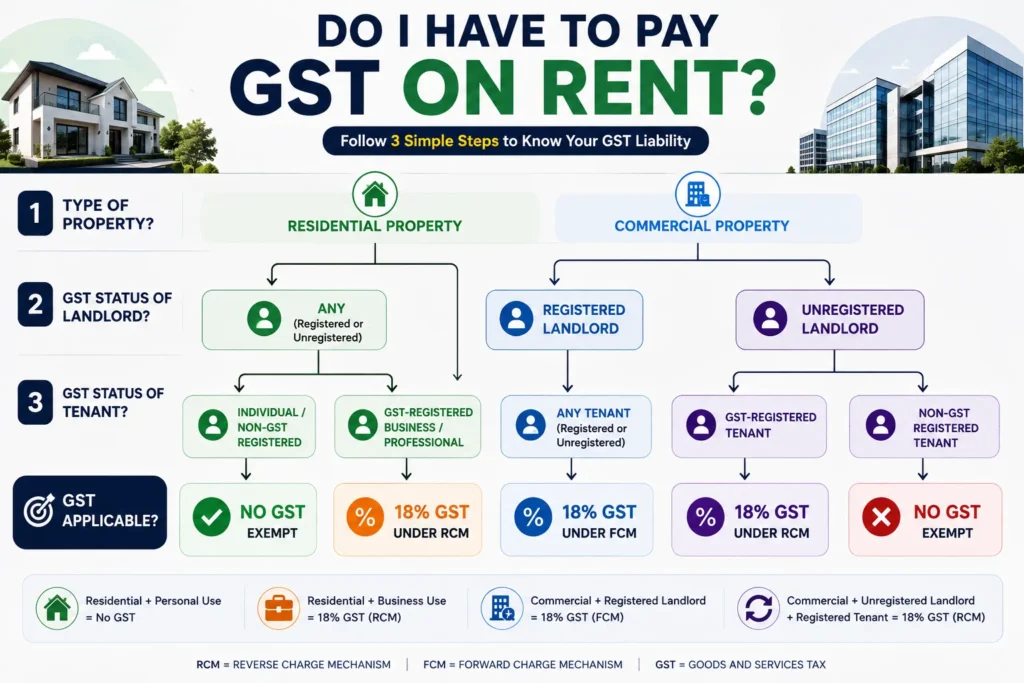
It depends on three things: the type of property, how it is used, and whether either party is GST-registered. Residential rent paid by an individual for personal use is fully exempt from GST, regardless of the rent amount. Commercial rent attracts 18% GST, either charged by the landlord under Forward Charge or paid by the tenant under Reverse Charge Mechanism (RCM). Residential rent paid by a GST-registered business or professional attracts 18% GST under RCM, even if the landlord is unregistered. The tenant, in that case, has to deposit the tax with the government. If both landlord and tenant are unregistered individuals and the rent is for a home, no GST applies at any level.
The Basic Rule: Rent Is a "Supply of Service" Under GST
Under Schedule II of the CGST Act, 2017, any lease, tenancy, licence to occupy land, or letting out of a building is treated as a supply of service. This is the foundational rule that brings rent into the GST net at all. Everything that follows is a set of exemptions and mechanisms carved out on top of it.
The default GST rate on rental services, whether residential or commercial, is 18%. Rental services carry two Service Accounting Codes: SAC 997211 for residential and SAC 997212 for commercial. The question is never whether GST exists on rent in principle. The question is always who is liable to pay it and whether an exemption applies.
GST on Residential Rent: When It Applies and When It Doesn't
Residential rent has two very different tax outcomes depending on who is paying it.
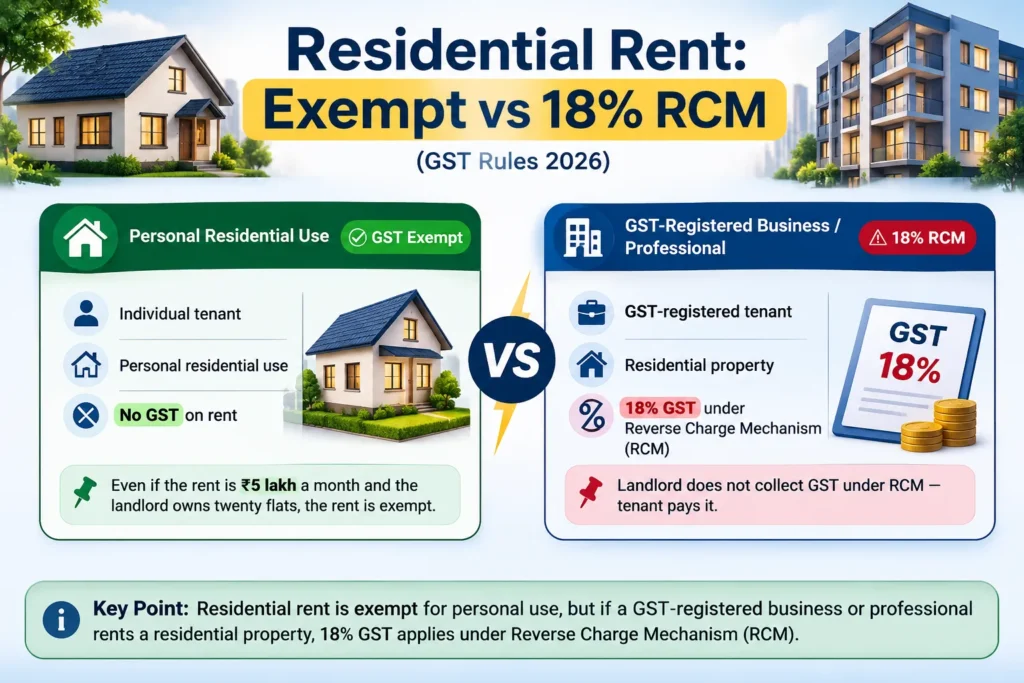
Case 1: An individual rents a home for personal residential use.
No GST applies. The landlord does not charge GST. The tenant does not pay GST. This is true even if the rent is Rs 5 lakh a month and the landlord owns twenty flats. The exemption sits in Entry 12 of Notification 12/2017-CT(R), and it survives at full force in 2026.
Case 2: A GST-registered business or professional rents a residential property.
Since 18 July 2022, this attracts 18% GST under the Reverse Charge Mechanism. The landlord does not add GST to the rent invoice. The tenant, being a registered person under GST, pays the 18% directly to the government while filing GSTR-3B and self-invoices the transaction. This rule was introduced by Notification 05/2022-CT(R) and applies regardless of whether the landlord is registered under GST.
There is one narrow exception. If a registered sole proprietor rents a residential property strictly in their personal capacity for personal use, RCM does not apply. This carve-out prevents the rule from taxing a self-employed person's own home rent simply because they hold a GST number for their business.
A common trap in this second case is Input Tax Credit. A company that rents an apartment for an employee cannot claim ITC on the 18% RCM it pays, because Section 17(5)(b) of the CGST Act blocks credit on rent-a-cab, food, beverages, and accommodation used for employee benefit. The RCM outflow becomes a pure cost.
GST on Commercial Rent: The 18% Standard and the RCM Twist
Commercial property covers offices, shops, warehouses, godowns, factories, and any building rented out for business use. Rent on commercial property has always attracted 18% GST. What changed in October 2024 is who has to deposit it.
A registered landlord rents to any tenant: The landlord adds 18% GST on the rent invoice under the Forward Charge Mechanism (FCM), collects it from the tenant, and deposits it with the government. The tenant, if registered, can claim ITC on this GST when the rented premises are used for taxable business supplies.
An unregistered landlord rents to a registered tenant: Before October 2024, this transaction escaped GST altogether because the landlord was outside the tax net. That loophole is now closed. Effective 10 October 2024, under Notification 09/2024-CT(R) recommended by the 54th GST Council meeting, the tenant must pay 18% GST under RCM directly to the government and self-invoice the transaction. The landlord does not have to register, but the tenant's compliance burden increases sharply.
Unregistered landlord rents to an unregistered tenant: No GST applies. Both parties are outside the GST framework, and the transaction stays outside it.
Missing the October 2024 RCM extension is one of the top reasons businesses are getting GST notices in early 2026. Many businesses that quietly rented small offices, shops, or godowns from individual owners had no idea their liability had shifted. A well-drafted rent agreement that captures the landlord's GST registration status and rent breakup upfront is the simplest way to avoid this exposure.
The Rs 20 Lakh Registration Threshold: What It Means for Landlords
A landlord earning only rental income becomes liable to register under GST once total aggregate turnover crosses Rs 20 lakh in a financial year, or Rs 10 lakh in special category states like Manipur, Mizoram, Nagaland, and Tripura. This threshold applies across all business income, not just rent. A landlord who earns Rs 15 lakh from rent and Rs 8 lakh from a consulting business crosses the threshold on aggregate.
For pure commercial landlords, this works out to roughly Rs 1,66,667 in monthly rent before registration becomes mandatory. Once registered, the landlord must charge 18% GST on every commercial rent invoice, file monthly GSTR-1 and GSTR-3B returns, and comply with e-invoicing where the annual turnover threshold applies.
Residential-only landlords who rent to individuals for personal use do not need to register at all, because that income is exempt and does not count towards the threshold.
Reverse Charge Mechanism (RCM) Explained Simply
RCM flips the usual GST flow. Under Forward Charge, the supplier of the service (the landlord) collects GST from the customer (the tenant) and deposits it. Under Reverse Charge, the customer (the tenant) has to calculate the GST, deposit it directly with the government, and self-invoice the transaction.
For a tenant on RCM, the practical steps are:
- Calculate 18% GST on the monthly rent
- Deposit it through GSTR-3B in the month of receipt of service
- Prepare a self-invoice under Section 31(3)(f) of the CGST Act
- Report it in GSTR-3B and, where applicable, GSTR-1
- Claim ITC in the next GSTR-3B, only if the rent is for taxable business use (not for exempt supplies or employee accommodation)
Missing any of these steps invites interest at 18% per annum, penalties, and disallowance of ITC.
GST on Rent Scenarios at a Glance 2026
| Scenario | GST rate | Who pays | Mechanism |
|---|---|---|---|
| Individual rents home for personal use | Exempt | Nobody | No GST |
| Registered business rents residential property | 18% | Tenant | RCM |
| Registered landlord rents commercial property to any tenant | 18% | Landlord collects, tenant pays | Forward Charge |
| Unregistered landlord rents commercial property to registered tenant | 18% | Tenant | RCM |
| Unregistered landlord rents commercial property to unregistered tenant | Exempt | Nobody | No GST |
| RWA maintenance up to Rs 7,500 per flat per month | Exempt | Nobody | No GST |
| RWA maintenance above Rs 7,500 per flat per month | 18% | Flat owner | Forward Charge |
| Refundable security deposit | Exempt | Nobody | Not a supply |
Common GST-on-Rent Compliance Traps in 2026
Even businesses with strong tax teams are slipping on these issues. Watch out for:
- Missing the October 2024 RCM on commercial rent. Businesses renting shops, offices, or warehouses from individual unregistered owners are the biggest bucket of unnoticed liability.
- Assuming residential rent to a company employee is exempt. The 2022 RCM rule catches this. If the lease is signed in the company's name, 18% GST is due under RCM.
- Claiming ITC on employee residential accommodation. Section 17(5)(b) blocks it. The RCM outflow is a cost, not a credit.
- Ignoring the RWA maintenance threshold. Once maintenance crosses Rs 7,500 per month per flat, 18% GST applies on the entire amount, not just the excess.
- Not documenting the landlord's GST status. A sample rent agreement that captures the landlord's GSTIN, unregistered status, or exempt-income declaration removes ambiguity at the outset.
- Treating security deposit as taxable. Refundable deposits are not consideration for a supply and stay outside GST. Only non-refundable deposits or forfeited amounts attract tax.
- Skipping self-invoicing under RCM. Even where GST is paid on time, missing the self-invoice can lead to ITC disallowance during audit.
For property owners drafting or renewing agreements this year, folding a clean GST clause into the online rent agreement is a small step that closes off most of these exposures.
How Housewise Supports GST-Ready Rent Agreements
Housewise coordinates rent agreement drafting, stamp duty payment, and registration for property owners across 23 Indian cities. Where the property is being rented for commercial use, or to a registered business, the agreement can be drafted with a proper GST clause, landlord GSTIN capture, and clear rent-plus-tax breakup, so both parties know upfront who bears the 18%. Owners who are still weighing whether a full lease or a leave and licence structure suits them can factor in the GST implications early, since both attract the same tax treatment but differ on possession, control, and eviction. Common drafting gaps that trigger tax notices are catalogued in the guide on common mistakes in rent agreements.
Frequently Asked Questions
Is GST applicable on residential rent in 2026?
No, if the tenant is an individual using the property as a home. Yes, at 18% under RCM, if the tenant is a GST-registered business or professional. The residential-for-residential-use exemption applies regardless of how high the monthly rent is.
Do I have to pay GST on commercial rent?
Yes. Commercial rent attracts 18% GST. If the landlord is registered, they charge it under Forward Charge. If the landlord is unregistered and the tenant is registered, the tenant pays it under Reverse Charge Mechanism as per Notification 09/2024-CT(R), effective 10 October 2024.
What is the GST registration threshold for landlords?
Rs 20 lakh in aggregate annual turnover across all business income, or Rs 10 lakh in special category states. For commercial-only landlords, this works out to about Rs 1,66,667 in monthly rent before mandatory registration under Form GST REG-01 kicks in.
When did RCM on residential rent start applying?
From 18 July 2022, under Notification 05/2022-CT(R). Any GST-registered person renting a residential property must pay 18% GST under RCM, deposit it via GSTR-3B, and self-invoice the transaction, regardless of whether the landlord is GST-registered.
Is GST payable on a security deposit?
No, if the deposit is refundable. Refundable security deposits are not treated as consideration for a supply and remain outside the GST net. Only non-refundable deposits or amounts that are later forfeited by the landlord attract 18% GST at the time of forfeiture.
Can I claim Input Tax Credit on rent paid?
Yes, if the rented property is used for making taxable business supplies. No, if it is used for exempt supplies, personal use, or as employee accommodation. Section 17(5)(b) of the CGST Act specifically blocks ITC on rent for residential accommodation of employees.
Is GST applicable on society maintenance charges?
Yes, if monthly maintenance exceeds Rs 7,500 per flat and the RWA's annual turnover crosses the GST registration threshold. In that case, 18% GST applies on the entire maintenance amount, not just the amount above Rs 7,500 per flat per month.
Do NRI landlords have to register for GST on Indian rental income?
Yes, if aggregate turnover from Indian rental income and other Indian business income exceeds Rs 20 lakh. NRI landlords must appoint a resident authorised representative for GST compliance and file monthly returns like any other registered landlord.
What happens if I miss paying RCM on commercial rent from an unregistered landlord?
Interest at 18% per annum applies on the unpaid GST, plus penalties under Section 122 of the CGST Act. Non-payment also affects ITC. Businesses have been receiving notices in 2026 based on the October 2024 amendment even for small monthly rents.
How does Housewise help with GST-compliant rent agreements?
Housewise drafts and stamps rent agreements across 23 Indian cities with clear GST clauses, landlord GSTIN capture, rent-plus-tax breakups, and use-based classification. This helps landlords and tenants avoid the RCM traps introduced in 2022 for residential and 2024 for commercial rent.


0 Comments