

For over a decade, cement has carried one of the highest GST rates in the Indian tax code. At 28%, it sat in the same slab as cars, air conditioners, and sin goods, a classification that economists and homebuilders had been protesting for years. The argument was simple. Cement is not a luxury. It is the single most consumed building material in India after sand, used in every government housing scheme, every rural dwelling, and every urban high-rise. GST on cement was 28%, in effect, a 28% tax on the roof over the common Indian's head.
The 56th GST Council Meeting on 3 September 2025 finally moved the needle. Cement was cut from the 28% slab to the 18% slab, part of the broader rate rationalisation package that has come to be called GST 2.0. The change took effect on 22 September 2025. For a full twelve months now, every bag of cement sold in India has carried the lower rate.
A year in, the question most Indian homebuilders and buyers are asking is whether building a house is actually cheaper, and by how much. This guide walks through what the cement cut did to construction maths, which materials still carry what rate, how much of the saving reaches the buyer, and what to expect if you are planning a self-build or buying an under-construction flat in 2026.
Is Building a House Cheaper in 2026?
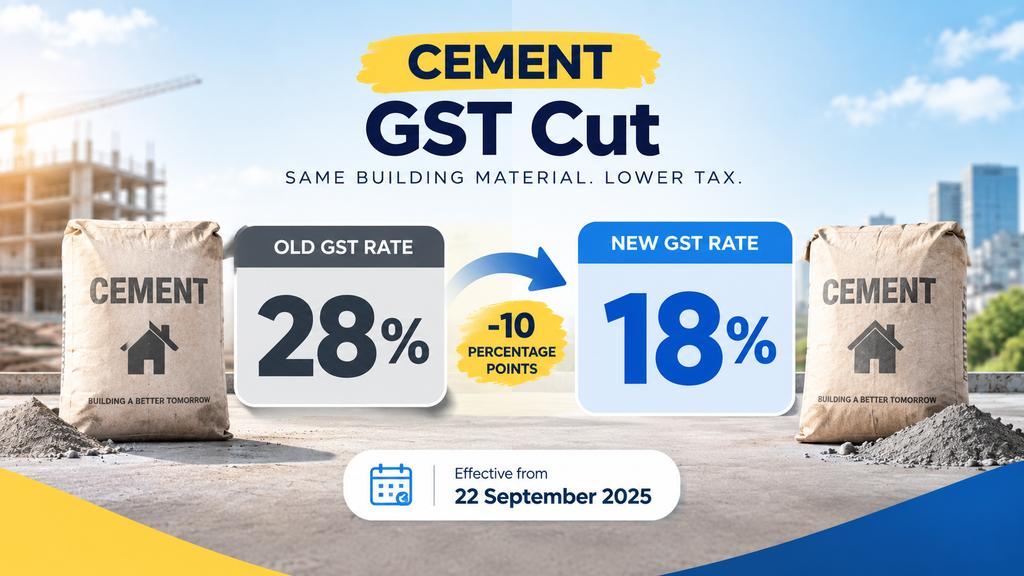
Yes, but by less than most homebuilders expect. The GST cut on cement from 28% to 18%, effective 22 September 2025, reduces the tax on cement by roughly 10 percentage points. Since cement typically accounts for 15 to 20% of total residential construction cost, the headline saving at the project level works out to approximately 2 to 3% on a self-built home. For a Rs 50 lakh construction, that is roughly Rs 1 lakh to Rs 1.5 lakh in direct savings on cement procurement. The actual saving is often slightly higher because freight and dealer margins on cement were also calculated on the inclusive 28% base, which now compresses. For buyers of under-construction flats from developers, the pass-through is uneven. Developers who operate under the 5% GST regime without Input Tax Credit (affordable housing) or 1% without ITC categories do not get to deduct the cement tax from output tax, so the saving largely drops to the bottom line of the developer rather than the buyer's cost sheet. For buyers of ready-to-move properties, there is no direct cement GST impact at all, because the property is sold as immovable property and is outside GST.
The GST 2.0 Cement Cut: What Actually Changed in September 2025
The 56th GST Council Meeting took three decisions on construction materials that together represent the biggest shake-up in the sector since GST was launched in 2017.
- Portland cement, aluminous cement, slag cement, and super-sulphate cement under HSN code 2523 were cut from 28% to 18%
- The rate came into effect on 22 September 2025
- The cut was framed as a measure to boost affordable housing and reduce home construction costs for individual builders
Alongside the cement cut, the Council retained the earlier rates on most other construction materials. Steel stays at 18%. Sand, gravel, and aggregates stay at 5%. Bricks remain in the 5-12% range depending on type. Ready-mix concrete stays at 18%. Paints, varnishes, electrical fittings, sanitaryware, and tiles stay at 18%.
The headline reform is cement alone, but it is the most impactful single rate change the construction sector has seen because of the sheer volume of cement used in a typical home.
Why Cement Matters So Much in Construction Economics
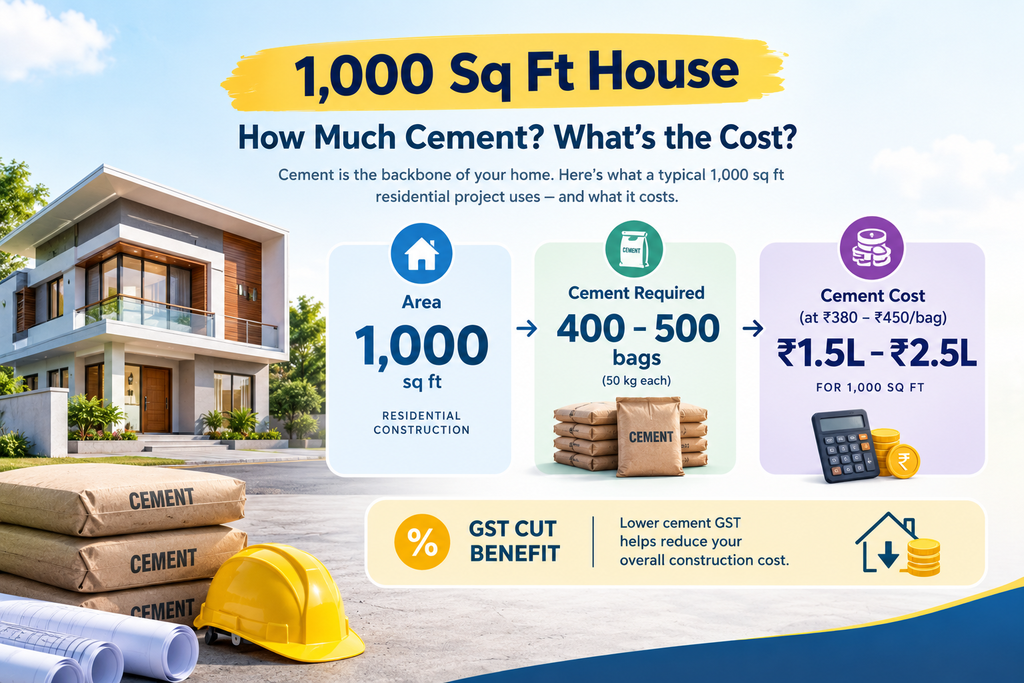
A typical reinforced concrete residential project in India uses about 400 to 500 bags of cement per 1,000 square feet of built-up area, depending on the structural design, number of floors, and foundation type. At current market prices of Rs 380 to Rs 450 per 50 kg bag, depending on brand and region, cement alone represents a Rs 1.5 to Rs 2.5 lakh outlay for every 1,000 square feet built.
In cost accounting terms, cement typically accounts for 15 to 20% of total construction cost in a residential project. Only labour and steel sit at comparable levels. A 10 percentage point tax reduction on an input that large is one of the biggest single-material savings any construction segment has seen.
The effect compounds. Cement is also the base for ready-mix concrete, plaster, mortar, and precast components. Suppliers of these downstream products have in turn been able to reduce their own pricing modestly, pushing the total benefit beyond the direct cement line item.
The Real Impact: How Much Did Cement Costs Actually Drop?
Taking a concrete worked example clarifies the maths.
A 50 kg bag of OPC 53 grade cement from a mid-tier brand sold at approximately Rs 420 in July 2025, inclusive of the then-28% GST. The pre-GST base price was therefore around Rs 328.
After the GST cut on 22 September 2025, with the same pre-tax base price, the new consumer price works out to around Rs 387 (Rs 328 plus 18% GST). That is a Rs 33 per bag reduction, or about 7.8% off the earlier shelf price.
For a 1,000 sqft construction using 450 bags, that is a direct saving of roughly Rs 14,850 on cement procurement. Scale that up to a 2,500 sqft house, and the saving on cement alone comes close to Rs 37,000.
Real market prices have moved slightly from this theoretical calculation. Cement companies have taken part of the headroom to pass smaller discounts to dealers and part to stabilise margins. Freight savings on cement transport have also compressed the overall rate. The net result for a self-building homeowner in 2026 is a cement bill roughly 7 to 9% lower than it would have been under the pre-reform regime.
Full Construction Material GST Rates in 2026
| Material | HSN Code | GST Rate (2026) | Pre-Reform Rate |
|---|---|---|---|
| Portland and other cement | 2523 | 18% | 28% |
| Steel (TMT bars, rods) | 7214 | 18% | 18% |
| Ready-mix concrete | 3824 | 18% | 18% |
| Bricks (common building) | 6904 | 12% | 12% |
| Fly ash bricks | 6815 | 5% | 5% |
| Sand (natural) | 2505 | 5% | 5% |
| Gravel and aggregates | 2517 | 5% | 5% |
| Marble blocks | 2515 | 12% | 12% |
| Marble slabs and tiles | 6802 | 18% | 18% |
| Granite blocks | 2516 | 12% | 12% |
| Granite slabs and tiles | 6802 | 18% | 18% |
| Ceramic tiles | 6907 | 18% | 18% |
| Paints and varnishes | 3208-3210 | 18% | 18% |
| Plaster of Paris | 2520 | 18% | 18% |
| Sanitaryware | 6910 | 18% | 18% |
| Electrical fittings and wires | 8536 | 18% | 18% |
| Plywood and particle board | 4412 | 18% | 18% |
The cement cut is the only major rate change. Everything else continues under its pre-reform rate structure, which is why the overall construction cost saving is modest rather than dramatic.
A Rs 50 Lakh Self-Build: Before and After
Take a 1,500 sqft independent home being self-built in a tier 2 city, with a total construction budget of Rs 50 lakh (excluding land).
- Cement cost pre-cut (675 bags at Rs 420): Rs 2,83,500
- Cement cost post-cut (675 bags at Rs 387): Rs 2,61,225
- Direct cement saving: Rs 22,275
- Indirect savings on RMC, plaster, mortar, and freight: Rs 15,000 to Rs 30,000
- Total construction cost savings in the project: Rs 40,000 to Rs 55,000
That works out to about 0.8 to 1.1% of the total construction budget. The 2 to 3% headline figure some reports cite applies to a cement-intensive project with high RCC content. For a typical mid-range residential self-build, the real saving sits closer to 1 to 1.5%.
Owners planning a build in 2026 should budget on the lower post-cut cement cost from the start, but not expect dramatic overall savings. The cut helps at the margin. It does not transform the economics.
Under-Construction Flats: Does the Saving Reach the Buyer?
For buyers of under-construction properties, the pass-through question is more complicated than for self-builders.
Under the current GST regime for residential real estate, developers operate under two main slabs:
- Affordable housing: 1% GST, with no Input Tax Credit allowed
- Other residential: 5% GST, with no Input Tax Credit allowed
Because developers in both categories cannot claim Input Tax Credit on their inputs, every input tax they pay is a sunk cost. The cement GST cut therefore reduces their input cost directly, improving project margins. Whether that margin improvement flows to the buyer depends entirely on the developer's pricing strategy and the local market.
In high-competition markets like Bengaluru's outer tech corridors, Pune's peripheral belts, and parts of Hyderabad, developers have passed on a modest portion of the savings, usually through festive discounts, reduced floor rise charges, or complimentary interior upgrades rather than outright price cuts. In supply-constrained markets like central Mumbai and central Delhi, the savings have largely stayed with developers.
For buyers of ready-to-move properties, which are sold as immovable property outside GST, the cement cut has no direct impact at all. Any benefit shows up only in the next construction cycle.
Other Factors Still Pushing Construction Costs Up
Even with the cement cut, construction cost inflation in 2026 remains real.
- Labour costs have risen 10 to 15% year-on-year in most tier 1 and tier 2 cities, driven by skilled worker shortages
- Steel prices are volatile and have risen 4 to 7% in parts of 2026
- Diesel and freight costs continue to rise, which affects every material delivery
- Compliance costs, including green building norms, fire safety upgrades, and RERA conditions, have added to per sqft overheads
- Sand supply is restricted in several states, pushing prices up at the local level
For a self-builder, these forces often cancel out some or all of the cement cut benefit. For a developer, the net cost picture remains tight even with the input tax reduction.
How Housewise Helps
Housewise manages residential rental properties for owners across 23 Indian cities, including those who have recently completed a self-build and want to let the property out before moving in, or NRIs who have invested in a new construction. Services include a professionally drafted rent agreement with correct stamp duty and registration, tenant onboarding, and periodic renewals. Owners weighing a full lease against a leave and licence structure for a newly-built property get help picking the right instrument, and first-time landlords can avoid the common mistakes in rent agreements that create friction with tenants later.
Frequently Asked Questions
When did the GST on cement change from 28% to 18%?
The 56th GST Council Meeting on 3 September 2025 recommended cutting GST on cement from 28% to 18%. The new rate took effect from 22 September 2025. This was part of the broader GST 2.0 rate rationalisation package that reformed multiple consumer-goods slabs.
How much cheaper is building a house in 2026 after the cement GST cut?
A self-built residential project is approximately 1 to 1.5% cheaper overall. On a Rs 50 lakh construction, that works out to Rs 40,000 to Rs 55,000 in savings. The savings include direct cement cost reduction and indirect savings on ready-mix concrete, plaster, and mortar.
Did cement prices actually drop after the GST cut?
Yes, by roughly 7 to 9% at the consumer shelf. A 50 kg bag that cost around Rs 420 at the end of August 2025 fell to approximately Rs 387 after 22 September 2025. Cement companies passed on most of the tax reduction.
Does the GST cut on cement benefit under-construction flat buyers?
Partially. Developers under the 1% and 5% residential GST regimes cannot claim Input Tax Credit, so the cement GST reduction improves their margins directly. Whether this reaches buyers depends on the market. Competitive markets have seen discounts; supply-constrained ones have not.
Which construction materials still have high GST in 2026?
Steel, ready-mix concrete, paints, electrical fittings, plywood, sanitaryware, and ceramic tiles all remain at 18%. Marble and granite slabs are at 18%. Common bricks are at 12%. Sand and aggregates stay at 5%. Only cement moved from 28% to 18% in this reform.
What is the GST rate on ready-mix concrete in 2026?
Ready-mix concrete remains at 18% under HSN code 3824. This rate did not change in the September 2025 reform. However, RMC prices have come down modestly because cement, which is a major RMC input, became cheaper under the new 18% rate on 22 September 2025.
Does the cement GST cut apply to ready-to-move properties?
No. Ready-to-move properties are sold as immovable property, which is outside GST entirely. The cement GST reform affects only new construction, affordable housing projects under the 1% slab, and other residential projects under 5%, as well as self-build and renovation activity.
How much cement is used in building a 1,000 sqft house?
A typical reinforced concrete residential project uses between 400 and 500 bags of 50 kg cement per 1,000 sqft of built-up area, depending on structural design and foundation type. This equates to Rs 1.5 to Rs 2.5 lakh in cement cost at 2026 prices.
Will construction costs continue falling in 2026?
Not necessarily. Labour costs have risen 10 to 15% year-on-year. Steel is up 4 to 7% in parts of 2026. Diesel, freight, sand, and compliance costs are also higher. The cement GST cut helps at the margin, but cost inflation remains real.
How does Housewise help owners of newly-built homes?
Housewise manages residential rentals for owners across 23 Indian cities, including rent agreement drafting, stamp duty, tenant onboarding, and periodic renewals. Owners who complete a self-build and want to let the property out get end-to-end paperwork handled, including for NRI owners managing from abroad.


0 Comments