

For most of Indian legal history, a Hindu daughter was raised inside the family home but stood outside its property. She could pray at the family altar, hold the keys, run the kitchen, care for aging parents, but when the ancestral house or the ancestral land was divided, her name never appeared on the paperwork. The Mitakshara law of coparcenary, followed across most of India, drew a bright line: only male descendants of a common ancestor were coparceners. Only they had a right by birth. Daughters, at best, were dependants.
That framework held for centuries. It began to give way with the Hindu Succession (Amendment) Act, 2005, which rewrote Section 6 of the parent Act and declared daughters to be coparceners by birth, with the same rights, liabilities, and privileges as sons. Even after that amendment, the law did not settle immediately. Different High Courts read the amendment differently. Some said it applied only if the father was alive on 9 September 2005. Others said the daughter's birth was the trigger, not the father's survival. That confusion ran for fifteen years, until the Supreme Court finally closed the debate in Vineeta Sharma v. Rakesh Sharma (2020).
This guide walks through what a daughter's right in ancestral property means in 2026, how it differs from her right in self-acquired property, what the Vineeta Sharma judgment actually decided, how the rules apply to married daughters, adopted daughters, and daughters born before 2005, and the same question for families governed by Muslim, Christian, and Parsi personal laws.
What is a Daughter's Right in Ancestral Property?
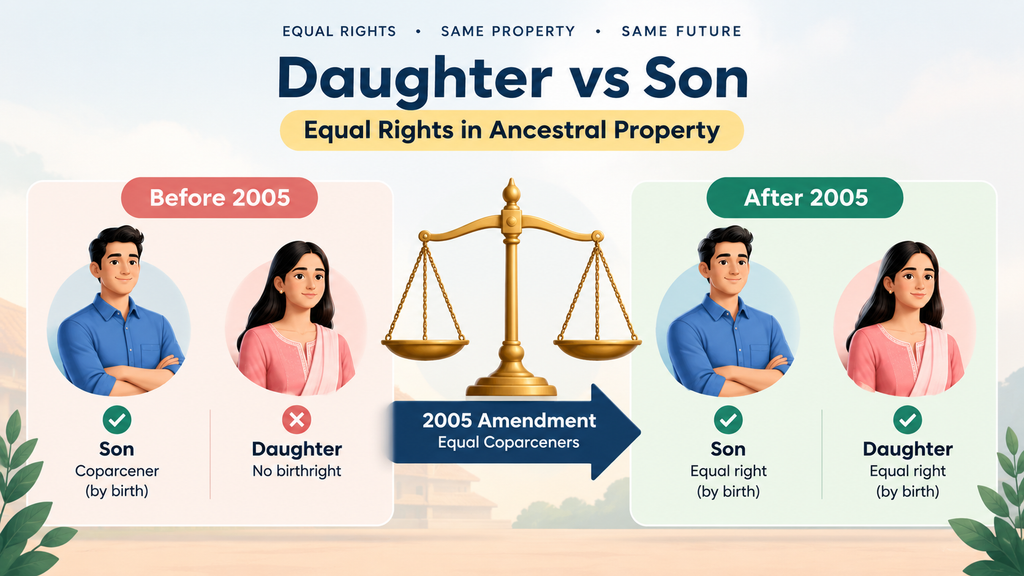
Under Hindu law, a daughter is a coparcener by birth in her father's ancestral property, with equal rights to that of a son. Section 6 of the Hindu Succession Act, 1956, as amended in 2005 and definitively interpreted by the Supreme Court in Vineeta Sharma v. Rakesh Sharma (2020) 9 SCC 1, gives daughters the same rights, liabilities, and privileges in the joint family property as sons. This right is not conditional on the father being alive on 9 September 2005, when the amendment came into force. It also applies whether the daughter is unmarried or married, and whether she was born before or after 2005. Ancestral property is distinct from self-acquired property, which the father can bequeath as he wishes through a valid Will. For daughters under Muslim law, Christian law, and Parsi law, the framework is different because those personal laws do not recognise the concept of coparcenary.
Ancestral Property vs Self-Acquired Property: The Distinction That Decides Everything
Before the law can decide what a daughter is entitled to, it has to classify the property. Two categories matter.
Ancestral property is property inherited by a person from his father, paternal grandfather, or paternal great-grandfather, and that has remained undivided across up to four generations. Under Mitakshara law, this property is coparcenary property, in which every coparcener has an equal right by birth. Since 2005, that includes daughters.
Self-acquired property is property that a person has bought, earned, or otherwise acquired through their own means, or has received as a gift or under a Will. The absolute owner of self-acquired property can sell it, gift it, or bequeath it as they choose. Daughters have no automatic right in a father's self-acquired property during his lifetime.
Property that was ancestral but has been formally partitioned ceases to be ancestral. Each coparcener's share becomes their self-acquired property. Property inherited through a Will is generally self-acquired in the hands of the recipient, unless the Will specifically directs otherwise. This classification determines whether a daughter has a birthright that no one can take away, or only a right at the point of succession under Class I heir rules.
Before 2005: The Old Rules Excluded Daughters
Under Section 6 of the unamended Hindu Succession Act, 1956, coparcenary property devolved by survivorship among male members of the joint family. If a father died leaving behind three sons and one daughter, only the three sons acquired an equal share in the ancestral property. The daughter was entitled to a share only if the father had first made a partition or Will in her favour. She could inherit from his self-acquired estate as a Class I heir, but the ancestral house and land passed straight to her brothers.
This position was widely criticised as inconsistent with Article 14 of the Constitution and with the international commitments India had signed on gender equality. Several states, including Kerala, Andhra Pradesh, Tamil Nadu, and Karnataka, passed their own state amendments in the 1980s and 1990s to give daughters coparcenary rights, but the position varied from state to state. National reform came only in 2005.
The 2005 Amendment: Daughters as Equal Coparceners
The Hindu Succession (Amendment) Act, 2005 substituted Section 6 with a new provision. The key change was a single sentence: a daughter of a coparcener shall, by birth, become a coparcener in her own right in the same manner as a son. She was given the same rights and liabilities, and the same ability to seek partition, dispose of her share by testamentary succession, and pass on the share to her heirs.
The amendment came into force on 9 September 2005. It applied to all daughters of coparceners, whether they were born before or after that date. But the question of whether daughters whose fathers had died before 9 September 2005 could also claim these rights split the courts for the next fifteen years.
The Vineeta Sharma Judgment: The Question Finally Settled
On 11 August 2020, a three-judge bench of the Supreme Court in Vineeta Sharma v. Rakesh Sharma (2020) 9 SCC 1 laid the debate to rest. The Court held that:
- A daughter is a coparcener by birth, not by the accident of when her father died
- The coparcenary right is inherent in birth and does not depend on the father being alive on 9 September 2005
- The rights conferred by the 2005 amendment apply retrospectively to daughters born before the amendment
- Previous conflicting decisions in Prakash v. Phulavati (2016) and Danamma v. Amar (2018), which had made the father's survival relevant, were overruled to that extent
The Court framed the principle in words that have since travelled widely across Indian courtrooms and family conversations: "Once a daughter, always a daughter; once a son, always a son." The judgment lifted the last major restriction on daughters' claims to ancestral property under Hindu law and directed pending litigation across the country to be decided within six months.
What Exactly Does a Daughter Inherit?

Take a simple worked example. A Hindu ancestral property is worth Rs 6 crore. The family consists of a father, his three children (two sons and one daughter), and his wife (the children's mother). If the father dies without a partition or Will:
- The daughter is a coparcener by birth, so on notional partition, she and each son take an equal 1/4 share along with the father. That gives the father, both sons, and the daughter 1/4 each, or Rs 1.5 crore per share.
- The father's 1/4 share is then distributed among his Class I heirs, which include his wife, sons, and daughter equally.
- The wife receives Rs 37.5 lakh as her share of the father's portion. Each son and the daughter receive an additional Rs 37.5 lakh from the father's share.
- Final tally: each son receives Rs 1.875 crore, the daughter receives Rs 1.875 crore, and the wife receives Rs 37.5 lakh.
The daughter's share is not "some percentage" or "half a son's share." Under Hindu law post-2005, it is a full, equal share by birth.
Daughter's Rights at a Glance
| Property Type | Daughter's Right | Legal Basis |
|---|---|---|
| Hindu ancestral property | Equal share by birth, same as a son | Section 6 Hindu Succession Act, 1956 (as amended) |
| Hindu father's self-acquired property (no Will) | Equal share as Class I heir | Section 8 Hindu Succession Act, 1956 |
| Hindu father's self-acquired property (with Will) | Only what the Will provides | Testamentary succession rules |
| Property inherited through Will | Recipient's self-acquired property | Testamentary succession rules |
| Property partitioned before 20 December 2004 | No right to reopen | Vineeta Sharma proviso |
| Muslim ancestral or self-acquired property | Half a son's share under Shariat | Muslim Personal Law (Shariat) Application Act, 1937 |
| Christian or Parsi property | Equal share as legal heir | Indian Succession Act, 1925 |
Special Situations Every Daughter Should Understand
Married daughters: Marriage does not extinguish a daughter's coparcenary right. She continues to be a coparcener in her natal family's ancestral property whether she is married or unmarried. She does not, however, acquire coparcenary rights in her husband's family's ancestral property.
Widowed daughters: A widowed daughter retains full coparcenary rights in her father's ancestral property. Her share, on her own death, passes to her children under the general rules of succession.
Adopted daughters: Under the Hindu Adoptions and Maintenance Act, 1956, an adopted daughter has the same rights as a biological daughter in her adoptive family's property. She loses her rights in her natural family's ancestral property from the date of adoption.
Deceased daughters: If a daughter dies before her father, her children still inherit her share in the ancestral property through the principle of representation.
Daughters born before 2005: After Vineeta Sharma, the year of birth is irrelevant. A daughter born in 1955, 1985, or 2015 has the same rights, provided the property was still coparcenary and had not been formally partitioned before 20 December 2004.
What About Daughters Under Muslim, Christian, and Parsi Law?
The Hindu Succession Act does not apply to families governed by other personal laws. The rules under those systems differ significantly.
Muslim law: The Muslim Personal Law (Shariat) Application Act, 1937 governs inheritance for Muslims in India. Muslim law does not recognise the concept of coparcenary or the distinction between ancestral and self-acquired property. On the death of a Muslim, the estate vests immediately in the heirs in fixed Quranic shares. A daughter is entitled to half the share of a son. A father can bequeath only up to one-third of his estate through a Will (Wasiyat), and any bequest beyond that requires consent from the other legal heirs.
Christian law: Christians are governed by the Indian Succession Act, 1925 (Sections 31 to 49). There is no distinction between ancestral and self-acquired property. All children, sons and daughters, inherit equally on the intestate death of a parent. A Christian can bequeath the entirety of the estate through a valid Will.
Parsi law: Parsis are governed by Sections 50 to 56 of the Indian Succession Act, 1925. As with Christians, sons and daughters inherit equally, and the concept of coparcenary does not apply.
Daughters seeking to enforce their share in ancestral property typically follow one of three routes.
Family settlement: The fastest and cheapest option. The family agrees to a division, executes a family settlement deed, and applies for mutation of records with the local revenue authority. No court is required.
Registered partition deed: Where consensus is reached, but the family wants a legally binding record, a registered partition deed on stamp paper is drawn up and registered with the sub-registrar. This becomes evidence for all future dealings.
Partition suit: Where consensus fails, a suit for partition is filed in the appropriate civil court. The court passes a preliminary decree identifying shares, followed by a final decree carving them out on the ground. Suits can take years, but the outcome is binding.
Alongside these routes, mutation of revenue records, updating of society share certificates, and, if the property is later rented out or sold, drafting of proper legal instruments become essential. For daughters who inherit a share and choose to let it out rather than sell, a professionally drafted rent agreement with correct stamp duty and registration protects the inheritance while it earns income.
What Cannot Be Undone: The 20 December 2004 Cut-Off
Vineeta Sharma carries one important proviso. If an ancestral property was formally partitioned by a registered instrument or a court decree before 20 December 2004, that partition is protected. Daughters cannot reopen such partitions to claim their coparcenary share. Oral partitions or informal family arrangements before that date are not protected, and courts have consistently held that only a registered partition deed or a decree meets the standard.
This cut-off matters because it draws the line between the old regime and the new. Where a daughter's father, uncles, or brothers formally split the property before that date, the settlement is final. Where they did not, the daughter can still claim.
How Housewise Helps
Housewise coordinates rent agreement drafting, stamp duty payment, and, in Maharashtra, registration for property owners across 23 Indian cities. Where a daughter has come into possession of an inherited flat or a share in ancestral property and decides to let it out, Housewise handles the paperwork end to end: state-appropriate templates, tenant verification, and periodic renewals. Owners drafting or renewing agreements can also avoid the common mistakes in rent agreements that create friction later, and those weighing a full lease against a leave and licence structure get help picking the right instrument for their city and profile.
Frequently Asked Questions
Does a daughter have equal rights in ancestral property as a son?
Yes. Under Section 6 of the Hindu Succession Act, 1956, as amended in 2005, a daughter is a coparcener by birth with the same rights and liabilities as a son. The Supreme Court in Vineeta Sharma v. Rakesh Sharma (2020) confirmed that this position applies retrospectively.
Can a married daughter claim ancestral property?
Yes. Marriage does not extinguish a daughter's coparcenary right in her natal family's ancestral property. She continues to be a coparcener whether married, unmarried, widowed, or divorced. She does not, however, acquire coparcenary rights in her husband's family's ancestral property.
Does the Vineeta Sharma judgment apply if my father died before 2005?
Yes. The Supreme Court in Vineeta Sharma held that a daughter's coparcenary right is by birth and does not depend on the father being alive on 9 September 2005. This overruled earlier decisions that had made the father's survival relevant.
What is the difference between ancestral and self-acquired property?
Ancestral property is inherited from the father, paternal grandfather, or great-grandfather and has remained undivided. Self-acquired property is bought or earned individually. Daughters have a birthright in ancestral property but inherit self-acquired property as Class I heirs only if there is no Will.
Can my father exclude me from his self-acquired property through a Will?
Yes. A father has absolute freedom to bequeath his self-acquired property through a valid Will, including excluding any or all children. This right does not extend to ancestral property, where the daughter's coparcenary share cannot be taken away by a Will made by the father.
What is the 20 December 2004 cut-off in Vineeta Sharma?
Partitions of ancestral property that were formally completed through a registered deed or court decree before 20 December 2004 are protected from being reopened. Daughters cannot claim their coparcenary share in such settled partitions. Oral or informal partitions before that date do not qualify.
How much share does a daughter get under Muslim law?
Under the Muslim Personal Law (Shariat) Application Act, 1937, a daughter receives half the share of a son. Muslim law does not distinguish between ancestral and self-acquired property, and does not recognise the concept of coparcenary. A father can bequeath only one-third by Will.
Do Christian and Parsi daughters have equal inheritance rights?
Yes. Under the Indian Succession Act, 1925, Christian daughters (Sections 31 to 49) and Parsi daughters (Sections 50 to 56) inherit equally with sons. There is no distinction between ancestral and self-acquired property, and no coparcenary concept applies to these communities.
How does a daughter enforce her share in ancestral property?
Through a family settlement deed, a registered partition deed, or a partition suit in civil court. Family settlement is fastest and cheapest. A partition suit is filed when the family refuses to divide voluntarily, and the court decrees the shares.
How does Housewise help daughters who inherit property?
Housewise coordinates rent agreement drafting, stamp duty, and, in Maharashtra, registration for property owners across 23 Indian cities. Where an inherited flat or share is being let out, Housewise handles the paperwork end-to-end, including state-appropriate templates, tenant verification, and periodic renewals.


0 Comments