

Walk through Bengaluru's Electronic City, Pune's Hinjewadi, or Hyderabad's Gachibowli on a weekday evening and you will see the same thing: young professionals with laptop bags heading into buildings that look like ordinary apartment blocks but carry the logo of a co-living brand on the gate. Five years ago many of these were standard 2BHK and 3BHK flats let out to a single family. Today they are rented by the bed.
The numbers behind this shift are hard to ignore. Colliers India estimates that India's organised co-living market had about 3 lakh beds in 2025, against an addressable demand base of roughly 66 lakh beds among urban migrants aged 20 to 34. It projects organised inventory to cross 10 lakh beds by 2030, with market size rising from about Rs 4,000 crore to close to Rs 20,000 crore. Colliers also found co-living rents can run up to 35% higher than a 1BHK in the same locality, and institutional investors are seeing returns closer to 10%, against 2 to 5% for traditional residential. Earlier CII and Anarock research had already placed co-living and student housing yields well above the roughly 3% national residential average.
For a small landlord sitting on one or two flats earning a 2.5% yield, those numbers sound like an easy upgrade. They are not automatically one. This guide breaks down the conversion models, the real economics, the legal and society hurdles, and the questions every small owner should answer before handing a flat to a co-living operator.
Quick Answer: Should Small Landlords Convert to Co-Living?
It depends on location, building rules, and how much effort or risk you can carry. Co-living works best for flats within commuting distance of large tech parks, colleges, or business districts in Bengaluru, Hyderabad, Pune, Gurugram, and Chennai, in buildings or societies that allow multiple unrelated occupants. In those locations, gross rental income can rise 20 to 35% over a single-family lease. But the gain shrinks after furnishing costs, faster wear and tear, operator fees, higher vacancy, and compliance work. Leasing the flat to a professional operator on a fixed rent gives modest upside with low effort. Revenue-share deals give more upside with more risk. Running it yourself gives the highest income and the highest workload. Owners of flats in family-oriented localities, restrictive societies, or far from employment hubs are usually better off with a well-managed long-term family tenancy.
What Is Driving the Co-Living Boom in 2026?
Four forces are pushing demand.
- Migration for work and study. Colliers counts roughly 5 crore urban migrants aged 20 to 34. Most arrive alone, on modest budgets, and do not want to pay a 10-month deposit and furnish an empty flat.
- Deposit and brokerage fatigue. Co-living operators typically ask one or two months' deposit, no brokerage, and move-in within days. That is a sharp contrast with traditional rentals in Bengaluru where 6 to 10 months' deposit was common for years.
- Flexibility. Young professionals change jobs often. Monthly or short lock-ins suit them better than an 11-month agreement.
- Institutional capital. Leading operators have raised about USD 1 billion since 2015, according to Colliers, and are expanding beyond Tier 1 into cities like Indore, Coimbatore, Chandigarh, Jaipur, Visakhapatnam, and Dehradun.
The result is an operator ecosystem actively looking for supply, which is where small landlords come in.
The Four Ways a Small Landlord Can Participate
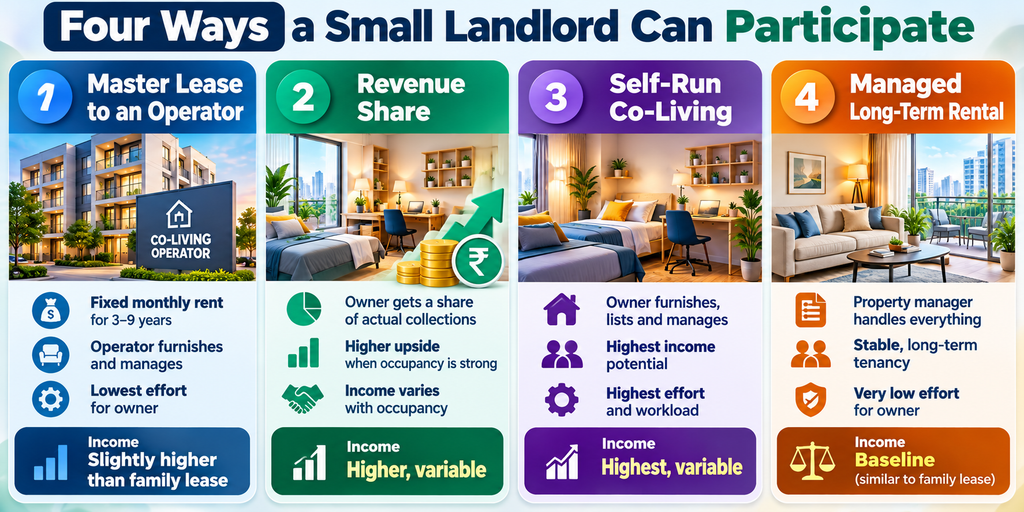
1. Master Lease to an Operator
The operator leases the entire flat or building on a fixed monthly rent, usually for 3 to 9 years, furnishes it, and runs it as co-living. The owner gets one rent cheque, typically with a lock-in period and a fixed escalation. This is the lowest-effort model and closest to a normal lease, but the rent premium over a family tenancy is usually modest, because the operator takes the occupancy risk and keeps the upside.
2. Revenue Share
The operator manages and markets the flat, and the owner receives a share of actual collections. Owners often fund some or all of the furnishing. Upside is higher when occupancy is strong, but income falls when beds sit empty, and the owner must trust the operator's reporting.
3. Self-Run Co-Living or PG
The owner furnishes, lists, collects, and manages residents directly. This captures the full rent premium, but it is effectively a small hospitality business: resident churn, daily complaints, cleaning, Wi-Fi, utilities, and compliance all land on the owner.
4. Managed Long-Term Rental
The flat stays a conventional family or professional tenancy, but a property manager handles tenant search, verification, agreement, rent collection, and maintenance. The yield does not jump, but effort drops to near zero and the tenancy is stable.
Comparing the Models Side by Side
| Factor | Master Lease to Operator | Revenue Share | Self-Run Co-Living | Managed Long-Term Rental |
|---|---|---|---|---|
| Income vs family lease | Slightly higher | Higher, variable | Highest, variable | Baseline |
| Owner effort | Low | Low to medium | Very high | Very low |
| Occupancy risk | Operator | Shared | Owner | Owner, but low churn |
| Furnishing cost | Usually operator | Often owner | Owner | Optional |
| Wear and tear | Higher | Higher | Highest | Normal |
| Exit flexibility | Locked in for lease term | Depends on contract | Flexible | 11-month cycles |
| Compliance burden | Mostly operator | Shared | Owner | Low |
The Real Economics: Gross Premium vs Net Gain
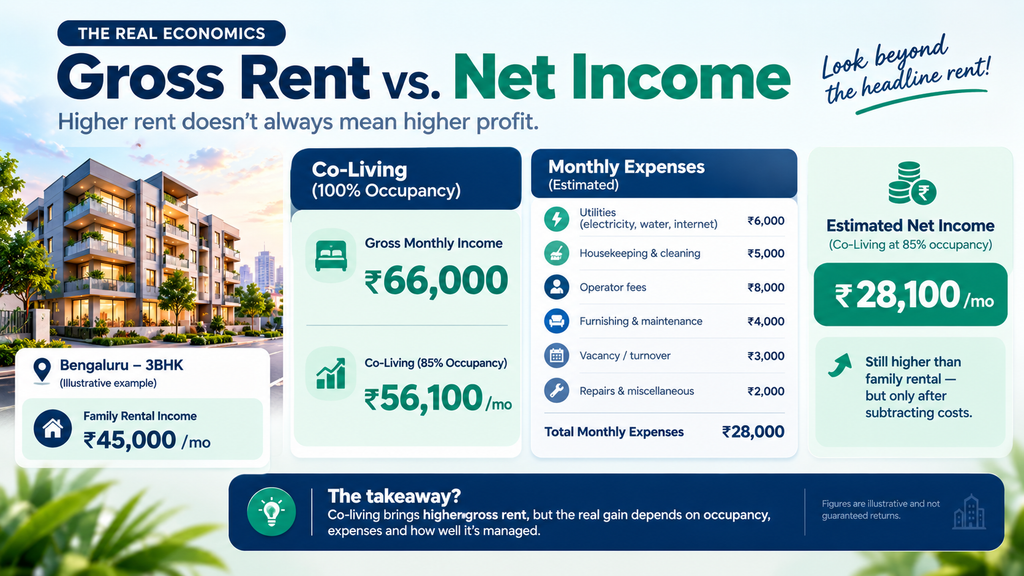
The headline rent uplift is where most landlords stop calculating. That is a mistake. Take a 3BHK in a Bengaluru tech corridor that rents for Rs 45,000 a month to a family.
As self-run or revenue-share co-living with six beds at about Rs 11,000 each, gross monthly income at full occupancy is Rs 66,000. Now subtract:
- Vacancy and churn. Co-living rarely runs at 100%. At 85% occupancy, income falls to about Rs 56,000
- Utilities, Wi-Fi, housekeeping, and common supplies, often Rs 6,000 to Rs 10,000 a month if the owner bears them
- Operator or platform fees on a revenue-share model
- Furnishing for six residents, which can easily run into several lakh rupees upfront, plus replacement every few years
- Faster wear on paint, fittings, mattresses, and appliances
After these costs, the net uplift over a well-managed family lease can shrink from roughly 45% gross to something in the 10 to 20% range, and sometimes lower in weaker locations. It is still a gain, but nowhere near what the gross numbers suggest.
Legal and Society Hurdles You Cannot Skip
Converting a flat to co-living changes its legal character in several ways.
- Society bye-laws. Many cooperative housing societies regulate commercial use and the number of occupants. Some insist on registration of every resident. Courts have struck down blanket bans on bachelors, but societies can still enforce reasonable rules on use, safety, and documentation.
- Licences. Running a PG or co-living facility may require municipal trade licences, fire safety clearances, and registration in some cities, depending on scale.
- Police verification. Every resident typically needs verification, and the obligation usually sits with the owner or operator.
- Agreement structure. Most co-living residents are licensees, not tenants. A leave and licence structure is the normal instrument, and the master agreement with an operator must be properly stamped and, where required, registered.
- GST and tax. Renting a residential dwelling for residential use is generally GST-exempt, but an operator's bundled services may be taxable, and owner income may shift from house property to business income if you run it yourself with substantial services.
- Home loan and insurance terms. Some lenders and insurers restrict commercial use. Check before signing.
Getting the operator agreement right matters most. Lock-in, escalation, who pays maintenance and property tax, damage restoration standards, and handover condition at exit should all be written down. The common mistakes in rent agreements that hurt ordinary landlords hurt even more in a multi-year operator lease.
Which Properties Are Good Candidates
A flat is a strong co-living candidate if most of these are true:
- Within 15 to 30 minutes of a large employment hub or college cluster
- Three or more bedrooms, ideally with attached or multiple bathrooms
- In a building or society that permits multiple unrelated occupants
- Good transport links and food options nearby
- Owner has capital for furnishing or a credible operator willing to fund it
- Owner is comfortable with a multi-year commitment
A flat is a weak candidate if it sits in a family-focused gated community with strict rules, is far from job centres, is a 1BHK where the uplift is small, or if the owner may want it back for family use within a few years.
Questions to Ask Any Co-Living Operator
- What occupancy has this operator achieved in this specific micro-market over the last 12 months?
- Is the rent fixed, revenue-linked, or a hybrid with a minimum guarantee?
- Who funds furnishing, and who owns it at exit?
- What is the lock-in, and what are the exit penalties on both sides?
- Who handles police verification, society registration, and licences?
- What condition will the flat be returned in, and how is damage assessed?
- How often will you receive statements, and can you audit them?
- What happens if the operator shuts down or exits the city?
The last question has become important. Several smaller operators have scaled back in recent years, leaving owners chasing dues and restoring damaged flats.
The Middle Path Many Small Landlords Choose
For many owners, especially NRIs and those with a single investment flat, the honest answer is that a professionally managed long-term rental delivers most of the benefit of hands-off income without the risk profile of co-living. A good property manager cuts vacancy through faster tenant placement, keeps rent at market, enforces a proper rent agreement with correct stamp duty, and handles repairs before they become disputes.
Co-living is a strong option for the right flat in the right location. It is not a universal upgrade.
How Housewise Helps
Housewise provides end-to-end property management for owners across 23 Indian cities, including tenant search and verification, rent agreements, rent follow-ups, inspections, and maintenance. For owners weighing co-living against a managed long-term lease, Housewise can help you assess what a stable tenancy would realistically earn in your micro-market, so the comparison with an operator's offer is based on real numbers rather than a brochure. Owners still deciding whether outside help is worth it can see the benefits of a property management company laid out in practical terms.
Frequently Asked Questions
How big is the co-living market in India in 2026?
Colliers estimates organised co-living had about 3 lakh beds in 2025, against demand of roughly 66 lakh beds. It projects inventory crossing 10 lakh beds by 2030, with market size rising from about Rs 4,000 crore to nearly Rs 20,000 crore.
Do co-living flats really earn more rent than normal rentals?
Gross income can be 20 to 35% higher than a comparable family lease. After furnishing, utilities, vacancy, operator fees, and faster wear and tear, the net gain is usually much smaller, often in the 10 to 20% range.
What is the difference between a master lease and a revenue-share model?
In a master lease, the operator pays a fixed rent and takes occupancy risk. In revenue share, the owner receives a portion of actual collections, earning more when occupancy is high and less when beds stay empty.
Can a housing society stop me from converting my flat to co-living?
Societies cannot impose blanket bans on bachelors, but they can enforce reasonable rules on use, safety, occupant registration, and documentation. Check your society bye-laws and any commercial-use restrictions before signing with an operator.
Do I need a licence to run co-living or a PG in my flat?
It depends on city and scale. Some municipalities require trade licences, fire safety clearances, or PG registration. Police verification of every resident is commonly required. Operators usually handle this under a master lease.
What agreement do co-living residents sign?
Residents usually sign a leave and licence agreement, which gives them permission to occupy but not tenancy rights. The owner's agreement with an operator is a separate lease that must be properly stamped and, where required, registered
Which flats are best suited for co-living conversion?
Three or more bedroom flats near large employment hubs or colleges, with multiple bathrooms, good transport links, and in buildings that allow unrelated occupants. Flats in strict family societies or far from job centres are weaker candidates.
Is co-living income taxed differently from normal rent?
Plain rental of a residential flat is taxed as house property income with a 30% standard deduction. If you run co-living yourself with substantial services, the income may be treated as business income. Take tax advice before converting.
What are the biggest risks of leasing a flat to a co-living operator?
Long lock-ins, faster wear and tear, operator exits or closures, unclear handover conditions, and reliance on the operator's occupancy reporting in revenue-share deals. A carefully drafted agreement covering exit, damage, and audit rights reduces most of these.
How does Housewise help landlords deciding between co-living and regular renting?
Housewise manages rental properties across 23 Indian cities, covering tenant search, verification, agreements, rent follow-ups, and maintenance. It helps owners benchmark what a stable managed tenancy would earn, so they can compare it fairly against an operator's co-living offer.


0 Comments