

Most property sellers in India think about tax on the price they actually receive. The Income Tax Department thinks about something else as well: the government's own valuation of the property, known as the circle rate, ready reckoner rate, guideline value, or collector rate, depending on the state. When the price written in your sale deed falls meaningfully below that government value, the law can tax you on the higher figure, even if you never received that money. The buyer can be taxed on the gap too.
This is not a rare problem. Circle rates are revised by state governments, often every year, and they do not always move in step with the market. In some micro-markets, prices have outrun circle rates. In others, especially older localities, peripheral areas, and slow-moving segments, circle rates have caught up or overshot actual transaction prices. Gurugram's collector rate revision from April 2026 raised rates sharply in several sectors, by as much as 75% in some, according to market reports. Maharashtra kept its ready reckoner rates unchanged for FY 2026-27 after a hike the year before. Every revision changes the gap, and the gap is what triggers tax.
This guide explains how circle rates work, how the seller-side and buyer-side deeming rules operate, the 10% tolerance band, what happens when your agreement and registration dates differ, how to challenge an inflated circle rate, and how to plan a sale so the gap does not cost you lakhs.
Quick Answer: How Can the Circle Rate Increase Tax When You Sell?
When you sell land or a building, the seller-side deeming rule (Section 50C of the Income-tax Act, 1961, carried into the Income-tax Act, 2025 from April 2026) says that if the stamp duty value is more than 110% of the actual sale price, the stamp duty value is treated as your sale price for capital gains. You pay tax on money you never received. The buyer-side rule (Section 56(2)(x)) taxes the buyer on the difference as income from other sources if it exceeds both Rs 50,000 and 10% of the price. Stamp duty itself is also charged on the higher of the two values. Sellers can avoid or reduce the hit by using the 10% tolerance, relying on the agreement-date value where part payment was made by banking channels, or asking for a reference to the Valuation Officer when the circle rate exceeds fair market value.
What is a Circle Rate?
A circle rate is the minimum value per square metre or square foot that a state government notifies for property in a given area, for the purpose of calculating stamp duty and registration charges. It goes by different names:
- Circle rate in Delhi and Uttar Pradesh
- Collector rate in Haryana and Punjab
- Ready reckoner rate in Maharashtra
- Guideline value in Karnataka, Tamil Nadu, and Telangana
- Jantri rate in Gujarat
States set these rates by locality, property type, floor, age, and amenities. Registration offices will not register a sale at a value below the circle rate without charging stamp duty on the circle value. The figure that the Sub-Registrar accepts for stamp duty is called the stamp duty value, and this is the figure income tax law compares with your sale price. The stamp duty rules for rent agreements follow a different calculation, but the principle of state-notified valuation is the same.
Why the Circle Rate and Market Rate Drift Apart

Circle rates are administrative numbers revised periodically. Market rates move with demand, interest rates, and local news. They drift apart for several reasons:
- States revise circle rates in bulk, sometimes after a gap of several years, then raise them sharply in one go
- Revisions often apply a uniform percentage across a zone, even though individual projects within it perform very differently
- Older buildings, ground floors, and units in poorly maintained societies often sell below the zone average
- Distress sales, quick-exit NRI sales, and inherited properties sold by multiple heirs often close below market
- In booming micro-markets, prices race ahead, and the circle rate lags
When the circle rate sits above your actual sale price by more than 10%, the tax rules start working against you.
Section 50C: How the Seller Gets Taxed on the Gap
For the seller, the rule works like this:
- Compare the actual sale consideration with the stamp duty value
- If the stamp duty value is up to 110% of the sale consideration, the actual price is accepted
- If the stamp duty value exceeds 110% of the sale consideration, the stamp duty value is treated as the full value of consideration for capital gains
The 10% tolerance band was introduced from FY 2020-21. Before that, it was 5%, and originally there was no tolerance at all.
A Worked Example
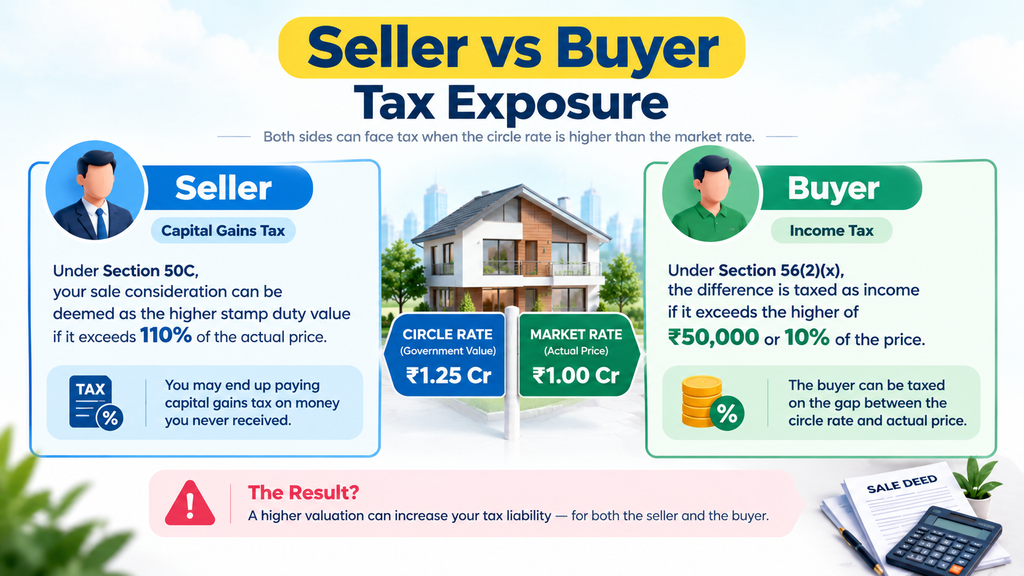
You sell a flat for Rs 1 crore. The stamp duty value, based on the circle rate, is Rs 1.25 crore. Since Rs 1.25 crore is more than 110% of Rs 1 crore (which is Rs 1.10 crore), the full value of consideration becomes Rs 1.25 crore.
If your indexed or actual cost is Rs 60 lakh, your long-term capital gain rises from Rs 40 lakh to Rs 65 lakh. At the current 12.5% long-term rate without indexation, plus 4% cess, the extra Rs 25 lakh of deemed gain costs roughly Rs 3.25 lakh in additional tax, on money you never received.
Resident individuals and HUFs who acquired property before 23 July 2024 can choose between 12.5% without indexation and 20% with indexation, whichever gives lower tax, but the deemed higher consideration applies under both options.
Section 56(2)(x): The Buyer Gets Taxed Too
The buyer faces a mirror rule. If the stamp duty value exceeds the actual purchase price by more than the higher of Rs 50,000 or 10% of the price, the difference is taxed in the buyer's hands as income from other sources, at the buyer's slab rate.
In the same example, the buyer paid Rs 1 crore for a property with a stamp duty value of Rs 1.25 crore. The Rs 25 lakh difference exceeds both thresholds, so it is added to the buyer's taxable income. A buyer in the 30% bracket faces roughly Rs 7.8 lakh of tax, including cess.
This is why sophisticated buyers now resist deals priced well below the circle rate, which in turn pushes sellers to justify the price or renegotiate.
Seller vs Buyer Exposure at a Glance
| Point | Seller | Buyer |
|---|---|---|
| Rule | Section 50C | Section 56(2)(x) |
| Trigger | Stamp duty value above 110% of sale price | Difference above the higher of Rs 50,000 or 10% of the price |
| What is taxed | Capital gain computed on stamp duty value | Difference taxed as income from other sources |
| Tax rate | 12.5% LTCG or slab rate for STCG | Buyer's slab rate |
| Relief | Valuation Officer reference, agreement-date value | Agreement-date value |
Builders and dealers holding property as stock-in-trade face a similar rule under Section 43CA.
The Agreement Date Relief Many Sellers Miss
Property deals often take months between signing the agreement to sell and registering the sale deed. If the circle rate rises in between, the stamp duty value on the registration date may be much higher than on the agreement date.
The law gives relief here. Where the agreement and registration dates differ, the stamp duty value on the agreement date can be used, provided at least part of the consideration was paid on or before the agreement date by account payee cheque, bank draft, or an electronic banking channel. Cash advances do not qualify.
Practical takeaways:
- Pay or receive the token amount through a bank transfer, never cash
- Keep the agreement to sell properly dated, stamped, and preferably registered
- Retain bank proof showing the payment date
This single step can protect sellers in states like Haryana where collector rates jumped sharply from April 2026.
How to Challenge a Circle Rate That Is Too High
If the circle rate genuinely overstates your property's value, you have two routes.
Before the stamp authority. Some states allow you to challenge the valuation at the registration stage before the stamp collector or appellate authority, with supporting evidence such as recent comparable sales, structural condition reports, or valuation reports.
Before the Income Tax Department. Under Section 50C, if you claim the stamp duty value exceeds fair market value, the Assessing Officer can refer the valuation to a Valuation Officer. If the Valuation Officer's figure is lower than the stamp duty value, that lower figure is used. It cannot be pushed above the stamp duty value.
Keep supporting evidence ready: photographs, age and condition of the building, legal encumbrances, tenancy, encroachment, location disadvantages, and registered sale deeds of similar units nearby.
Circle Rate Changes in 2026 Worth Watching
- Haryana (Gurugram). Collector rates revised from April 2026, with sharp increases reported in several sectors, in some cases by as much as 75%.
- Maharashtra. Ready reckoner rates were kept unchanged for FY 2026-27, after an increase in FY 2025-26.
- Other states. Most states review rates annually around April. Check your state IGR or revenue department portal before fixing a sale price.
The rule of thumb is simple. Before you agree a price, check the current circle rate for your exact property category, calculate the stamp duty value, and see whether your price clears the 90% mark.
Tips for NRI Sellers
NRIs face an added layer. The buyer deducts TDS on the sale consideration, and from 1 October 2026, resident individual and HUF buyers can do this using their PAN through Form 141. If the stamp duty value exceeds the sale price by more than 10%, your final capital gains tax may exceed the TDS deducted. Plan for the gap, and if your actual liability is lower than the TDS rate, apply early for a lower deduction certificate.
How Housewise Helps
Housewise works with property owners across 23 Indian cities on renting, managing, and selling property. For owners preparing to sell, Housewise's property sales support includes site visits, inspections, buyer screening, and connecting you with legal and financial experts who can check circle rate exposure before you agree on a price. Owners who decide to hold and rent out instead get a professionally drafted rent agreement, tenant onboarding, and the end-to-end property management that keeps the asset earning while the market settles.
Frequently Asked Questions
Selling a property in India from abroad? Housewise runs the whole sale for you, from pricing and buyer checks to TDS and registration. See our property sale service, or work out what reaches you with our NRI property sale calculator.
What is the difference between circle rate and market rate?
The circle rate is the minimum property value notified by a state government for stamp duty purposes. The market rate is the price buyers actually pay. They can differ widely depending on locality, building age, condition, and how recently circle rates were revised.
What does Section 50C do when selling property?
If the stamp duty value exceeds 110% of the actual sale price, Section 50C treats the stamp duty value as the sale price for capital gains. The seller pays tax on a higher amount than actually received.
Is there any tolerance when the sale price is below the circle rate?
Yes. Since FY 2020-21, a 10% tolerance applies. If the stamp duty value is no more than 110% of the sale price, the actual price is accepted for capital gains, and no deemed consideration applies.
Can the buyer be taxed if they buy below the circle rate?
Yes. Under Section 56(2)(x), if the stamp duty value exceeds the purchase price by more than the higher of Rs 50,000 or 10%, the difference is taxed as the buyer's income from other sources at slab rates.
What if the circle rate increased between agreement and registration?
The stamp duty value on the agreement date can be used, provided part of the payment was made on or before that date through cheque, draft, or electronic banking. Cash advances do not qualify for this relief.
How can a seller challenge an inflated circle rate?
You can contest valuation before the state stamp authority at registration, or ask the Assessing Officer to refer the valuation to a Valuation Officer under Section 50C. If the officer's value is lower, that figure is used.
Do Sections 50C and 56(2)(x) still apply under the new Income-tax Act, 2025?
Yes. The Income-tax Act, 2025, effective 1 April 2026, carried these deeming rules forward with renumbered provisions. The 10% tolerance and agreement-date relief continue, so the same planning steps apply.
Does stamp duty also depend on the circle rate?
Yes. Stamp duty and registration charges are levied on the higher of the agreement value and the circle rate-based value. Buying below the circle rate does not reduce stamp duty below the government valuation.
Did circle rates change in 2026?
Several states revised rates around April 2026. Gurugram collector rates rose sharply in many sectors, with reported increases of up to 75% in some. Maharashtra kept ready reckoner rates unchanged for FY 2026-27 after a hike the previous year.
How does Housewise help owners planning to sell or rent?
Housewise supports owners across 23 Indian cities with property sales assistance, buyer screening, and access to legal and financial experts, plus rent agreements, tenant onboarding, and full property management for owners who choose to hold and rent instead.


0 Comments