

The rental market in India runs on two quiet contradictions. Tenants often want the flexibility to rent out a spare room, host a friend on rent, or list the flat on Airbnb when they travel. Landlords, at the same time, want tight control over who actually lives in the property they own. When these two intentions collide, the outcome depends on a clause most people skim past in the rent agreement, and a set of laws most tenants have never read.
Subletting is one of the most common flashpoints in landlord-tenant disputes across Indian cities. A tenant sublets a bedroom to a colleague to cut costs. A landlord discovers it on a random visit. A notice goes out. A court case follows. In many cases, the tenant loses not just the sublet income but the flat itself.
This guide explains when a tenant can and cannot legally sublet a property in India, what the Transfer of Property Act, the Model Tenancy Act, and state rent laws actually say, what the penalties look like in 2026, and how to do it the right way if you decide to go ahead.
Can a Tenant Legally Sublet in India?
A tenant in India can sublet a rented property only if the rent agreement expressly permits it, or if the landlord gives prior written consent. Under Section 108(j) of the Transfer of Property Act, 1882, a tenant has a default right to sublet the whole or part of the property. However, this right is almost always taken away by the standard "no subletting without landlord's written consent" clause in modern rent agreements. Subletting without permission is a valid ground for eviction under every state Rent Control Act in India and under the Model Tenancy Act, 2021. The safer route is a supplementary agreement signed by all three parties: the landlord, the original tenant, and the sub-tenant.
What is Subletting? And How It Differs from Assignment
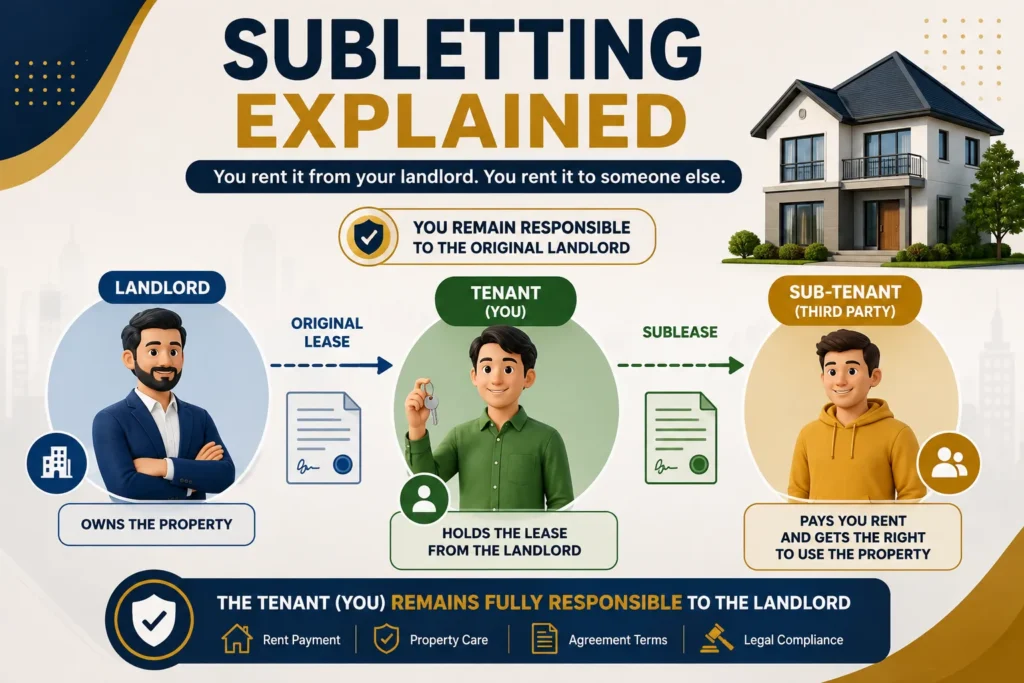
Subletting happens when a tenant rents out the whole or part of the property they have leased to a third party, called the sub-tenant, while continuing to hold the original lease. The tenant becomes the landlord to the sub-tenant, but stays legally responsible to the original landlord.
Three related concepts often get confused:
| Arrangement | Who holds the tenancy? | Who is liable to the original landlord? |
|---|---|---|
| Subletting | Original tenant retains lease, creates a new one below | Original tenant remains fully liable |
| Assignment | Original tenant transfers all rights and exits | New tenant steps in and becomes liable |
| Roommate or licence | No new tenancy created, occupant is a licensee | Original tenant remains solely liable |
The distinction matters because it decides who can be sued when rent goes unpaid or the property is damaged. A pure roommate arrangement, where a friend contributes to rent without any independent occupancy right, is usually not treated as subletting. A short-term Airbnb guest for two nights is not a sub-tenant. But the moment the third party gets exclusive possession of a room or the flat for a defined period, it starts looking like a sublease in the eyes of the law.
The Legal Framework: Which Laws Govern Subletting in India?

Subletting sits at the intersection of a central act, one central template, and 28 state rent laws. Four provisions do most of the work.
Section 108(j) of the Transfer of Property Act, 1882: This is the default rule. A lessee may transfer their interest, mortgage the leasehold, or sublet the whole or any part of the property. The critical qualifier is "unless expressly prohibited by the lease." Almost every modern rent agreement expressly prohibits subletting without written consent, which overrides the default.
Section 111(e) of the Transfer of Property Act, 1882: This is the enforcement side of the same law. If a tenant sublets in breach of the agreement, the landlord has the right to forfeit the lease and take back possession of the property. It is the legal basis for eviction on subletting grounds.
State Rent Control Acts: Every state has its own rent legislation, including the Maharashtra Rent Control Act, 1999, the Delhi Rent Control Act, 1958, the Karnataka Rent Act, 1999, and the Tamil Nadu Regulation of Rights and Responsibilities of Landlords and Tenants Act, 2017. All of them treat unauthorised subletting as one of the strongest grounds for evicting a tenant, even when the tenant otherwise enjoys rent control protection.
Model Tenancy Act, 2021: Under the MTA, subletting is prohibited unless the tenant enters into a supplementary agreement with the landlord and files intimation with the Rent Authority within 30 days. States that have adopted the MTA, including Andhra Pradesh, Tamil Nadu, and Uttar Pradesh, now follow this three-step compliance chain.
Courts have reinforced this framework repeatedly. In Ram Murti Devi v. Pushpa Devi (2017), the Supreme Court confirmed that once a landlord shows a third party has the tenanted premises, the burden shifts to the tenant to prove the arrangement is not a sublease.
When is Subletting Allowed?
Subletting is legally allowed in India in exactly three situations.
- The rent agreement expressly permits it: Some commercial and shared-accommodation agreements include a clear subletting clause, sometimes with conditions like the landlord's approval of the sub-tenant.
- The landlord gives prior written consent: A signed letter, an email trail, or a supplementary agreement all count. Verbal consent is technically valid but almost impossible to prove in court.
- The lease is silent, and Section 108(j) applies: This is rare in the residential market. Most professionally drafted agreements block subletting from the start.
Even where subletting is permitted, three practical layers still apply: the housing society's bylaws may restrict short-term guests or commercial use, the local municipal authority may require a licence for paying-guest or short-stay operations, and the income from the sub-tenant must be declared in the tenant's tax return.
What Happens If You Sublet Without Permission?
Unauthorised subletting is one of the fastest routes to losing a rental home in India. Four consequences typically follow.
Eviction: Every state rent law treats unauthorised subletting as a valid ground for eviction, and courts have consistently backed landlords on this. Even where the tenant has stayed in the property for decades, an unauthorised sublease can undo statutory protection overnight.
Financial penalties: Karnataka has proposed hiking the penalty for unauthorised subletting from Rs 5,000 to Rs 50,000, or double the rent received from the sub-tenant. Landlords convicted of demanding money for granting sublet consent may face fines up to Rs 30,000 under the same amendment. Other states have their own penalty structures, but the direction of travel is uniformly stricter.
Loss of security deposit: Landlords routinely retain the entire security deposit as compensation for the unauthorised arrangement and any related damage.
Civil suit for damages: The landlord can sue the original tenant for any loss caused by the sub-tenant, including property damage, unpaid utilities, and legal costs.
If a landlord discovers an unauthorised sublet, the typical response is a legal notice giving the tenant 15 to 30 days to end the arrangement, followed by an eviction petition in the appropriate rent court if the notice is ignored.
How to Sublet Legally: A Step-by-Step Process
If the tenant genuinely needs to sublet, the correct process protects everyone involved.
- Read the rent agreement first: Check whether subletting is expressly prohibited, permitted with conditions, or unaddressed. This decides the negotiating position.
- Approach the landlord in writing: Explain the reason, the duration, and the proposed sub-tenant's identity and background. A short email works better than a phone call because it starts a paper trail.
- Get written consent: Ask for either a signed letter of consent or a supplementary agreement executed on stamp paper. Verbal permission is not enough.
- Draft a sub-tenancy agreement: The document should cover rent, term, deposit, notice, and clearly state that the original lease and its house rules continue to apply.
- Notify the society or RWA: Many cooperative housing societies require pre-approval for any new occupant. Skipping this creates a parallel line of complaints.
- File intimation with the Rent Authority:: Where the Model Tenancy Act applies, the tenant must inform the Rent Authority within 30 days of the sublease being executed.
- Declare the income: Sublet income is taxable in the original tenant's hands and must be declared in the annual ITR to avoid a mismatch with the sub-tenant's rent payment record.
For a broader view of how rent agreements should be structured to include or exclude a subletting clause, Housewise has ready templates in the Sample Rent Agreements and Templates guide.
Special Cases: PG, Airbnb, and Roommates
Three arrangements sit in a grey zone and are worth calling out.
PG or paying guest: A tenant who rents out a room in the leased flat to a paying guest is subletting for legal purposes, even if the arrangement is casual. Most landlord agreements prohibit this, and running a PG usually needs a separate municipal licence and police verification of residents.
Airbnb and short-term rentals: Listing a rented flat on Airbnb without the owner's consent is unauthorised subletting. The landlord can use the listing itself as evidence in an eviction petition. Many housing societies also explicitly ban short-term commercial rentals, and municipal authorities can impose fines and shut down unlicensed operations. Undeclared Airbnb income adds a tax exposure on top.
Roommates: A friend or colleague sharing rent without a separate tenancy is usually a licensee, not a sub-tenant. The line gets thin when the roommate has exclusive use of a bedroom, pays a fixed monthly amount, and is treated by neighbours as a resident in their own right. In doubt, a written intimation to the landlord is still the safer path.
Rights of the Sub-Tenant
A sub-tenant's rights are always weaker than those of a primary tenant, and even weaker when the sublease was unauthorised. Broadly:
- A sub-tenant can occupy the property only for as long as the original lease is valid. If the primary lease ends or is forfeited, the sublease ends with it.
- A sub-tenant cannot claim any direct tenancy right against the original landlord unless the landlord has expressly accepted them.
- If the landlord evicts the primary tenant for unauthorised subletting, the sub-tenant loses possession without any independent remedy against the owner.
- The sub-tenant can, however, sue the original tenant for any deposit and unfulfilled contractual obligations.
Why Most Landlords Say No to Subletting
From the owner's side, the reluctance is not arbitrary. Once a third party is in possession, control over property use dilutes. Society complaints often trace back to unknown occupants. Deposits become harder to enforce. Insurance and municipal compliance can be affected. And in states with rent control protection, extended possession by a sub-tenant can occasionally give rise to claims that complicate eviction later. For owners weighing whether a leave and license structure gives them tighter control than a full rent agreement on issues like subletting, the Leave and Licence vs Rent Agreement guide covers the difference in practical terms.
How Housewise Helps Owners and Tenants Handle Subletting
Housewise drafts and stamps rent agreements across 23 Indian cities with clearly worded clauses on subletting, house rules, and permitted occupants. Owners who want to allow limited subletting can build the conditions into the original agreement instead of dealing with disputes later. Tenants planning a legitimate sublease can request a supplementary agreement on stamp paper with proper registration where the state requires it. The online rent agreement service covers state-appropriate templates and workflows. Owners looking to avoid common drafting oversights in this area can also check the Common Mistakes in Rent Agreements guide before signing.
Frequently Asked Questions
Can a tenant sublet a property in India without the landlord's permission?
No, in almost every practical situation. While Section 108(j) of the Transfer of Property Act allows subletting by default, this right is overridden by the standard "no subletting without written consent" clause in modern rent agreements and by every state Rent Control Act in force.
What is the difference between subletting and assignment?
In subletting, the original tenant keeps the lease and creates a new tenancy below with a sub-tenant. In assignment, the tenant transfers all rights and exits completely. Both usually need landlord consent, but assignment ends the original tenant's liability while subletting does not.
Is Airbnb legal for tenants in India?
Listing a rented property on Airbnb without written consent from the landlord is unauthorised subletting and grounds for eviction. Most housing societies also ban short-term rentals, and municipalities can require a licence. Undeclared Airbnb income creates a separate tax exposure.
Can a tenant rent out one room to a paying guest?
Only if the rent agreement permits it or the landlord gives written consent. Running a PG from a rented flat also usually needs a municipal licence, police verification of residents, and society approval. Most standard residential agreements prohibit this outright.
What happens if a tenant sublets without permission?
The landlord can issue a legal notice, evict the tenant on the ground of unauthorised subletting under state rent law, retain the security deposit, and sue for damages. Some states, like Karnataka, are hiking financial penalties for unauthorised subletting to Rs 50,000.
Does the Model Tenancy Act allow subletting?
Yes, but only with a supplementary agreement signed by the landlord and tenant, and intimation to the Rent Authority within 30 days of execution. Without both steps, any sublet under the MTA is unauthorised and can trigger eviction proceedings.
What rights does a sub-tenant have in India?
A sub-tenant's rights are limited to the duration of the original lease. If the primary lease ends or is forfeited due to subletting, the sub-tenant loses possession with no direct claim against the landlord, though they can sue the original tenant for deposit refund.
Do I need to register a sub-lease agreement?
Registration follows the same state rules as any lease. In Maharashtra, every leave and license agreement, including a sublease, must be registered. In most other states, registration becomes mandatory if the sublease term exceeds 11 months, but stamp duty applies to shorter agreements too.
Is a roommate considered a sub-tenant?
Usually not. A roommate who informally shares rent is treated as a licensee, not a sub-tenant. The classification changes if the roommate has exclusive use of a room, pays a fixed amount, and is treated as an independent occupant.
How does Housewise help with subletting-related clauses in rent agreements?
Housewise drafts and stamps rent agreements across 23 Indian cities with clearly worded subletting clauses, house rules, and permitted-occupant terms. Owners can restrict or allow subletting through the original agreement, and tenants can execute supplementary agreements on stamp paper.


0 Comments