

Reviewed and updated on 22 November 2026. The tax rates, TDS rules, exemptions and forms in this guide have been checked against the law in force today, including the Income-tax Act, 2025, which applies from 1 April 2026.
When an NRI sells property in India, the profit is taxed as a capital gain, and the buyer must deduct tax at source from the sale price. Here is how the tax, TDS, exemptions and repatriation work today, including the changes from 23 July 2024 and the new Income-tax Act from 1 April 2026.
Understanding Capital Gains Tax:
Live abroad? Housewise manages property in India for 5,500+ NRI owners in 45+ countries. See our NRI property management services.
1. Short-Term Capital Gains (STCG):
- Definition: If the property is held for 24 months or less before the sale, it is a short-term capital asset.
- Tax Rate: These gains are added to the NRI's total income and taxed at the applicable slab rates, plus surcharge and cess.
- Computation: The gain is calculated by subtracting the cost of acquisition and improvement from the sale price.
2. Long-Term Capital Gains (LTCG):
- Definition: If the property is held for more than 24 months before the sale, it is a long-term capital asset.
- Tax Rate: For sales on or after 23 July 2024, the gains are taxed at 12.5% without indexation (plus surcharge and cess). NRIs do not get the option of 20% with indexation that resident individuals have for property bought before that date.
- Computation: The gain is the sale price minus the cost of acquisition, the cost of improvement and the expenses of the sale. There is no indexation.
Tax Deducted at Source (TDS):
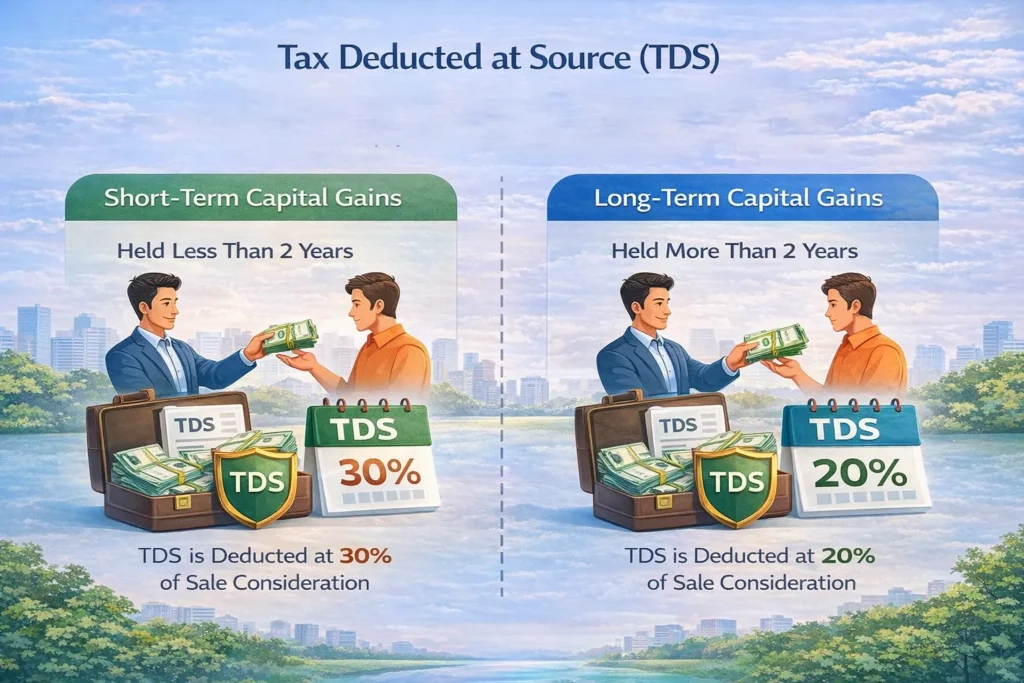
When an NRI sells property in India, the buyer must deduct TDS before making the payment. The applicable TDS rates are:
- For Short-Term Capital Gains: TDS is deducted at 30% of the sale consideration, plus surcharge and cess.
- For Long-Term Capital Gains: TDS is deducted at 12.5% of the sale consideration, plus surcharge and cess (20% for sales before 23 July 2024).
Buyer’s Responsibility:
- TAN or PAN: Since 1 October 2026, a buyer who is a resident individual or HUF can deduct and deposit the TDS with their PAN through Form 141 (Schedule E). Other buyers must obtain a Tax Deduction and Collection Account Number (TAN).
- Deduct TDS: The buyer should deduct TDS at the applicable rate from the sale consideration.
- Deposit TDS: Buyers using their PAN deposit it through Form 141. Buyers with a TAN pay through Challan ITNS 281 by the 7th of the following month and file a quarterly TDS return (Form 27Q, now Form 144).
- Issue TDS Certificate: The buyer gives the NRI seller the TDS certificate downloaded from TRACES, which the seller uses to claim credit in their return.
Lower TDS Certificate:
NRIs who believe their total tax liability is lower than the TDS being deducted can apply for a lower TDS certificate. The process involves:
- Application: Apply online to the income tax department (Form 13 until 31 March 2026, Form 128 from tax year 2026-27), with the sale agreement, purchase details and a computation of capital gains.
- Approval: If approved, the assessing officer will issue a certificate specifying a lower TDS rate.
- Implementation: Provide this certificate to the buyer, allowing them to deduct TDS at the reduced rate.
Capital Gains Exemption:
NRIs can claim exemptions on long-term capital gains under certain sections:
1. Section 54:
- Eligibility: If the capital gains are reinvested in another residential property within two years of the sale or if a new property is constructed within three years. The new property must be in India, and the exemption is capped at ₹10 crore of capital gains.
- Conditions: The exemption is proportional to the amount of capital gains reinvested.
2. Section 54EC:
- Eligibility: If the capital gains are invested in specified bonds (e.g., NHAI or REC) within six months of the sale.
- Holding Period: The investment should be held for at least five years.
- Limit: Maximum investment limit is Rs. 50 lakh.
Repatriation of Sale Proceeds
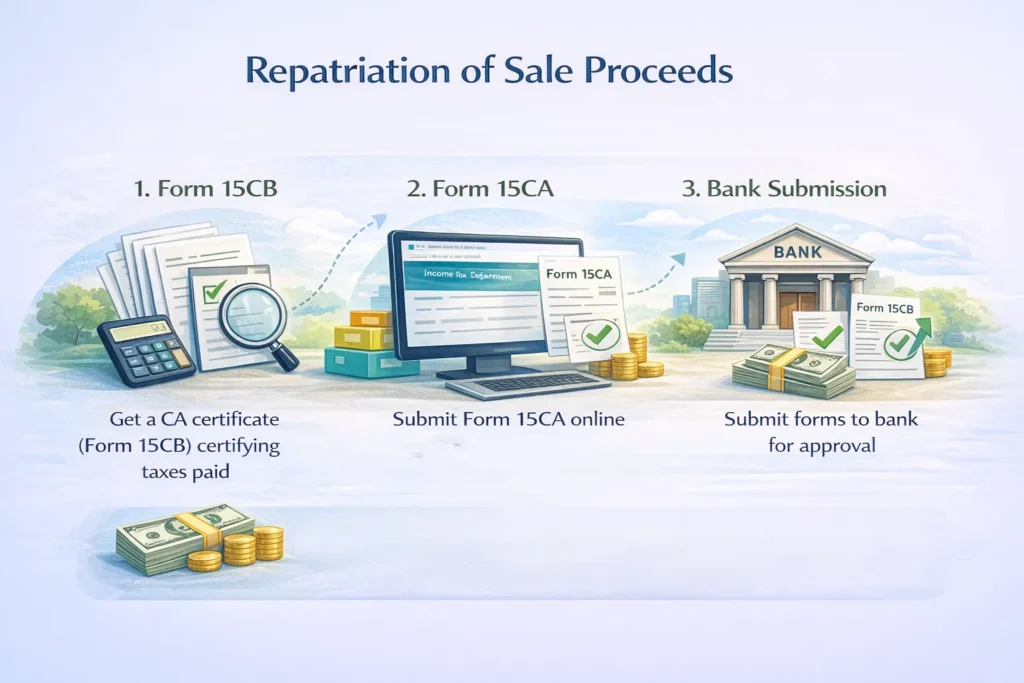
NRIs can repatriate the proceeds from the sale of property, subject to certain conditions:
- Form 15CB: Obtain a certificate from a chartered accountant (Form 15CB, now Form 146 from 1 April 2026), certifying that taxes have been paid.
- Form 15CA: Submit the remittance declaration online (Form 15CA, now Form 145) on the income tax portal, along with the chartered accountant's certificate.
- Bank Submission: Submit these forms to the bank for approval to facilitate the repatriation process. NRIs can repatriate up to USD 1 million per financial year, provided all taxes are duly paid.
Filing Income Tax Return:
NRIs must file an income tax return in India if they have sold property during the financial year. This return should detail the property sale, capital gains, and taxes paid. Filing the return ensures compliance with Indian tax laws and allows for claims of any eligible refunds.
Conclusion:
Navigating the tax implications for NRIs selling property in India requires a clear understanding of capital gains tax, TDS requirements, potential exemptions, and the repatriation process. By adhering to these regulations and maintaining proper documentation, NRIs can ensure a smooth and compliant transaction, ultimately maximizing their financial returns. Proper planning and consulting with tax experts can further simplify the process and help avoid any legal complications. By staying informed and proactive, NRIs can make informed decisions and successfully manage the sale of their property in India.
Also Read: Navigating Through Section 54 of the Income Tax Act with Housewise: A Guide to Financial Savvy
Also Read: How to Pay Property Tax in Hyderabad


0 Comments
Trackbacks/Pingbacks