
You bought a rental property. Congratulations.
Now the phone rings at 2 AM. The toilet is overflowing. The tenant is angry. You need to find a plumber right now.
Welcome to landlord life.
I have been there myself. My first rental property seemed like a smart investment. What I did not expect was the constant stream of problems. Late night calls. Tenant disputes. Maintenance emergencies. The list never ended.
After six months of sleepless nights, I started wondering about hiring help. Could a property manager fix this mess? Would it cost too much? Was it even worth it?
If you are asking the same questions, you came to the right place.
In this guide, I will walk you through the pros and cons of hiring a property manager. We will look at costs, benefits, drawbacks, and real situations where each choice makes sense. By the end, you will know whether property manager vs self management works for your situation.
Let us dive in.
What Does a Property Manager Do?
Before we weigh the pros and cons, you need to understand the job.
A property manager: handles the day-to-day operations of rental properties. Think of them as your replacement. They do the work so you do not have to.
Here is what they typically handle:
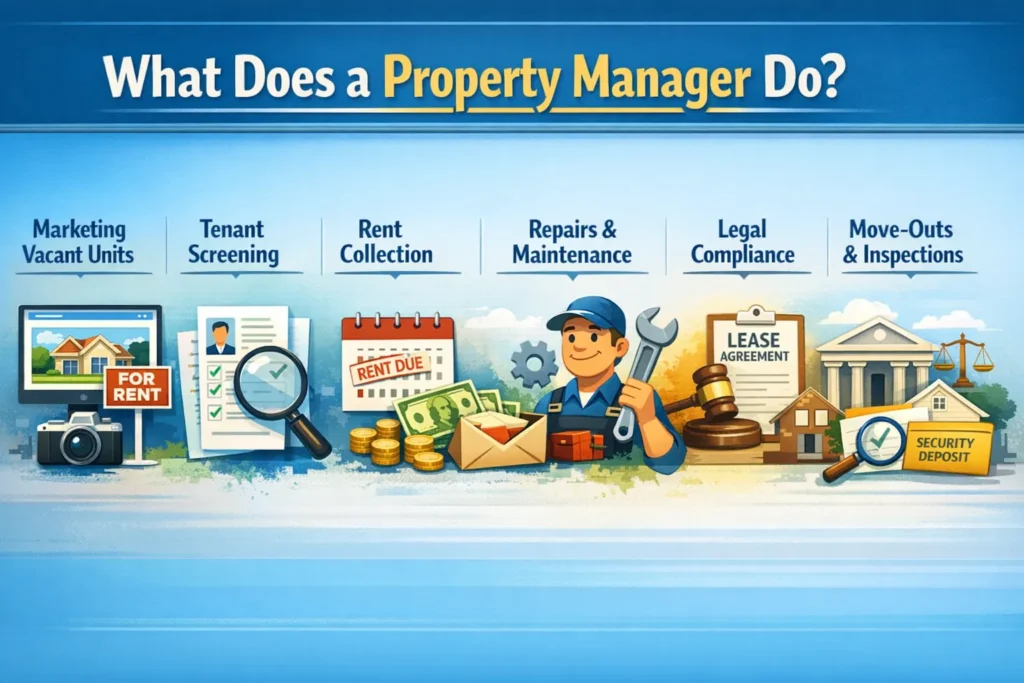
Marketing vacant units: They list your property on rental sites. They take photos. They write descriptions. They set up showings.
Screening tenants: This is huge. They run background checks. They verify income. They call previous landlords. They check credit scores. They separate good applicants from potential problems.
Collecting rent: They send reminders. They process payments. They chase late payers. They handle the awkward money conversations.
Managing repairs and maintenance: When something breaks, they find someone to fix it. They get quotes. They schedule the work. They make sure it gets done right.
Handling legal compliance: They know landlord-tenant laws. They prepare leases that hold up in court. They follow proper eviction procedures if things go wrong.
Dealing with move-outs: They inspect the unit. They calculate security deposit returns. They get the place ready for the next tenant.
How property managers help with tenants, rent collection, and maintenance is straightforward. They become the point of contact for everything. Your tenants call them instead of calling you.
Sounds good, right? But here is the catch. It costs money.
Cost of Hiring a Property Manager
Nothing in life is free. Property management comes with fees.
Most companies charge a percentage of your monthly rent. The typical range is 8 to 12 percent. If your rent is $2,000 per month, you pay $160 to $240 every single month.
But that is not the only cost.
Many companies charge additional fees on top of the monthly percentage. These can include:
Tenant placement fee. This covers finding and screening a new tenant. It might be one month’s rent or a flat fee. You pay this when the unit turns over.
Lease renewal fee. Some managers charge when a tenant signs a new lease. Yes, even for keeping the same tenant.
Maintenance coordination fee. They might add a markup on repairs. If a plumber charges $300, the manager bills you $330.
Inspection fees. Some charge for regular property inspections.
Early termination fee. If you fire them, you might pay a penalty.
The cost of property management fees percentage of rent varies by location and company. In expensive cities, fees run higher. For multiple units, you might negotiate lower rates.
I once asked a property manager how much do property managers charge for a duplex I owned. The quote came back at 10 percent monthly plus a $500 leasing fee. I did the math. That was nearly $3,000 per year. I decided to keep managing it myself.
But money is not everything. Sometimes paying the fee makes sense. Let us look at why.
Pros of Hiring a Property Manager
Professional Tenant Screening
Bad tenants destroy rental properties. They stop paying rent. They damage the unit. They cause legal headaches. They make your life miserable.
How property managers screen tenants reduces this risk significantly.
They run credit checks. They verify employment. They call references. They look for past evictions. They spot red flags that amateurs miss.
I once tried to screen a tenant myself. The guy seemed great. Good job. Nice personality. Paid the deposit immediately. Three months later, he stopped paying rent. I later found out he had been evicted from two previous apartments. I simply did not know how to check properly.
Professional managers know the warning signs. They protect you from problem tenants before they move in.
Efficient Rent Collection
Money only matters if you actually collect it.
Property managers set up systems for consistent payments. Tenants get automatic reminders. They have online payment options. They know late fees apply immediately.
When tenants fall behind, managers handle the awkward conversations. They send the formal notices. They start the eviction process if needed.
You never have to say, “Hey, you are late on rent again.” The manager handles that stress for you.
Maintenance and Repairs Management
Things break. It happens every single time.
When a toilet leaks at 10 PM, someone needs to fix it. When the heater dies in winter, tenants expect immediate action. When the roof starts dripping, you cannot wait until next week.
Property managers have vendor networks. They know plumbers who work late. They have electricians who answer weekend calls. They get better prices because they send steady business to these contractors.
The manager handles the chaos. You sleep through the night.
Reduced Vacancy Rates
Empty units cost you money. Every day without a tenant is lost income.
Property managers understand local rental markets. They know what rent to charge. They know how to market your property. They know what photos attract attention. They know how to stage showings for success.
Their goal is simple. Keep your unit occupied. They only get paid when you have paying tenants.
Legal Compliance and Landlord Protection
Landlord-tenant laws are complicated. They change frequently. They vary by city and state. Getting them wrong can cost you thousands.
Property managers stay current on regulations. They know what lease clauses are enforceable. They understand eviction procedures. They know security deposit rules. They handle fair housing compliance.
Legal compliance and landlord protection might be the most valuable service they provide. One lawsuit can wipe out years of rental profits.
Ideal for Long-Distance Landlords
This one hits close to home. I moved three hours away from my first rental property. Suddenly, I could not just drive over when something broke. I could not show the unit to prospective tenants. I could not handle emergencies personally.
Benefits of hiring a property manager for out of state landlords are obvious. You cannot be there. Someone needs to be.
If you live far from your property, a manager is almost essential. Trying to manage remotely leads to stressed tenants and neglected maintenance.
Time Freedom
Think about your time. What is it worth?
Every hour spent on tenant issues is an hour away from your family, your job, your hobbies. Property management is not a nine-to-five job. Problems happen at night. They happen on weekends. They happen during your vacation.
A property manager buys back your time. You get to live your life while they handle the headaches.
Cons of Hiring a Property Manager
Management Fees
Here is the obvious one. It costs money.
That cost of property management fees comes straight out of your cash flow. If your property barely breaks even, those fees might push you into the red.
Let me give you a real example. A friend owns a small house renting for $1,400 per month. His mortgage is $1,100. Taxes and insurance add another $200. His monthly profit is $100. A property manager would charge $140 per month. That turns his $100 profit into a $40 loss.
For some properties, the math simply does not work.
Loss of Control
When you hire a manager, you stop making decisions.
They choose the tenants. They set the rent (within your guidelines). They approve repairs. They decide when to evict. You become an observer rather than an operator.
Some landlords hate this. They want final say on everything. They want to pick their own tenants. They want to approve every repair over $100.
If you are a control-oriented person, handing over the reins feels uncomfortable. You might constantly second-guess their choices.
Potential Communication Delays
Here is a scenario. Your tenant has an issue. They call the manager. The manager takes a message. The manager calls you for approval. You do not answer. The manager calls back the tenant tomorrow.
Simple problems become complicated. Urgent issues get delayed. The chain of communication slows everything down.
Tenants get frustrated when they cannot reach the owner directly. They feel like their concerns are ignored, even when the manager is handling them properly.
Quality Depends on the Company
Not all property managers are created equal.
Some are excellent. They communicate well. They handle problems quickly. They keep your property in great shape. They find quality tenants.
Others are terrible. They ignore tenant calls. They delay maintenance. They rent to anyone with a pulse. They lose money through poor management.
The drawbacks of hiring a property manager often come down to choosing the wrong company. A bad manager causes more problems than managing yourself.
They May Not Care Like You Do
Here is the hard truth. It is your property. It is their job.
You care about every scratch on the floor. You care about the landscaping. You care about the long-term condition of the building.
For the property manager, it is one of many properties. They do not have the same emotional investment. They might approve repairs that only fix the immediate problem rather than addressing the root cause.
Potential Hidden Fees
Remember those extra charges we discussed? They add up.
Some companies charge for every little thing. Leasing fees. Renewal fees. Inspection fees. Maintenance markups. You might sign up expecting 10 percent and end up paying 15 percent after all the extras.
Always read the contract carefully. Ask about every possible fee before signing.
Property Manager vs Self Management: Which Is Better?
Let us compare side by side.
| Factor | Self-Management | Property Manager |
|---|---|---|
| Time commitment | High. You handle everything. | Low. You stay in the background. |
| Monthly cost | No management fees. | 8 to 12 percent of rent plus fees. |
| Control | Complete control over all decisions. | Shared control with manager making most calls. |
| Expertise | You learn as you go. Mistakes happen. | Professional experience with systems in place. |
| Availability | You must be available 24/7. | Manager handles after-hours calls. |
| Tenant screening | You do your best with available tools. | Professional screening with proven methods. |
| Legal knowledge | Risk of missing legal requirements. | Stay compliant with current laws. |
| Stress level | Direct exposure to all problems. | Problems get filtered through manager. |
The property manager vs self management which is better question has no universal answer. It depends entirely on your situation.
When Hiring a Property Manager Is Worth It
Let me give you specific situations where hiring makes sense.
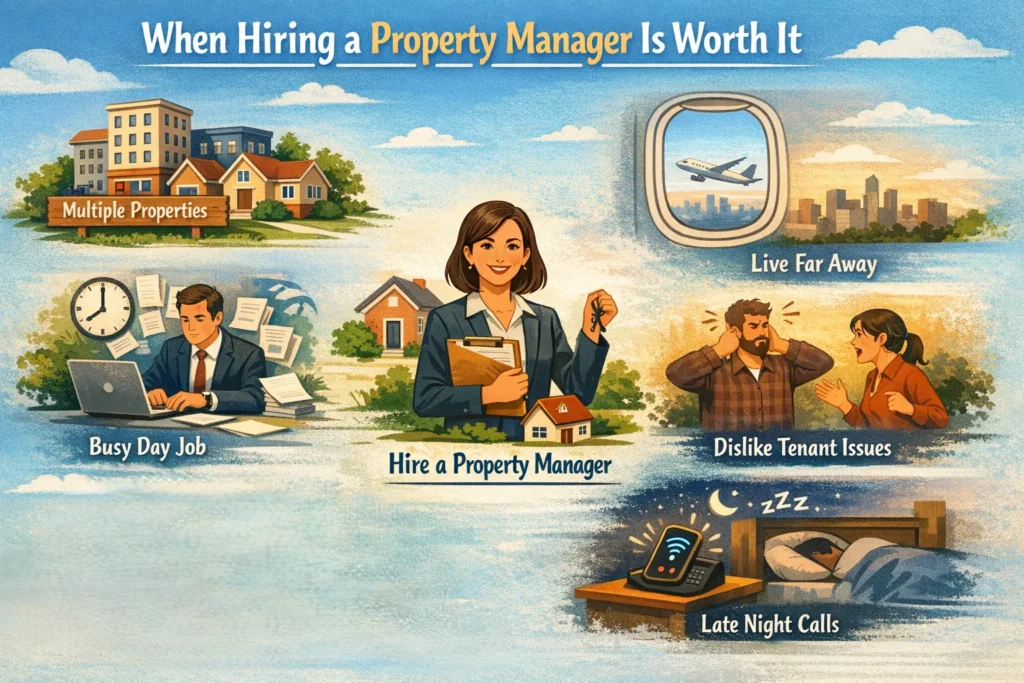
You own multiple properties. One property is manageable. Five properties become a full-time job. At some point, you cannot be everywhere at once.
You live far away. If you cannot reach the property within an hour, you need someone local. Emergencies do not wait for your next visit.
You have a demanding day job. If you work long hours or travel frequently, you cannot drop everything for tenant issues.
You hate dealing with people. Some landlords simply dislike tenant interactions. The constant communication wears them down. That is okay. Hire someone who enjoys it.
You are tired of late night calls. Sleep is valuable. Peace of mind is valuable. Paying someone else to take the calls might be worth every penny.
Is hiring a property manager worth it for small landlords? For a single property, maybe not. For two or three, the math starts shifting. For five or more, it becomes almost necessary.
When Self-Managing May Be Better
Self-management works well in these scenarios.
You own one property. The workload is manageable. The fees would eat a significant portion of your profit.
You live nearby. Being close means you can handle showings and emergencies yourself.
You have flexible time. If your schedule allows quick responses, you can manage effectively.
You want maximum profit. Every dollar counts. Keeping the management fee in your pocket improves your returns.
You enjoy the work. Some landlords genuinely like managing properties. They like fixing things. They like meeting tenants. If that sounds like you, keep doing it.
Real-World Benefits of Property Management
I have seen both sides work well and work poorly.
A landlord I know owned four units in a rough neighborhood. He managed them himself for years. Constant problems. Constant stress. Constant tenant turnover. He finally hired a manager.
The difference was dramatic. The manager implemented better screening. They found more stable tenants. They handled maintenance proactively. Vacancies dropped. Profits increased.
Real examples of higher rent and lower vacancy after hiring a property manager are common. Professional management often pays for itself through better results.
Another landlord I know had the opposite experience. He hired a cheap manager who did almost nothing. Tenants complained constantly. Maintenance got delayed. The property fell into disrepair. He fired them and went back to self-management.
The lesson is simple. A good manager is worth the cost. A bad manager is worse than none at all.
Questions to Ask Before Hiring a Property Manager
If you decide to hire, ask these questions first.
What services are included in your monthly fee? Get everything in writing. Know exactly what you pay for.
What is your tenant screening process? Do they check credit? Income? Rental history? Criminal background? How thorough are they?
How do you handle maintenance requests? Do they have approved vendors? Do they get multiple bids? How quickly do they respond?
What is your eviction process? Have they done evictions before? Do they know the local laws? How do they handle non-paying tenants?
How often will I receive financial reports? Monthly statements? Online access? What information will you see?
How do you handle security deposits? Where is the money held? How are deductions handled?
What are all your fees? Ask about leasing fees, renewal fees, inspection fees, maintenance markups. Leave nothing hidden.
Questions to ask before hiring a property management company separate good companies from bad ones. Take your time. Get references. Check reviews. Choose carefully.
Signs You Should Hire a Property Manager
How do you know it is time? Look for these signs.
Managing tenants feels overwhelming. Every phone call makes you cringe. You dread dealing with people.
Maintenance issues keep piling up. You cannot keep up with repairs. Things stay broken longer than they should.
You own multiple rental units. The workload multiplies with each property.
You moved away from your property. Distance makes management much harder.
Your rental business is growing. Success creates more work. More work requires more help.
You are tired of being on call. You want evenings and weekends back.
When should a landlord stop self managing and hire a property manager? When the stress outweighs the savings. When your time becomes more valuable than the fees. When you stop enjoying the work.
Tips for Choosing the Right Property Manager
Check their reputation. Read online reviews. Talk to current clients. Visit properties they manage.
Verify licensing and experience. Some states require licenses. Ask how long they have been in business.
Understand their pricing. Get a complete fee schedule. Know what triggers additional charges.
Test their communication. Call them. See how quickly they respond. This tells you how they will treat your tenants.
Meet the actual manager. Not the salesperson. Not the owner. The person who will handle your property day to day.
Review the management agreement carefully. Understand termination clauses. Know your rights. Get everything in writing.
Conclusion
Here is the bottom line.
Hiring a property manager offers professional expertise, time savings, and legal protection. You trade money for peace of mind. You hand over headaches in exchange for reduced stress.
But the management fees and reduced control are real considerations. You pay for the help. You let go of decisions. You trust someone else with your investment.
Every landlord must weigh these factors differently. Your time matters. Your stress matters. Your profit matters. Your personality matters.
Evaluate your property portfolio, time availability, and management skills before deciding. Run the numbers. Consider your tolerance for tenant drama. Think about your long-term goals.
For some landlords, self-management works perfectly. For others, hiring a professional is the best decision they ever made.
Only you can decide which path fits your life.
The pros and cons of hiring a property manager are clear. The choice is yours.
FAQs
Is hiring a property manager worth it?
Yes for busy, remote, or multi-property landlords. No for hands-on owners with one nearby property. It depends on your time, stress levels, and profit goals.
How much do property managers charge?
Most charge 8 to 12 percent of monthly rent. Additional fees for leasing, renewals, and maintenance are common. Total costs typically range from 10 to 15 percent.
What does a property manager do?
They handle tenant screening, rent collection, maintenance coordination, legal compliance, and move-out inspections. They become the main contact so you don’t have to.
Can a property manager increase my rental income?
Yes. Professional pricing strategies, better marketing, and reduced vacancies often lead to higher net income despite management fees. Good managers earn their keep.
What are the disadvantages of hiring a property manager?
Management fees reduce profits. You lose some control over decisions. Communication delays can frustrate tenants. Quality varies greatly between companies.
How do property managers screen tenants?
They run credit and background checks. They verify income and employment. They call previous landlords. They look for past evictions or rental problems.
Should I hire a property manager for one rental property?
For many owners, managing one property is manageable. But if you live far away or hate landlord duties, hiring help still makes sense despite the cost.
How do I choose a good property manager?
Check online reviews. Interview multiple companies. Ask for references. Visit properties they manage. Review their contract carefully. Test their communication responsiveness.
What questions should I ask before hiring?
Ask about all fees, tenant screening process, maintenance handling, eviction experience, financial reporting, and what services are included in the monthly fee.
When should I stop self-managing and hire a property manager?
When stress outweighs savings. When you own multiple properties. When you move away. When you’re tired of late night calls. When your time becomes more valuable than the fees.


0 Comments