
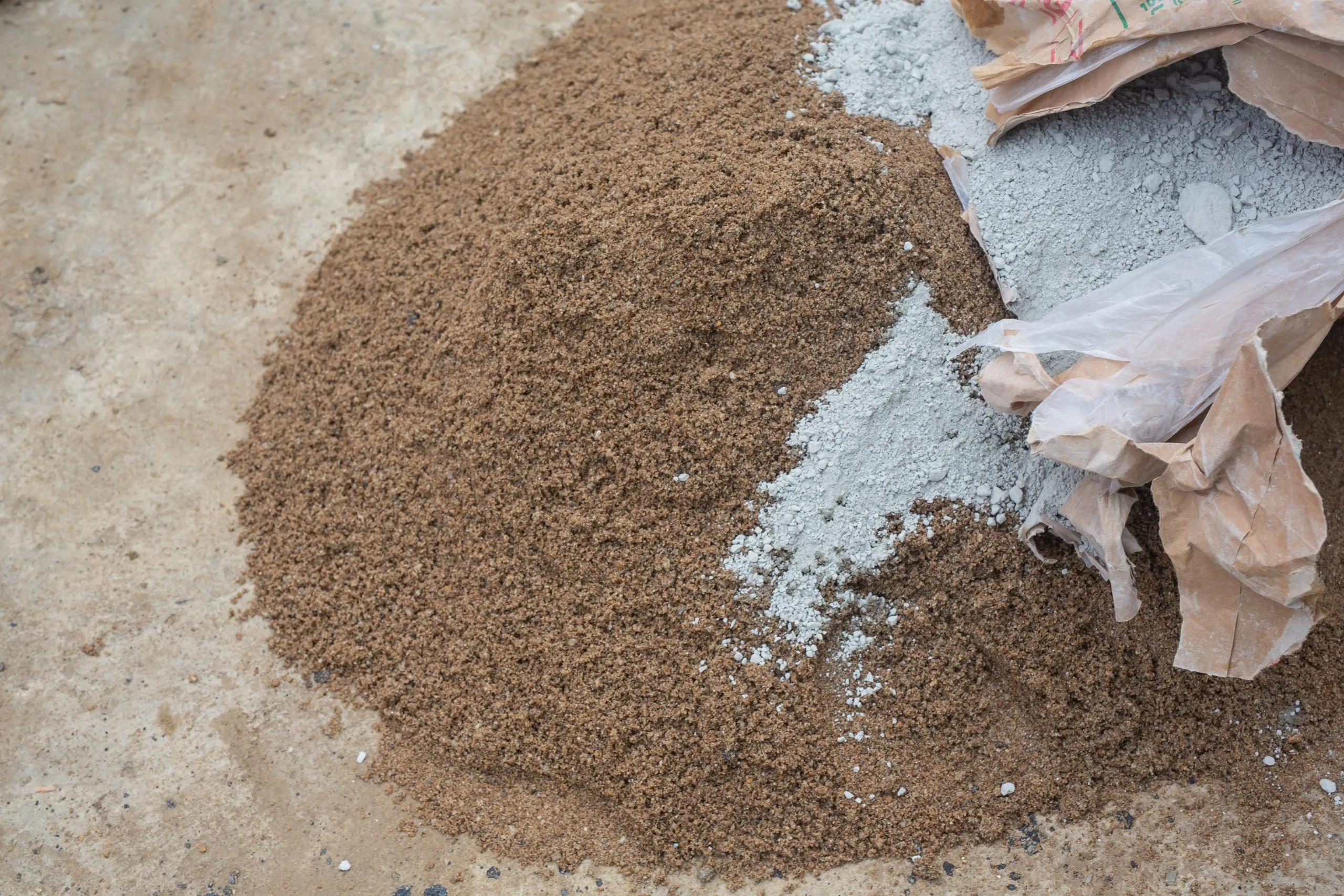
Let’s talk concrete.
Specifically, let’s talk about M20 concrete. If you’re a civil engineering student, a new site engineer, or even a homeowner planning a small project, this is the grade you’ll hear about the most.
It’s the backbone of modern construction.
This guide will show you exactly what the M20 concrete ratio is. We’ll then walk through a simple, step-by-step calculation to figure out how much cement, sand, and aggregate you need for 1 cubic meter (1m³) .
No complex jargon. Just clear, practical information you can use on site.
The Basics: What is M20 Concrete?
Before we start calculating, let’s understand what we’re working with.
M20 concrete is a standard grade of concrete. The ‘M’ stands for Mix. The number ’20’ represents its compressive strength. In simple terms, after 28 days of curing, a properly mixed M20 concrete cube can withstand a crushing pressure of 20 Megapascals (MPa) or roughly 20 Newtons per square millimeter.
Think of it like this. If you had a 1-inch by 1-inch cube of hardened M20 concrete, it could support the weight of a small car without breaking.
The Standard M20 Concrete Ratio
The nominal mix ratio for M20 grade concrete is:
1 : 1.5 : 3
This ratio is the secret recipe. It breaks down like this:
- 1 part Cement
- 1.5 parts Fine Aggregate (Sand)
- 3 parts Coarse Aggregate (Gravel/Stone)
Why is M20 So Popular?
You’ll find M20 concrete everywhere. It’s the go-to grade for a reason.
- Strength: It provides a perfect balance of strength for residential and light commercial structures.
- Versatility: It’s suitable for slabs, beams, columns, and footings. It’s the workhorse of reinforced cement concrete (RCC) work.
- Cost-Effective: It gives you great performance without blowing your budget. It’s the sweet spot between affordability and durability.
The Raw Materials
To make M20 concrete, you need four key ingredients. It’s like baking a cake. You need the right ingredients in the right quantities to get a perfect result.
- Cement: The binding agent. It’s the glue that holds everything together.
- Fine Aggregate (Sand): This fills the voids between the larger stones. It ensures the mix is dense and workable.
- Coarse Aggregate: This is the skeleton of the concrete. It provides the main structural strength.
- Water: The catalyst. It activates the cement, starting a chemical reaction called hydration, which hardens the mix.
The Density of M20 Concrete
When we talk about 1 cubic meter of concrete, we often talk about its weight. The density of M20 concrete is approximately 2400 kg/m³.
So, if you were to pick up a cube of concrete that is 1 meter by 1 meter by 1 meter, it would weigh about 2.4 metric tons. That’s heavier than a small car.
The Main Event: Step-by-Step Calculation for 1m³
This is the part you came for. How do you calculate the exact amount of cement, sand, and aggregate to produce 1 cubic meter of M20 concrete?
Here’s a crucial thing to understand. The calculation isn’t a simple 1:1.5:3 of a cubic meter. We have to account for the dry volume of the materials.
When you mix dry materials like cement, sand, and aggregate with water, they don’t fill the space perfectly. The particles settle and the volume shrinks. This is a fact of construction life.
To get 1m³ of wet concrete, you need about 1.54m³ of dry materials. This is called the dry volume factor or bulking factor.
Let’s do this step-by-step.
Step 1 – Find the Dry Volume
Our target is to produce 1m³ of concrete.
Dry Volume = Wet Volume × 1.54 Dry Volume = 1 × 1.54 = 1.54 m³
This is the total volume of dry materials (cement, sand, aggregate) we will need.
Step 2 – Calculate the Total Parts
The M20 mix ratio is 1:1.5:3.
To find the total number of parts, you simply add them up.
Total Parts = 1 + 1.5 + 3 = 5.5 parts
Step 3 – Cement Calculation
Now, let’s find out how much cement we need. The cement is 1 part out of the total 5.5 parts.
Cement Volume = (Cement Part / Total Parts) × Dry Volume Cement Volume = (1 / 5.5) × 1.54 Cement Volume = 0.28 m³
Okay, we have the volume in cubic meters. But on a construction site, we don’t think in cubic meters of cement. We think in bags.
A standard cement bag in many parts of the world (like India) weighs 50 kg and has a volume of approximately 0.035 m³.
So, let’s find out how many bags that is.
Number of Bags = Cement Volume / Volume of 1 Bag Number of Bags = 0.28 m³ / 0.035 m³ per bag Number of Bags = 8 bags
You need approximately 8 bags of cement for 1m³ of M20 concrete.
Step 4 – Sand (Fine Aggregate) Calculation
Now, let’s calculate the sand.
Sand Volume = (Sand Part / Total Parts) × Dry Volume Sand Volume = (1.5 / 5.5) × 1.54 Sand Volume = 0.42 m³
You will need 0.42 cubic meters of sand.
Step 5 – Coarse Aggregate Calculation
Finally, the aggregate.
Aggregate Volume = (Aggregate Part / Total Parts) × Dry Volume Aggregate Volume = (3 / 5.5) × 1.54 Aggregate Volume = 0.84 m³
You will need 0.84 cubic meters of coarse aggregate.
The Final M20 Concrete Quantity Table for 1m³
Here’s a summary of everything you need in one simple table.
| Material | Quantity (approx) |
|---|---|
| Cement | 8 bags (50 kg each) |
| Sand | 0.42 m³ |
| Coarse Aggregate | 0.84 m³ |
| Water | 160–180 liters |
Water & Mix Design Nuances
We added water to the table above. But how much is the right amount? This is where the water-cement ratio comes in.
The M20 Water-Cement Ratio
The water-cement ratio is the weight of water divided by the weight of cement. It’s the single most important factor for concrete strength.
For M20 concrete, the water-cement ratio is typically between 0.45 and 0.55.
What does this mean in practice?
If you are using 8 bags of cement (8 x 50 kg = 400 kg), the water you should use is:
- Minimum water = 400 kg × 0.45 = 180 liters
- Maximum water = 400 kg × 0.55 = 220 liters
So, for 1m³ of M20 concrete, you’ll need roughly 180 liters of water.
Using too little water will make the concrete unworkable and difficult to place. Using too much water will weaken the final concrete, leading to cracks. It’s a delicate balance.
Nominal Mix vs. Design Mix
The 1:1.5:3 ratio we’ve been using is called a nominal mix. It’s a standard, time-tested recipe. It’s perfect for small to medium-sized projects where lab testing isn’t feasible.
For large, critical structures like high-rise buildings or bridges, engineers will perform a design mix. They’ll test the local materials in a lab to determine the most efficient and precise ratios. This ensures the concrete meets the exact required strength while optimizing cost.
Putting M20 Concrete to Work
Where is M20 Concrete Used?
You can’t go wrong with M20 concrete for most RCC work. Here are its common applications:
- Slabs: Floors, roofs, and pavements.
- Beams: The horizontal members that support the slab and transfer loads.
- Columns: The vertical members that hold up the structure.
- Footings: The base that spreads the building’s load to the soil.
- Retaining Walls: For landscaping or minor structural support.
Weight of 1 Cubic Meter of M20 Concrete
Remember the density we talked about? For quick reference, 1m³ of M20 concrete weighs about 2400 kg.
Cement Consumption
You can now say with confidence that the cement consumption for M20 concrete is approximately 8 bags per cubic meter.
The Cost of M20 Concrete
The cost of M20 concrete varies depending on where you are. But let’s break down the components so you can estimate for yourself.
M20 Concrete Rate per Cubic Meter
The total cost is a sum of:
- Material Cost: Cement, sand, aggregate, and water.
- Labor Cost: Mixing, placing, and compacting the concrete.
- Equipment Cost: Mixer machine rental, vibrator use.
- Overheads: Transportation and other site costs.
A Sample Cost Breakdown (for estimation only)
Let’s assume approximate prices:
- Cement: $6 per bag (8 bags) = $48
- Sand: $40 per m³ (0.42 m³) = $17
- Aggregate: $35 per m³ (0.84 m³) = $30
- Labor & Equipment: A rough estimate could be $20-$40 per m³.
A rough total for materials alone could be around $95-$100 per m³. Adding labor can push it to $120-$150 per m³. Always check current local prices for a real estimate.
Avoiding Common Calculation Mistakes
I’ve seen people make these mistakes. It’s easy to do, but avoiding them will save you time, money, and a lot of stress.
Common Mistakes in M20 Concrete Calculation
- Ignoring the Dry Volume Factor: This is the number one mistake. If you just add up 1m³ of materials based on the ratio, you’ll end up with only about 0.65 m³ of concrete. Always multiply by 1.54.
- Wrong Ratio: I once saw a team use a 1:1:3 ratio, thinking it was stronger. They ended up with a mix that was too rich in cement, which led to shrinkage cracks. Stick to the 1:1.5:3 standard for M20.
- Incorrect Water Content: This is a common site error. Workers often add water just to make the concrete easier to pour. This creates a weak, porous concrete. Use a water measure, don’t just guess.
- Poor Mixing: Just having the right materials isn’t enough. They need to be mixed thoroughly until the color and consistency are uniform.
Tips for Accurate Concrete Calculation
- Always use the dry volume factor: Start with 1.54 m³ for every 1 m³ of concrete.
- Double-check your ratios: Before you start mixing, confirm your mix design.
- Maintain a strict water ratio: It’s better to have a slightly stiffer mix than one that’s too wet.
- Use a calculator: A simple concrete calculator can help you double-check your math before you order materials.
Conclusion
Working with M20 concrete doesn’t have to be a mystery.
The mix ratio is simple: 1:1.5:3. But getting the right materials for 1m³ requires a little more math.
We’ve seen that to make one cubic meter of M20 grade concrete, you need roughly 8 bags of cement, 0.42 m³ of sand, 0.84 m³ of aggregate, and about 180 liters of water.
A proper mix ensures your structure is safe, strong, and durable. Always double-check your calculations, stick to the correct water-cement ratio, and when in doubt, refer to the IS 456 code for concrete guidelines in India or your local equivalent.
So, next time you’re on site, you’ll know exactly what it takes to make perfect M20 concrete.
Frequently Asked Questions (FAQs)
What is the M20 concrete ratio?
The nominal mix ratio for M20 concrete is 1:1.5:3. This means 1 part cement, 1.5 parts sand, and 3 parts coarse aggregate by volume. It’s a standard grade used for residential slabs, beams, columns, and footings.
How many cement bags for 1m³ M20 concrete?
You need approximately 8 bags of 50 kg cement for 1 cubic meter of M20 concrete. This comes from the calculation: dry volume of 1.54 m³, cement ratio of 1/5.5, which gives 0.28 m³ of cement, equivalent to 8 bags.
What is the water-cement ratio for M20?
The ideal water-cement ratio for M20 concrete is between 0.45 and 0.55. For 8 bags of cement (400 kg), this means using 180 to 220 liters of water. Too much water weakens the concrete, while too little makes it hard to work with.
What is dry volume factor in concrete calculation?
The dry volume factor accounts for volume reduction when dry materials mix with water. For concrete, it’s 1.54. This means 1.54 m³ of dry cement, sand, and aggregate yields 1 m³ of wet concrete. You must use this factor for accurate material estimation.
Is M20 concrete suitable for slabs?
Yes, M20 concrete is perfectly suitable for slabs in residential and light commercial buildings. It provides adequate strength of 20 MPa, good durability, and is cost-effective. It’s widely used for roof slabs, floor slabs, and pavement applications.
What is the density of M20 concrete?
The density of hardened M20 concrete is approximately 2400 kg per cubic meter. This means 1 m³ of M20 concrete weighs about 2.4 metric tons. This value is useful for calculating structural loads and transportation requirements on site.
What is the compressive strength of M20?
M20 concrete has a characteristic compressive strength of 20 MPa (Megapascals) or about 20 Newtons per square millimeter. This strength is achieved after 28 days of proper curing under standard conditions. It’s tested by crushing concrete cubes in a lab.
What is the difference between nominal mix and design mix?
Nominal mix uses fixed ratios like 1:1.5:3 for M20 concrete. It’s simple and suitable for small projects. Design mix involves lab testing of local materials to determine precise proportions. It’s used for large, critical structures to optimize strength and cost.
How do I calculate materials for M20 concrete manually?
First, take dry volume as 1.54 m³. Add ratio parts (1+1.5+3=5.5). Cement = (1/5.5)×1.54 = 0.28 m³ (≈8 bags). Sand = (1.5/5.5)×1.54 = 0.42 m³. Aggregate = (3/5.5)×1.54 = 0.84 m³. Water = 180 liters.
Where is M20 concrete commonly used?
M20 concrete is used in slabs, beams, columns, footings, and retaining walls for residential and commercial buildings. It’s the standard grade for reinforced cement concrete (RCC) work where moderate strength is required without overspending on higher-grade materials.


0 Comments