
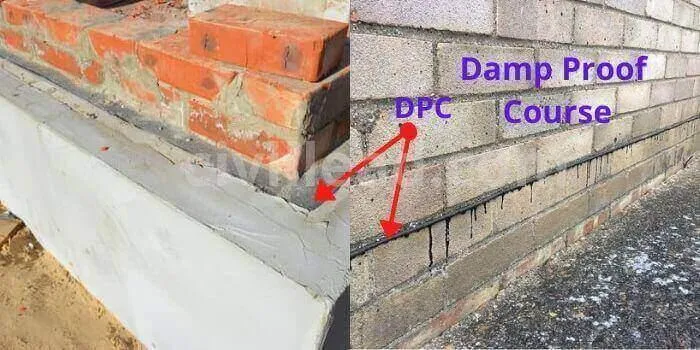
You walk into a house. The walls look beautiful. Fresh paint. Clean lines. But then… you notice it. A dark patch near the floor. The paint is bubbling. There’s a faint, musty smell in the air.
That’s dampness. And it’s a silent killer for buildings.
It starts small. A little moisture seeping through. But over time, it eats away at plaster. It weakens bricks. It turns a beautiful home into a headache of repairs and health problems.
The good news? There’s a simple, effective solution. It’s called a Damp Proof Course, or DPC.
Think of it as a raincoat for your building’s foundation. It stops moisture in its tracks. In this guide, I’ll explain what DPC in construction really means. We’ll cover the materials, the methods, and why skipping this step is a mistake you can’t afford to make.
DPC Full Form & Meaning
Let’s start with the basics.
DPC full form is Damp Proof Course.
That’s the technical term. But what does it actually mean?
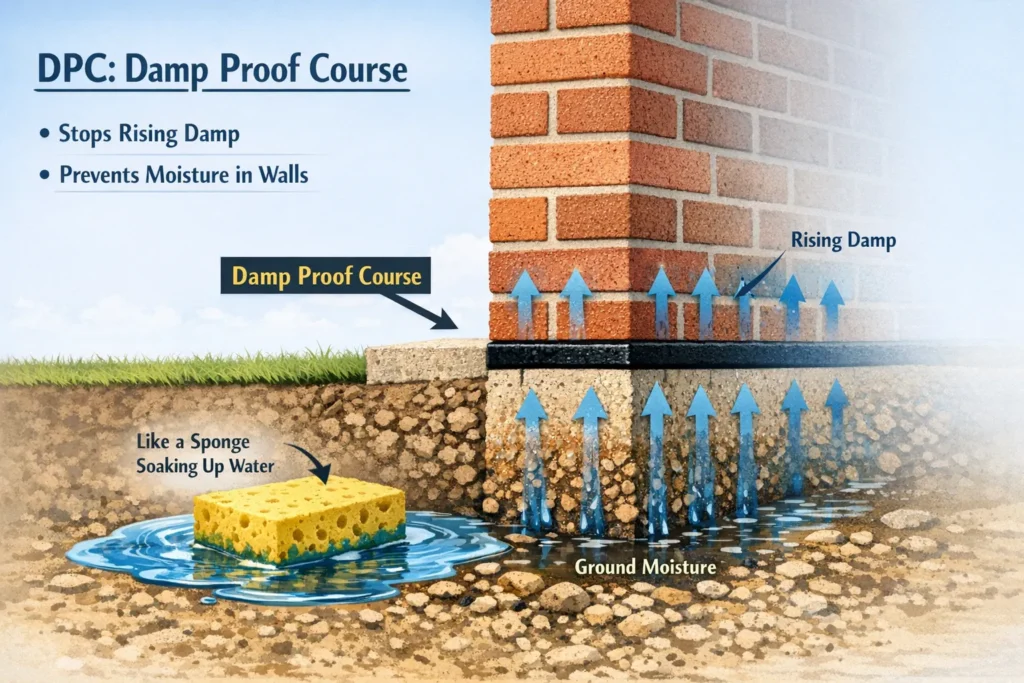
Imagine a sponge sitting in a puddle of water. The water slowly travels up the sponge. That’s capillary action. Water moves upward through tiny pores.
Bricks and mortar work the same way. They act like that sponge. If your building sits on the ground, moisture from the soil will naturally rise into the walls.
A Damp Proof Course is a barrier. It’s a layer of material that you insert into the wall. Its only job is to stop that upward movement. It’s a simple idea with a powerful result.
In civil engineering terms, the DPC meaning in construction is straightforward: it’s the protective layer that keeps ground moisture out of your walls. No moisture. No dampness. No problems.
What Is DPC in Construction?
Let me paint a clearer picture.
You build a house. You dig the foundation. You lay the concrete base. Then, at a certain height, you stop. Usually, it’s at the plinth level. That’s the level right above the ground.
At that point, you install the DPC. It’s a continuous layer. It runs along the entire wall. It’s like a belt wrapped around the building.
Everything below that layer can get wet. But everything above stays dry.
The DPC acts as a shield. It blocks the path of moisture. Water tries to rise from the ground, but it hits this barrier. It can’t go any further. It’s forced to stop.
This simple layer is the difference between a dry, healthy home and a damp, deteriorating one. In most buildings, you’ll find the dpc level in construction just above the ground. It’s the first line of defense against moisture.
Why DPC Is Important
I once visited an old family home that had been built without a proper DPC. The owners had lived there for 30 years. The walls near the floor were crumbling. The paint wouldn’t stay on. Every year, they’d repaint, and every year, it would peel off again.
They spent thousands on repairs and cosmetic fixes. But the root cause was never addressed. The moisture was still there, quietly destroying the structure from the inside.
That’s what happens when you ignore damp proofing.
Here’s why DPC is non-negotiable.
It prevents rising damp. This is the main job. Water from the ground stops at the barrier. It never reaches your living space.
It increases the life of the building. Moisture is the enemy of bricks, concrete, and steel. It weakens everything it touches. A good DPC protects the structure for decades.
It protects your finishes. Paint, wallpaper, plaster… they all fail when moisture is present. A DPC keeps your walls looking fresh and clean.
It improves indoor hygiene. Damp walls breed mold and fungus. These release spores into the air. They can trigger allergies, asthma, and other health issues. A dry home is a healthier home.
Where Is DPC Provided in a Building?
You don’t put a DPC everywhere. You put it where moisture is most likely to attack.
The most common location is at the plinth level. That’s the level between the foundation and the superstructure. It’s usually about 150 mm to 450 mm above ground level. This stops ground moisture from entering the walls.
If your building has a basement, you need DPC in the basement walls as well. Basements are below ground level. They are constantly surrounded by moist soil. A DPC in this location is critical.
Sometimes, you also need DPC at the floor level. If the floor is directly on the ground, moisture can seep up through it. A layer of DPC under the flooring prevents that.
In rare cases, DPC is also used on roofs. This is more common in flat roofs where water can pool. But for most residential buildings, the primary location is the plinth level.
Types of DPC
Not all DPC materials are the same. They come in different types, each suited for different situations. Think of it like choosing the right jacket for the weather. A light rain jacket works for a drizzle. But for a downpour, you need something heavier.
Flexible DPC
This type is made from materials that can bend and stretch. Common options include bitumen sheets, plastic sheets like polyethylene, and mastic asphalt.
Flexible DPC is easy to install. You just roll it out and lay it down. It’s great for uneven surfaces because it can adapt. It also resists cracking over time.
Rigid DPC
This is the most common type in India. It’s made from cement concrete or mortar with waterproofing additives.
Rigid DPC is strong and durable. It becomes part of the wall structure. Once it sets, it’s permanent. It’s the go-to choice for most residential buildings.
Semi-Rigid DPC
This is a mix of flexible and rigid materials. You might see it used in special cases where you need a balance of strength and flexibility. But for standard homes, rigid or flexible options work perfectly.
Integral DPC
This is different. Instead of adding a separate layer, you mix waterproofing compounds directly into the concrete or mortar. The entire material becomes water-resistant. It’s often used as an extra layer of protection alongside a traditional DPC.
These are the main types of dpc you’ll encounter. Each has its place. For most builders, rigid concrete DPC is the standard choice.
Materials Used in DPC
The material you choose matters. A weak material will crack. A poor material will allow moisture to pass through. Here are the common options.
Bitumen: This is a black, sticky substance derived from petroleum. It’s used in sheets or as a liquid coating. It’s flexible and highly water-resistant.
Cement Concrete: This is the most popular material. It’s a mix of cement, sand, and aggregate. When mixed with a waterproofing compound, it creates a strong, rigid barrier.
Polythene Sheets: These are plastic sheets. They are cheap and easy to install. They work well as a flexible DPC, especially for floors.
Metal Sheets: Lead, copper, or aluminum sheets can be used. They are expensive but extremely durable. They’re often used in historical buildings or high-end construction.
Waterproof Chemicals: These aren’t a material by themselves. They are additives mixed into concrete or mortar. They make the material less porous and more resistant to water.
Choosing the right damp proof course material depends on your budget, the type of building, and the level of moisture in the soil.
Thickness of DPC
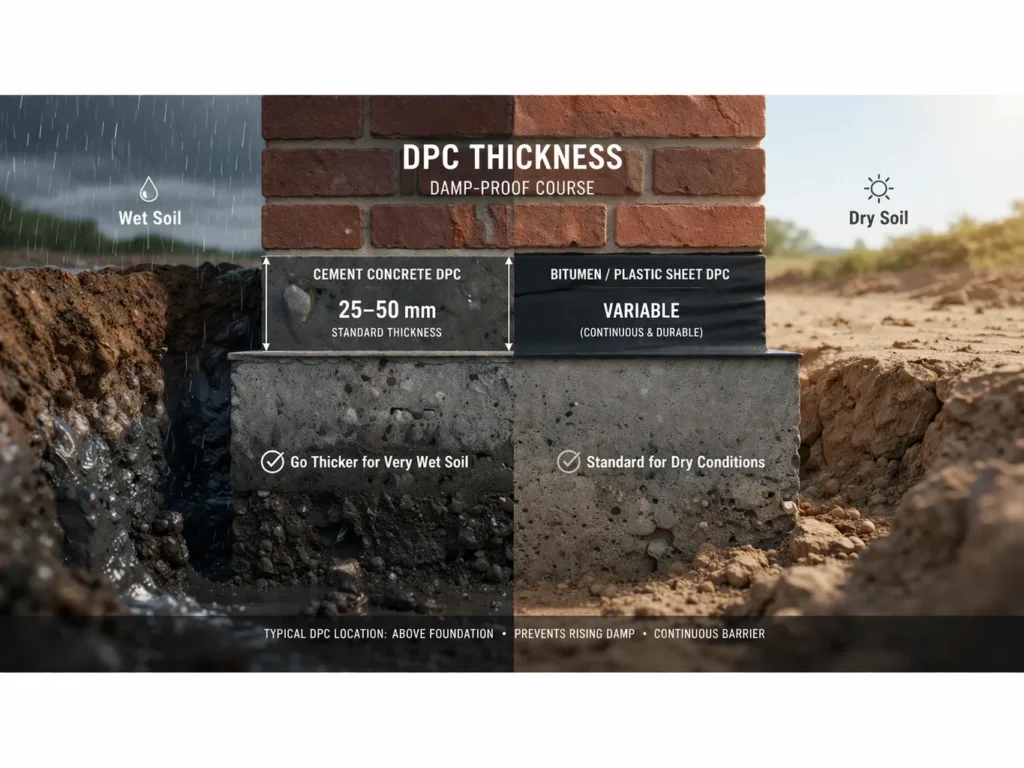
This is a simple one. The thickness of dpc matters because if it’s too thin, it won’t be strong enough. If it’s too thick, it might create a weak point in the wall.
For cement concrete DPC, the standard thickness is 25 mm to 50 mm.
For bitumen or plastic sheets, the thickness varies. But the principle is the same. It needs to be continuous and durable.
The exact thickness depends on the building type and the moisture conditions. If the soil is very wet, you go thicker. If it’s dry, the standard thickness works.
DPC Mix Ratio
If you’re using concrete for your DPC, you need the right mix. The dpc ratio is crucial. Too much sand, and it becomes weak. Too little cement, and it won’t bond properly.
The standard mix is 1 : 2 : 4.
That’s one part cement, two parts sand, and four parts aggregate. This is the same mix used for many structural elements.
But you don’t stop there. You also add a waterproofing compound. This is a chemical that fills the tiny pores in the concrete. It makes the layer almost impermeable to water.
The grade of concrete used in dpc is usually M15 or M20. M15 is the minimum. For better protection, builders often use M20.
Step-by-Step DPC Construction Process
Installing a DPC isn’t complicated. But it requires care. A small gap or crack can ruin the entire system. Here’s how it’s done.
Step 1: Clean the surface. The wall at the plinth level must be clean. No dirt. No loose mortar. A clean surface ensures the DPC bonds properly.
Step 2: Apply a base layer. A thin layer of mortar is applied to level the surface. This gives you a flat, even base for the DPC.
Step 3: Lay the DPC material. If you’re using concrete, you pour it at the required thickness. If you’re using bitumen sheets, you roll them out. If you’re using a liquid coating, you apply it evenly.
Step 4: Ensure uniform thickness. This is critical. The DPC should be the same thickness across the entire wall. Any variation creates a weak spot.
Step 5: Allow proper curing. If you’re using concrete, curing is essential. You keep it moist for at least 7 days. This allows the concrete to gain strength. Without curing, the DPC can crack and fail.
Difference Between DPC and Damp Proofing
These terms get mixed up often. Let’s clear it up.
DPC is a specific layer. It’s a physical barrier installed in the wall. It has a defined thickness and location.
Damp proofing is a broader term. It includes DPC, but it also includes other methods. Think of coatings, surface treatments, and waterproof plasters. Damp proofing is the overall system. DPC is one part of that system.
If you’re building a house, you need both. You need the DPC as your main defense. And you need proper damp proofing for other areas like roofs and bathrooms.
Common Problems Without DPC
A building without a DPC is a ticking time bomb. Here’s what happens.
Rising damp: This is the first symptom. You see dark patches at the bottom of walls. The moisture slowly travels higher over time.
Cracks in plaster: Wet plaster loses its strength. It starts to crack and crumble. Eventually, it falls off the wall.
Fungal growth: Damp walls are a breeding ground for mold. You see black or green patches. You smell a musty odor. It’s unpleasant and unhealthy.
Paint failure: Paint doesn’t stick to damp surfaces. It bubbles, peels, and flakes off. You spend money on repainting, only to see it fail again.
Structural damage: Over years, moisture weakens bricks and mortar. Walls lose their strength. In extreme cases, the structure becomes unsafe.
All of this can be avoided with one simple layer.
DPC vs Waterproofing
Here’s another common confusion.
DPC stops ground moisture from rising into walls. It’s for water coming from the ground.
Waterproofing protects from rainwater, leaks, and standing water. It’s for water coming from above.
They are different problems with different solutions.
You need a DPC to protect from the ground. You need waterproofing for terraces, bathrooms, and external walls. Both are essential. One does not replace the other.
Cost of DPC in Construction
The cost varies. It depends on the material, the thickness, and the labor.
For cement concrete DPC, the cost is typically between ₹20 and ₹80 per square foot. This includes materials and labor.
If you use bitumen sheets or other premium materials, the cost goes up. But compared to the cost of repairing dampness later, a proper DPC is a small investment.
Think of it as insurance. You pay a little now to avoid a huge expense later.
Common Mistakes in DPC Work
Even with the right materials, mistakes happen. Here are the ones I see most often.
Improper thickness: Some contractors try to save money by making the DPC too thin. It cracks easily. Moisture finds its way through.
Poor material quality: Cheap cement. Low-grade waterproofing compound. The result is a weak DPC that fails within a few years.
Discontinuity in the layer: The DPC must be continuous across the entire wall. If there’s a gap, even a small one, water will find it. It’s like a dam with a hole. The whole thing becomes useless.
No waterproofing compound: Some builders skip the waterproofing additive. They assume the concrete alone is enough. It’s not. Concrete is porous. Without the additive, moisture can still pass through.
Skipping curing: This is a common shortcut. If the concrete DPC isn’t cured properly, it won’t gain full strength. It becomes brittle and prone to cracking.
Pro Tips for Better DPC
I’ve seen DPC work perfectly. I’ve also seen it fail. Here’s what I’ve learned.
Use quality waterproofing chemicals: Don’t buy the cheapest one. A good additive makes a huge difference. It fills the pores and creates a true barrier.
Ensure a continuous layer: Walk around the entire building. Check that the DPC runs without interruption. No gaps. No breaks.
Check the level alignment: The DPC should be at the same level across all walls. If one section is lower, water can bypass it.
Avoid gaps or cracks: After installation, inspect the DPC. Look for any cracks or gaps. If you find them, fix them before moving forward.
Combine with proper drainage: A DPC works best when water is directed away from the foundation. Make sure your site has good drainage. Keep the soil around the building sloped away from the walls.
Conclusion
A building is a long-term investment. You want it to last. You want it to stay strong and healthy for decades.
Moisture is the enemy. It’s slow, but it’s relentless. If you don’t stop it at the ground level, it will find its way up. It will ruin your walls, your finishes, and your peace of mind.
That’s why DPC in construction is not an option. It’s a necessity. It’s a simple layer of material that does one job and does it well. It stops water in its tracks.
Whether you’re building a small home or a large commercial building, invest in a proper DPC. Use quality materials. Follow the right process. Don’t cut corners.
A few extra rupees spent today will save you thousands in repairs tomorrow. Your building will thank you. And you’ll enjoy a dry, healthy, long-lasting home.
FAQs
What is DPC in construction?
DPC stands for Damp Proof Course. It is a protective layer installed in walls at plinth level to stop ground moisture from rising into the building.
What is the full form of DPC?
The full form of DPC is Damp Proof Course. It is a standard term used in civil engineering and building construction.
What is the thickness of DPC?
For cement concrete DPC, thickness is usually 25 mm to 50 mm. Flexible materials like bitumen sheets have varying thickness based on product specifications.
Which material is used in DPC?
Common materials include cement concrete with waterproofing compounds, bitumen sheets, polythene sheets, and metal sheets like lead or copper.
What is the ratio of DPC concrete?
The standard mix ratio is 1:2:4 (cement : sand : aggregate). A waterproofing compound is added to fill pores and prevent moisture passage.
Where is DPC provided in a building?
DPC is primarily installed at plinth level, about 150 mm to 450 mm above ground. It is also placed in basements and under floors.
What happens if a building has no DPC?
Moisture rises through walls, causing peeling paint, cracking plaster, mold growth, and structural weakness. Repairs become costly and frequent.
Is DPC the same as waterproofing?
No. DPC stops ground moisture from rising. Waterproofing protects against rainwater, leaks, and standing water from above. Both are different and necessary.
What are the types of DPC?
The main types are flexible DPC (bitumen sheets), rigid DPC (cement concrete), semi-rigid DPC, and integral DPC with waterproofing additives.
How is DPC installed?
The surface is cleaned, a base mortar layer is applied, DPC material is laid with uniform thickness, and concrete DPC is cured for 7 days.


0 Comments