
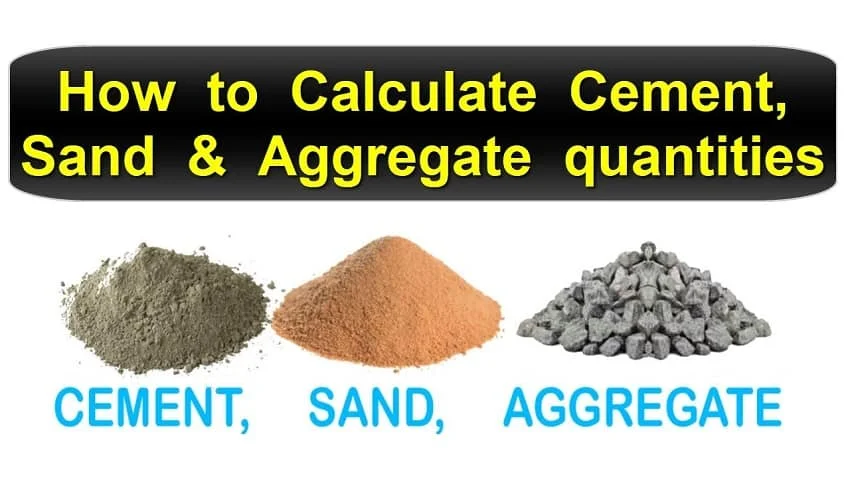
You are standing on a construction site. The slab is marked. The steel is tied. Now comes the moment of truth: pouring the concrete. But how much cement do you order? How many loads of sand and stone will you need?
Order too little, and the pour stops halfway. A disaster. Order too much, and you waste hard-earned money on materials that harden into useless lumps.
Getting this right is not complicated. It is a simple recipe. You just need to follow the steps. Think of it like baking a cake. If you use the right ingredients in the right amounts, you get a perfect result every time. Concrete is no different. It is made from cement, sand, fine aggregate, coarse aggregate, and water.
This guide will show you exactly how to calculate the quantities for any concrete work. I will use simple math and explain every step.
Why the Correct Mix Ratio Matters
Concrete is the most widely used construction material in the world. Its strength and durability depend entirely on one thing: the cement sand aggregate ratio.
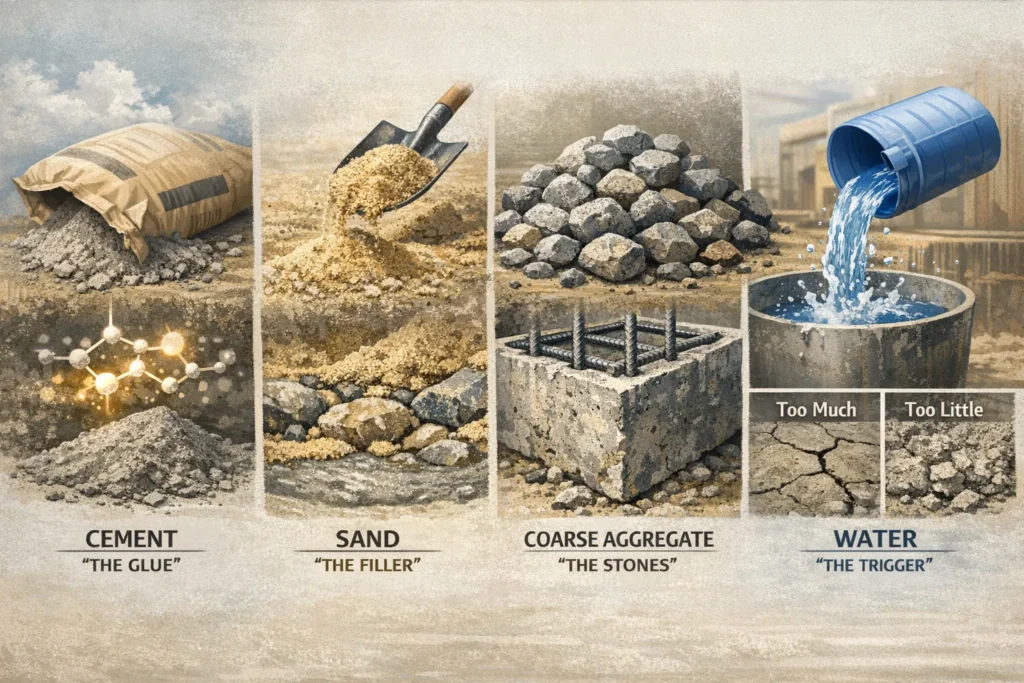
Each component has a job:
- Cement: This is the glue. It coats the surface of the sand and stones. When water is added, it starts a chemical reaction called hydration. This reaction hardens the glue and binds everything into a solid mass.
- Sand (Fine Aggregate): Think of sand as the filler. It fills the tiny voids between the larger stones. This makes the concrete dense and prevents it from being weak and porous. The right cement sand ratio ensures a smooth, workable mix.
- Coarse Aggregate: These are the stones. They are the backbone of concrete. They provide the structural strength and take the compressive loads. Without them, concrete would shrink and crack.
- Water: Water is the trigger. It kickstarts the hydration process. But the amount of water is critical. Too much water makes weak concrete. Too little makes it impossible to work with.
Common Concrete Mix Ratios You Should Know
In many parts of the world, we use what are called nominal mix ratios. These are simple proportions by volume. They are perfect for small projects and general construction.
Here are the most common ones you will see:
| Concrete Grade | Mix Ratio (Cement : Sand : Aggregate) | Typical Use |
|---|---|---|
| M10 | 1 : 3 : 6 | Lean concrete base course (PCC) |
| M15 | 1 : 2 : 4 | General RCC work like beams, slabs, columns |
| M20 | 1 : 1.5 : 3 | Structural work requiring higher strength |
For a standard house slab, the 1 2 4 concrete mix (M15) is the most common. A driveway or footing might use the stronger 1 1.5 3 concrete mix (M20). If you are just filling a large area, the 1 3 6 concrete mix (M10) is often used.
The Basic Formula: From Wet Volume to Dry Volume
Before you start calculating, you need to understand one key concept. The formula for volume is simple: Length x Width x Height. That gives you the wet volume of concrete you need.
For example, let’s say you have a slab that is 5 meters long, 4 meters wide, and 0.15 meters thick.
- Wet Volume = 5m × 4m × 0.15m
- Wet Volume = 3 cubic meters (m³)
So, you need 3m³ of concrete. Easy, right?
But here is the catch. When you order cement, sand, and aggregate, you cannot simply take this 3m³ and split it up. Why? Because of something called dry volume.
Imagine a bucket filled with stones. There are lots of air gaps between them. Now, imagine pouring sand into that bucket. The sand fills the gaps. The materials you buy have these voids. Cement has air between its particles. Sand has moisture and voids. Aggregate has large gaps.
When you mix them with water, the sand and cement paste fill the voids in the aggregate. This causes the total volume to shrink. To get 3m³ of final wet concrete, you need to order more than 3m³ of dry materials.
The standard factor used across the construction industry is 1.54. This means your dry volume is 54% more than your wet volume.
- Dry Volume = Wet Volume × 1.54
- For our slab: 3 m³ × 1.54 = 4.62 m³
This 4.62 m³ is the number you will use for your material calculations.
Let’s Calculate: A Step-by-Step Example (M15 Grade)
We will use the M15 grade (1:2:4) for our slab. This is the most common mix.
Step 1: Find the total number of parts in the mix.
- Cement: 1 part
- Sand: 2 parts
- Aggregate: 4 parts
- Total Parts = 1 + 2 + 4 = 7 parts
Step 2: Calculate the quantity of cement.
Cement is always the first ingredient we figure out.
- Volume of cement = (Cement Parts / Total Parts) × Dry Volume
- Volume of cement = (1 / 7) × 4.62 m³
- Volume of cement = 0.66 m³
In most countries, cement is sold in 50kg bags. One bag of cement has a volume of about 0.0347 cubic meters. To find out how many bags you need:
- Number of bags = 0.66 m³ / 0.0347 m³ per bag
- Number of bags = 19 bags (approximately)
This is a classic cement calculation for concrete. Remember, this is an estimate. It is always wise to add a little extra.
Step 3: Calculate the quantity of sand.
Now, we use the sand calculation formula in the same way.
- Volume of sand = (Sand Parts / Total Parts) × Dry Volume
- Volume of sand = (2 / 7) × 4.62 m³
- Volume of sand = 1.32 m³
Step 4: Calculate the quantity of coarse aggregate.
Finally, the aggregate calculation for concrete.
- Volume of aggregate = (Aggregate Parts / Total Parts) × Dry Volume
- Volume of aggregate = (4 / 7) × 4.62 m³
- Volume of aggregate = 2.64 m³
So, for a 3 cubic meter slab of M15 concrete, you need:
- Cement: 19 bags
- Sand: 1.32 m³
- Aggregate: 2.64 m³
You can use this method as a concrete material quantity calculator for any project. Just change the mix ratio and the wet volume.
Example Calculation for M20 Concrete (1:1.5:3)
Let’s do another quick example for a smaller volume. Imagine you need 1 cubic meter of M20 grade concrete for a column.
- Wet Volume: 1 m³
- Dry Volume: 1 × 1.54 = 1.54 m³
- Total Parts: 1 + 1.5 + 3 = 5.5 parts
Now, calculate how to calculate cement quantity in m20 concrete:
- Cement: (1 / 5.5) × 1.54 = 0.28 m³. In bags, that is 0.28 / 0.0347 = 8 bags.
- Sand: (1.5 / 5.5) × 1.54 = 0.42 m³.
- Aggregate: (3 / 5.5) × 1.54 = 0.84 m³.
You see? The process is identical.
Understanding Material Density
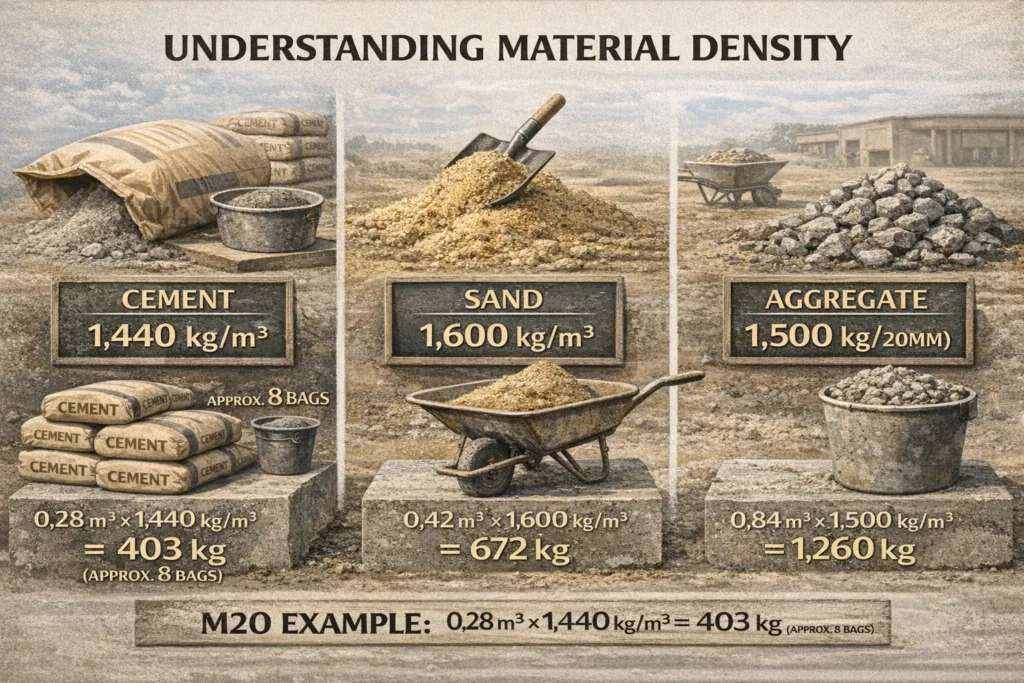
Sometimes, you need quantities in kilograms instead of cubic meters. This is where the density of cement sand and aggregate comes in.
Here are the approximate values we use on site:
- Cement: 1440 kg/m³
- Sand: 1600 kg/m³ (this can vary with moisture)
- Aggregate: 1500 kg/m³ (for 20mm size)
So, for our M20 example above:
- Cement weight = 0.28 m³ × 1440 kg/m³ = 403 kg (roughly 8 bags of 50kg)
- Sand weight = 0.42 m³ × 1600 kg/m³ = 672 kg
- Aggregate weight = 0.84 m³ × 1500 kg/m³ = 1260 kg
Knowing the density of sand and aggregate helps when you are buying materials by weight rather than volume.
The Importance of the Water-Cement Ratio
Getting the quantities of solids right is half the battle. The other half is water.
The water cement ratio calculation is a rule of thumb. For every 50kg bag of cement, you need a specific amount of water. The ratio is usually between 0.4 and 0.6.
A ratio of 0.5 means you use 25 liters of water for every 50kg bag of cement (because 0.5 x 50kg = 25 liters). For our M15 example with 19 bags, the total water needed would be around 19 x 25 = 475 liters.
This is just for the chemical reaction. But remember, the sand you use is often wet. This adds more water to the mix. A good mason adjusts the final water on the fly. He adds just enough so the concrete is workable but not soupy.
Common Mistakes to Avoid
I have seen people make the same errors for years. Here is what to watch out for:
- Forgetting the Dry Volume Factor: This is the biggest one. If you calculate based on wet volume, you will be short by over 50%. Always use the 1.54 factor.
- Using the Wrong Mix Ratio: Do not use a 1:2:4 mix for a heavy-duty column that needs M20. Check your structural drawings.
- Incorrect Bag Conversion: People often forget that one bag of cement is not 1 cubic foot. It is about 1.25 cubic feet. Stick to the standard volume of 0.0347 m³ per bag to be safe.
- Ignoring Wastage: Material spills. It gets stuck in the mixer. It blows away in the wind. Always add 5% to 10% to your final quantities. This simple tip saves you from last-minute rushes to the supplier.
Practical Tips for the Site
When you are actually on the ground, these tips help:
- Measure First: If you are using volume batching (like with a farma or measuring box), make sure your boxes are the right size. Calibrate them for your mix.
- Check Your Sand: Sand can be loose or compacted. Its volume changes when it rains. If the sand is very wet, its volume increases. This is called bulking. You might need to use a little less volume of wet sand to get the right amount.
- Check Your Aggregate: Make sure the aggregate is clean and of the right size. Too much dust or clay in it will weaken the concrete.
- Maintain Consistency: Once you find the right water level that gives you good workability, keep it the same for every batch. Do not let one batch be dry and the next one soupy.
Conclusion
Calculating concrete materials is not a mystery. It is a simple three-step process. First, find the wet volume of your structure. Second, convert that to dry volume by multiplying by 1.54. Third, divide that dry volume by the total parts of your mix ratio and multiply by each individual part.
Understanding this cement sand aggregate proportion is a fundamental skill. It ensures your structure has the designed strength. It also helps you order exactly what you need, saving your project from delays and your pocket from waste.
Whether you are pouring a small garden path or a large building foundation, this method works. Grab your calculator, measure your slab, and work through the steps. You will have your material list in minutes.
Frequently Asked Questions
How many bags of cement for 1m³ concrete?
For M20 mix (1:1.5:3), you need about 8 bags of 50kg cement. For M15 mix (1:2:4), you need roughly 6.5 bags. This varies based on the mix ratio and the dry volume factor of 1.54 used in calculations.
What is the best concrete mix ratio for a slab?
For a typical house slab, M15 grade with a 1:2:4 ratio (cement:sand:aggregate) works well. For driveways or heavier loads, use M20 with a 1:1.5:3 ratio. The right ratio ensures proper strength and durability.
How do I calculate sand for concrete?
Multiply your dry volume by the sand proportion from your mix ratio. For a 1:2:4 mix, sand is 2 parts out of 7. So, sand quantity = (2/7) × dry volume. Dry volume is your wet volume multiplied by 1.54.
Why do we multiply by 1.54 for dry volume?
When cement, sand, and aggregate are dry, they have air voids between particles. Mixing with water fills these voids, reducing volume. The 1.54 factor accounts for this 54% volume reduction, ensuring you order enough materials.
What is the water-cement ratio?
The water-cement ratio is the weight of water divided by the weight of cement. For good strength, use 0.45 to 0.55. This means 22.5 to 27.5 liters of water per 50kg cement bag. Too much water weakens concrete.
How much aggregate do I need for 1m³ concrete?
For 1m³ of M15 concrete (1:2:4), you need about 0.88m³ of aggregate. This comes from the formula: (4/7) × 1.54 = 0.88m³. The 4 represents aggregate parts, 7 is total parts, and 1.54 is the dry volume factor.
What is the difference between nominal mix and design mix?
Nominal mix uses fixed ratios like 1:2:4 for small jobs. Design mix calculates proportions based on material testing for large projects. Design mix ensures exact strength but requires lab testing. Nominal mix is simpler for everyday construction.
How do I measure concrete materials on site?
Use measuring boxes called farmas for volume batching. One box should match your mix ratio, like one box cement, two boxes sand, four boxes aggregate. For weight batching, use a weigh batcher or platform scale for accuracy.
What is bulking of sand?
Sand bulking happens when moisture creates films around particles, pushing them apart and increasing volume. Wet sand can bulk up to 30% more. Always account for this by either using dry sand or increasing your sand quantity slightly.
How much concrete do I need for a 10×10 slab?
For a 10ft x 10ft slab that is 4 inches thick, first convert to meters: 3.05m x 3.05m x 0.1m = 0.93m³ wet volume. Add 5-10% for wastage, so order about 1m³ of concrete or the equivalent dry materials.


0 Comments