
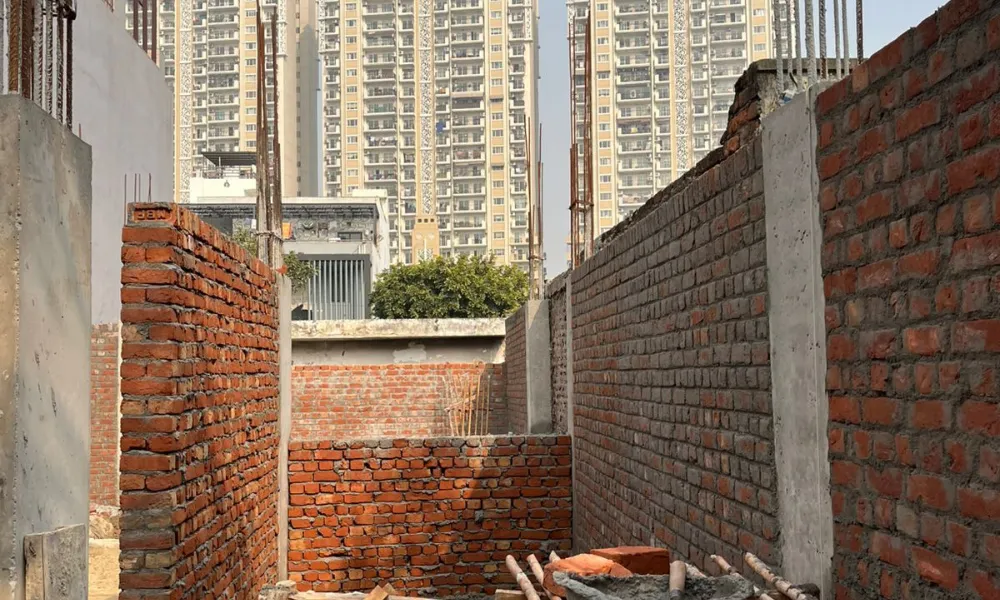
Picture this. You’re standing on an empty plot of land. The foundation is dug. The concrete is poured. Now comes the real moment of truth.
You need to order bricks. But how many?
Order too few, and your workers sit idle while you scramble for more. Order too many, and you’re left with stacks of unused bricks eating into your budget. I have seen this happen on countless construction sites.
The question seems simple. But the answer requires some basic math. In fact, brick calculation is one of the most important steps in construction planning. Even small errors in estimation can lead to major problems. You might face material wastage on one side or a frustrating shortage on the other.
Homeowners ask me this all the time. Contractors need to know this daily. Civil engineers build their entire material order around this number.
So let’s answer the question directly.
How many bricks are required for 1 sq ft of a 9-inch wall?
The short answer is about 10 to 11 bricks.
But getting to this number requires understanding a few key things. Brick sizes. Mortar thickness. Wall volume. Unit conversions.
I will walk you through each step. By the end, you will know exactly how to calculate brick quantity for any wall thickness.
Standard Brick Size in India
Before we do any math, we need to agree on what we are measuring.
Bricks are not all the same size. Different countries follow different standards. Even within India, you might find slight variations between manufacturers. But there is a standard size that most suppliers follow.
Common Brick Size Without Mortar
In India, the standard modular brick size is:
190 mm × 90 mm × 90 mm
Let me convert that into feet for easier calculation:
- Length = 190 mm = 0.625 feet
- Width = 90 mm = 0.30 feet
- Height = 90 mm = 0.30 feet
This is the actual physical size of the brick. When you hold a brick in your hand, these are its real dimensions.
Brick Size With Mortar
Here is where things get interesting. When you place bricks on a wall, you add mortar between them. The mortar joint is usually about 10 mm thick.
So the nominal size of a brick including mortar becomes:
200 mm × 100 mm × 100 mm
In feet, that translates to:
0.66 ft × 0.33 ft × 0.33 ft
Why does this matter? Because when we calculate how many bricks fit into a wall, we must account for the space taken by mortar. If we use the actual brick size without mortar, our calculation will be wrong. We will end up ordering more bricks than we actually need.
I learned this lesson the hard way during my first small construction project. I calculated based on bare brick dimensions and ended up with 12 percent extra bricks sitting around. The supplier refused to take them back.
Always use the nominal size with mortar for your calculations.
What Is a 9-Inch Wall?
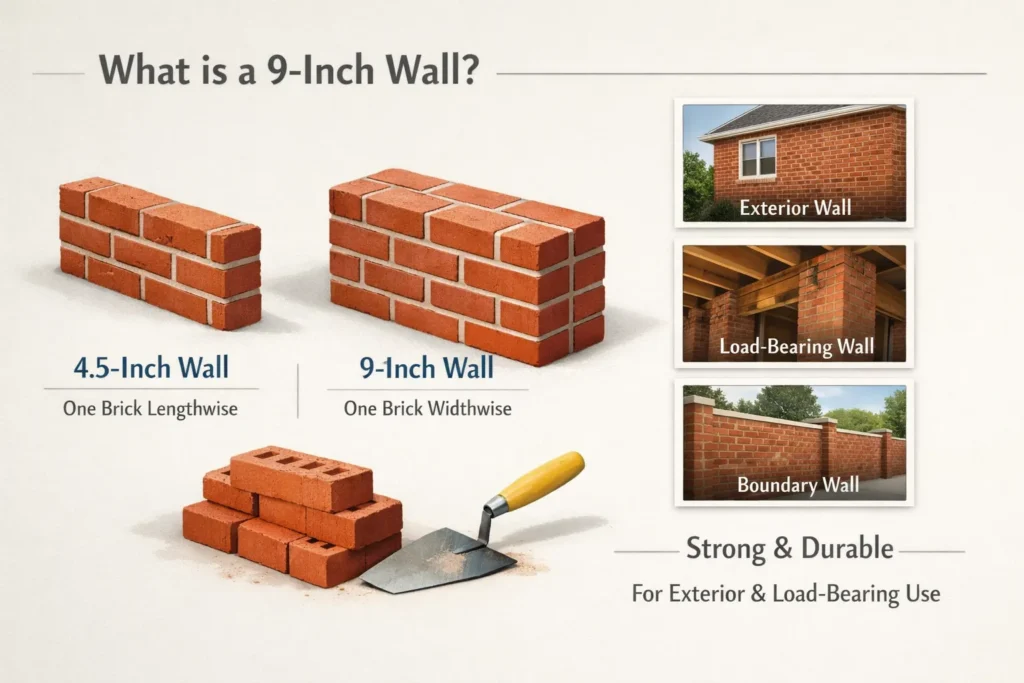
A 9-inch wall means the thickness of the wall is 9 inches. Simple, right?
But in construction terminology, a 9-inch wall is also called a one-brick thick wall. This is because the width of a standard brick is about 4.5 inches. So when you place bricks side by side along their length, you get a 4.5-inch wall. When you place them across their width, you get a 9-inch wall.
Think of it like stacking books on a shelf. If you put books with their spines facing you, you see the narrow side. If you turn them so the covers face you, you see the wide side. Bricks work the same way.
Where do we use 9-inch walls?
These walls are typically used for:
- External walls that face the outside of the building
- Load-bearing walls that carry the weight of the roof and upper floors
- Boundary walls that need strength and durability
A 4.5-inch wall is usually used for internal partitions. It saves space and material. But for exterior walls, you need the extra thickness for strength and insulation.
Basic Concept of Brick Calculation
Here is the fundamental principle.
Number of bricks = Wall Volume ÷ Volume of One Brick (with mortar)
That is it. The entire calculation boils down to this simple formula.
Think of it like filling a box with smaller boxes. If you have a large container and you want to know how many smaller containers fit inside, you divide the large volume by the small volume.
The wall is our large container. Each brick with its surrounding mortar is our small container.
But we must be careful. The wall volume depends on three things:
- Wall thickness – 9 inches in our case
- Wall area – 1 square foot for our basic calculation
- Wall height – included in the area measurement
The brick volume depends on:
- Brick dimensions including mortar
- Consistent units – everything in feet or everything in meters
Mixing units is the fastest way to get wrong numbers. I have seen engineers make this mistake. Convert everything to the same unit before you start calculating.
Step-by-Step Calculation for 1 Sq Ft Wall
Let me show you exactly how I calculate this. Grab a calculator if you want to follow along.
Step 1: Calculate Wall Volume
We are calculating for 1 square foot of wall area.
Wall area = 1 square foot Wall thickness = 9 inches
But our area is in square feet. Our thickness is in inches. We need to convert the thickness to feet.
9 inches ÷ 12 = 0.75 feet
Now we can calculate the volume.
Wall volume = Area × ThicknessWall volume = 1 sq ft × 0.75 ftWall volume = 0.75 cubic feet
This is the space we need to fill with bricks and mortar.
Step 2: Calculate Volume of One Brick With Mortar
Remember, we use the nominal size that includes mortar.
Brick length with mortar = 0.66 ft Brick width with mortar = 0.33 ft Brick height with mortar = 0.33 ft
Volume of one brick with mortar = Length × Width × HeightVolume = 0.66 × 0.33 × 0.33Volume = 0.0718 cubic feet
This number represents how much space each brick occupies in the wall, including its share of the mortar joints.
Step 3: Calculate Number of Bricks
Now we divide the wall volume by the brick volume.
Number of bricks = Wall volume ÷ Brick volumeNumber of bricks = 0.75 ÷ 0.0718Number of bricks = 10.44 bricks
The Final Answer
For 1 square foot of 9-inch thick wall, you need approximately 10 to 11 bricks.
I usually round this up to 10.5 bricks for calculations. When ordering for larger areas, I multiply by 10.5 and then add wastage.
But here is a reality check. Different brick manufacturers have slightly different sizes. Some bricks are 190 mm exactly. Others might be 200 mm. Always confirm the actual size from your supplier before placing a large order.
Quick Reference Table
I keep this table handy for quick estimates. You might want to save it.
| Wall Thickness | Bricks per Square Foot |
|---|---|
| 4.5 inch wall | 5 to 6 bricks |
| 9 inch wall | 10 to 11 bricks |
| 13.5 inch wall | 15 to 16 bricks |
The pattern is simple. Double the thickness, double the bricks. A 9-inch wall needs roughly twice the bricks of a 4.5-inch wall.
This table assumes standard Indian brick sizes. If you are using larger bricks or different thicknesses, the numbers will change.
Calculation per Square Meter
Some people think in square meters. I understand. Many construction plans use metric measurements.
Here is how to convert.
1 square meter = 10.76 square feet
If we need 10.5 bricks per square foot, then:
Bricks per square meter = 10.5 × 10.76Bricks per square meter = 113 bricks
So for a 9-inch thick wall, you need approximately 110 to 115 bricks per square meter.
This is useful when you are reading architectural drawings that use metric units. Most engineers in India work in meters for large projects and switch to feet for smaller residential work.
Example: Bricks Required for 100 Sq Ft Wall
Let me give you a practical example.
Suppose you are building a small room. One wall measures 10 feet in length and 10 feet in height.
Wall area = 10 ft × 10 ft = 100 square feet
Using our calculation:
Bricks required = 100 sq ft × 10.5 bricks per sq ftBricks required = 1050 bricks
But wait. This wall has a door or window. You need to subtract that area. If the door is 3 ft by 7 ft, that is 21 square feet.
Adjusted wall area = 100 – 21 = 79 square feet
Bricks required = 79 × 10.5 = 830 bricks
This is why accurate measurement matters. If you order for the full 100 square feet without subtracting openings, you will have 220 extra bricks. That is money wasted.
Example: Bricks Required for 1000 Sq Ft Construction
Now let us think bigger.
A typical 1000 square foot house might have:
- External walls of 9-inch thickness
- Internal partitions of 4.5-inch thickness
- Multiple rooms with doors and windows
For rough estimation, contractors often use a rule of thumb. A 1000 square foot house needs between 70,000 and 90,000 bricks.
Why such a wide range?
Because house design varies. A simple rectangular layout uses fewer bricks than a complex design with many corners. A single-story home needs fewer bricks than a two-story home with the same footprint. Wall heights differ. Window sizes differ.
I recently helped a friend estimate bricks for his 1200 square foot house. His design had many curves and projections. The final brick count was 92,000. A simple rectangular house of the same size might need only 75,000.
Always do detailed calculations based on your actual plans. Rules of thumb are only for initial budgeting.
Mortar Requirement Along With Bricks
Bricks are not the only material you need. Mortar holds everything together.
In our calculation, we already included mortar in the brick volume. But if you want to know how much cement and sand to order, here is the breakdown.
Mortar volume is typically 25 to 30 percent of the brickwork volume.
For a 9-inch wall:
Total brickwork volume = 0.75 cubic feet per square foot Mortar volume = 25% of 0.75 = 0.1875 cubic feet per square foot
For 100 square feet: Mortar volume = 100 × 0.1875 = 18.75 cubic feet
This mortar is made of cement and sand in ratios like 1:4 or 1:6. You can calculate exact cement bags and sand quantity from this volume.
But remember, some mortar falls on the ground. Some gets stuck in mixing trays. Order 10 percent extra for wastage.
Factors Affecting Brick Quantity
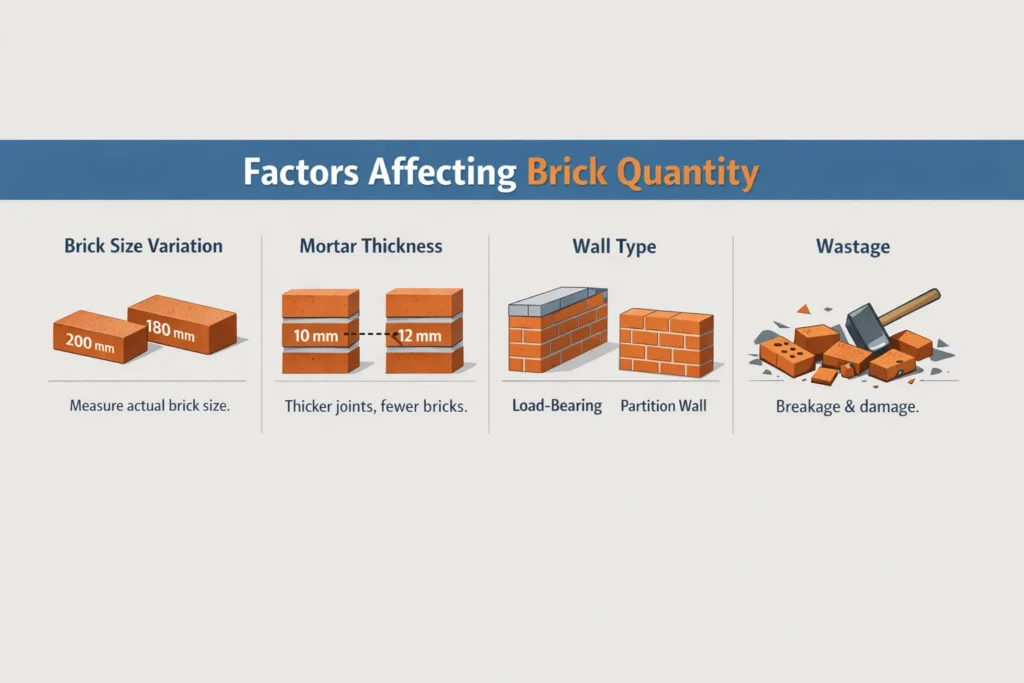
Real construction is never as clean as calculations on paper. Several factors can change your final brick count.
Brick Size Variation
Not all bricks are exactly 190 mm. Some manufacturers produce bricks slightly larger or smaller. If your bricks are 200 mm long, you will need fewer bricks. If they are 180 mm, you will need more.
Always measure a sample from the actual batch you receive.
Mortar Thickness
I assumed 10 mm mortar joints. Some masons use 12 mm joints. Thicker joints mean fewer bricks because each brick occupies more space. But thicker joints also use more mortar.
Wall Type
Load-bearing walls need stronger bonds and sometimes extra bricks for corners. Partition walls might use different bonding patterns.
Wastage
Bricks break during transport. They crack during handling. They get damaged during cutting for corners and openings.
I always add 5 to 10 percent extra for wastage. For a large project, this could mean thousands of extra bricks. But it is better than running short in the middle of construction.
Brick Cost Estimation
Now let us talk money.
Brick prices vary widely across India. In Chennai, you might pay one price. In Patna, another. In Mumbai, something else entirely.
Typical red brick prices range from ₹6 to ₹10 per brick as of 2024.
For a 9-inch wall requiring 10.5 bricks per square foot:
Brick cost per square foot = 10.5 × ₹8 (average price)Brick cost per square foot = ₹84
For 1000 square feet of wall area: Total brick cost = 1000 × ₹84 = ₹84,000
This is just for bricks. Add cement, sand, labor, and other materials. The wall construction cost becomes significantly higher.
Fly ash bricks cost differently. Concrete blocks have different rates. Always check current prices in your local market.
Common Mistakes in Brick Calculation
I have made some of these mistakes myself. Learn from them.
Ignoring Mortar Thickness
Using bare brick dimensions instead of nominal size gives you a higher brick count. You end up ordering more bricks than needed.
Wrong Unit Conversion
Mixing millimeters and feet without converting properly. I once saw someone calculate brick volume in cubic inches and wall volume in cubic feet. The numbers were completely wrong.
Forgetting Openings
Calculating for the full wall area without subtracting doors and windows. This mistake alone can add 15 to 20 percent extra to your order.
No Wastage Allowance
Ordering exactly the calculated number and hoping nothing breaks. Something always breaks.
Assuming All Bricks Are Identical
Different batches from the same manufacturer can have slight size variations. Check before ordering bulk quantities.
Pro Tips for Accurate Estimation
Here is what I have learned from years of construction experience.
Always add 5 to 10 percent extra bricks: This covers breakage, cutting waste, and future repairs. You can always use extra bricks for garden paths or store them for later.
Confirm actual brick size from your supplier: Do not rely on standard sizes. Ask for the exact dimensions of the bricks they will deliver.
Use a calculator for large projects: Manual calculations are fine for small walls. For entire houses, use spreadsheet formulas or construction apps.
Consult an engineer for structural walls: Load-bearing walls might require specific bonding patterns that affect brick quantity.
Measure twice, order once: Check your wall dimensions multiple times before placing the final order.
Conclusion
Brick calculation seems complicated at first. But it is really just division. Wall volume divided by brick volume.
For a 9-inch thick wall, 1 square foot needs about 10 to 11 bricks. This number comes from standard Indian brick sizes and typical mortar thickness.
Accurate calculation helps you in three ways. You estimate costs better. You plan material procurement smoothly. You reduce wastage and save money.
The next time someone asks you how many bricks they need, you can give them a confident answer. Show them the math. Explain the factors. Help them avoid the mistakes I made when I started.
Construction is part art, part science. The science part demands accurate numbers. Now you have the numbers for brick calculation.
Use them well. Build strong walls. Save your budget for the finishing touches that make a house a home.
Frequently Asked Questions
How many bricks for 1 sq ft 9-inch wall?
Approximately 10 to 11 bricks per square foot for a 9-inch thick wall using standard Indian brick sizes with mortar.
How many bricks per square meter?
Around 110 to 115 bricks per square meter for a 9-inch wall. Multiply per square foot calculation by 10.76 to convert.
Does mortar affect brick quantity?
Yes. Mortar increases the space each brick occupies. Using nominal size with mortar gives accurate count. Bare brick size overestimates quantity.
How many bricks for 100 sq ft?
About 1000 to 1100 bricks for 100 square feet of 9-inch wall. Subtract door and window openings before calculating.
What is standard brick size in India?
190 mm × 90 mm × 90 mm without mortar. With 10 mm mortar joints, nominal size becomes 200 mm × 100 mm × 100 mm.
How much wastage should I add?
Add 5 to 10 percent extra for breakage, cutting, and handling losses. This prevents shortage during construction.
How many bricks for 1000 sq ft house?
A typical 1000 square foot house needs 70,000 to 90,000 bricks depending on design complexity and wall thickness.
What is 9-inch wall used for?
External walls and load-bearing walls use 9-inch thickness. Internal partitions typically use 4.5-inch walls.
How much mortar for brickwork?
Mortar volume is 25 to 30 percent of brickwork volume. For 100 sq ft wall, you need approximately 18 to 20 cubic feet of mortar.
Does brick size vary by manufacturer?
Yes. Always measure actual bricks from your supplier before ordering. Size variations affect final quantity calculation.


0 Comments