

You have an apartment to rent. It is clean. Painted. Ready for someone new.
A person walks in. Smiles. Shakes your hand. Says all the right things. They love the place. They want to move in.
You want to say yes. But here is the thing. You do not know them. Not really. You do not know if they pay bills on time. You do not know if they have been evicted before. You do not know if they have a criminal history.
That is where background checks come in.
Think of it like this. You are hiring someone to live in your property. Just like a job interview, you check references. You verify claims. You look for red flags.
This guide covers everything. What background checks look for. How to run them. How long they take. What makes someone fail. And how to do it all legally.
Let us get started.
What Is an Apartment Background Check?
Definition & Purpose
An apartment background check is a screening process. Landlords use it before approving a tenant.
The goal is simple. Find out if the applicant is reliable. Will they pay rent? Will they follow rules? Will they be a problem?
What it includes:
- Credit history
- Criminal records
- Rental history
- Employment verification
- Identity confirmation
Why landlords do it:
- Reduce risk of non-payment
- Avoid legal trouble
- Protect other tenants
- Protect property value
Think of it like a test drive. You would not buy a car without checking under the hood. You should not rent an apartment without checking the person.
Do Landlords Always Run Background Checks?
Not always. But most professional landlords do.
Who runs checks:
- Large apartment complexes
- Property management companies
- Professional landlords with multiple units
Who might skip:
- Individual owners renting a single unit
- Landlords in a hurry to fill vacancy
- Informal rentals in smaller towns
Should you skip?
Probably not. Every tenant seems nice at first. The ones who cause problems also seemed nice on day one. A background check costs a few hundred rupees. An eviction costs lakhs. Do the math.
What Apartment Background Checks Look For
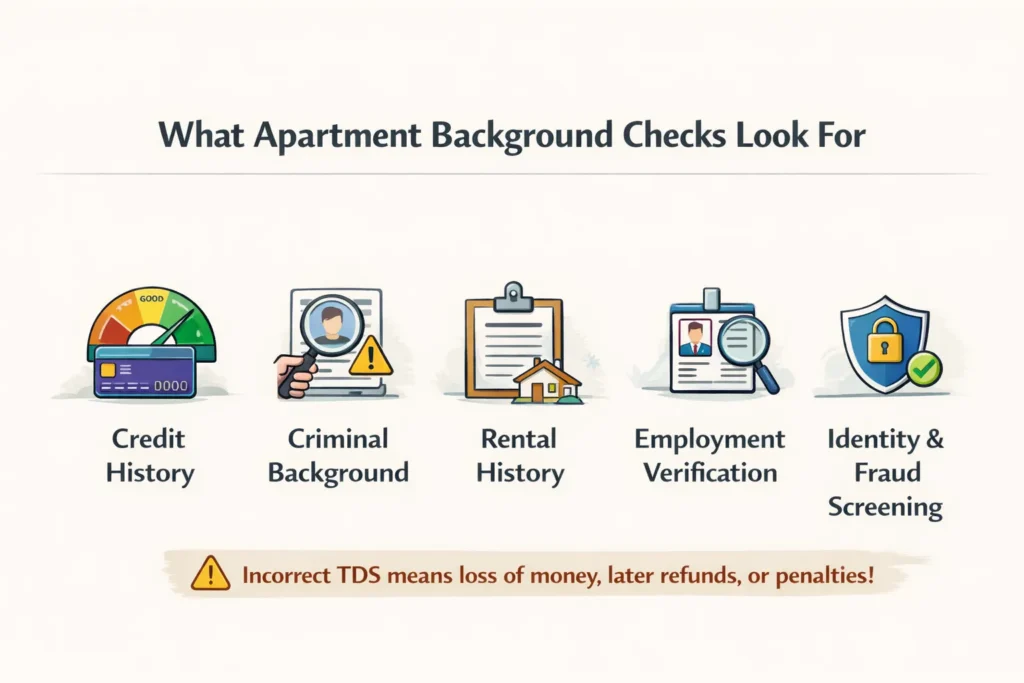
Credit History
This is the first thing landlords check.
What they look at:
- Credit score
- Outstanding debts
- Payment history
- Bankruptcies
Why it matters: If someone has bad credit, they may struggle to pay rent. If they have high debt, rent may be low priority. If they have a history of late payments, that pattern may continue.
What landlords want: Not a perfect score. Just proof that you pay your bills. A score above 650 is usually fine. Below 600 raises questions.
Can you rent with bad credit?
Yes. Some landlords accept if you have:
- Higher security deposit
- Guarantor or co-signer
- Proof of stable income
- Explanation for past issues
Criminal Background
Safety matters. Landlords want to know who lives in their property.
What shows up
- Felony convictions
- Misdemeanors (depending on severity)
- Sex offender registry
- Drug-related offenses
What does not show up
- Arrests without conviction
- Expunged records
- Minor traffic violations
Legal limits: Landlords cannot discriminate. But they can reject based on legitimate safety concerns. Violent crimes. Property crimes. Drug manufacturing. These are valid reasons.
Fair housing laws: Some cities restrict how far back criminal records can be considered. Seven years is common limit. Check local laws.
Rental History
Past behavior predicts future behavior.
What landlords check
- Previous landlord references
- Eviction records
- Lease violations
- Late payment patterns
Why it matters: A tenant who was evicted before is high risk. A tenant who left without notice is high risk. A tenant with multiple complaints from neighbors is high risk.
What if this is your first rental?
No rental history is okay. Landlords will focus more on credit and income. Offer a larger deposit if needed.
Employment Verification
Income must support the rent.
How it works
Landlords verify
- Job status
- Monthly income
- Length of employment
Common rule: Rent should not exceed 30% to 40% of monthly income. If rent is ₹25,000, income should be at least ₹62,500 per month.
Verification methods
- Recent payslips (last 3 months)
- Bank statements showing salary credit
- Employer contact (HR or manager)
- Income tax returns for self-employed
Self-employed tenants:
IT returns and bank statements work. Some landlords ask for 6 months to 1 year of statements.
Identity & Fraud Screening
Is the applicant who they claim to be?
What is checked
- Government ID (passport, driver’s license, Aadhaar in India)
- Address proof
- Social media presence (sometimes)
Why it matters: Rental fraud is real. People use fake identities. They move in, stay for months without paying, then disappear. Identity screening prevents this.
Red flags
- ID seems tampered
- Name does not match documents
- No online presence at all (suspicious in 2025)
- Refusal to provide ID
What Shows Up on a Rental Background Check
Typical Report Includes
A complete background check report contains:
Credit section
- Credit score
- Open loans
- Credit card balances
- Payment history
- Defaults or write-offs
Criminal section
- Convictions
- Pending cases (sometimes)
- Sex offender status
Eviction section
- Past eviction filings
- Court judgments
Employment section
- Verified employer
- Income amount
- Job stability
Address history
- Previous addresses
- Duration at each address
Identity verification
- Name matches records
- No fraud alerts
How Far Back Checks Go
Time limits vary by what is being checked.
Credit history: Usually 7 years for negative items. Bankruptcies may stay 10 years.
Criminal records: Varies by country and state. Some places limit to 7 years. Others show everything.
Eviction records: Typically 7 years. But some records stay longer in court databases.
Employment history: As far back as the landlord verifies. Usually 2 to 3 years is enough.
What this means: A mistake from 10 years ago may not show up. A recent issue will. Good behavior over time helps.
Step-by-Step Guide to Run a Tenant Background Check
Step 1 – Get Tenant Consent
You cannot run a background check without permission. That is illegal.
What you need: Written consent. Signed by the applicant.
What consent should include
- Permission to run credit check
- Permission to verify employment
- Permission to contact previous landlords
- Statement that check will not affect application unfairly
Sample consent line on application
“I authorize [landlord name] to obtain my credit report, verify my employment, and contact my previous landlords for rental history.”
Why this matters
Without consent, you violate privacy laws. Tenant can sue. Check is invalid.
Step 2 – Collect Tenant Information
You need details to run the check.
What to collect
- Full legal name (as on ID)
- Date of birth
- Government ID number
- Current address
- Previous addresses (last 3 to 5 years)
- Employer name and address
- Annual income
- Email and phone
For credit check: May need additional details like PAN card in India or SSN in US. Depends on screening platform.
Be careful: Collect only what you need. Too much information creates privacy risk. Store documents securely.
Step 3 – Choose Screening Method
You have options. Pick what works for you.
DIY background check: You do it yourself. Call employers. Call previous landlords. Search court records online. Takes time but costs less.
Third-party screening tools: Companies that specialize in tenant screening. You pay a fee. They run credit, criminal, and eviction checks. Provide report in hours.
Property management platforms: Software like Buildium, AppFolio, or Yardi includes screening. Integrated with applications. Automated process.
For India: Screening is less automated. Many landlords still do manual checks. But platforms are emerging. Check with rental portals and fintech companies.
Step 4 – Run Credit Check
Credit check is essential. It shows financial behavior.
How to run: Use a credit bureau or screening platform. In India, CIBIL, Experian, and Equifax provide credit reports. You need tenant consent and usually their PAN.
What you learn
- Credit score
- Loan accounts
- Payment track record
- Defaults or late payments
Interpreting results
- 750+ score: Excellent, low risk
- 650–749: Good, standard risk
- 600–649: Fair, may need explanation
- Below 600: High risk, consider co-signer or higher deposit
Step 5 – Run Criminal & Eviction Check
Safety check. Legal history check.
How to run: Screening platforms access court databases. Some provide nationwide searches. Others are state or region specific.
What you learn
- Felony convictions
- Misdemeanors (relevant ones)
- Eviction filings
- Sex offender status
Limitations: No database is 100% complete. Some records are sealed. Some counties not digitized. Use multiple sources if possible.
Decision framework: Not all crimes are equal. A theft conviction 10 years ago may not matter. A recent violent crime matters. Use judgment. Consult legal advice if unsure.
Step 6 – Verify Income & Employment
Can they afford the rent?
Verification methods:
Payslips: Ask for last 3 months. Check consistency. Gross income should meet your threshold.
Bank statements: Look for salary credits. Match with payslip amounts. Check if account is regularly used.
Employer contact: Call HR or manager. Confirm employment dates. Confirm salary range (if they share). Some employers only confirm job status, not salary.
Self-employed: Request IT returns for last 2 years. Business bank statements. GST returns in India.
Red flags
- Income barely meets rent
- Income varies wildly month to month
- Employer cannot be reached
- Documents look altered
Step 7 – Evaluate Results
You have the report. Now what?
Create a scoring system
- Credit score above 650: 2 points
- No criminal record: 2 points
- Income 3x rent: 2 points
- Good landlord reference: 2 points
- Stable employment (2+ years): 2 points
Set a minimum score for approval. This removes bias. You are not rejecting people. You are applying consistent criteria.
Borderline cases
If score is close, consider:
- Larger security deposit
- Guarantor or co-signer
- Shorter lease term
- Explanation for past issues
Rejection: If applicant fails, notify them. Some laws require adverse action notice. Tell them why. Give them chance to dispute.
How Long Apartment Background Checks Take
Screening Timeline
Time varies by method and depth.
Credit check: Instant to 24 hours. Online platforms return results immediately.
Criminal check: 1 to 3 business days. Court record searches take time. Some counties are slow.
Eviction check: 1 to 2 business days. Depends on court database access.
Employment verification: 1 to 3 days. Depends on employer responsiveness.
Previous landlord reference: 1 to 2 days. If you can reach them.
Full comprehensive check: 3 to 5 business days. This is typical for professional screening.
DIY check: 1 to 2 weeks. Because you are calling people, searching manually, waiting for responses.
What tenants can do: Speed up the process. Provide documents upfront. Authorize checks quickly. Respond to verification requests. Tell your employer to expect a call.
Common Reasons Applicants Fail Background Checks
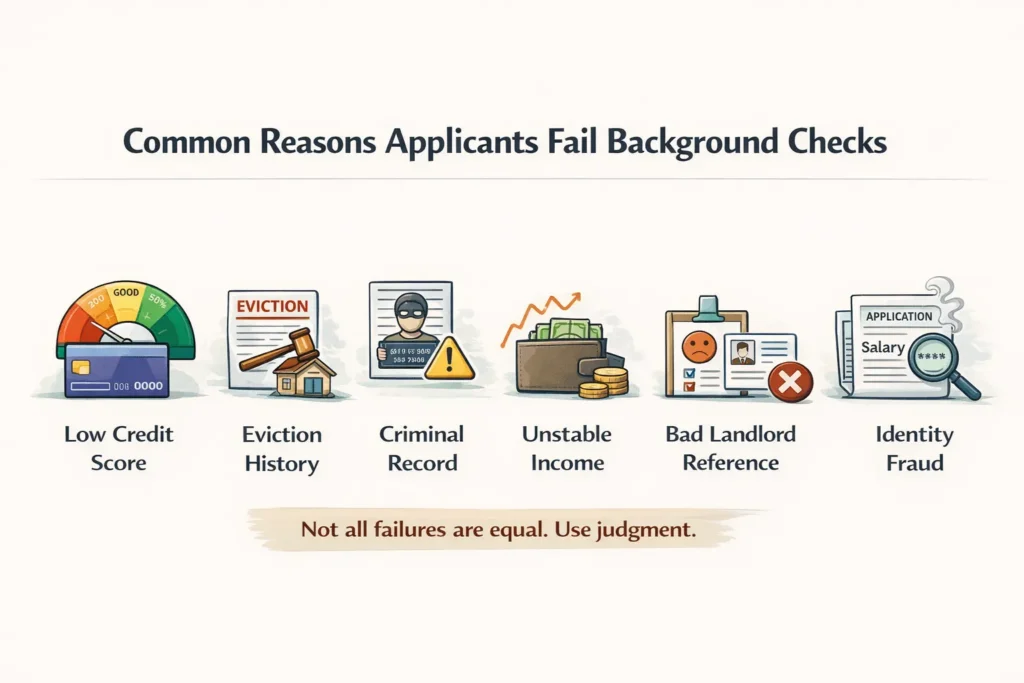
High-Risk Factors
Low credit score below 600: Shows financial instability. May indicate missed payments, high debt, or bankruptcy.
Eviction history: Major red flag. If a court had to remove them before, they will likely be trouble again.
Criminal record (violent or property crimes): Safety risk for other tenants. Landlord liability concerns.
Unstable income: Frequent job changes. Irregular earnings. Cannot reliably pay rent.
Bad landlord reference: Previous landlord says they were problematic. Late payments. Complaints. Damage.
Identity fraud: Fake documents. Name mismatch. Address cannot be verified.
Lying on application: If they lie about income or job, what else are they hiding?
Not all failures are equal. A single late payment five years ago is not a failure. A recent eviction is. Use judgment.
Legal & Compliance Considerations
Landlord Legal Responsibilities
Background checks come with legal duties.
Fair housing laws: You cannot discriminate based on:
- Race
- Religion
- National origin
- Gender
- Family status
- Disability
Applying consistent criteria protects you. If you reject someone, ensure reason is valid and non-discriminatory.
Adverse action notice: If you reject based on credit or background check, some laws require you to notify applicant. Provide name of screening company used. Give them chance to dispute.
Data privacy: Store tenant information securely. Do not share with unauthorized people. Delete after use if no longer needed.
Local laws vary: Some cities restrict use of criminal records. Some limit credit checks. Know your local rules.
Consent & Disclosure Rules
Written consent required: Before running check, get signature. Explain what you will check.
Disclosure of rights: Inform applicant they can request a copy of report. Tell them how to dispute errors.
Fee rules: If you charge application fee for screening, amount must be reasonable. Some jurisdictions cap fees. Disclose fee upfront.
No surprises: Applicants should know exactly what you will check. Surprise checks create distrust and legal risk.
Tools & Platforms for Tenant Screening
Professional Screening Platforms
International platforms
- Experian Connect
- TransUnion SmartMove
- RentPrep
- Cozy (now Apartments.com)
- Avail
India-specific options
- CIBIL for credit checks
- Experian India
- Local rental portals with verification features
- Fintech apps with tenant scoring
Property management software
- Buildium
- AppFolio
- Yardi
- TenantCloud
What to look for
- Covers credit, criminal, eviction
- Complies with local laws
- Fast turnaround
- Reasonable cost
- Good customer support
Cost per check: ₹500 to ₹2,000 in India equivalent. $20 to $50 in US. Worth every rupee for the protection.
Housing Without Background Checks
Is It Possible?
Yes. Some landlords skip background checks.
Who rents without checks
- Individual owners renting a room
- Informal agreements in small towns
- Desperate landlords with vacant property
- Sublets where main tenant handles screening
Risks for landlords
Higher chance of
- Non-payment
- Property damage
- Illegal activity
- Eviction costs
Risks for tenants: If landlord does not screen others, you may end up with bad neighbors.
Should you do it? Only if you know the person personally. Friend of friend. Family referral. Even then, basic verification helps.
Best Practices for Landlords
Screening Policy Checklist
Do this every time
- [ ] Get written consent
- [ ] Collect full information
- [ ] Run credit check
- [ ] Run criminal check
- [ ] Verify employment
- [ ] Contact previous landlord
- [ ] Check ID documents
- [ ] Apply consistent criteria
Document everything
Keep copies of
- Signed application
- Consent forms
- Screening reports
- Notes on verification calls
- Approval or rejection reason
Create written policy: Write down your screening criteria. Share with applicants if asked. Follow it every time.
Risk-Based Decision Framework
Not all red flags mean rejection.
Consider context
- Bad credit due to medical bills? Ask for explanation.
- Old criminal record with no repeat? Maybe acceptable.
- Low income but large savings? Could work.
Mitigation options
- Higher security deposit
- Guarantor
- Shorter lease with review
- Monthly payment tracking
Balance: Too strict and property stays empty. Too loose and you invite trouble. Find middle ground.
Internal Linking Strategy
Link these related articles:
- Lease agreement guide
- Tenant screening checklist
- Property management tips for landlords
- Rent agreement clauses explained
- How to handle security deposits
Conversion Section (For Property Platforms)
If you are a landlord or property manager
Manual screening takes time. Paperwork piles up. Verifications get delayed.
Use a tenant screening tool
- Automated credit checks
- Instant criminal database access
- Employment verification
- Standardized reports
Benefits
- Save hours per applicant
- Reduce risk
- Make data-driven decisions
- Stay compliant
Check out [Platform Name] for seamless tenant screening. Start your free trial today.
Conclusion
Background checks are not optional anymore. They are standard.
For landlords, they reduce risk. For tenants, they create trust. For property managers, they are part of professional service.
Key takeaways
- Always get written consent
- Check credit, criminal, rental history
- Verify income and identity
- Apply consistent criteria
- Know your legal obligations
- Use professional tools when possible
A good tenant is worth keeping. A bad tenant costs more than you think. Screening helps you tell the difference.
Take the time. Do it right. Your property deserves it.
Frequently Asked Questions
Can landlords run background checks legally?
Yes, with written consent from the applicant. Laws vary by location, but consent is universally required. Professional landlords always use formal screening processes.
Do warrants show up on background checks?
Sometimes. Outstanding warrants may appear in criminal database searches. But not all databases include warrants. Court records are more reliable for actual convictions.
Can tenants request a copy of their background check?
Yes. If you were rejected based on a report, you have right to request copy from the screening company. Landlord must provide company name.
How to pass a background check for an apartment?
Pay bills on time. Maintain good credit. Have stable income. Provide honest information. Be responsive during verification. Offer references who will speak well of you.
Do all apartments check credit?
Most professional complexes do. Individual landlords may not. But increasingly, credit checks are standard. Be prepared for them.
How far back do apartment background checks go?
Typically 7 years for negative items. Credit issues, evictions, and criminal records within this period are most relevant. Older items may not appear.
Can a tenant be rejected for low credit score?
Yes, if credit score indicates inability to pay. But consistent criteria must apply. Rejection should be based on financial risk, not arbitrary standards.
What if a tenant has no credit history?
First-time renters often have no credit. Landlords may accept:
Proof of stable income
Larger deposit
Guarantor
Reference from employer or school
How much do tenant background checks cost?
₹500 to ₹2,000 in India. $20 to $50 in US. Some landlords pass cost to applicant as application fee. Others absorb it as business expense.
Can a tenant dispute a background check error?
Yes. If report contains errors, tenant can contact screening company. Company must investigate and correct. Landlord should reconsider if error affected decision.


0 Comments