

Reviewed and updated on 22 November 2026. The rates, limits and rules in this guide have been checked against the law in force today, including the Income-tax Act, 2025, which applies from 1 April 2026.
Selling property in India can be a profitable venture, but it’s essential to understand the tax implications associated with it. One of the most significant considerations is capital gain tax, which is levied on the profit you make from the sale of a capital asset, such as property. In this blog, we’ll break down the capital gains rules for property sales in India, including what capital gains are, the types of capital gains, applicable tax rates, exemptions, and tips for tax planning. Lets understand the capital gains tax calculator on sale of property.
What are Capital Gains?
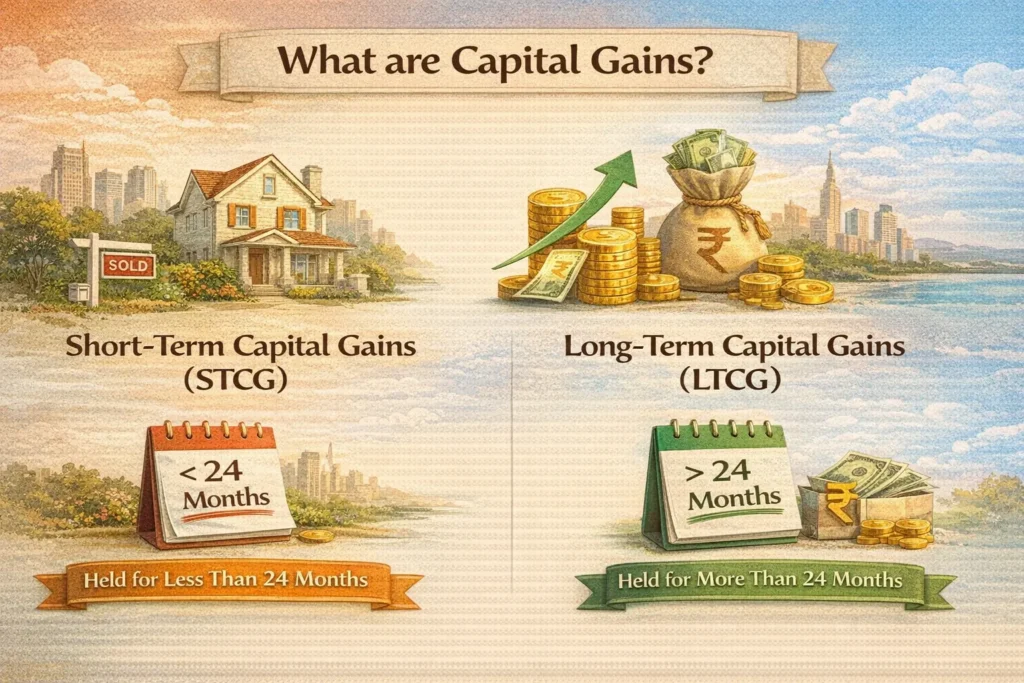
Capital gains are the profits earned when you sell a capital asset, like real estate, at a price higher than the purchase price. These gains are classified into two types based on the duration you hold the asset before selling:
- Short-Term Capital Gains (STCG): If the property is held for 24 months or less before selling, the profit is a short-term capital gain.
- Long-Term Capital Gains (LTCG): If the property is held for more than 24 months, it qualifies as long-term capital gains.
This classification is essential as it impacts the tax rate and available exemptions.
Capital gains tax calculator on sale of property
The tax rates for capital gains on property sales differ for short-term and long-term holdings:
- Short-Term Capital Gains Tax: STCG on property is taxed at the individual’s applicable income tax slab rate. This means that short-term gains are added to your income for the year and taxed as per your slab rate.
- Long-Term Capital Gains Tax: For sales on or after 23 July 2024, LTCG on property is taxed at 12.5% without indexation. Resident individuals and HUFs who bought the property before 23 July 2024 may instead pay 20% with indexation, whichever gives the lower tax. NRIs pay 12.5% without indexation; the 20% option is not open to them. Surcharge (where it applies) and 4% health and education cess are added on top.
Calculating Capital Gains:
Calculating capital gains involves determining the sale price, purchase price, and any improvement costs. Here’s a step-by-step outline of the calculation process for short-term and long-term gains:
For Short-Term Capital Gains:
1. Calculate the Sale Price: Sale Price = Total amount received from the sale of the property.
2. Deduct the Purchase Cost and Expenses: This includes the original purchase price, brokerage, stamp duty, legal fees, and any improvement costs.
Formula: Short-Term Capital Gains = Sale Price - (Purchase Price + Expenses)
For Long-Term Capital Gains:
1. Deduct the cost: Take the sale price and subtract the purchase price, the cost of any improvements and the expenses of the sale (brokerage, legal fees). This is the gain taxed at 12.5%.
2. Only if you are a resident who bought before 23 July 2024: also work out the gain with indexation, using Indexed Cost = Purchase Price × (Cost Inflation Index of the year of sale ÷ Cost Inflation Index of the year of purchase), tax it at 20%, and pay whichever of the two taxes is lower.
Formula: Long-Term Capital Gains = Sale Price - (Purchase Price + Improvement Costs + Expenses). With the indexation option, use the indexed purchase cost instead.
Exemptions on Long-Term Capital Gains:
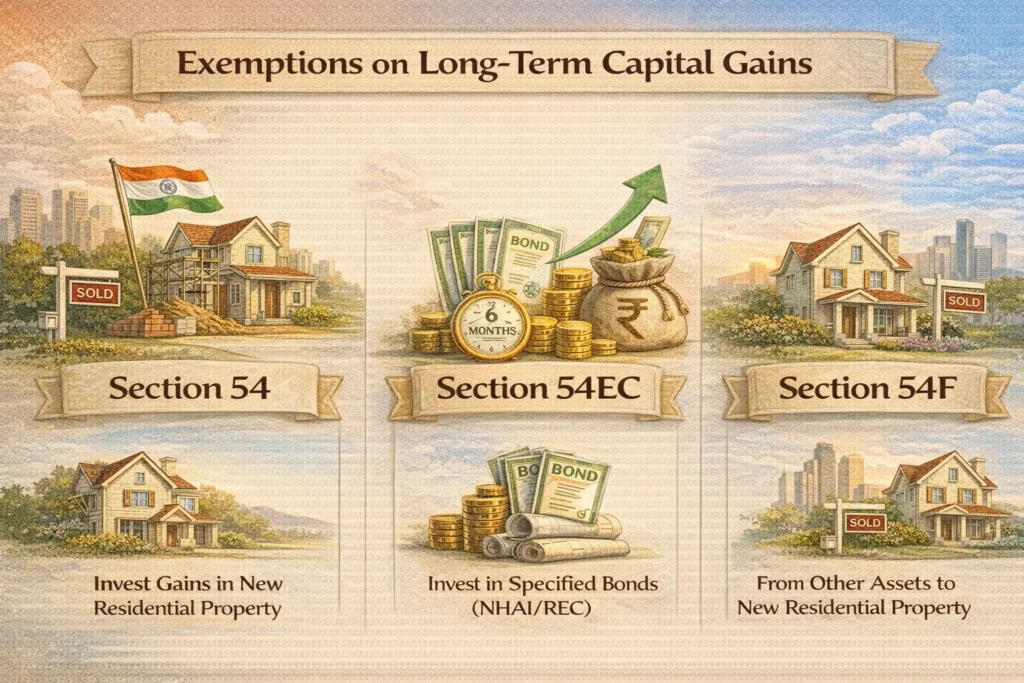
To encourage investment and reinvestment in real estate and specific financial products, the Indian tax system provides several exemptions under Sections 54, 54EC, and 54F for long-term capital gains.
- Section 54: If you sell a residential property and invest the capital gains in purchasing or constructing another residential property, you can claim an exemption. The new property must be bought within 1 year before or 2 years after the sale, or constructed within 3 years. The exemption is capped at ₹10 crore of capital gains, for sales from 1 April 2023 onwards.
- Section 54EC: This allows you to invest up to Rs. 50 lakhs of your long-term capital gains in specific bonds (such as those from NHAI or REC) within six months of the sale. These bonds have a lock-in period of 5 years.
- Section 54F: If you sell any long-term capital asset other than a residential property and use the proceeds to buy a new residential property, you can claim an exemption. However, certain conditions apply, such as not owning more than one residential property at the time of investment. The same ₹10 crore cap applies.
Special Considerations and Tips:
- Joint Ownership: If the property is jointly owned, the capital gains can be split based on the ownership ratio, potentially reducing the tax burden.
- Set-off and Carry Forward of Losses: Capital losses, if any, from property sales can be set off against capital gains. Unutilized losses can be carried forward for up to eight assessment years.
- Tax Planning for NRIs: When an NRI sells, the buyer must deduct TDS on the full sale price, not just the gain: 12.5% plus surcharge and cess for long-term gains, and 30% plus surcharge and cess for short-term gains. NRIs can apply for a lower deduction certificate before the sale. From 1 October 2026, resident individual and HUF buyers can deposit this TDS with their PAN through Form 141, without getting a TAN.
Filing Capital Gains Tax:
Capital gains from property sales should be disclosed in your income tax return (ITR) under "Capital Gains." To avoid complications, make sure you keep records of all documentation, including purchase agreements, sale deeds, and improvement costs.
Sales made up to 31 March 2026 are reported under the Income-tax Act, 1961, in the return for AY 2026-27. Sales from 1 April 2026 fall under the Income-tax Act, 2025: the rates and exemptions above stay the same, but the sections have new numbers and the year is now called the "tax year".
Conclusion:
Navigating capital gains tax on property sales in India can seem complex, but understanding the basics can help you make informed financial decisions. By planning your sale strategically, taking advantage of available exemptions, and consulting with tax professionals when needed, you can reduce your tax burden and maximize your gains. Whether you’re selling property to upgrade, downsize, or for investment purposes, knowing the capital gains tax rules will ensure a smoother, tax-efficient transaction.
Also Read: Documents Required To Sale Property In India
Selling a property in India from abroad? Housewise runs the whole sale for you, from pricing and buyer checks to TDS and registration. See our property sale service, or work out what reaches you with our NRI property sale calculator.


0 Comments