

Every few months, an Indian newspaper carries a small legal notice at the corner of a page. "I, so-and-so, hereby declare that my son, so-and-so, has been disowned from all my movable and immovable property. Anyone dealing with him does so at their own risk." A furious parent, an estranged son, and a two-column advertisement pretending to be a legal document.
These notices have become such a familiar sight in Indian classifieds that most people assume they carry legal weight. They do not. Under Indian law, a public notice of disownment has almost zero legal effect. It does not sever the parent-child relationship. It does not cancel the child's surname. It does not remove the child's inheritance rights. And it does not stop the child from claiming a share in ancestral property.
At the same time, the opposite belief is equally common. Many adult children assume that they cannot be excluded from a parent's property no matter what. That is also wrong. Parents in India do have significant, legally recognised power to exclude a child from their property, but only within a specific framework and only over specific categories of property. Some doors are wide open. Others are firmly shut. This guide walks through what the law actually allows, what it does not, and what parents and children on either side of this equation need to understand in 2026.
Can Parents Disinherit a Child in India?
Yes, but only from self-acquired property, and only through a properly executed legal instrument like a valid Will or a registered gift deed. Under Section 30 of the Hindu Succession Act, 1956, and Section 59 of the Indian Succession Act, 1925, parents have absolute freedom to bequeath their self-acquired property to anyone they choose, including excluding a child entirely. However, parents cannot disinherit a child from ancestral or coparcenary property under Hindu law. Section 6 of the Hindu Succession Act, as reinforced by the Supreme Court in Vineeta Sharma v. Rakesh Sharma (2020), gives every child, son and daughter alike, a birthright in ancestral property that cannot be taken away by any Will, gift, or disownment notice. Muslim law limits testamentary freedom to one-third of the estate. Christian and Parsi parents can bequeath any property freely. Newspaper notices announcing "disowning" of a child carry no legal weight at all.
Disownment vs Disinheritance: Two Very Different Things
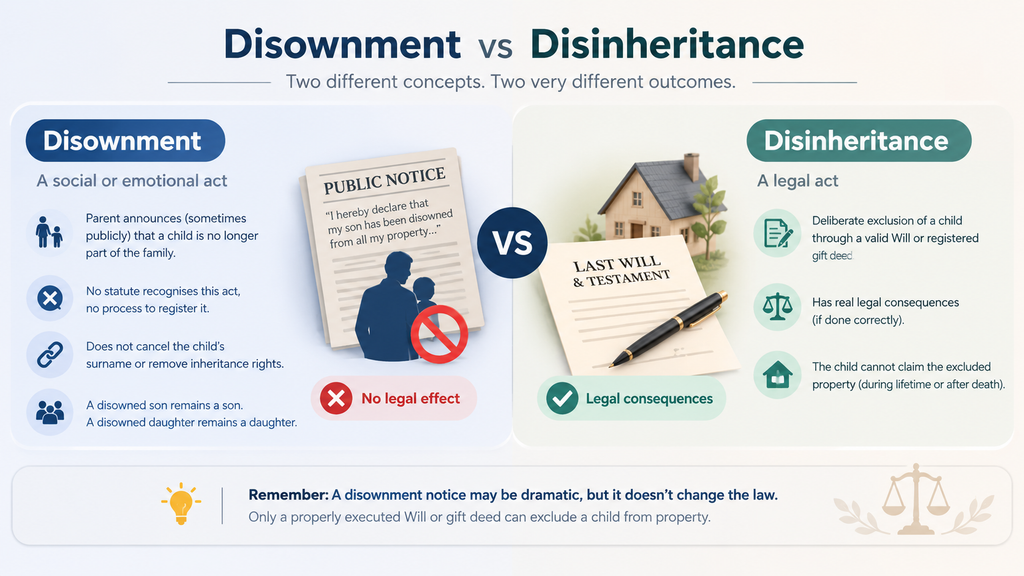
Indian family disputes often collapse two concepts into one word. Disownment and disinheritance sound similar but do very different things under the law.
Disownment is a social or emotional act. A parent announces, sometimes publicly, that a child is no longer part of the family. Under Indian law, there is no statute that recognises this act, no procedure to register it, no certificate to issue. The parent-child relationship is created by birth or adoption, and Indian law does not permit a parent to unilaterally cancel it. A disowned son remains a son. A disowned daughter remains a daughter. Both continue to be legal heirs, retain their surname, and hold whatever inheritance rights the law gives them.
Disinheritance is a legal act. It is the deliberate exclusion of a child from receiving property, executed through a specific legal instrument. If done correctly, disinheritance has real consequences. The child cannot claim the excluded property either during the parent's lifetime or after their death.
The confusion between the two words is why so many families end up in prolonged litigation. A parent publishes a disownment notice, believes the matter is settled, and never executes a proper Will. When they die intestate, the "disowned" child appears at the succession proceeding and inherits an equal share along with siblings. The newspaper announcement counts for nothing.
The Rule That Decides Everything: Self-Acquired vs Ancestral Property
Before any question of disinheritance is asked, the property has to be classified. The answer differs entirely by category.
Self-acquired property is property that the parent has bought with their own income, earned through their own effort, or received as a gift or inheritance from a non-lineal source. It also includes property that was ancestral but has been formally partitioned, so the parent's share has become their own separate estate. Over self-acquired property, the parent is the absolute owner and can dispose of it as they wish.
Ancestral property in Hindu law is coparcenary property, inherited through four generations of male lineage and remaining undivided. Every coparcener, including daughters after 2005, has a right by birth in this property. A parent is a coparcener like everyone else, but not an owner. Their power to dispose of ancestral property extends only to their own notional share, not to the shares of other coparceners.
Disinheritance From Self-Acquired Property: Yes, Parents Can
Over self-acquired property, Indian law gives parents essentially complete freedom to distribute as they see fit. The instruments they can use include:
- A valid Will under Section 59 of the Indian Succession Act, 1925
- A registered gift deed under Sections 122 to 129 of the Transfer of Property Act, 1882
- A registered settlement deed
- A family settlement agreement
For Hindus, Christians, Parsis, Sikhs, Jains, and Buddhists, there is no legally mandated minimum share for any child. A parent can leave the entire self-acquired estate to one child, split it unequally, give it to a charity, or transfer it to a friend. A well-drafted Will excluding a named child by name typically prevails, unless the child successfully challenges it in probate court.
The requirements for such a Will to hold are strict. It must be:
- Made by a person of sound mind, above 18 years of age
- Executed in writing (with narrow exceptions for privileged Wills)
- Signed by the testator or by someone under their direction
- Attested by two witnesses who saw the testator sign
- Free from fraud, coercion, or undue influence
Registration of the Will is not mandatory in India, but it substantially strengthens its evidentiary value if the exclusion is later challenged.
Disinheritance From Ancestral Property: No, Not Under Hindu Law
Ancestral property is a different world. Under Section 6 of the Hindu Succession Act, 1956, as amended in 2005 and definitively interpreted by the Supreme Court in Vineeta Sharma v. Rakesh Sharma (2020) 9 SCC 1, every child is a coparcener by birth. That right cannot be extinguished by:
- A disownment notice, public or private
- A Will executed by the parent
- A gift deed excluding the child
- A family arrangement without the child's consent
The parent's Will can dispose of their own coparcenary share, but not the child's. If the parent tries to bequeath the entire ancestral property to one child, the excluded siblings retain their legal right to claim their coparcenary shares through a partition suit. The Vineeta Sharma judgment made it clear that this rule applies equally to daughters, and that neither the daughter's marital status nor the father's date of death changes it.
The only exception is a registered partition executed before 20 December 2004, which protects settlements finalised before the Vineeta Sharma cut-off from being reopened.
How the Rules Differ Under Muslim, Christian, and Parsi Law
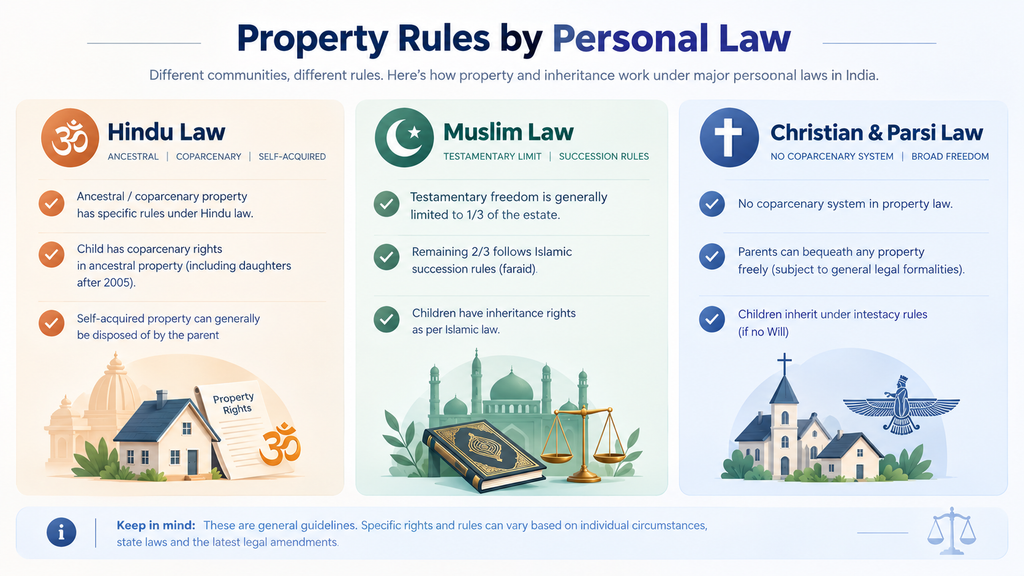
The Hindu framework of ancestral property does not exist in other personal laws, but each has its own limits on parental testamentary freedom.
Muslim law: Governed by the Muslim Personal Law (Shariat) Application Act, 1937. A Muslim parent cannot fully disinherit any legal heir. Testamentary freedom (Wasiyat) is capped at one-third of the estate. Even that one-third generally cannot be bequeathed to a legal heir without the consent of the other heirs. The remaining two-thirds devolves automatically among legal heirs in fixed Quranic shares. In practical terms, a Muslim child, even one whose parent has explicitly written them out, will still inherit a share by operation of law.
Christian and Parsi law: Governed by the Indian Succession Act, 1925. There is no concept of ancestral property, no coparcenary, and no forced heirship. Parents have full freedom to bequeath their property by Will to any person, including excluding one or all children. If the parent dies intestate, all children inherit equally.
Ways Parents Can Legally Exclude a Child: At a Glance
| Legal Instrument | What It Does | Best Suited For |
|---|---|---|
| Registered Will | Distributes estate after death | Straightforward exclusion from self-acquired property |
| Registered Gift Deed | Transfers property during lifetime | Immediate transfer to preferred beneficiary |
| Settlement Deed | Transfers with conditions | Retaining certain rights, adding maintenance clauses |
| Family Settlement | Consensual division | Where all family members agree, avoids litigation |
| Public disownment notice | No legal effect | Never a standalone solution |
The right instrument depends on the parent's goal, the property involved, and the relationship dynamics. A parent who wants to move a house entirely out of the excluded child's reach during their lifetime typically uses a registered gift deed. A parent who wants to retain control until death but ensure exclusion at succession uses a properly executed Will.
When a Disinherited Child Can Challenge the Will
Even a well-drafted Will can be challenged in probate proceedings. Common grounds under Sections 61 to 63 of the Indian Succession Act, 1925 include:
- Fraud or forgery: The Will does not actually bear the parent's signature, or the document was altered after execution.
- Undue influence: The parent was pressured, isolated, or manipulated into excluding the child, often by another family member who stands to benefit.
- Unsound mind: The parent lacked the mental capacity to understand what they were signing at the time of execution.
- Coercion: The parent was threatened or forced.
- Formal defects: The Will was not properly signed, was not witnessed by two people, or was executed by a minor.
Courts scrutinise Wills that make unusual or unequal distributions much more closely than balanced ones. A Will that gives everything to one child and expressly excludes another routinely faces this scrutiny, even where the exclusion was entirely legitimate. Reasons stated in the Will, executed in the presence of neutral witnesses, dated with a doctor's fitness certificate for the parent, dramatically reduce the risk of successful challenge.
The Senior Citizens Act: The Ace Up Elderly Parents' Sleeves
There is a mirror image of the disinheritance question that catches many families by surprise. What happens when a parent has already transferred property to a child, and the child then neglects the parent?
The Maintenance and Welfare of Parents and Senior Citizens Act, 2007, provides a powerful answer. Under Section 23(1), any transfer of property by a senior citizen, whether by gift deed or settlement deed, is treated as subject to an implied condition that the recipient will maintain and provide basic amenities to the transferor. If the recipient fails to do so, the transfer can be declared void by the Maintenance Tribunal, and the property returned to the senior citizen.
The Madras High Court reinforced this principle in a widely-cited 2025 division bench ruling, holding that the maintenance expectation is implied in every gift deed executed by a senior citizen in favour of a child, even where the deed does not spell it out. In another 2025 case, the same court upheld the revocation of a settlement deed executed by an 87-year-old woman whose daughter-in-law had neglected her after the son's death.
This creates an important reverse-flip. A parent who has already gifted property to a child, and who is being neglected, has a statutory route to reclaim it, entirely independent of any Will or new disinheritance decision.
Practical Guidance for Parents Considering Disinheritance
Parents who are seriously considering excluding a child from their property should think through several steps before signing anything.
- Classify the property: Self-acquired property can be freely bequeathed. Ancestral property cannot be alienated beyond the parent's own share.
- Draft a proper Will, not a notice: A registered Will executed with two witnesses and a mental fitness statement is worth infinitely more than any newspaper announcement.
- State reasons briefly: A one-line explanation for the exclusion in the Will substantially reduces the risk of a successful challenge on undue influence grounds.
- Consider a gift deed with maintenance conditions: For lifetime transfers, an express maintenance clause preserves the ability to invoke the Senior Citizens Act if the recipient fails to care for the parent.
- Get medical certification: For elderly parents, a doctor's certificate of sound mind on the date of Will execution neutralises the "unsound mind" challenge.
- Register the instrument: Registration is optional for a Will but strongly recommended for exclusions. It is mandatory for gift deeds and settlement deeds.
- Update the Will after major life events: Marriage, divorce, births, deaths, and property acquisitions all warrant a fresh review.
How Housewise Helps
Housewise coordinates rent agreement drafting, stamp duty payment, and, in Maharashtra, registration for property owners across 23 Indian cities. Where a family has resolved property distribution through a Will, gift deed, or family settlement, and the recipient chooses to let out the property rather than sell it, Housewise handles the tenancy paperwork end-to-end with state-appropriate templates, tenant verification, and periodic renewals. Owners drafting their first agreement can also avoid the common mistakes in rent agreements that create friction later, and those weighing a full rent agreement against a leave and licence structure get help picking the right instrument for their city and profile.
Frequently Asked Questions
Can parents legally disinherit a child in India?
Yes, from self-acquired property, through a properly executed Will, gift deed, or settlement deed. Parents cannot disinherit a child from Hindu ancestral property, which the child holds as a birthright coparcenary. Muslim law limits testamentary freedom to one-third of the estate.
Is a newspaper notice disowning a child legally binding?
No. A newspaper disownment notice has no legal effect in India. It does not sever the parent-child relationship, remove the child's inheritance rights in ancestral property, or affect their claim as a Class I heir if the parent dies intestate.
Can parents disinherit a child from ancestral property under Hindu law?
No. Under Section 6 of the Hindu Succession Act, 1956, and Vineeta Sharma v. Rakesh Sharma (2020), every child is a coparcener by birth in ancestral property. This right cannot be extinguished by a Will, gift deed, or disownment notice from the parent.
Can a Muslim parent disinherit a child completely?
No. Under Muslim personal law, testamentary freedom is capped at one-third of the estate, and even that generally cannot be bequeathed to a legal heir without the other heirs' consent. The remaining two-thirds devolves by fixed Quranic shares to all legal heirs.
What is the difference between disownment and disinheritance?
Disownment is a social act announcing severance of the parent-child relationship. It has no legal effect. Disinheritance is a legal act, executed through a valid Will, gift deed, or settlement deed, that excludes a child from inheriting specific property. Only disinheritance has legal consequences.
Can a disinherited child challenge the parent's Will?
Yes. A disinherited child can challenge the Will under Sections 61 to 63 of the Indian Succession Act, 1925, on grounds of fraud, undue influence, coercion, unsound mind, forgery, or formal defects. Courts examine unequal Wills more strictly than balanced ones.
Can parents revoke a gift deed already made to a child?
Yes, under Section 23(1) of the Maintenance and Welfare of Parents and Senior Citizens Act, 2007. If the child receiving the property fails to maintain the elderly parent, the Maintenance Tribunal can declare the transfer void and restore ownership to the senior citizen.
Is registration of a Will mandatory in India?
No, registration of a Will is not mandatory under Indian law, but it is strongly recommended in cases involving exclusion of one or more children. A registered Will has significantly higher evidentiary value in probate proceedings and is much harder to challenge.
Do parents still have to maintain a "disowned" child?
For minor children, yes. Section 144 of the Bharatiya Nagarik Suraksha Sanhita, 2023, and the Hindu Adoptions and Maintenance Act, 1956, impose a maintenance duty until majority. For adult self-supporting children, the maintenance duty generally ends, except where the child has a disability preventing self-support.
How does Housewise help owners after property distribution decisions?
Housewise handles rent agreement drafting, stamp duty, and, in Maharashtra, registration across 23 Indian cities for property owners who choose to let out inherited or gifted property. This covers state-appropriate templates, tenant verification, and periodic renewals for turning the property into income.
1. Can parents legally disinherit a child in India?
Yes, from self-acquired property, through a properly executed Will, gift deed, or settlement deed. Parents cannot disinherit a child from Hindu ancestral property, which the child holds as a birthright coparcenary. Muslim law limits testamentary freedom to one-third of the estate.
2. Is a newspaper notice disowning a child legally binding?
No. A newspaper disownment notice has no legal effect in India. It does not sever the parent-child relationship, remove the child's inheritance rights in ancestral property, or affect their claim as a Class I heir if the parent dies intestate.
3. Can parents disinherit a child from ancestral property under Hindu law?
No. Under Section 6 of the Hindu Succession Act, 1956, and Vineeta Sharma v. Rakesh Sharma (2020), every child is a coparcener by birth in ancestral property. This right cannot be extinguished by a Will, gift deed, or disownment notice from the parent.
4. Can a Muslim parent disinherit a child completely?
No. Under Muslim personal law, testamentary freedom is capped at one-third of the estate, and even that generally cannot be bequeathed to a legal heir without the other heirs' consent. The remaining two-thirds devolves by fixed Quranic shares to all legal heirs.
5. What is the difference between disownment and disinheritance?
Disownment is a social act announcing severance of the parent-child relationship. It has no legal effect. Disinheritance is a legal act, executed through a valid Will, gift deed, or settlement deed, that excludes a child from inheriting specific property. Only disinheritance has legal consequences.
6. Can a disinherited child challenge the parent's Will?
Yes. A disinherited child can challenge the Will under Sections 61 to 63 of the Indian Succession Act, 1925, on grounds of fraud, undue influence, coercion, unsound mind, forgery, or formal defects. Courts examine unequal Wills more strictly than balanced ones.
7. Can parents revoke a gift deed already made to a child?
Yes, under Section 23(1) of the Maintenance and Welfare of Parents and Senior Citizens Act, 2007. If the child receiving the property fails to maintain the elderly parent, the Maintenance Tribunal can declare the transfer void and restore ownership to the senior citizen.
8. Is registration of a Will mandatory in India?
No, registration of a Will is not mandatory under Indian law, but it is strongly recommended in cases involving exclusion of one or more children. A registered Will has significantly higher evidentiary value in probate proceedings and is much harder to challenge.
9. Do parents still have to maintain a "disowned" child?
For minor children, yes. Section 144 of the Bharatiya Nagarik Suraksha Sanhita, 2023, and the Hindu Adoptions and Maintenance Act, 1956, impose a maintenance duty until majority. For adult self-supporting children, the maintenance duty generally ends, except where the child has a disability preventing self-support.
10. How does Housewise help owners after property distribution decisions?
Housewise handles rent agreement drafting, stamp duty, and, in Maharashtra, registration across 23 Indian cities for property owners who choose to let out inherited or gifted property. This covers state-appropriate templates, tenant verification, and periodic renewals for turning the property into income.


0 Comments