

There is a strange paradox at the heart of the NRI story. A software engineer in Bengaluru who moves to Seattle sees their salary jump from Rs. 25 lakh to $150,000, roughly a five-fold increase in nominal terms. A nurse who relocates from Kerala to the UK earns three times her salary at home. And yet, ten years later, most NRIs have accumulated far less wealth than the math predicts. The dirhams, dollars, and pounds do not translate into proportional net worth back home. Something is quietly draining the surplus.
That something has a name. It is called the guilt tax.
The Guilt Tax: The Silent Levy on Every NRI Paycheck
When you move eight thousand kilometres away from your parents, siblings, and extended family, a specific emotional cocktail sets in: survivor’s guilt. You have better infrastructure, higher wages, cleaner air, and a stronger currency. Your parents, meanwhile, are still navigating the same commutes, hospital queues, and monsoon power cuts. The imbalance feels wrong. And because you cannot be there physically to help with the small things, you compensate financially.
Money becomes a substitute for presence. Over time, that substitution hardens into a self-imposed obligation that is not written in any law and not enforced by any court, but is culturally binding all the same.
The Three Faces of Guilt Spending

- Love spending. Paying for a cousin’s medical treatment or a niece’s school fees feels like a duty rather than a choice. Saying no, even when the request is unreasonable, feels like betraying the family that raised you.
- Absence spending. Funding a lavish wedding, a milestone anniversary, or a housewarming feast is a way of saying, “I am still part of this family, even though I cannot be here.”
- Status spending. Renovating the ancestral home, buying a car for a sibling, or gifting expensive electronics is a way of showing that the foreign-settled child is thriving and taking care of everyone.
None of this is inherently wrong. The problem is scale and unconsciousness. Most NRIs never sit down and quantify what they are transferring, why, and whether it matches their own long-term financial plan.
The Math That Never Adds Up
Building wealth requires two key elements: earning a surplus and allowing that surplus to compound over time in productive assets. The guilt tax breaks both.
The Host Country Wealth Trap
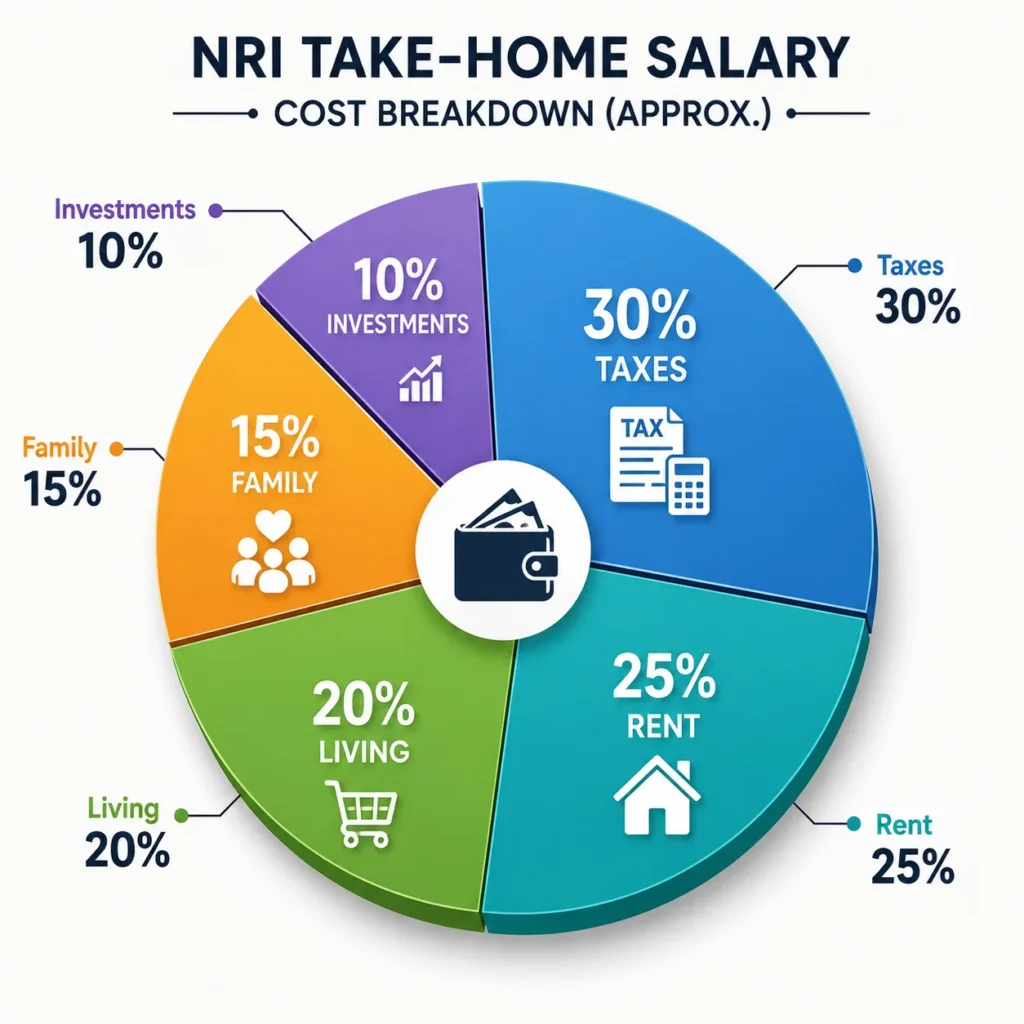
Living in London, Dubai, Toronto, or the Bay Area is expensive. Rent alone can eat 40 to 50 percent of take-home pay in tier-1 global cities. Add in taxes, health insurance, transport, and grocery inflation, and the after-tax surplus that actually looks large in rupee terms starts to shrink fast.
For an NRI earning Rs. 1.5 crore equivalent in the US, the actual investable surplus after taxes, mortgage, and cost of living may be closer to Rs. 30 lakh. That is a real number, but it is not the “I earn six times what I would in India” number the family sees.
The Family ATM Effect
Once one relative discovers that you say yes to a request, the informal network activates. Requests for tuition fees, medical bills, wedding contributions, and business loans start to arrive quietly. Some NRIs end up supporting three to five extended family dependents, in addition to their own household abroad and their nuclear family goals.
The Zero Compounding Problem
Money sent home for a wedding or a home renovation does not compound. It converts into celebration, memory, and social capital, none of which pay dividends thirty years later. Meanwhile, the same rupees invested in mutual funds, index ETFs, or a well-managed rental property could have grown at 10 to 12 percent annually.
Over twenty years, this gap is not a rounding error. It is the difference between financial independence and being permanently stuck abroad.
The Return Dilemma: Why Most NRIs Never Come Back
Every NRI leaves with a plan: work abroad for five years, save aggressively, come home. Five becomes ten, ten becomes twenty, and the plane ticket back keeps getting postponed. The guilt tax is the reason.
- Lifestyle lock-in. Your parents and siblings have adjusted to a certain standard of living funded by your remittances. Air conditioners, private schools, imported groceries, foreign holidays. If the foreign income stops, that entire lifestyle collapses, and it is now emotionally on you.
- The missing safety net. You did not save enough in hard currency to survive the pay cut of moving to an Indian salary. The rupee cushion that should have been your buffer went into consumption instead of compounding assets.
- Fear of judgment. Returning without a visible fortune feels like a public failure. Years of being placed on a pedestal make it psychologically hard to come back with just an “average” nest egg.
The result is what financial planners call golden handcuffs. You are wealthy on paper, exhausted in practice, and unable to actually leave the job or country that is costing you your family time.
The One Asset Category NRIs Get Right (and Then Get Wrong)
There is one type of guilt spending that could actually compound: buying property in India. Real estate in a tier-1 or tier-2 Indian city is a genuine asset. It appreciates, it generates rent, and it holds value in the currency you will eventually need to spend if you return.
The problem is what happens after the purchase.
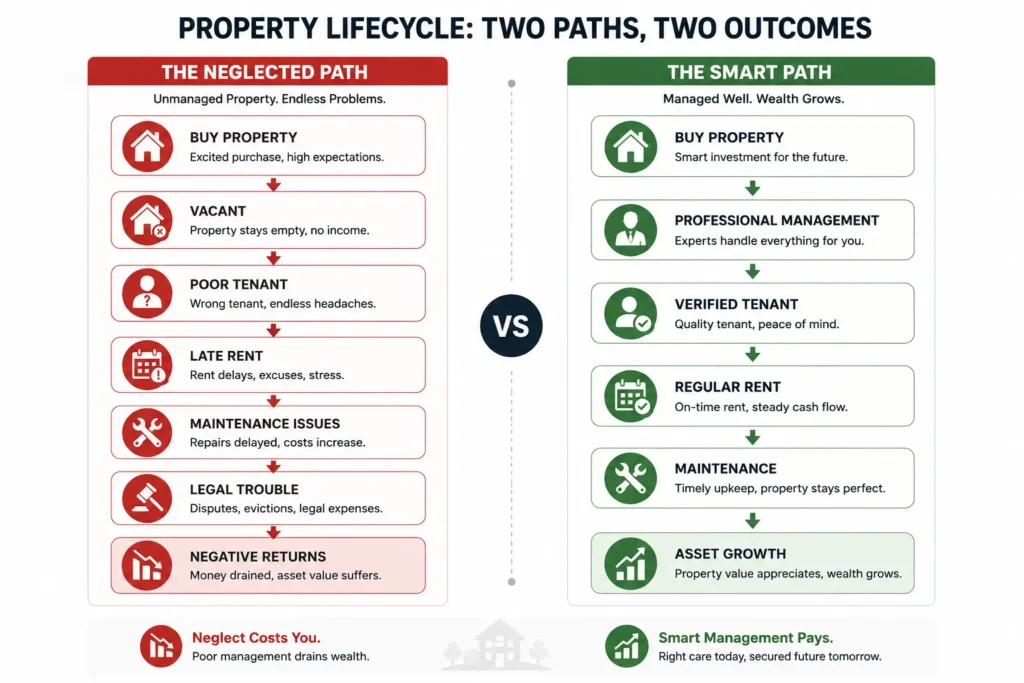
- The flat sits vacant for two years while the family tries to find a “good tenant” through word of mouth.
- A friend of a cousin moves in and pays intermittently, then stops entirely.
- No registered rent agreement exists, so eviction takes three years in a civil court.
- Maintenance dues, society transfers, and utility bills pile up because no one is coordinating.
- The property was supposed to be an asset. It becomes a slow-motion drain.
This is the point where the guilt-driven purchase becomes another leak in the wealth bucket. The house is real. The wealth it was supposed to build is not.
How to Turn Emotional Remittances into Financial Freedom
Breaking the guilt tax cycle does not mean cutting off your family. It means shifting from emotional impulsiveness to structured financial boundaries. The framework is straightforward.
- Separate necessities from luxuries. Fund essential medical care, elderly-parent living costs, and genuine emergencies. Push back gently but clearly on wedding upgrades, non-critical renovations, and lifestyle inflation gifts.
- Automate what you send. A fixed monthly transfer to parents is dignified and predictable. Ad-hoc panic transfers are neither.
- Ring-fence your compounding capital. Decide what percentage of your income is untouchable savings, and treat it like a non-negotiable tax on yourself.
- Turn Indian property into a productive asset. If you own real estate in India, it should be earning rent, staying tenanted, and being professionally managed. A vacant flat is not a family asset. It is a family liability with a title deed.
The last point is where most NRI wealth quietly dies. And it is exactly the problem that professional property management is built to solve.
How Housewise Helps NRIs Stop the Wealth Leak
Housewise is a property management company built specifically for the NRI reality: owners who are seven time zones away, cannot fly in for a leaking pipe, and do not want to bother their parents to chase a rent cheque.
Our NRI property management service handles the complete lifecycle of your Indian rental property:
- Tenant sourcing, screening, and background verification
- Legally sound rent agreement drafting and registration
- Monthly rent collection with direct transfer to your bank
- Maintenance coordination, society liaison, and bill payments
- Move-in and move-out inspections
- Compliance with state rent control acts and the Model Tenancy Act framework
For legally clean tenancies, we handle the complete online rent agreement service, including e-stamping and biometric verification, entirely remotely. If you are unsure whether your property needs a leave and licence or a standard rent agreement, our Leave and Licence vs Rent Agreement guide breaks it down. For updates on the new tenancy rules taking effect across states, see our Model Tenancy Act explainer.
NRI landlords in Bangalore, Chennai, Gurugram, and Noida already use Housewise to turn their Indian real estate into what it was always supposed to be: a compounding asset, not a compounding worry.
Conclusion
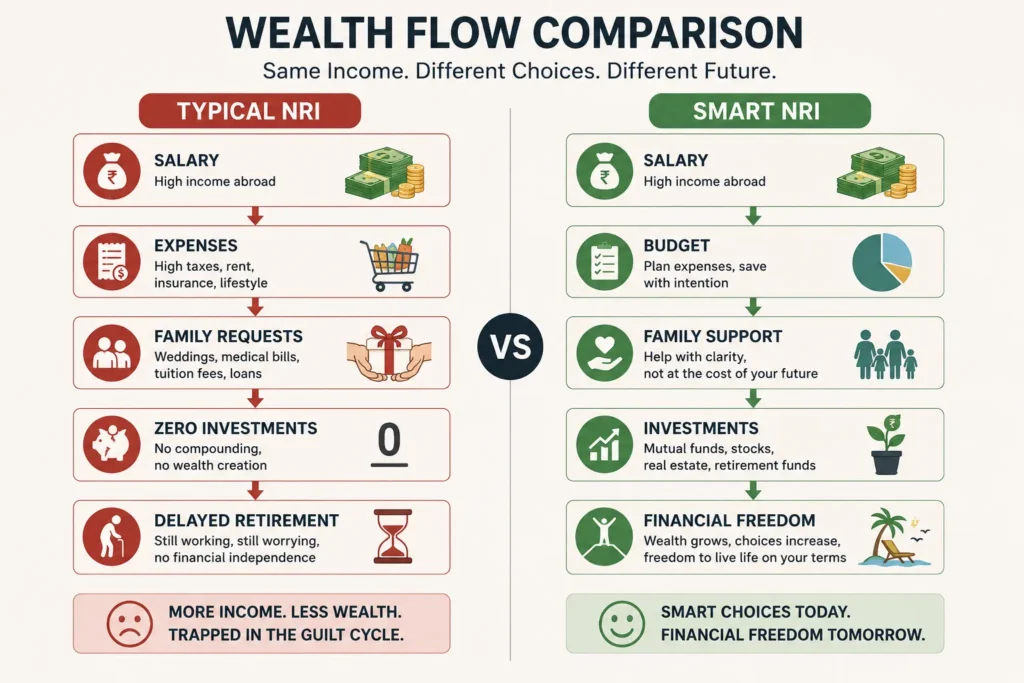
The guilt tax is not paid in one lump sum. It is paid in small, emotionally reasonable increments over decades, until one day you look at your net worth and realise the salary was never the problem. The unstructured outflow was.
Breaking the cycle does not require becoming distant, cold, or transactional with your family. It requires the courage to say “I can help with necessities, not luxuries,” and the discipline to route the rest of your surplus into assets that actually grow.
If part of that surplus already sits in Indian property, talk to Housewise about turning it into a compounding asset. Because the best gift you can give the family you love is not another remittance. It is a version of yourself that is financially free enough to eventually come home.
Frequently Asked Questions
What exactly is the NRI guilt tax?
The NRI guilt tax is the culturally driven pattern of overspending on extended family through weddings, renovations, medical bills, and lifestyle gifts. It is not a legal tax, but it silently drains surplus income that should otherwise be building long-term wealth.
Why do high foreign salaries fail to translate into NRI wealth?
Foreign salaries look large in rupee terms but face high host-country costs, taxes, and healthcare expenses. Combined with heavy remittances for family obligations, the actual investable surplus is far smaller than the family assumes it should be.
Is sending money home to family always financially harmful?
No. Supporting elderly parents, funding genuine medical needs, and covering emergencies is both ethical and manageable. The problem starts when discretionary luxuries, lavish weddings, and non-essential renovations consume the surplus meant for retirement compounding.
Why do most NRIs struggle to return to India permanently?
NRIs face lifestyle lock-in from remittance-funded family standards, insufficient hard-currency savings for a lower Indian salary, and fear of being judged for returning without visible wealth. These emotional and financial pressures often keep them abroad indefinitely.
Can Indian property actually build wealth for NRIs?
Yes, provided it is professionally managed. A tenanted, well-maintained rental property in a tier-1 or tier-2 Indian city appreciates in rupee value, generates monthly income, and hedges against future returns. A vacant or mismanaged property does the opposite.
How do I set financial boundaries with family without damaging relationships?
Communicate transparently, differentiate necessities from luxuries, and automate a fixed monthly transfer for parents. Say yes to essential needs and gently decline non-critical requests. Consistency matters more than any single conversation for preserving both wealth and relationships.
What percentage of NRI income should go into compounding investments?
Financial planners typically recommend 30 to 40 percent of net income into long-term compounding assets like index funds, mutual funds, or professionally managed rental property. This range balances family support obligations with the need for retirement independence.
Should NRIs prioritise buying property in India over investing abroad?
Both matter, and the right split depends on return plans. If you intend to move back, Indian property makes strong sense as a currency hedge and future residence. Diversifying across geographies remains sensible regardless of the return timeline.
What are the biggest mistakes NRIs make with Indian rental property?
Leaving flats vacant while searching informally for tenants, skipping registered rent agreements, avoiding professional property management, and depending on family members to chase rent. Each mistake converts a productive asset into a slow-motion financial and emotional drain.
How does Housewise support NRI property owners?
Housewise handles end-to-end property management for NRIs across 22+ Indian cities. Services include tenant screening, registered rent agreements, monthly rent collection, maintenance, society liaison, and legal compliance, all coordinated remotely without needing family involvement.


0 Comments