
Mumbai has thousands of ageing buildings. Many have never had a formal structural assessment. If you own property in Mumbai, a structural audit is not just paperwork. It is your earliest warning system for safety risks, your gateway to redevelopment, and increasingly, a legal requirement you cannot ignore.
This guide explains what a structural audit in Mumbai actually involves, when it is mandatory, what the process looks like step by step, what it costs, and what NRI property owners specifically need to know.
What Is a Structural Audit?
A structural audit is a systematic inspection of a building carried out by a qualified structural engineer. The goal is simple: assess whether the building is safe, stable, and in good structural condition.
Think of it like a full health check-up. Not just for you, but for the building you live in or own. The engineer examines the foundation, columns, beams, slabs, walls, and staircases. Every load-bearing element that keeps the building standing gets assessed.
At the end, the engineer produces a formal report. This report classifies the building’s condition and recommends what action needs to be taken. That report can mean minor repairs, major intervention, or in serious cases, evacuation.
Is Structural Audit Mandatory in Mumbai?
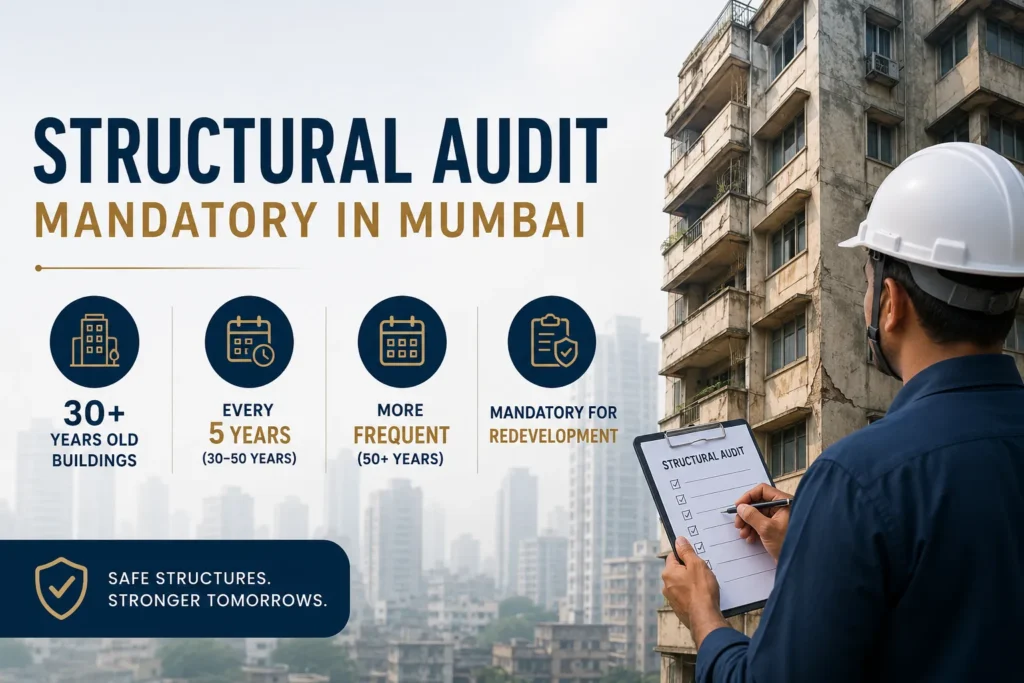
Yes. Under MCGM (Municipal Corporation of Greater Mumbai) guidelines, structural audits are mandatory for buildings that cross the prescribed age threshold, generally 30 years and older. The frequency of subsequent audits depends on the age of the building. Buildings between 30 and 50 years old generally require an audit every 5 years, while buildings above 50 years old may require more frequent audits as per applicable MCGM guidelines.
The responsibility for conducting the structural audit lies with the housing society or building owner. Non-compliance can lead to regulatory action, and in cases where a building is found to be unsafe, MCGM may issue notices requiring appropriate action.
There is also the redevelopment angle. If your housing society is considering redevelopment, a structural audit is a mandatory prerequisite before anything else can move forward. You cannot even begin the conversation with a developer without it.
So if you have been putting it off, this is your sign to stop.
What Is a Structural Audit of an RCC Building?
Most of Mumbai’s residential buildings are RCC structures. RCC stands for Reinforced Cement Concrete. It is essentially concrete strengthened with steel bars running through it.
An RCC building audit is more specific than a general inspection. The engineer is looking at the health of both the concrete and the steel reinforcement inside it.
Here is what gets tested:
- Concrete quality — Has the concrete weakened over time?
- Carbonation depth — Carbon dioxide from the air penetrates concrete over years, making it acidic and corroding the steel inside
- Chloride penetration — Buildings near Mumbai’s coastline absorb salt from sea air. Salt corrodes steel rapidly
- Cover depth — Is there enough concrete protecting the steel bars?
- Crack mapping — Where are the cracks, how deep are they, and what is causing them?
- Load-bearing capacity — Can the structure still safely carry the loads it was designed for?
Mumbai’s buildings face a particularly harsh environment. Age, sea air, relentless monsoon cycles, and varying construction quality from decades ago all combine to create real structural vulnerability. That is why this audit matters more here than almost anywhere else.
The Stages of a Structural Audit
The audit process follows a clear, sequential path. Here is how it works.
Stage 1: Visual Inspection
This is where everything begins.
The structural engineer walks through the entire building, inside and out. They are looking for visible signs that something is wrong. Cracks in walls or ceilings. Concrete that is flaking or breaking off (called spalling). Steel bars poking through the surface where the concrete cover has fallen away. Water seepage stains. Any signs that the building has settled unevenly.
Every observation gets photographed and noted. This stage forms the foundation for everything that follows. If the visual inspection looks relatively clean, the audit may not need to go much further. If it raises concerns, it opens the door to deeper testing.
This directly answers: What is the first stage of a structural audit?
Stage 2: Non-Destructive Testing (NDT)
This is where the engineer goes beneath the surface without causing damage. The tests are done on the building’s existing structure, and nothing gets broken or drilled in this stage.
The three most common tests used in Mumbai building audits are:
- Rebound Hammer Test — A device is pressed against the concrete surface and measures how hard it bounces back. This gives an indication of the concrete’s surface hardness and approximate strength
- Ultrasonic Pulse Velocity Test — Sound waves are sent through the concrete. The speed at which they travel reveals the internal quality of the concrete. Slow speed means voids, cracks, or poor quality inside
- Half-Cell Potential Test — This detects corrosion in the steel reinforcement beneath the concrete surface. It essentially checks whether the steel is rusting from the inside
These tests provide valuable information about the building’s structural condition while causing minimal disturbance to the structure and its residents.
Stage 3: Detailed Investigation and Sampling
If Stage 2 raises red flags, the engineer goes further.
Core samples are extracted from structural elements. A small cylindrical piece of concrete is drilled out and sent to a laboratory. The lab tests it for:
- Actual compressive strength (how much load it can bear)
- Carbonation depth
- Chloride content
This stage is more invasive. Small holes get drilled. But it only happens when the earlier stages indicate there is a genuine structural concern. It is not done on every building automatically.
Stage 4: Structural Audit Report and Classification
Everything comes together here.
The engineer compiles all findings into a formal structural audit report. For mandatory statutory structural audits, this report is submitted to MCGM as per applicable requirements. The building gets classified under one of three categories:
| Classification | What It Means | Action Required |
|---|---|---|
| C1 | Building is dangerous and unsafe for occupation | Evacuation and demolition may be recommended as per MCGM directions |
| C2 | Building requires major structural repairs | Extensive repairs are required; in some cases, temporary evacuation may be necessary |
| C3 | Building requires minor repairs | Repairs and maintenance should be carried out within the recommended timeline |
This classification does not just sit in a file. It determines what happens to your building next.
Cost of Structural Audit in Mumbai
Let’s be honest. This is the first question most people type into Google.
The cost of a structural audit in Mumbai is not fixed. It depends on several factors:
- Age of the building
- Number of floors and units
- Type of construction
- Scope of testing required (visual only, or NDT, or core sampling)
As an indicative range: for a small housing society of 10 to 20 units in a building under 7 floors, costs can range from Rs 30,000 to Rs 80,000. For larger societies with multiple wings or more than 10 floors, costs can run into several lakh rupees, especially if extensive NDT or core testing is required.
One important point: for audits that will be submitted to MCGM for official compliance, the engineer must be empanelled with MCGM. Only registered structural engineers can conduct these audits for regulatory purposes.
Always get multiple quotes. Do not go with the first engineer who gives you a number.
What Happens If a Building Fails a Structural Audit in Mumbai?
This is the question underneath every other question. What most property owners are really asking when they search for structural audit information.
Here is what happens.
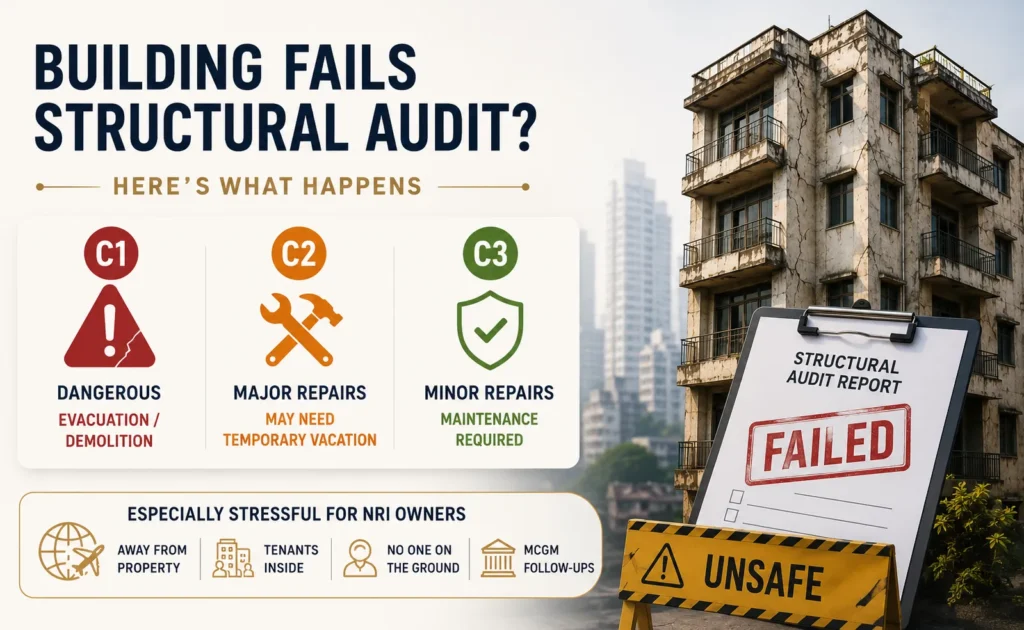
C2 classification: The society must carry out major structural repairs as recommended in the audit report. Depending on the severity of the damage, certain cases may require temporary evacuation until repairs are completed.
C1 classification: This is the most serious category. The building is considered dangerous and unsafe for occupation. MCGM may issue evacuation notices and take further action, including demolition, as per applicable regulations.
C3 classification: The building generally requires minor repairs and maintenance to address identified structural issues.
For NRI property owners, a C2 or C3 classification is particularly stressful. You are thousands of kilometres away. Your building has been flagged. You have tenants inside. You have no one on the ground to monitor what is happening, attend society meetings, or follow up with the engineer and MCGM.
That is exactly the gap that a property management service like Housewise fills. Housewise tracks compliance obligations, monitors society communications, and keeps NRI owners informed of every development at their property, without them needing to be in Mumbai.
Structural Audit and Building Redevelopment in Mumbai
Redevelopment is one of the most searched topics in Mumbai real estate right now. And the structural audit sits right at the centre of it.
If your housing society is considering redevelopment, a structural audit plays an important role in assessing the building’s condition and is generally required as part of the redevelopment process and related approvals.
Here is the practical reality: the findings of a structural audit help the society, developers, and authorities understand the building’s actual condition. A severely distressed building, particularly one classified under C1, may strengthen the case for redevelopment or other significant intervention. Developers use this to build the financial and regulatory case for redevelopment.
Under the newer MCGM redevelopment guidelines, structural audits have become even more central to the entire process. If your society has been discussing redevelopment for years without moving forward, getting a structural audit done is often the step that finally unlocks the process.
What NRI Property Owners in Mumbai Need to Know About Structural Audits
Most NRI property owners are not aware that their Mumbai building may already be past the 30-year threshold. Or that MCGM may have already issued an audit notice that the society has not acted on.
Here is what you need to check:
- Contact your housing society secretary and ask directly whether a structural audit has been conducted and what the classification was
- Check the MCGM portal for notices issued to your building
- Engage a property manager if you cannot easily get this information from abroad
Why does this matter so urgently for NRIs? Because a dangerous structural classification can affect rental continuity, tenant occupancy, and future decisions regarding repairs or redevelopment. Managing these developments remotely can become challenging without someone on the ground. And you are sitting abroad with no visibility into what is happening.
Housewise works specifically with NRI property owners in exactly this situation. Tracking audit compliance, attending society meetings on your behalf, liaising with MCGM, and making sure you are never blindsided by a notice you did not know about.
Conclusion
A structural audit is not something Mumbai property owners can afford to ignore.
Whether your building is approaching 30 years, your society is considering redevelopment, or you simply want peace of mind about your property’s safety, the structural audit is the starting point. Understand the applicable structural audit requirements. Make sure your society engages an MCGM-empanelled structural engineer for statutory compliance audits. Act promptly on whatever classification the report gives you. And if you are living abroad, make sure you have someone on the ground who will keep you informed.
For NRI property owners who want to stay on top of their Mumbai property’s compliance, maintenance, and society communications without being physically present, Housewise manages it all on the ground.
Disclaimer: This content is for informational purposes only. Structural audit requirements, MCGM guidelines, and costs are subject to change. Property owners should consult a qualified structural engineer and verify current MCGM requirements before proceeding.
Frequently Asked Questions
What is the cost of structural audit in Mumbai?
The cost depends on the building’s size, age, and the scope of testing needed. For a small to mid-size housing society, expect costs ranging from Rs 30,000 to several lakh rupees for larger buildings with extensive testing. Always get quotes from multiple MCGM-empanelled structural engineers before committing.
What is structural audit?
A structural audit is a systematic inspection by a qualified structural engineer to assess a building’s safety, stability, and overall structural condition. It examines the foundation, columns, beams, slabs, and other structural elements, and produces a formal report classifying the building and recommending action.
Is structural audit mandatory?
Yes. In Mumbai, structural audits are mandatory for buildings that cross the prescribed age threshold, generally 30 years and older under MCGM guidelines. The frequency of subsequent audits depends on the building’s age and applicable MCGM requirements. Non-compliance can result in the building being declared dangerous.
Is structural audit required for redevelopment under new guidelines?
Yes. A structural audit is a mandatory prerequisite for housing societies initiating redevelopment in Mumbai. The audit report helps establish the building’s structural condition and supports decision-making during the redevelopment process. and is required by MCGM as part of the approval process.
What is structural audit of an RCC building?
It involves inspecting and testing the reinforced concrete structure, including concrete quality, reinforcement corrosion, crack mapping, and load-bearing capacity. Common tests include the rebound hammer test, ultrasonic pulse velocity test, and half-cell potential test.
What is the first stage of a structural audit?
The first stage is a comprehensive visual inspection of the building, exterior and interior, to identify visible signs of distress such as cracks, spalling concrete, exposed reinforcement, water seepage, and settlement. This is documented with photographs and forms the basis for further testing.


0 Comments