

If you own property in India while living abroad, you have tax obligations that do not pause because you are in a different country. Municipal property tax needs to be paid to your local municipal body every year. Rental income from your Indian property is taxable and needs to be declared. If you sold a property, capital gains tax applies. And all of this needs to be reported to the Income Tax Department through the right ITR form.
This blog explains exactly what taxes apply to NRI property owners, how rental income is calculated and what deductions you can claim, which ITR form NRIs must use and why ITR 1 is not an option, what the applicable tax slabs look like under both the old and new regime, how TDS on rent and property sales works for NRIs, and how to file your ITR online from abroad without visiting India once.
You will also find answers to the most common questions NRIs have at tax time. Whether ITR filing is mandatory for you. How much income is tax-free. What the new rules for 2026 change. And what documents you need to have ready before you start.
By the end of this guide, you will know exactly where you stand and what steps to take.
Is ITR Filing Mandatory for NRIs in India?
Let us start with the question most NRIs type into Google at 2am.
NRIs generally need to file an ITR if their taxable India-sourced income exceeds the applicable exemption limit in a financial year. They may also need to file to claim refunds of excess TDS deducted on rent, bank interest, or property transactions.
But here is what many NRIs miss. Even if your India income is below the exemption limit, filing is still a smart move. Why? Because your tenant may already have deducted TDS (Tax Deducted at Source) on the rent they paid you. Your bank may also have deducted TDS on your NRO fixed deposit interest. One of the primary ways to claim that excess tax back is to file an ITR and claim a refund.
Not filing can mean leaving refundable tax unclaimed.
What counts as taxable India-sourced income for NRIs?
- Rent collected from a property located in India
- Capital gains from selling Indian property or shares
- Interest earned on NRO savings accounts or fixed deposits
- Dividends received from Indian companies
Two things that are not taxable: interest from NRE (Non-Resident External) accounts and income from FCNR (Foreign Currency Non-Resident) deposits. Both are fully exempt, regardless of the amount.
So to directly answer the most searched question: do NRIs need to file ITR if there is no income in India? If your total India income is genuinely zero or below the applicable exemption limit and no TDS has been deducted anywhere, filing is generally not mandatory. But if TDS has been cut on anything, filing may help you claim a refund.
NRI Property Tax in India: What You Need to Pay

Here is something that surprises a lot of NRIs. Property tax has nothing to do with the Income Tax Department.
Municipal property tax is levied by the local body. The municipal corporation of your city. It applies to every property owner in India. Resident or NRI, it does not matter. If you own a flat in Delhi, a house in Pune, or a shop in Chennai, your municipality expects its annual tax payment.
Think of it like a subscription fee to the city. Roads, drainage, street lighting. The municipality funds these partly through property tax collected from owners. Miss the payment and penalties may start accumulating over time.
How is property tax calculated?
It depends on where your property sits. Different municipalities use different methods. The two most common are:
- Annual Rental Value method: Tax is calculated as a percentage of the property’s estimated annual rental income. Many older municipal bodies use this.
- Capital Value method: Tax is a percentage of the property’s current market value. Mumbai’s BMC follows this approach.
The municipality assesses your property and assigns it a value. Your tax is a percentage of that figure. Rates vary city to city, so check your local municipal portal for the exact numbers.
How do NRIs pay this tax?
Most major cities now have online payment portals. Delhi’s MCD, Mumbai’s BMC, Bengaluru’s BBMP. You can pay using net banking or a debit or credit card from anywhere in the world. You do not need to be physically present in India.
If online payment feels complicated, your property manager or a trusted family member can handle it on your behalf.
Non-payment may result in penalties, recovery proceedings, or municipal enforcement action over time. That is a serious consequence for a tax that can usually be cleared online in under ten minutes.
How Is Rental Income from Indian Property Taxed for NRIs?
Picture this. You own a 2BHK in Gurugram. Your tenant pays you ₹40,000 a month. That sounds clean and simple. But from a tax perspective, quite a bit is happening behind the scenes.
Rental income from Indian property is taxable for NRIs at the applicable income tax slab rates. But before you calculate the full ₹40,000 as taxable, the Income Tax Act allows some deductions that reduce your taxable amount significantly.
Deductions you can claim on rental income:
- 30% standard deduction: A flat 30% of your net annual value is deductible. No bills required. No proof needed. It covers repairs, maintenance, and general wear and tear automatically.
- Municipal tax paid: If you have paid property tax to the municipal body, that amount is deductible from your gross rent subject to applicable tax rules.
- Home loan interest: If you have an active home loan on the rented property, the interest portion of your EMI is deductible subject to applicable provisions.
So on ₹40,000 monthly rent (₹4.8 lakh annually), you can claim the standard deduction and eligible home loan interest deductions before calculating the taxable amount. That brings your actual tax liability down considerably.
Now here is the part many NRI landlords do not know about.
Your tenant has a legal obligation to deduct TDS at rates applicable to NRIs under Section 195 before transferring rent to you. These rates are generally much higher than the TDS rates applicable to resident landlords and may typically work out to around 31.2% depending on surcharge and cess.
So if your tenant is deducting TDS but you are not filing an ITR and claiming your deductions, you may end up overpaying tax. You may already have paid substantial TDS on gross rent. But after deductions, your actual tax liability might be far lower. The difference comes back to you only when you file.
This is exactly the kind of situation where having organised rental records makes a real difference. Housewise helps NRI property owners maintain proper rent receipts, track TDS certificates (Form 16A), and keep all rental documentation in order. When tax filing time comes, everything is already in place.
NRI Income Tax Slabs for 2026
NRIs are broadly taxed on their India-sourced income using the same slab structure as resident individuals. But there are important differences. NRIs do not get the higher exemption limit that resident senior citizens enjoy, and certain resident-specific rebates may not apply.
Here are the current tax slab rates for 2026 based on presently applicable rules. These should be verified against the latest Finance Act before filing.
Old Tax Regime
| Income Slab | Tax Rate |
|---|---|
| Up to ₹2.5 lakh | Nil |
| ₹2.5 lakh to ₹5 lakh | 5% |
| ₹5 lakh to ₹10 lakh | 20% |
| Above ₹10 lakh | 30% |
New Tax Regime (Default from FY 2024-25 onwards)
| Income Slab | Tax Rate |
|---|---|
| Up to ₹3 lakh | Nil |
| ₹3 lakh to ₹7 lakh | 5% |
| ₹7 lakh to ₹10 lakh | 10% |
| ₹10 lakh to ₹12 lakh | 15% |
| ₹12 lakh to ₹15 lakh | 20% |
| Above ₹15 lakh | 30% |
A surcharge applies on higher incomes. A Health and Education Cess of 4% is added on top of the tax amount for everyone.
Old regime or new regime: which works better for NRIs?
The old regime allows deductions. Home loan interest, standard deduction on rent, property tax paid. If your India-sourced income involves heavy deductions, the old regime often results in lower tax.
The new regime offers lower slab rates but allows very few deductions. If your India income is straightforward with minimal deductions, the new regime might work out cheaper. Run the numbers both ways before deciding. A qualified CA can help you compare based on your specific situation.
Which ITR Form Should NRIs File?
This is the most Googled NRI tax question. And honestly, it causes unnecessary confusion because the answer is actually quite straightforward once you understand the rules.
NRIs cannot use ITR 1 or ITR 4. Full stop. These forms are restricted to resident Indians only. It does not matter how simple your income is. If you are an NRI, ITR 1 and ITR 4 are off the table.
NRIs with Salary, House Property, or Capital Gains: ITR 2
ITR 2 is the go-to form for most NRIs. It covers income from house property, salary from an Indian employer, and capital gains from selling property or investments. If you own and rent out a property in India, ITR 2 is your form. No ambiguity there.
NRIs with Only Interest Income: ITR 2
This one surprises people. An NRI who earns only NRO savings interest or fixed deposit interest might assume a simpler form applies. It does not. ITR 2 is still the correct form even if interest income is your only India-sourced income. NRIs are simply not eligible for ITR 1, regardless of income simplicity.
In ITR 2, you declare NRO interest under the head “Income from Other Sources.” The form has a dedicated section for this.
NRIs with House Property and Other Income: ITR 2
If you have rental income from your property and some capital gains from a mutual fund redemption, both go into the same ITR 2 form. No need for multiple filings. ITR 2 handles all of this in one submission.
The only exception: if you run a business or have professional income sourced from India, ITR 3 applies instead. But for the typical NRI property owner, ITR 2 covers everything.
New NRI Tax Rules in India for 2026
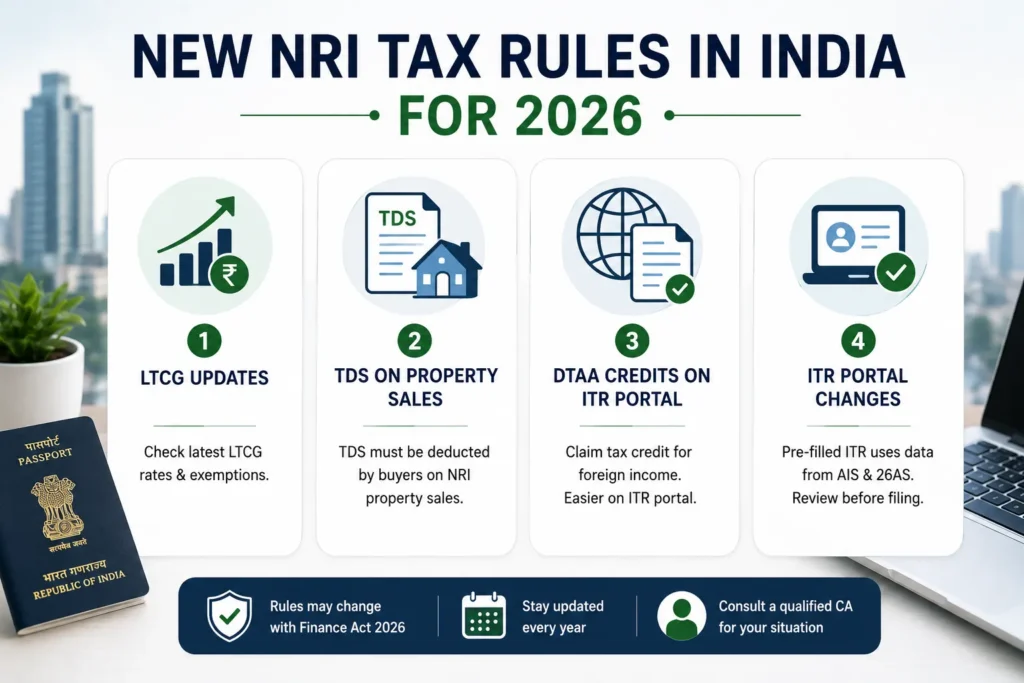
Tax rules change every year with the Union Budget and Finance Act. Here are the key updates relevant to NRIs for 2026. Note: Verify these against the Finance Act 2026 before filing. Consult a qualified CA for your specific situation.
Long-Term Capital Gains (LTCG) updates: Capital gains taxation rules for property and equity transactions have seen changes in recent Finance Acts. NRIs should verify the latest applicable LTCG rates, indexation provisions, and exemptions with a qualified CA before filing.
TDS on property sales involving NRIs: When an NRI sells property, buyers are generally required to deduct TDS under the applicable provisions for NRI transactions. The effective rate depends on factors like the nature of gains, surcharge, cess, and lower deduction certificates issued by the Income Tax Department.
DTAA credits on the ITR portal: DTAA stands for Double Taxation Avoidance Agreement. India has DTAAs with many countries. If you have paid tax abroad on income that is also taxable in India, you can claim a credit to avoid being taxed twice. The ITR portal has improved its DTAA credit claim process for 2026, making it easier to fill and submit Schedule TR.
ITR portal changes: The e-filing portal has a pre-filled ITR feature that pulls data from Form 26AS and AIS (Annual Information Statement). NRIs should review pre-filled data carefully before submitting, as discrepancies between AIS and actual income need to be reconciled.
How to File ITR as an NRI Online: Step by Step
Filing from abroad is completely doable. Thousands of NRIs do it every year without visiting India. Here is how it works, step by step.
Step 1: Register or log in to the e-filing portal

Go to Income Tax Official Website. If you are filing for the first time, register using your PAN (Permanent Account Number). PAN is mandatory for NRIs with taxable India income and helps ensure proper TDS credit and refund processing.
Step 2: Gather your documents
Before you start filling the form, collect everything you need. This includes your PAN card, Form 26AS (tax credit statement), AIS (Annual Information Statement), NRO bank statements, rental agreements, home loan interest certificate, and capital gains statements from your broker or mutual fund.
Step 3: Download and review Form 26AS and AIS
Both are available inside your e-filing portal account. Check that all TDS deductions made by your tenant, bank, or buyer are accurately reflected. Any mismatch needs to be clarified before filing.
Step 4: Select ITR 2
On the portal, choose ITR 2 as your applicable form. Do not select ITR 1 or ITR 4 as these are not applicable for NRIs.
Step 5: Fill in your income details
Enter income from house property, capital gains, interest, and any other India sources in the relevant schedules. Claim your eligible deductions on rental income. Enter home loan interest in the house property section where applicable. Add DTAA credits in Schedule TR if applicable.
Step 6: Review your tax computation
The portal calculates your total tax liability automatically. Compare it with the TDS already credited. If TDS exceeds your liability, you have a refund coming. If you owe additional tax, pay it using Challan 280 before submitting.
Step 7: Submit and e-verify
After submission, the ITR must be verified within the prescribed timeline. NRIs have a few options for e-verification. Net banking login, Demat account, or using an Aadhaar OTP if your Aadhaar is linked to an Indian mobile number. If none of these work, you can sign and send a physical ITR-V form to the CPC office in Bengaluru.
Keeping property records organised throughout the year makes this entire process significantly smoother. Rental agreements, rent receipts, maintenance records, TDS certificates from tenants. When these are filed properly from day one, tax season stops being stressful. Housewise manages all of this documentation on behalf of NRI owners so nothing is scrambled at filing time.
Conclusion
NRI property tax and ITR filing in India is entirely manageable once you understand what applies to you.
Pay your municipal property tax on time. Declare your rental income in ITR 2. Claim eligible deductions like the standard deduction on rental income, home loan interest, and any applicable DTAA credits. File before the due date. E-verify and you are done.
The confusion comes from scattered information and rules that change every year. But at its core, the process is straightforward. Know your income, pick ITR 2, and file.
The harder part for most NRIs is not the filing itself. It is staying on top of everything that feeds into the filing. Rent receipts. TDS certificates from tenants. Municipal tax payment receipts. Maintenance records. When you are living abroad, tracking all of this across 12 months is genuinely difficult.
That is where Housewise comes in. Housewise handles rent collection, tenant management, property inspections, and keeps all your property documentation organised throughout the year. When your CA or you sit down to file your ITR, everything is already in order. No scrambling. No missing documents. No last-minute panic.
Managing an Indian property from abroad is more than just collecting rent. It is staying compliant. And having the right team on the ground makes all the difference.
Disclaimer: This content is for informational purposes only and does not constitute financial or tax advice. Tax rules are subject to change. Please consult a qualified Chartered Accountant
Frequently Asked Questions
Is ITR-1 or ITR-2 required for NRI?
NRIs must generally file ITR 2. ITR 1 and ITR 4 are not available to NRIs regardless of income level or source. ITR 2 covers all income types commonly applicable to NRIs including house property, capital gains, salary, and interest income.
Is ITR filing required for NRI?
Yes, if an NRI’s taxable India-sourced income exceeds the applicable exemption limit in a financial year, filing is generally mandatory. Even below this limit, filing may be advisable to claim TDS refunds on rental income or fixed deposit interest.
Which ITR form is required for house property and other income?
ITR 2 is the correct form for NRIs with income from house property, capital gains, salary, or other sources. NRIs cannot use ITR 1 even if their income is straightforward.
How much property tax do NRIs pay in India?
Property tax for NRIs is the same as for resident owners and is levied by the local municipal body. The amount depends on the property’s location, size, and annual rental or capital value as assessed by the municipality. It must be paid separately from income tax.
What is the new rule for NRIs in India for 2026?
Key changes for 2026 include updates to capital gains taxation provisions, TDS rules on property transactions involving NRIs, and DTAA claim procedures on the ITR portal. NRIs should verify the latest rules under the Finance Act 2026 or consult a qualified tax advisor.
Is ITR 1 or ITR 4 for NRI?
Neither ITR 1 nor ITR 4 can be filed by NRIs. ITR 2 is the correct form for most NRIs. ITR 3 applies only if the NRI has business or professional income sourced from India.
How much income is tax-free for NRIs?
The exemption threshold for NRIs depends on the tax regime selected. Under the old regime, the basic exemption limit is generally ₹2.5 lakh. Under the new regime, different slab thresholds apply. Income from NRE accounts and FCNR deposits is generally tax-exempt subject to applicable conditions.


0 Comments