
You found the perfect flat. The price is right. The location works. You’re ready to sign.
Then someone mentions stamp duty value. And suddenly there’s a number on the table that doesn’t match what you agreed to pay. The registration officer quotes a higher figure. Your tax consultant brings up Section 50C. And you’re sitting there wondering what just happened.
This is more common than you’d think. Stamp duty value catches a lot of buyers and sellers off guard. Not because it’s complicated, but because nobody explains it clearly before the deal is done.
This guide changes that. By the end, you’ll know exactly what stamp duty value is, how it’s calculated, and why it matters for your taxes and your wallet.
What Is Stamp Duty?
Let’s start from the beginning.
Stamp duty is a tax. It’s charged by the state government every time a property changes hands. When you buy a house, a flat, or a plot, you pay stamp duty to legally register that transaction in your name.
Think of it like a fee for the government to officially recognise that the property now belongs to you. Without paying it, the sale deed isn’t valid. The property legally doesn’t become yours.
The amount you pay depends on the state you’re in, the type of property, and critically, the value of the property. And that’s where stamp duty value enters the picture.
What Is Stamp Duty Value of Property?
Here’s the key definition.
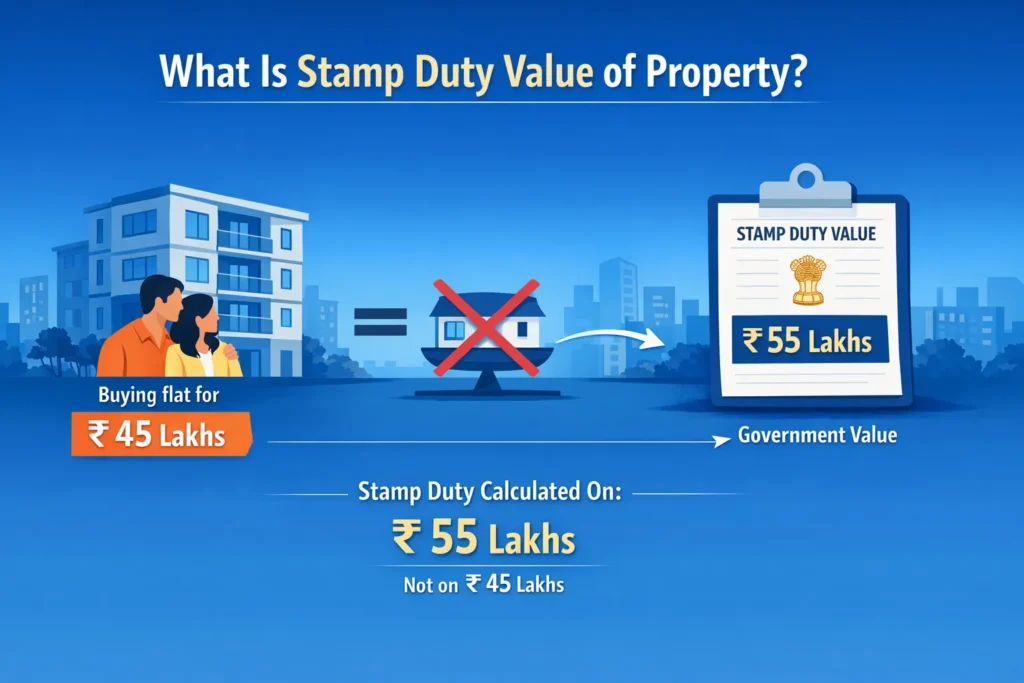
Stamp duty value (SDV) is the minimum value assigned to a property by the government, for the purpose of calculating stamp duty and registration charges. It is based on what the government believes the property is worth, regardless of what you actually agreed to pay the seller.
So if you buy a flat for Rs. 45 lakhs, but the government has set the stamp duty value of that property at Rs. 55 lakhs, you will pay stamp duty on Rs. 55 lakhs. Not on Rs. 45 lakhs.
This matters enormously. Both for registration costs and for your income tax.
SDV Full Form in Tax
You’ll often see the abbreviation SDV in income tax documents, property papers, and legal filings.
SDV stands for Stamp Duty Value.
Under Indian income tax law, SDV is referenced specifically under Section 50C (for sellers) and Section 56(2)(x) (for buyers). Both sections use SDV as a benchmark to determine whether a property deal has been done at a “fair” price. If it hasn’t, there are tax consequences. We’ll get to those shortly.
How Stamp Duty Value Is Determined
The government doesn’t pick a number randomly. SDV is based on something called the circle rate, also known as the ready reckoner rate in some states.
Circle rates are set by the state’s registration or revenue department. They represent the minimum price per square foot (or square metre) at which a property in a specific area can be registered.
Several factors influence circle rates:
Location is the biggest one. A flat in South Mumbai has a much higher circle rate than one on the outskirts of Nagpur.
Property type also matters. Residential properties, commercial spaces, agricultural land, and industrial plots all have different rates.
Floor level can be a factor in many cities. Higher floors often carry a premium in circle rate calculations.
Amenities and construction quality are sometimes factored in too, especially in newer developments.
Each state publishes its circle rates publicly, usually on the registration department’s website. These rates are revised periodically, sometimes annually.
Stamp Duty Value vs Market Value vs Agreement Value
These three terms get confused constantly. Here’s a clear breakdown.
Market value is what a buyer and seller agree the property is actually worth in the real world. It’s driven by demand, location, condition, and comparable sales in the area. It’s the price you’d find if you looked up similar properties on a real estate platform.
Agreement value is the price you and the seller have formally agreed upon in the sale agreement. This is the number written in your contract.
Stamp duty value is the government’s version. It’s the minimum registered value based on circle rates. This is the floor, not the ceiling.
Here’s a simple analogy. Imagine the government says a particular bicycle model must be worth at least Rs. 10,000 for tax purposes. You find a seller willing to give it to you for Rs. 7,000. The actual deal happens at Rs. 7,000. But the government still taxes you as if the transaction happened at Rs. 10,000.
That’s exactly how SDV works with property.
How to Calculate Stamp Duty Value of Property
The basic formula is straightforward:
Stamp Duty Value = Circle Rate per sq ft x Built-up Area (sq ft)
Let’s break that down with a clear example.
Say you’re buying a 1,000 sq ft flat in a locality where the government circle rate is Rs. 6,000 per sq ft.
SDV = Rs. 6,000 x 1,000 = Rs. 60,00,000 (Rs. 60 lakhs)
Your stamp duty and registration charges will be calculated on this Rs. 60 lakh figure, regardless of whether you agreed to buy the property for Rs. 50 lakhs or Rs. 70 lakhs.
Some additional factors that can adjust the final SDV calculation:
- Floor level premiums (higher floors may carry 5-10% extra in some cities)
- Age of the building (older buildings may have a depreciation factor applied)
- Amenities like lifts, parking, clubhouse (can add to the base circle rate)
Each state has its own rules for these adjustments, so the formula can vary slightly.
How to Find Stamp Duty Value of Property Online
You don’t need to visit any government office for this. Most states have made this information available online.
In Maharashtra, visit the IGR Maharashtra website (igrmaharashtra.gov.in) and use the ready reckoner tool to look up rates by district, village, and property type.
In Delhi, check the Delhi government’s online portal for circle rates by colony and category.
In Karnataka, the Kaveri online portal (kaverionline.karnataka.gov.in) lets you calculate stamp duty and check guidance values.
In other states, search for “[State name] registration department circle rate” and you’ll typically land on the official state portal.
You’ll need to enter the locality, property type, and area to get an estimated SDV figure.
Stamp Duty Value and Income Tax: Section 50C Explained
This section is where most sellers get tripped up.
Imagine you’re selling a flat. The actual sale price you agreed on is Rs. 40 lakhs. But the SDV for that property is Rs. 55 lakhs.
Under Section 50C of the Income Tax Act, if the sale price is lower than the SDV, the Income Tax Department will treat the SDV as the actual sale price for computing your capital gains.
So even though you only received Rs. 40 lakhs in your bank account, you’ll be taxed as if you received Rs. 55 lakhs. The capital gains tax applies on the higher SDV figure.
This was introduced to prevent underreporting of property prices, a practice where buyers and sellers used to declare lower values on paper to reduce their tax burden.
The message from the tax department is simple: if you sell below the government value, we’ll still tax you on the government value.
Section 56(2)(x) for Buyers
The tax implications don’t stop with the seller. Buyers have their own section to worry about.
Under Section 56(2)(x), if you buy a property for less than its stamp duty value, the difference is treated as income in your hands.
Here’s an example. You buy a property for Rs. 40 lakhs. The SDV is Rs. 55 lakhs. The difference is Rs. 15 lakhs.
That Rs. 15 lakh difference gets added to your income for that financial year. You pay income tax on it at your applicable slab rate.
This provision targets buyers who get properties at suspiciously low prices, often from relatives or in off-the-books deals. The government basically says: if you’re getting a discount larger than what the rules allow, that discount is income.
The Safe Harbour Rule (Tolerance Limit)
Here’s the relief that most people don’t know about.
The government recognises that SDV is based on circle rates, which don’t always perfectly match actual market prices. There are genuine cases where a fair market deal results in a price slightly below SDV.
So the law provides a safe harbour or tolerance limit.
As per the current rules, if the difference between the agreement value and the stamp duty value is 10% or less, no tax adjustment is made. The transaction is treated as clean.
For properties purchased under affordable housing schemes under certain budget announcements, this limit was extended to 20% in recent years.
So if the SDV is Rs. 50 lakhs and you’re buying at Rs. 46 lakhs, the difference is 8%. You’re within the safe harbour. No Section 56(2)(x) income is added to your hands. No Section 50C adjustment is made for the seller.
But if you buy at Rs. 40 lakhs against an SDV of Rs. 50 lakhs, that’s a 20% gap. Depending on the applicable limit, this may trigger tax implications for both parties.
What Happens If Property Is Bought Below Stamp Duty Value?
Let’s put it all together with a realistic scenario.
A friend of mine once bought a flat in a hurry. The seller needed cash quickly and agreed to a below-market price. The agreement value was Rs. 38 lakhs. The stamp duty value for that property was Rs. 52 lakhs.
The difference was Rs. 14 lakhs, well above the 10% safe harbour.
Here’s what happened:
For the seller: Capital gains were computed on Rs. 52 lakhs, not Rs. 38 lakhs. The seller ended up paying significantly more capital gains tax than expected.
For the buyer: Rs. 14 lakhs was added to taxable income for that year, resulting in a higher income tax liability.
For registration: Stamp duty and registration charges were paid on Rs. 52 lakhs, adding to the buyer’s upfront costs.
The deal looked attractive on paper. But the total tax impact on both sides made it far less profitable than it appeared.
The lesson: always check the SDV before finalising any deal, not after.
Why Stamp Duty Value Matters for Homebuyers
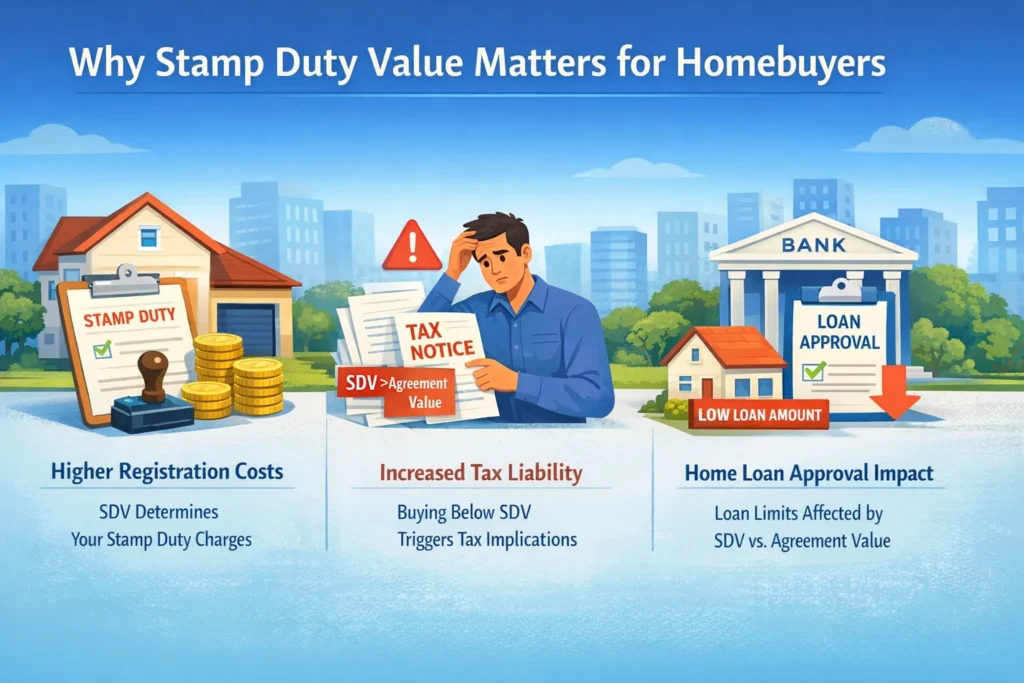
SDV affects you in three direct ways.
Registration costs. Your stamp duty and registration charges are calculated on the higher of the agreement value or SDV. If SDV is higher, you pay more upfront at the time of registration.
Tax liability. As explained under Section 56(2)(x), buying below SDV can result in additional income being attributed to you in that financial year.
Home loan approval. Banks and NBFCs typically sanction loans based on the lower of the market value, agreement value, or SDV. If there’s a large gap between your agreement value and SDV, it can affect how much the lender is willing to finance.
Understanding SDV isn’t just a legal formality. It directly shapes how much money leaves your pocket when you buy property.
Stamp Duty Charges in India: Overview by State
Stamp duty rates are set by individual state governments and vary significantly. Here’s an approximate overview as of 2026:
| State | Stamp Duty (Men) | Stamp Duty (Women) | Registration Charge |
|---|---|---|---|
| Maharashtra | 6% | 5% | 1% |
| Delhi | 6% | 4% | 1% |
| Karnataka | 5% | 5% | 1% |
| Tamil Nadu | 7% | 7% | 1% |
| Uttar Pradesh | 7% | 6% | 1% |
| West Bengal | 6% | 6% | 1% |
| Rajasthan | 6% | 5% | 1% |
Note: These are indicative figures. Always check the current rates on your state’s registration department website before calculating.
Several states offer discounts for women buyers. Some offer temporary waivers or reductions during festive periods or to boost the real estate market.
Urban and rural properties within the same state can also attract different rates.
Common Mistakes Buyers Make Around Stamp Duty Value
A few mistakes come up repeatedly.
Not checking circle rates before negotiating. Many buyers agree on a price without knowing the SDV. They get a surprise at the registration office and at tax time.
Assuming agreement value is what matters for tax. It isn’t, if it’s below SDV. The higher of the two applies.
Underreporting to save on registration. This used to be common. But with digital land records, circle rate databases, and stricter scrutiny from the Income Tax Department, it’s a risk that rarely pays off.
Ignoring the safe harbour calculation. Some buyers panic when they see a gap between their deal price and SDV. But if the gap is within 10%, there’s no tax issue at all. Know the rule before assuming the worst.
Tips to Avoid Extra Tax on Your Property Purchase
A few practical steps:
Compare your agreement value against the SDV before signing. Look up the circle rate for that locality and calculate the SDV yourself. It takes ten minutes online.
Check if you’re within the safe harbour. If you’re negotiating a deal slightly below SDV, calculate the percentage difference. Keep it within 10% to stay clean on both sides.
Get a proper sale agreement drafted. Vague or undervalued agreements create problems at registration and invite scrutiny later.
Consult a CA or tax advisor before the deal closes, especially for high-value transactions. The cost of an hour of advice is nothing compared to an unexpected tax demand.
Conclusion
Stamp duty value isn’t a technicality. It’s a number that directly impacts how much you pay at registration, how much tax you owe, and whether your property deal holds up under scrutiny.
The rules around SDV, Section 50C, and Section 56(2)(x) exist to bring transparency to property transactions. Knowing them protects you. Ignoring them costs you.
Before you sign any property deal in India, check the circle rate for that locality. Calculate the SDV. Compare it to your agreement value. If there’s a gap, figure out whether it falls within the safe harbour. And if you’re unsure, talk to a tax advisor before the ink dries.
Property is one of the largest financial decisions most people make. Ten minutes of SDV research can save you a very unpleasant conversation with the tax department later.
FAQs
What is meant by stamp duty value?
Stamp duty value is the minimum price the government assigns to a property for tax and registration purposes. It is based on circle rates set by the state. Even if you buy or sell at a lower price, stamp duty is calculated on this government-determined value, not your actual deal price.
What is the difference between stamp duty value and market value?
Market value is the price a buyer and seller agree on in the real world. Stamp duty value is the government’s minimum benchmark based on circle rates. Market value can be higher or lower. But for registration and tax purposes, the higher of the two is typically used.
What if property is sold for less than the stamp duty value?
The seller pays capital gains tax on the stamp duty value, not the actual sale price, under Section 50C. The buyer may have the difference added to their taxable income under Section 56(2)(x). Both parties face a higher tax burden if the gap exceeds the 10% safe harbour limit.
Who will pay 1% TDS on sale of property?
The buyer is responsible for deducting and depositing 1% TDS when purchasing an immovable property worth Rs. 50 lakhs or more. This is governed by Section 194-IA of the Income Tax Act. The buyer deducts it from the payment made to the seller and deposits it with the government.
How much is TDS for a Rs. 50 lakh property?
TDS is 1% of the total sale value. On a Rs. 50 lakh property, that works out to Rs. 50,000. The buyer deducts this before paying the seller. If the seller does not have a PAN, the TDS rate jumps to 20%, making it Rs. 10 lakhs on the same transaction.
What if the seller doesn’t have a PAN?
TDS is deducted at a much higher rate of 20% instead of the standard 1%, as per Section 206AA of the Income Tax Act. On a Rs. 50 lakh deal, that means Rs. 10 lakhs in TDS. Always confirm the seller’s PAN before finalising any property transaction to avoid this situation entirely.
What is the 36-month rule in property sale?
If you sell a property within 36 months of buying it, the profit is treated as short-term capital gain and taxed at your income slab rate. If you hold it beyond 36 months, it qualifies as long-term capital gain, attracting a lower tax rate of 20% with indexation benefit.
Does stamp duty get refunded?
Generally, no. Once stamp duty is paid and the property is registered, it is non-refundable. However, if the transaction is cancelled before registration, some states allow a partial refund through a formal application to the collector of stamps. The process, timeline, and refund amount vary from state to state.
What is the 2% rule for property transactions?
The 2% rule typically refers to the registration charge applied in most Indian states, though many now cap it at 1%. It is charged separately from stamp duty on the total property value at the time of registration. Together, stamp duty plus registration charges form the total upfront government cost of buying property.
Can I avoid stamp duty legally?
You cannot avoid it entirely, but you can reduce it legally. Several states offer lower rates for women buyers. Some offer temporary waivers during specific periods. Certain transactions like inheritance or gifts between close family members attract lower or nominal stamp duty. Always check your state’s specific exemptions before assuming the standard rate applies.
Also Read: How to Run a Credit Check on a Tenant: Step-by-Step Guide for Landlords
Also Read: 8 Proof of Income Documents Landlords Should Require from Tenants


0 Comments