

Renting out your property can feel like a leap of faith. You hand over the keys to a stranger, trusting they’ll treat your place with respect and, most importantly, pay the rent on time. Every month.
The biggest risk you face isn’t a scratched floor or a broken appliance. It’s a tenant who simply can’t pay. That’s the nightmare scenario. It’s why the first rule of property management is simple: verify the money.
But how do you do that without feeling like a detective? You ask for the right paperwork. Think of it as a safety net. It’s not about being nosy. It’s about being smart.
So, what documents should you actually ask for? Let’s break down the eight best proof of income documents that will help you find a reliable tenant and avoid a financial headache.
What Is Proof of Income, Anyway?
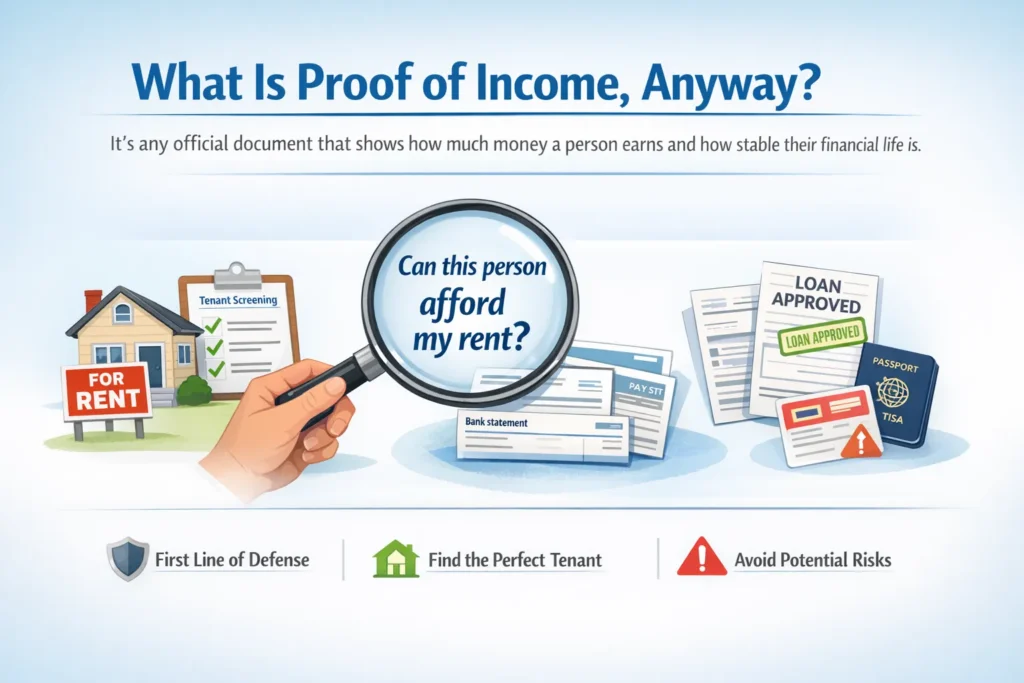
Let’s start with the basics. Proof of income is any official document that shows how much money a person earns and how stable their financial life is.
It’s the evidence you need to answer one question: Can this person afford my rent?
For landlords, it’s the cornerstone of tenant screening. It’s also used for things like loan applications and visa processing. But for you, it’s the difference between a tenant who’s a perfect fit and one who’s a potential risk. It’s the first line of defense.
Why You Can’t Skip This Step
I’ve been on both sides of the rental table. As a tenant, I remember feeling like I was handing over my entire financial life. It felt invasive. But as a landlord, I get it. You need to know.
Verifying income isn’t just a box to check. It’s about protecting your investment. If a tenant struggles to pay rent, you’re the one who ends up covering the mortgage, the taxes, and the repairs.
Here’s the rule of thumb most property experts use: a tenant’s monthly income should be at least 2.5 to 3 times the monthly rent. If the rent is $1,500, you want to see a monthly income of at least $3,750 to $4,500.
This isn’t a magic number. It’s a buffer. It means they can handle the rent, their car payment, groceries, and an unexpected expense without falling behind. Asking for verifiable income is the only way to know if they meet that standard.
8 Proof of Income Documents You Should Require
Now for the main event. Here are the eight documents that give you a clear picture of a tenant’s financial health. Don’t just pick one. A strong application will have a mix of these.
1. Pay Stubs
This is the gold standard for salaried employees. A pay stub is a simple, direct snapshot of their earnings.
Ask for the last two or three months’ worth. When you look at them, don’t just glance at the number. Look at the details. Does the employer’s name match their LinkedIn profile? Is the year-to-date total consistent with the monthly amount? Does the income seem stable?
If you see gaps in employment or a sudden drop in pay, that’s a flag worth investigating. A pay stub proof of income is your first, most reliable clue.
2. Bank Statements
A pay stub shows what someone should be earning. A bank statement shows what they actually have.
This is a powerful document. It reveals their true cash flow. You can see the rent payments from their previous place. You can see if they’re living paycheck to paycheck or if they’re good savers.
Look for the deposit that matches their salary. Does it come in regularly? Also, watch for red flags. Bounced check fees are a bad sign. So are unexplained, large cash deposits. A bank statement proof of income adds a layer of reality to the application that a simple pay stub can’t provide.
3. Income Tax Returns
This one is essential for freelancers, gig workers, or anyone who is self-employed. A pay stub might not exist for them. But the tax return doesn’t lie.
The tax return shows their total annual income. It’s a big-picture view that can smooth over the natural ups and downs of freelance work. You can see their business deductions, their overall profitability, and whether they’re making enough to cover the rent.
For a self-employed person, asking for a tax return isn’t just smart. It’s necessary. It’s the single best way to answer, “Can I use my tax return as proof of income?” Yes, you can. And you should.
4. Employment Verification Letter
This is a formal letter written on company letterhead. It’s a simple but powerful piece of evidence.
The letter should state the tenant’s job title, how long they’ve been there, and their salary. It should also confirm whether they are a full-time, permanent employee or a contract worker.
This is your chance to confirm that the job is stable. A new job with a high salary might look great on paper. But a job they’ve held for three years shows stability. This document is also known as an income verification letter for an apartment, and it’s a great way to quickly confirm the information from the pay stubs.
5. Offer Letter or Employment Contract
This is the perfect document for a tenant who is just starting a new job. Maybe they’re moving to your city for work.
They might not have pay stubs yet because they haven’t started. That’s okay. Their signed offer letter or employment contract is a valid substitute.
It will outline their start date, their title, and their salary. It gives you the confidence that their future income is real and secured. Just be sure to follow up after they start to get the first pay stub as well.
6. Form 16 / W-2 / 1099 Forms
The specific form depends on where you live. But these are the official government tax documents that serve as a summary of a person’s earnings for the year.
In the US, a W-2 is for employees. It shows their annual wages and the taxes withheld. A 1099 is for freelancers and independent contractors. In India, Form 16 serves a similar purpose for salaried employees.
These forms are hard to fake. They come directly from an employer or a client and are filed with the government. Asking for the prior year’s W-2 or 1099 is a great way to verify the stability of their income over a longer period.
7. Self-Declaration of Income
This is a bit of a wildcard. A self declaration of income form is used when a tenant doesn’t have formal paperwork.
This is common for people who are new to the country, work for cash tips, or are in a transition period. It’s a signed, sworn statement from the tenant outlining their income sources and monthly earnings.
Is it the strongest form of proof? No. But it’s a starting point. If you accept this, you’ll need to do extra due diligence. You’ll want to cross-reference it with bank statements and call their references to verify the information.
8. Rental Income or Business Proof
This one is for a specific type of tenant: the entrepreneur or the landlord.
If your applicant owns their own business, ask for invoices or their business bank statements. If they own other rental properties, ask for their lease agreements. Seeing proof of rental income from their own properties shows they have a successful track record as a property owner themselves. It adds a layer of financial maturity to their application.
How Many Months of Proof Should You Ask For?
This is a common question. The answer depends on who your tenant is.
For a standard salaried employee, ask for two to three months of pay stubs and bank statements. That’s enough to see a pattern.
For a freelancer or self-employed person, you need a longer view. Ask for six to twelve months of bank statements. A freelancer might have a fantastic month followed by a slow one. You need to see the average to be comfortable. Their tax return from the previous year will also help you understand the full picture.
How to Actually Verify the Income
Getting the documents is just step one. Now you have to check if they’re real. Here’s how to do it without feeling like a spy.
Cross-check everything. Does the deposit on the bank statement match the pay stub? Does the employer’s name on the pay stub match the employment letter? If the numbers don’t line up, you have a problem.
Contact the employer. A quick phone call can work wonders. Call the number listed on the company’s website, not the number on the application. Just ask to verify employment. They will usually confirm the job title and salary without giving away any private information.
Look for the details. A fake document often has small mistakes. Blurry logos. Inconsistent fonts. A phone number that doesn’t work. Use your eyes. A little scrutiny can save you from a huge headache.
Red Flags to Watch Out For
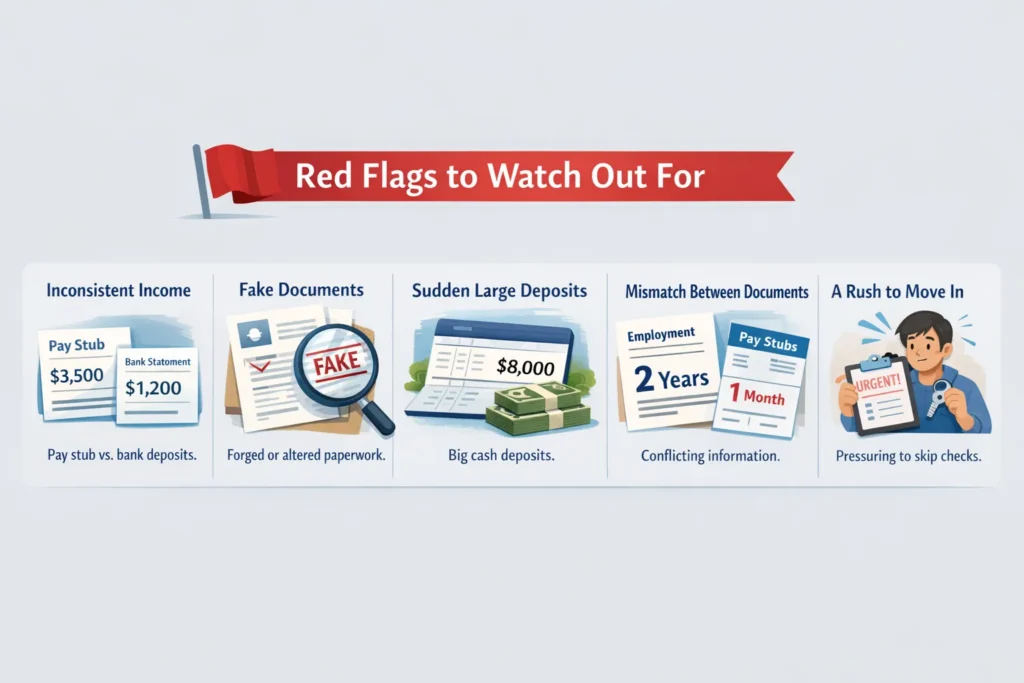
As you review these documents, keep your eyes peeled for warning signs.
- Inconsistent Income: The pay stub says one thing, but the bank deposit says another.
- Fake Documents: The paper feels wrong, or the logo looks photoshopped.
- Sudden Large Deposits: A tenant might try to make their account look healthy by depositing a big sum of cash right before applying. Ask where it came from.
- Mismatch Between Documents: The employment letter says they’ve been there for two years, but the pay stubs only go back one month.
- A Rush to Move In: If they are desperate to move in immediately and push you to skip the background check, that’s a major red flag.
Can Bank Statements Alone Be Used as Proof?
This is a question I hear a lot. “Can I use a bank statement as proof of income?”
The short answer is yes, but it shouldn’t be your only proof. A bank statement is a fantastic supporting document. It shows you their actual habits.
But a bank statement alone doesn’t tell you why money is coming in. It could be a gift from a parent. It could be a temporary side hustle. It could be the last of their savings.
The best approach is to combine a bank statement with a pay stub or a tax return. One shows the source of the money. The other shows how they manage it. Together, they tell the full story.
Income Requirements for Tenants
Let’s circle back to that 30-40% rule. It’s the industry standard for a reason.
I had a tenant once who was earning just enough to cover the rent. She loved the place. I loved her as a person. But I ran the numbers. After rent, she would have had about $200 left for everything else. Food. Utilities. Gas. It was impossible.
I had to say no. A few months later, I heard she moved into a cheaper place and was doing great. That was a win for both of us.
Setting a clear income requirement isn’t just about protecting yourself. It’s about protecting the tenant from taking on a financial burden they can’t handle. It sets everyone up for a more stable, less stressful living situation.
Special Cases: What About Freelancers and Students?
Not every applicant has a neat stack of pay stubs. Here’s how to handle the exceptions.
Freelancers and Gig Workers
Your checklist for them is different. Ask for:
- Invoices: Show their active client work.
- Bank Statements (6-12 months): Show their cash flow over time.
- Tax Returns: Show their net income for the previous year.
- A Client Reference: A quick call to a regular client can confirm they’re reliable and well-paid.
Students
A student likely won’t have a full-time salary. So, you verify their support system.
- Sponsor’s Proof of Income: Ask for the parent or guardian’s pay stubs or tax returns.
- Bank Balance: Ask for a bank statement showing enough funds to cover the entire lease term. If the rent is $1,000 a month for a 12-month lease, you want to see a balance of at least $12,000 plus living expenses.
- Scholarship or Financial Aid Award Letter: This can serve as a form of guaranteed income for the semester.
Self-Employed Tenants
This group can be very stable but has the most complicated paperwork.
- Income Tax Returns (2 years): This shows their income trend.
- Business Registration: Proves their business is legitimate.
- Profit and Loss Statement: A simple summary of their business’s income and expenses for the year.
Your Income Verification Checklist
To make this easy, create a checklist. Here’s a sample to get you started:
- [ ] Pay Stubs: Last 2-3 months for all employed applicants.
- [ ] Bank Statements: Last 2-3 months for everyone.
- [ ] Tax Returns: Last year’s return for self-employed applicants.
- [ ] Employment Verification Letter: For all salaried applicants.
- [ ] Government-Issued ID: To confirm the name on all documents matches the person.
- [ ] Self-Declaration Form: If any formal documents are missing, with a note on why.
Having this list makes the process consistent and fair for everyone.
Common Mistakes Landlords Make
I’ve made some of these myself. Learn from my stumbles.
Accepting only one document. This is the biggest one. A single pay stub is just a piece of paper. A single bank statement is just a snapshot. You need multiple angles to see the whole picture.
Not verifying authenticity. It’s easy to assume everything is real. But people do fake documents. It’s sad but true. A quick phone call or a close look at a logo can prevent a disaster.
Ignoring income stability. A high income that’s erratic is riskier than a moderate income that’s rock-solid. Look for patterns, not just numbers.
Skipping the background check. Proof of income is vital, but it’s not everything. Combine it with a credit check and a background check for a complete view of the applicant.
Tips for Tenants: How to Create a Strong Application
If you’re reading this as a tenant, here’s how to make a landlord’s job easy. A clean application gets approved faster.
Submit more than the minimum. Don’t just give the one document they ask for. Give them everything. A folder with pay stubs, bank statements, a letter from your boss, and a copy of your last tax return screams, “I am responsible and have nothing to hide.”
Ensure consistency. The name on your pay stub should match your ID. The address on your bank statement should match your current lease. Any mismatch invites suspicion.
Maintain a clean bank record. Avoid overdrafts in the months leading up to your apartment search. If you can, keep a healthy cushion in your account. It’s the best visual proof of your financial health.
Provide professional references. A previous landlord will vouch for your payment history. A manager at work can vouch for your stability. A good reference adds a human element to the paperwork.
Conclusion
The rental application process can feel awkward. You’re asking a stranger to share their personal financial details. But remember, this is business. It’s about protecting your property and ensuring a positive, long-term relationship with a tenant.
Don’t skip the verification step. Don’t accept just one document. Take the time to review the paperwork, make a few calls, and trust your gut.
Asking for the right proof of income documents is the single most effective way to reduce your risk. It helps you avoid the stress of chasing late payments and the high cost of eviction. It’s the foundation of a smart, safe, and profitable rental experience. A little work upfront saves a ton of trouble down the road.
FAQs
What is the most common proof of income?
Pay stubs from the last 2-3 months are the most common. They show employer name, salary, and year-to-date earnings, giving landlords a clear snapshot of stable, verifiable income.
Can I use bank statements as proof of income?
Yes, bank statements show actual cash flow and deposits. However, they work best alongside pay stubs or tax returns to confirm the source of the money and ensure consistency.
How do freelancers show proof of income?
Freelancers should provide tax returns, 6-12 months of bank statements, and client invoices. These documents show income consistency over time, which is more reliable than a single pay stub.
What if my tenant has a new job?
Ask for their signed offer letter or employment contract. It confirms the start date, job title, and salary. Follow up after they begin working to get their first pay stub.
How many months of proof should I ask for?
Ask for 2-3 months for salaried employees. For self-employed or freelance tenants, request 6-12 months of bank statements plus the previous year’s tax return to see the full picture.
Is a self-declaration of income acceptable?
It’s a backup option when formal documents are missing. Use it cautiously. Always cross-check it with bank statements and call references to verify the claimed income is legitimate.
What income level should a tenant have?
Aim for a tenant whose monthly income is 2.5 to 3 times the rent. This ensures they can comfortably afford rent plus other living expenses without falling behind.
How do I verify if documents are real?
Cross-check numbers across all documents. Call the employer using the company’s main line, not the number on the application. Look for blurry logos or inconsistent formatting that suggests forgery.
What are red flags in proof of income?
Watch for inconsistent numbers between documents, sudden large cash deposits, missing employer information, or a rush to move in without completing the verification process.
Can a student qualify without a job?
Yes. Ask for a parent or sponsor’s proof of income, a bank statement showing sufficient funds for the lease term, or a scholarship award letter that guarantees regular payments.
Also read: What Is Rent Reporting? Meaning, Benefits, and How It Works


0 Comments