

Reviewed and updated on 22 November 2026. The TDS rates, forms and rules in this guide have been checked against the law in force today, including the Income-tax Act, 2025 and the PAN-based TDS route for NRI property sales from 1 October 2026.
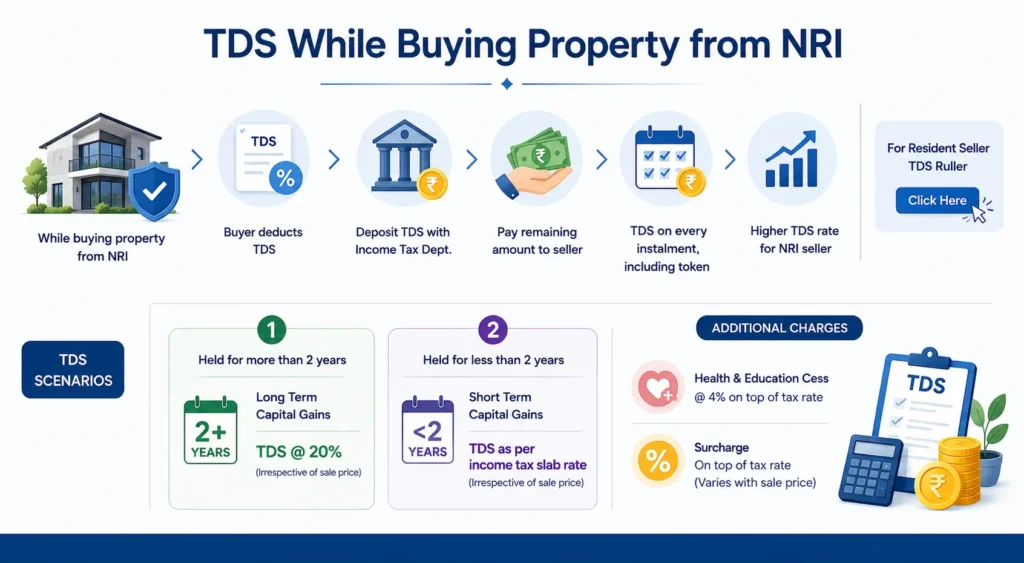
While buying property from NRI, the buyer must deduct TDS while making payment to the seller. This TDS has to be deposited with the income tax department. The remaining amount can be paid to the seller.
The TDS should be deducted not only on the final amount but on every instalment paid to the seller. Even on the token amount to be paid to the seller, this TDS should be deducted as per the income tax rules.
This TDS is charged at a rate higher in case of NRI seller. In case of a resident seller, you can click here to check the TDS rules.
Various scenarios -
1. If the seller has held the property for more than 24 months, the gain is long-term. For sales on or after 23 July 2024, the buyer must deduct TDS at 12.5% of the sale price (it was 20% before that date), whatever the sale price.
2. If the seller has held the property for 24 months or less, the gain is short-term, and the buyer deducts TDS at 30% of the sale price.
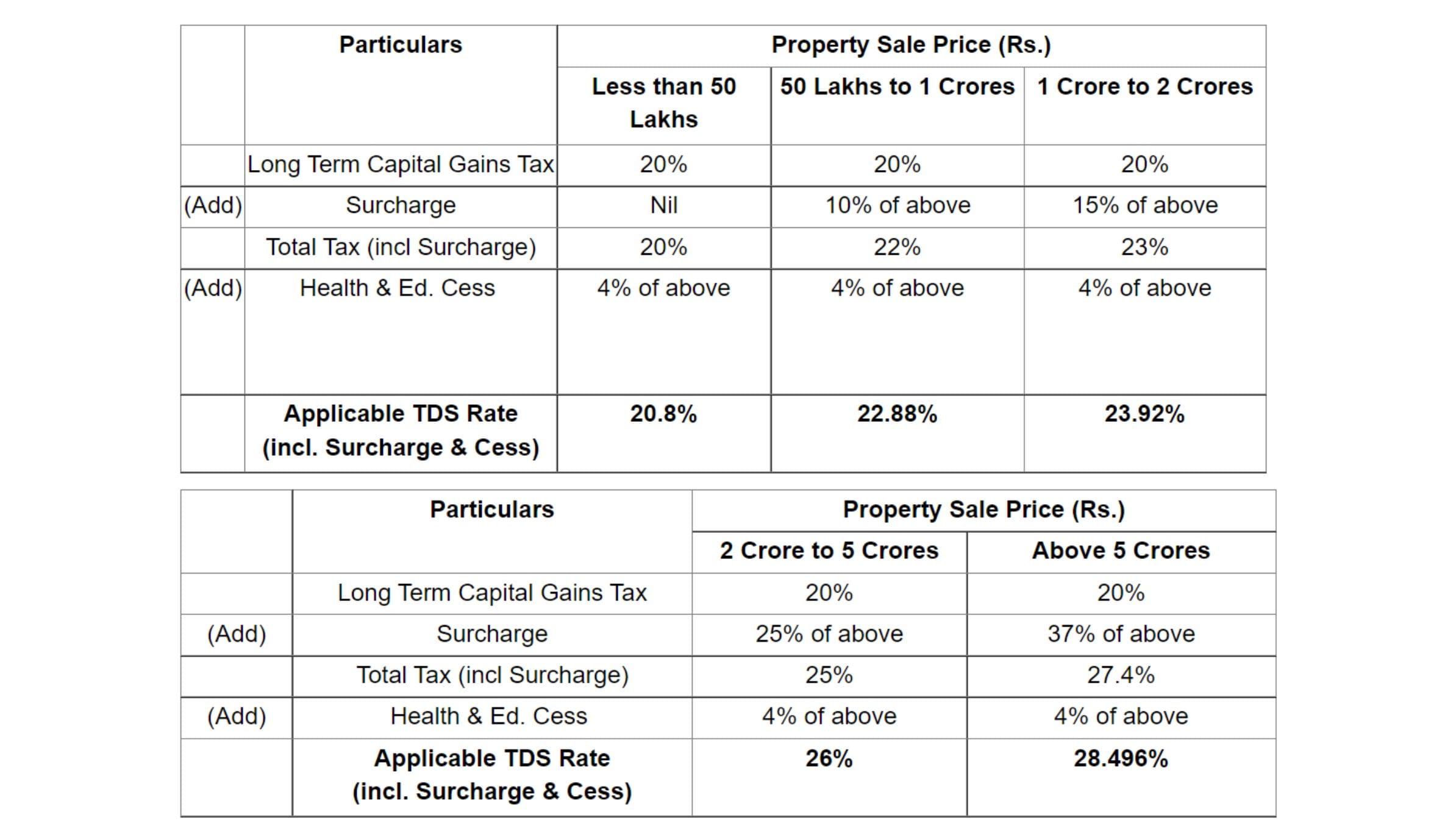
In either of the above case, a health and education cess of 4% is charged on top of the tax rate.
In either of the above case, a surcharge is charged on top of the tax rate. This surcharge varies depending on the sale price.
Since 1 October 2026, a buyer who is a resident individual or HUF can deduct and deposit this TDS using their PAN, through Form 141 (Schedule E) on the income tax portal, without getting a TAN. Companies, firms and other buyers still need a TAN and pay through Challan ITNS 281.
Buyers using the TAN route then file a quarterly TDS return: Form 27Q for deductions up to 31 March 2026, and Form 144 from 1 April 2026.
NRIs can reduce the TDS by applying to the income tax department for a lower deduction certificate: in Form 13 until 31 March 2026, and in Form 128 (under section 395 of the Income-tax Act, 2025) from tax year 2026-27. Under the new Act only lower-rate certificates are issued, not nil-rate ones.
Based on the information the seller gives, the department works out the actual capital gain and issues a certificate that lets the buyer deduct tax at a lower rate, closer to the tax really due, instead of on the full sale price.
Live abroad? Housewise manages property in India for 5,500+ NRI owners in 45+ countries. See our NRI property management services.
Process of obtaining lower TDS certification
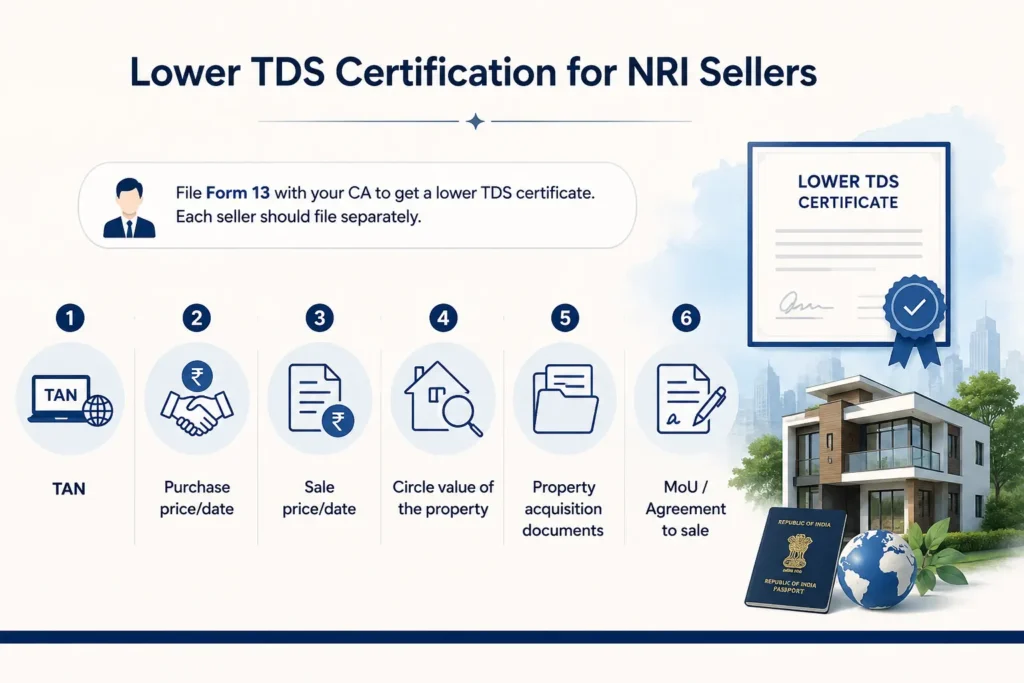
NRI sellers can apply for a lower deduction certificate (Form 13, or Form 128 from tax year 2026-27) with help from a chartered accountant. If there is more than one seller, each applies separately. The following information and documents are needed:
a) The buyer's TAN, or the buyer's PAN where the buyer is a resident individual or HUF using the Form 141 route from 1 October 2026.
b) Purchase price/date
c) Sale price/date
d) Circle value of the property
e) Property aquisition related documents
f) MoU/Agreement to sale
Once a lower TDS certificate is obtained, seller should hand it over to the buyer.
Image by mohamed Hassan from Pixabay


0 Comments