
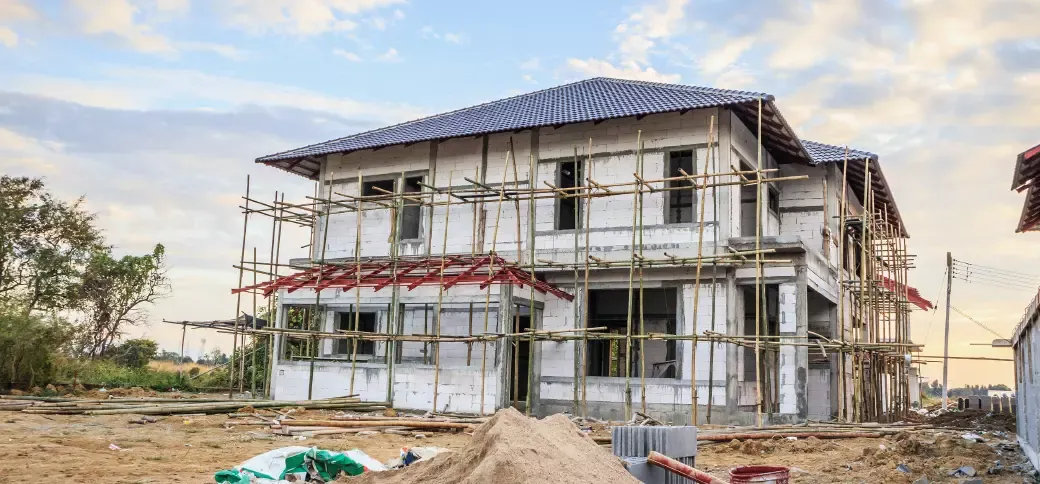
Imagine this. You have saved for years. You finally have a plot of land. The dream of your own house feels real. You sit down with a contractor. He quotes a number. Your heart skips a beat. The number is much higher than you expected. The dream suddenly feels heavy with doubt.
This moment is where most homeowners start. The first question is always the same: What is the construction cost per sq ft?
This simple number is your starting line. It is not just a rate. It is your key to planning, your shield against overspending, and your tool for comparing builders.
Knowing the average cost per square foot helps you in three big ways. First, it allows you to set a realistic budget. You will not be guessing. You will be planning. Second, it lets you compare quotes from different contractors. You can see who is overcharging or who is cutting corners. Third, it helps you estimate the total cost of your future home before you even draw the final plan.
But here is the thing. This number is never fixed. It changes like the weather. It depends heavily on your city, the quality of materials you choose, the design complexity, and even the time of year you build.
Getting a clear, realistic picture of the cost of construction per sq ft is the most important first step you can take. Let us break it down, so your dream home is built on a foundation of knowledge, not just hope.
What Is Construction Cost Per Sq Ft?
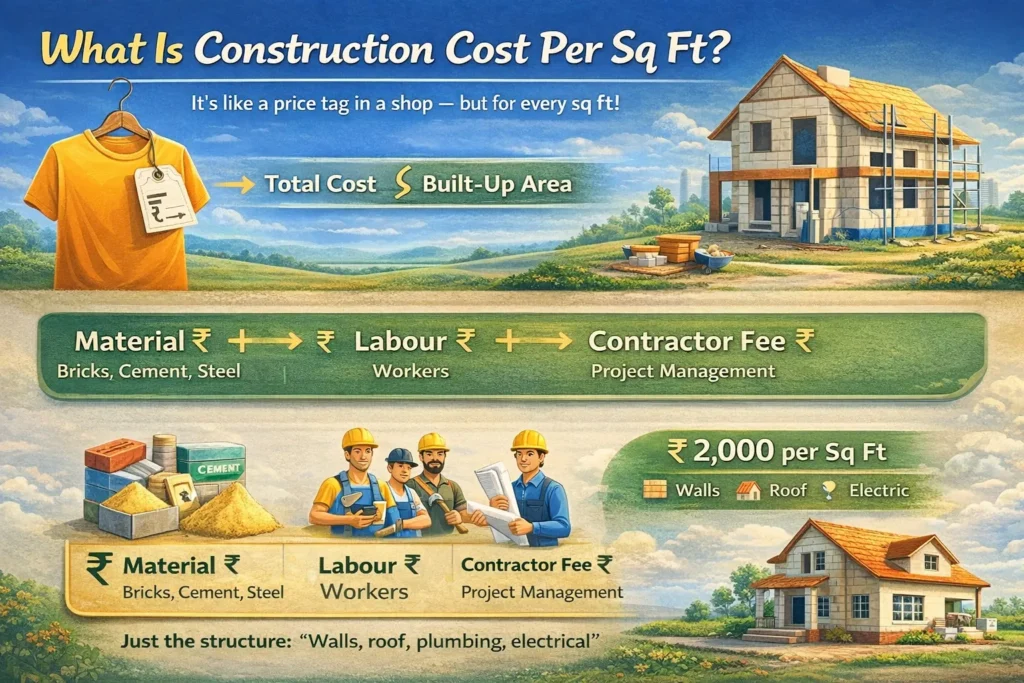
Think of it like the price tag on a shirt. But instead of one price for the whole shirt, you are paying for every square inch of fabric. Construction works similarly.
The construction cost per sq ft is simply the total cost to build your house, divided by its total built-up area.
Built-up area means all the covered space. It includes the area of the walls. If you have a 1,000 sq ft plot, your built-up area might be 800 sq ft, because the walls take up some space.
This per-square-foot rate bundles together several big costs:
- Material Cost: The bricks, cement, steel, sand, tiles, pipes, and wires.
- Labour Cost: The wages for masons, carpenters, plumbers, and helpers.
- Contractor’s Margin: Their fee for managing the project.
What does it not include? It usually excludes the price of the land. It also typically excludes movable furniture like sofas and beds, and sometimes even fixed interior items like kitchen cabinets, depending on your agreement.
So when a builder says “₹2,000 per sq ft,” they are talking about the shell of the house. The structure, the walls, the roof, the basic plumbing and electrical lines.
Average Construction Cost Per Sq Ft in India (2026)
Let us talk numbers. As we look ahead to 2026, prices for materials and labour continue to adjust. The range is broad because “construction” can mean many things.
Here is a straightforward look at what you can expect based on quality:
| Quality Grade | Cost per Sq Ft (₹) | What You Get |
|---|---|---|
| Basic | 1,600 – 1,900 | Functional finish, local materials, standard fittings. Good for rental or budget homes. |
| Standard | 2,000 – 2,400 | The most common choice. Good quality branded materials (like ACC/Ultratech cement, local steel), better finishes. |
| Premium | 2,600 – 3,200 | High-end materials (Birla Gold cement, TMT steel), imported fittings, architectural details. |
| Luxury | 3,500 and above | Top-tier everything. Designer tiles, smart home wiring, premium woodwork, and complex designs. |
A crucial reminder. These are national average ranges. The final number on your quote will dance around this range based on where you live and the brands you pick. A “Standard” home in a village might cost ₹1,800 per sq ft. The same “Standard” home in South Mumbai could easily touch ₹3,000.
The Big Split: Material Cost vs Labour Cost
Where does your money actually go? If your total cost is ₹2,200 per sq ft, it is not one lump sum. It gets divided. Understanding this split is like seeing the recipe for your house.
Typically, for a standard quality construction, the pie is cut like this:
| Component | % of Total Cost |
|---|---|
| Materials | 60–65% |
| Labour | 30–35% |
| Contractor Margin | 5–10% |
Materials are the biggest chunk. This is the physical stuff: cement, steel, bricks, sand, tiles, paint, sanitaryware. Choosing a more expensive tile or a premium brand of steel will directly pull this number up.
Labour cost for house construction per sq ft is the second largest piece. This pays for the skill and time of the people who build your house. Labour rates vary wildly from state to state and city to city. A skilled mason in Kerala may charge more than one in Uttar Pradesh.
The contractor’s margin is their fee for project management, arranging materials, and supervising labour. A fair margin ensures they are motivated to do a good job without cutting corners.
Material Cost Per Sq Ft: A Detailed Look
Let us open the “Materials” box. What are you actually buying?
Cement: The glue of your house. You will need roughly 7 to 8 bags of cement for every 100 square feet of construction. The brand matters. A bag of Ultratech cement costs more than a local brand, but it also offers more consistent strength.
Steel (TMT Bars): The skeleton. This is often the single largest material expense. You can expect to use about 3.5 to 4 kilograms of steel per square foot of construction. The price of steel fluctuates daily. Using branded TMT bars from SAIL, Tata, or JSW is a non-negotiable for safety.
Bricks or Blocks: The flesh. You have a choice here.
- Red Clay Bricks: The traditional choice. Cost varies by quality.
- AAC Blocks: Lighter, bigger, and offering better thermal insulation. They can reduce the overall structural load and may even save on cement and steel. Their material supply cost is higher per piece, but they can speed up construction.
Sand & Aggregate: The bulk fillers.
- River Sand: Becoming scarcer and more expensive due to regulations.
- Manufactured Sand (M-Sand): A reliable, legal alternative. Consistent quality and often recommended by engineers.
Plumbing & Electrical (Conduit): The nerves and veins. Concealed plumbing and wiring look neat but cost 15-20% more than surface wiring. They also need more skilled labour. Do not try to save money here. Good pipes and wires inside your walls prevent nightmares later.
Labour Cost Per Sq Ft in India
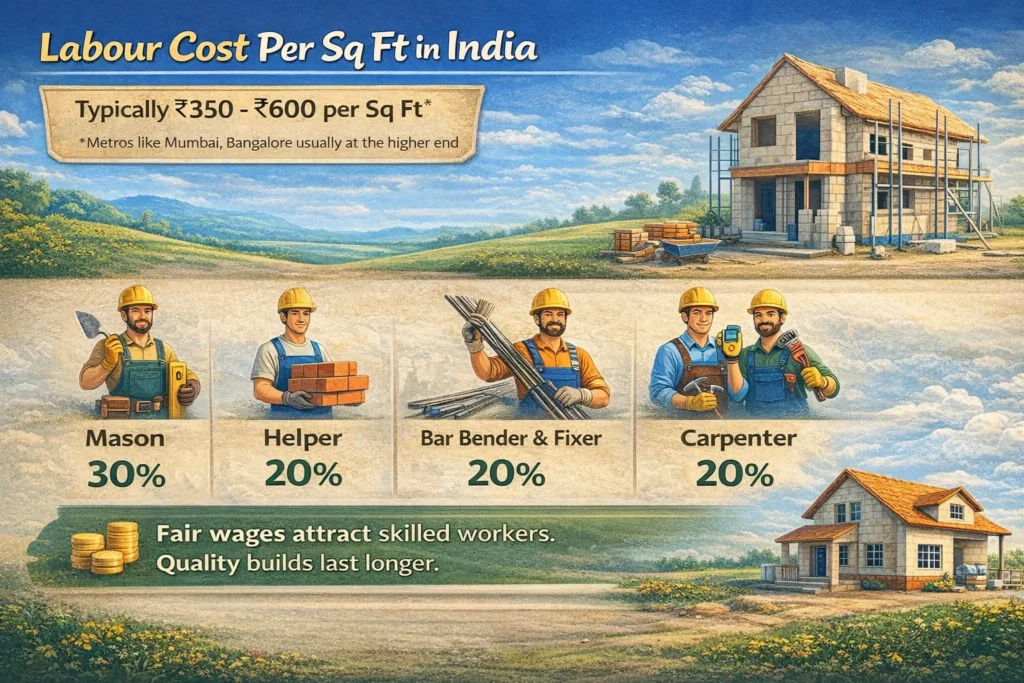
Labour is not just a cost. It is an investment in quality. A highly skilled mason lays straighter walls, which saves on plaster. A good carpenter ensures doors don’t stick.
Here is a breakdown of the key players and their share of your labour cost per square feet:
- Mason: The wall expert. Their work defines the shape of your rooms.
- Helper: Assists the mason, moves materials.
- Bar Bender & Fixer: Cuts and ties the steel reinforcement. Precision here is critical for strength.
- Carpenter: Does the shuttering (molds for concrete) and later, door/window frames.
- Electrician & Plumber: Specialized trades. Their skill determines if your switches work and your drains flow.
So, what is the typical civil work labour rate bundled together? For a standard project, the total labour cost can range from ₹350 to ₹600 per square foot. In metropolitan cities like Bangalore or Mumbai, it leans towards the higher end. In smaller towns, it can be lower.
A good contractor pays fair wages. This attracts skilled workers. It is a sign of a well-managed project.
RCC Construction Cost Per Sq Ft
RCC—Reinforced Cement Concrete—is the backbone of any modern building. It is the framework of your house: the foundation, columns, beams, and slabs.
The RCC construction cost per sq ft is a major subset of your total cost. It typically consumes 25% to 30% of your total budget.
Why is RCC so important? It defines the structural safety of your home. The quality of cement and steel used here, and the skill with which it is poured and cured, cannot be compromised. This is not an area to choose the cheapest quote.
When you look at a slab cost per sq ft breakdown, it includes the concrete, the steel inside it, the shuttering (temporary wooden support), and the labour to put it all together. A thicker slab for a larger span will cost more per square foot than a thinner one.
Breaking Down Slab, Shuttering & Foundation Cost
These three elements are the heart of RCC work.
Foundation Cost: This is the very first RCC work. The cost depends not on your design, but on your soil. Soft, unstable soil needs deeper, stronger foundations (like pile foundations), which can be very expensive. Rocky soil might need blasting. A proper soil test before starting can save huge surprises later.
Shuttering Rate: Shuttering is the temporary mold that holds wet concrete until it sets. You can use:
- Wooden Planks: Traditional, cheaper for small projects, but can warp.
- Plywood (Commercial/Filter): Gives a smoother finish to the concrete underside.
- Steel Shuttering: More expensive, but reusable many times and gives an excellent finish. Often used by large builders.
The shuttering rate per sq ft is part of your slab cost. Better shuttering means less time spent later cleaning up rough concrete ceilings.
Slab Construction Cost: As mentioned earlier, this is a function of thickness and design. A simple, square slab is cheapest. A slab with complex shapes, drop beams, or cantilevers costs significantly more per square foot to engineer and build.
City-Wise Construction Cost Per Sq Ft (2026 Estimates)
A “standard” home does not cost the same everywhere. Labour rates, material transportation, and local taxes create a map of varying costs.
Here is an estimated construction cost per square feet range for major Indian cities for a standard quality finish:
| City / Region | Approx. Cost per Sq Ft (₹) | Why It Varies |
|---|---|---|
| Bangalore | 2,000 – 2,800 | High labour costs, good quality standards. |
| Chennai | 1,900 – 2,600 | Steady labour market, availability of local materials. |
| Hyderabad | 1,800 – 2,500 | Competitive contractor market, growing infrastructure. |
| Mumbai | 2,500 – 3,800+ | Highest in India. Extreme land constraints, high logistics and labour costs. |
| Delhi NCR | 2,200 – 3,200 | Wide range based on location (Noida vs. Central Delhi), premium demands. |
| Kolkata | 1,800 – 2,400 | Traditionally lower labour rates, established supply chains. |
| Tier-2 Cities | 1,700 – 2,200 | (e.g., Coimbatore, Kochi, Pune suburbs, Chandigarh) Better value often found here. |
| Tier-3 Towns | 1,600 – 2,000 | Lower logistics and labour costs drive down prices. |
Construction Cost for Popular House Sizes
Let us make this real with examples. These are estimates for a standard quality finish. Your design choices will change them.
| House Built-up Area | Estimated Total Cost Range (₹) | Simple Math (Using ₹2,200/sq ft avg.) |
|---|---|---|
| 600 sq ft | 12 Lakhs – 15 Lakhs | ~ ₹13.2 Lakhs |
| 1,000 sq ft | 18 Lakhs – 25 Lakhs | ~ ₹22 Lakhs |
| 1,200 sq ft | 22 Lakhs – 30 Lakhs | ~ ₹26.4 Lakhs |
| 1,500 sq ft | 28 Lakhs – 40 Lakhs | ~ ₹33 Lakhs |
| 2,400 sq ft | 45 Lakhs – 70 Lakhs | ~ ₹52.8 Lakhs |
So, a 1000 sq ft house construction cost will likely start around ₹20 lakhs for the basic structure. Remember to add another 15-20% for interior finishes, gates, compound walls, and utility connections.
First Floor Construction Cost Per Sq Ft
Planning to add a floor later? Good news. The first floor construction cost per square feet is usually 10-15% cheaper than the ground floor.
Why? You are not paying for the most expensive parts: the foundation and the plinth. The ground floor already provides a strong base. However, you must ensure your existing foundation and columns were designed to hold an additional floor. If they were not, you need structural strengthening, which can add significant cost.
Prefabricated vs Traditional RCC House Cost
This is a modern question. Prefabricated houses are built from factory-made sections assembled on-site.
- Prefab Houses: Construction is incredibly fast (weeks vs. months). The quality is controlled in a factory. However, the design flexibility is lower. The per sq ft cost can be similar to or slightly higher than standard RCC, but you save massively on time and potentially on loan interest.
- Traditional RCC Houses: Fully customizable. The timeline is long (8-18 months). The final cost depends entirely on your choices and site management.
For most homeowners wanting a unique, customized home, traditional RCC remains the preferred choice. Prefab is excellent for quick, standardized structures like site offices, granny flats, or rural homes.
How to Calculate Your Construction Cost: A Step-by-Step Guide
Let us put this all together. Here is how you, as a homeowner, can make a realistic estimate.
Step 1: Finalize Your Built-up Area. Get this from your architect’s plan. Do not use the plot area.
Step 2: Choose Your Quality Grade. Be honest. Do you want Basic, Standard, or Premium? This decides your per sq ft rate.
Step 3: Do the Core Math.Total Estimated Cost = Built-up Area (sq ft) × Chosen Rate per sq ft Example: 1,200 sq ft × ₹2,200/sq ft = ₹26,40,000.
Step 4: Add the “Extras” (They are not really extra).
- Architect & Plan Approval Fees: 3-5% of project cost.
- Utility Connections: Water, electricity, sewerage. Can be ₹50,000 – ₹2,00,000.
- Compound Wall & Gate: Often forgotten.
- Contingency Buffer: This is mandatory. Add 10% of the total cost for unforeseen issues. Soil problems, rain delays, small design changes.
Step 5: That is your ballpark figure. Use this to check if your savings and loan eligibility are in the right zone.
Using a Construction Cost Calculator
You will find many construction cost per square foot calculator tools online. They are a great starting point.
You input your city, area, and quality. They give an instant estimate. But remember, these calculators work on averages. They cannot know that your plot needs special foundation work or that you want Italian marble.
Use them for initial guidance, not final budgeting. The final cost will come from a detailed Bill of Quantities (BOQ) from your contractor.
Factors That Secretly Increase Construction Cost
Budget overruns are common. Here is what causes them:
- Complex Design: Every corner, curve, or cantilever adds cost.
- Site Access: If a big truck cannot reach your plot, moving materials manually increases labour cost.
- Remote Location: Transporting materials far from suppliers adds a huge premium.
- Labour Shortages: During peak seasons, labour rates go up.
- Choosing All Premium Materials: One premium item is fine. Choosing them all for every single element will multiply your cost.
- Changes During Construction: This is the biggest budget killer. “Let’s move this wall here” after it’s built is incredibly expensive.
Common Costly Mistakes to Avoid
I have seen these happen too many times.
- Underestimating Labour: Thinking you can manage labour yourself to save money often leads to delays and poor quality.
- Ignoring Material Wastage: A good contractor accounts for 5-8% wastage (cut bricks, spilled cement). If a quote has zero wastage, they will run short and ask for more money later.
- No Contingency in Budget: If your entire life savings is exactly the estimated cost, you are in trouble.
- Comparing Only the Bottom Line: A lower quote might use lower-grade steel or cement. Always compare the specifications of materials in the quote.
- Not Visiting the Site Regularly: Your presence shows you care about quality. It prevents shortcuts.
What is the current construction cost per sq ft in India for 2026?
For a standard, good-quality finish in 2026, plan for ₹2,000 to ₹2,400 per square foot on average. This gets you branded cement, reliable TMT steel, and decent finishes. Costs can drop to ₹1,700 for basic quality in smaller towns or shoot past ₹3,000 for premium finishes in metro cities like Mumbai. Always ask for a detailed breakup with material brands.
Does the per sq ft rate include everything—material, labour, and interiors
Usually not everything. The standard per sq ft rate quoted by most contractors covers the “shell and core.” This means the structure (RCC), brickwork, plaster, basic flooring (like rough tiles), external doors/windows, and the rough plumbing/electrical lines inside the walls. It typically excludes kitchen cabinets, toilet fittings (basin, commode), final painting, high-end flooring, and compound walls. Always clarify what’s “in” and what’s “extra.”
How much will a 1,000 sq ft house cost to build?
For a 1,000 sq ft built-up area with a standard finish, the construction cost will be roughly ₹18 to ₹25 lakhs. This is for the structure. You must add another ₹3-5 lakhs for basic interior finishes (painting, flooring, basic fittings), utility connections, and compound wall. So, a total budget of ₹22-30 lakhs (excluding land) is a realistic starting point.
Why is there such a huge price difference between cities?
Three main reasons: Labour, Logistics, and Luxury. Labour rates in Mumbai or Bangalore are significantly higher than in Indore or Lucknow. Transporting materials to city centers or hilly areas adds cost. Finally, client expectations and builder margins are higher in metros. The same “standard” home can cost 40% more in South Mumbai than in a Pune suburb.
Is building the first floor cheaper than the ground floor?
Yes, typically. Constructing the first floor costs about 10-15% less per sq ft than the ground floor. This is because you avoid the most expensive elements: the foundation and the plinth (the raised base). However, this assumes your original foundation was designed to hold an extra floor. If it wasn’t, strengthening it could erase any savings.
How much of the cost is labour, and how much is materials?
For a standard project, materials consume about 60-65% of your total cost, and labour takes 30-35%. The remaining 5-10% is the contractor’s supervision fee. So, on a ₹2,200/sq ft project, roughly ₹1,430 goes to materials, ₹770 to labour. Skimping on labour rates often leads to unskilled workers and poor quality, which costs more to fix later.
What are the biggest hidden costs that blow the budget?
Homeowners most commonly underestimate:
Soil Work: Weak soil needs deep, expensive foundations.
Design Changes: Moving a wall after it’s built is incredibly costly.
Statutory Fees: Plan sanction, utility connection (electricity, water) fees.
Contingency: Not keeping a 10% buffer for rain delays, material price hikes, or small errors.
Quality Upgrades: Deciding mid-way to switch from vitrified tiles to marble.
Should I choose a contractor who quotes the lowest per sq ft rate?
Not necessarily. The cheapest quote is often the most expensive in the long run. A very low rate usually means one of three things: using lower-grade materials (like cheap, unbranded steel), underestimating quantities (and asking for more money later), or cutting corners in workmanship. Always compare the specification sheets (brands and quantities of materials) behind the quotes, not just the final number.
How accurate are online construction cost calculators?
They are good for a ballpark figure, but not for final budgeting. Online calculators use average data for your city and area. They cannot account for your specific plot condition, soil type, design complexity, or choice of material brands. Use them to get a general idea. Your final budget must be based on a detailed Bill of Quantities (BOQ) from your architect or contractor.
What is a fair contractor margin or supervision fee?
A professional contractor’s fee for managing the entire project—arranging labour, buying materials, and supervising quality—typically ranges from 5% to 10% of the total project cost. This is reasonable for the responsibility they shoulder. Be wary of fees below 5% (they may be making money elsewhere on material margins) or above 10% without a very clear, premium service justification. Get this fee structure in writing.


0 Comments