
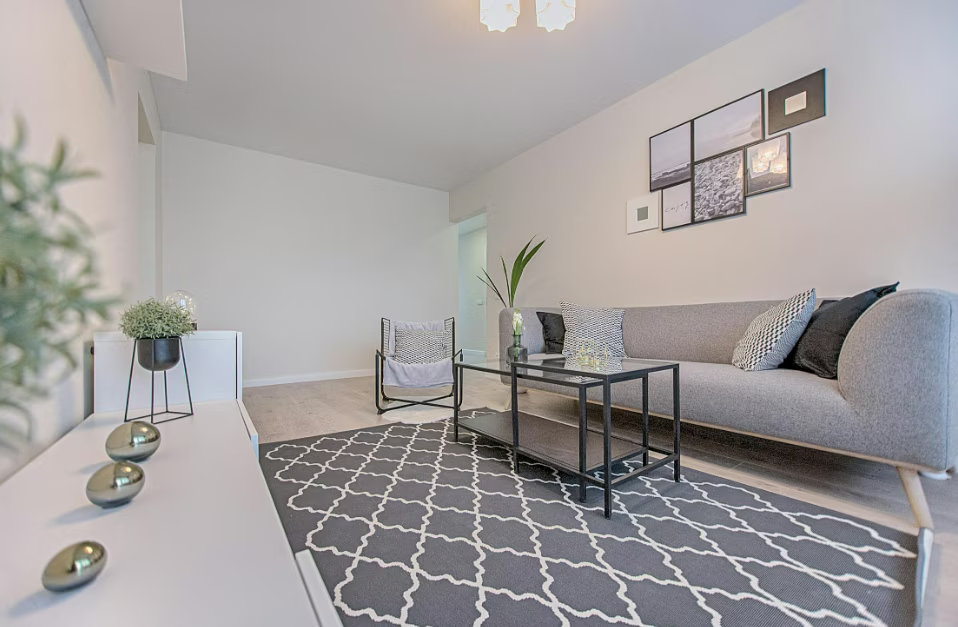
You walk into a sales office. The brochure says “2BHK, 1300 sq. ft.” It looks perfect. But later, you measure the rooms. You feel a squeeze. Something is off. The space feels much smaller than 1300 square feet.
This is a common story. Builders use area terms that sound big. Terms like “super built-up area.” But the space you actually live in is called “carpet area.” The difference between these terms can be huge. It can change the price you pay by lakhs of rupees.
Understanding these three terms is not about complex math. It is about knowing what you are buying. It is about seeing past the marketing to the reality of your home. This guide will give you that clarity.
What is Carpet Area?
Imagine you are laying down wall-to-wall carpets in your new flat. The total floor space those carpets would cover is your carpet area.
It is the actual usable area inside the walls of your apartment. The space where you can place your furniture, walk around, and live.
It includes:
- The living room.
- All bedrooms.
- The kitchen.
- Bathrooms and toilets.
It excludes:
- The thickness of the internal and external walls.
- The balcony.
- Any utility ducts.
- Common areas like the lobby or staircase.
Think of it as your private living space, measured from the inside wall to inside wall. Under RERA rules, this is the most important definition. It is the standard for fair pricing.
What is Built-up Area?
Built-up area takes the carpet area and adds the space taken up by the structure of the building.
Built-up Area = Carpet Area + Wall Thickness + Balcony + Utility Ducts
It is sometimes called the covered area. It represents the total area your apartment covers on the floor plate. If you looked down from above, the built-up area is the total footprint of your flat, including its walls and balcony.
It is always bigger than the carpet area. A builder might use this for pricing in some cases. But it is still less common than super built-up area.
What is Super Built-up Area
This is where builders add the common spaces of the entire building. It is the largest number you will see in an advertisement.
Super Built-up Area = Built-up Area + Your Share of Common Areas
What are these common areas? They include:
- The lobby and corridors.
- Staircases and lift shafts.
- The clubhouse, gym, and swimming pool.
- Security rooms and society office.
- Garden and play areas.
You do not own these spaces privately. You share them with all other residents. But the builder adds a portion of their cost to your apartment’s area. This inflates the number. That 1300 sq. ft. brochure figure is almost always the super built-up area.
Quick Comparison Table
| Feature | Carpet Area | Built-up Area | Super Built-up Area |
|---|---|---|---|
| Usable private space | Yes | No | No |
| Includes wall thickness | No | Yes | Yes |
| Includes private balcony | No | Yes | Yes |
| Includes shared common areas | No | No | Yes |
| Typically used for pricing | Under RERA | Sometimes | Most often by builders |
| Reflects actual living space | Yes | Partially | No |
Difference Between Carpet Area and Built-up Area
The gap between these two is the physical structure of your flat.
- Carpet Area: The empty, usable floor space.
- Built-up Area: The carpet area plus the walls, balcony, and ducts that enclose it.
Think of a book. The carpet area is the total area of all the pages you can write on. The built-up area is the area of the pages plus the thickness of the book’s covers and spine.
Difference Between Built-up Area and Super Built-up Area
This difference is about shared versus private space.
- Built-up Area: Only your private apartment’s footprint.
- Super Built-up Area: Your private footprint plus a slice of the building’s shared amenities.
Now, think of a private office room in a large business park. The built-up area is the size of your locked office, including its walls. The super built-up area would include a part of the shared lobby, the corridors, the cafeteria, and the gym. You use them, but you share them with everyone.
Difference Between Carpet Area and Super Built-up Area
This is the most critical difference for your budget. It is the gap between what you live in and what you pay for.
- Carpet Area: The space you actually own and use daily.
- Super Built-up Area: A marketing number that includes shared, non-private spaces.
This difference is often called the loading factor or common area percentage. A higher loading factor means you are paying for more shared space relative to your private space.
Carpet Area vs Covered Area: Are They the Same?
Often, yes. In common language, “covered area” usually means the built-up area. It covers everything under the roof of your apartment, including walls. So, Covered Area ≈ Built-up Area. Carpet area is a subset of the covered area. It is the useful space inside the cover.
How are These Areas Calculated?
Let us break it down with a simple example. Assume the core of your flat, the carpet area, is 1000 square feet.
- Carpet Area to Built-up Area: Your walls are about 6 inches thick. Your balcony is 50 sq ft. Utility ducts take up 20 sq ft. Built-up Area = 1000 + (Area of walls, say 150 sq ft) + 50 + 20 = Approx. 1220 sq ft.
- Built-up Area to Super Built-up Area: The builder applies a “loading factor” for common areas. This factor is often 25% to 40%. If the loading factor is 30%, then: Super Built-up Area = Built-up Area × (1 + Loading Factor) = 1220 × 1.30 = 1586 sq ft.
See what happened? Your usable 1000 sq ft carpet area is now advertised as a ~1586 sq ft apartment.
Super Built-up Area to Carpet Area Conversion
This is the calculation you must do as a buyer. You need to work backwards from the fancy number to the real number.
Step 1: Ask the builder for the Loading Factor or Common Area Percentage. They are legally required to provide it. Step 2: Use this formula: Carpet Area ≈ Super Built-up Area ÷ (1 + Loading Factor)
If a flat is advertised as 1300 sq ft (super built-up) with a 30% loading factor: Estimated Carpet Area = 1300 ÷ 1.30 = 1000 sq ft.
Always do this math. It tells you the truth.
Typical Ratios in India
As a rule of thumb, you can use these common approximations:
| If Carpet Area is 100% then… | Typical Percentage |
|---|---|
| Built-up Area is about | 115% – 125% |
| Super Built-up Area is about | 140% – 165% |
This means if the super built-up area is 1500 sq ft, your carpet area is likely between 900 – 1070 sq ft. The variation is why you must ask for the exact loading factor.
RERA Carpet Area vs Traditional Carpet Area
RERA has a strict, buyer-friendly definition. It states that carpet area includes the internal partition walls of the apartment. Earlier, some builders would exclude these to show a smaller number. Now, the measurement is more consistent and slightly larger (in your favour).
Most importantly, RERA mandates that builders must sell properties based on the carpet area price. They can still advertise the super built-up area, but the sale agreement and the price per square foot must be based on the carpet area. This allows for true apples-to-apples comparison between projects.
Why Do Builders Still Quote Super Built-up Area?
Old habits and marketing. A bigger number sounds more impressive in an ad. Saying “Spacious 1600 sq ft 2BHK” attracts more clicks than “1000 sq ft carpet area 2BHK,” even though they describe the same apartment. It creates an illusion of more space for your money.
Which Area Should You Focus On?
Always, always focus on the Carpet Area. This is your true living space. When comparing two flats, never look at the super built-up price.
Compare the Price per Square Foot of Carpet Area.
- Flat A: ₹1 Crore price, 1000 sq ft carpet area = ₹10,000/sq ft (carpet).
- Flat B: ₹1.05 Crore price, 1200 sq ft carpet area = ₹8,750/sq ft (carpet).
Even though Flat B costs more in total, it gives you more actual living space for your money.
Is Balcony Included in Carpet Area?
No. As per RERA’s clear definition, balconies, verandahs, and terraces are excluded from the carpet area. They are, however, included in the built-up and super built-up areas. You pay for them, but they are not counted as your primary usable living space.
Common Tricks to Be Aware Of
- Undefined Loading Factor: If a builder hesitates to give you the exact common area percentage, be cautious.
- Inflated Common Areas: Including extravagant but rarely used facilities (like a massive clubhouse) to inflate the super built-up area.
- Changing Terminology: Using vague terms like “saleable area” without defining if it’s built-up or super built-up. Always ask for the RERA-defined carpet area.
- Misleading Layouts: Brochure floor plans that don’t clearly dimension each room, making it hard for you to calculate the real carpet area yourself.
A Real-World Example
Let us look at “Skyview Towers,” advertising a 2BHK.
- Advertised (Super Built-up Area): 1350 sq. ft., priced at ₹1.35 Crore. Price/sq ft = ₹10,000.
- Builder’s Loading Factor: 35%.
- Your Calculation: Estimated Carpet Area = 1350 ÷ 1.35 = 1000 sq ft.Real Price per sq ft (Carpet) = ₹1,35,00,000 ÷ 1000 = ₹13,500.
Now, compare with “Green Valley Homes.”
- Advertised (Carpet Area as per RERA): 1050 sq. ft., priced at ₹1.40 Crore.
- Price per sq ft (Carpet) = ₹1,40,00,000 ÷ 1050 = ₹13,333.
Suddenly, Green Valley Homes offers 50 sq ft more of actual usable space for a similar price per square foot. By looking only at carpet area, you make an informed choice. You see past the marketing.
Conclusion
Buying a home is a major decision. The language of “areas” should not be a trick. It should be a tool for clarity. Remember this simple rule: Ignore the super built-up area. Demand the RERA carpet area. Compare prices based on that.
When you focus on the carpet area, you shift the power. You are no longer buying a vague promise of space. You are buying measured, usable square feet for you and your family. You move from being confused by the numbers to being in control of them. That is the first step to finding a true home.
FAQ
Also Read: What is PCC in Construction? Meaning, Mix Ratio & Uses
Also Read: Construction Cost Per Sq Ft in India: Material, Labour & Total Cost Breakdown (2026 Guide)
What is the key difference between carpet area and built-up area?
The carpet area is the actual usable floor space inside your apartment walls, where you can place furniture. The built-up area includes the carpet area PLUS the space taken up by the walls, your private balcony, and utility ducts. Built-up area is always larger.
What does “super built-up area” include that the others don’t?Super
built-up area includes everything in the built-up area, PLUS a proportionate share of the building’s common areas. This includes lobbies, staircases, lifts, gyms, gardens, and corridors. It is the largest of the three measurements and is often used in advertising.
Which area should I use to compare prices between two flats?
Always compare the price per square foot based on the RERA carpet area. This is the only way to compare the true cost of your actual living space. Ignore the super built-up price, as it includes shared amenities you don’t privately own.
How can I convert super built-up area to carpet area?
You need the builder’s “loading factor” (common area percentage). Use this formula: Estimated Carpet Area = Super Built-up Area ÷ (1 + Loading Factor). For example, if a flat is 1300 sq ft (super built-up) with a 30% loading factor: 1300 ÷ 1.30 = 1000 sq ft carpet area.
What is a “loading factor”?
The loading factor is the percentage added to your apartment’s built-up area to account for your share of the building’s common spaces. A 25-40% loading factor is common. A higher factor means you are paying for more shared space relative to your private flat.
Which area definition is legally binding under RERA?
The RERA-defined Carpet Area is legally binding. Since 2016, builders are required to sell and register properties based on this area. The price quoted must be based on the carpet area, bringing transparency for buyers.
Why do builders advertise super built-up area?
Builders use super built-up area in ads because it’s a larger number. A “1600 sq ft apartment” sounds more impressive and spacious than a “1100 sq ft apartment,” even if they have the same usable carpet area. It’s a marketing tactic.
What is typically included in the built-up area?
Built-up area typically includes:
The carpet area (all rooms).
The thickness of the internal and external walls.
Your private balcony or terrace.
Utility ducts and dry balconies.
How much smaller is carpet area compared to super built-up area?
Typically, the carpet area is about 25-40% smaller than the super built-up area. If a flat is advertised as 1400 sq ft (super built-up), expect the real usable carpet area to be roughly between 1000 – 1120 sq ft, depending on the project’s loading factor. Always ask for the exact numbers.


0 Comments