


Top 10 Rental Property Management Software for Landlords
You’re tracking rent payments in a spreadsheet. Tenant calls come to your personal phone at all hours. Receipts are scattered across your email and kitchen counter.
Sound familiar? Managing rentals manually works. Until it doesn’t. The breaking point usually comes around property number three. Or when you forget to follow up on late rent. Or when tax season arrives and you realize your records are a mess.
Modern cloud-based property management software solves these problems. It automates rent collection. Organizes tenant data. Generates financial reports. Tracks maintenance requests. This guide compares the top 10 rental property management software tools in . We’ll focus on what small landlords and residential property owners actually need. No enterprise features you’ll never use. No technical jargon that confuses more than it helps.
Let’s find the right tool for your rental business.
What Is Rental Property Management Software?
Think of it as your digital property management assistant.
Property management software handles the repetitive tasks that eat up your time. Collecting rent. Tracking expenses. Communicating with tenants. Managing lease documents.
The core purpose breaks down into four areas.
Tenant management: keeps all tenant information in one place. Contact details. Lease dates. Payment history. Communication logs. Everything you need about each tenant is instantly accessible.
Rent collection: happens automatically. Tenants pay online. The software tracks who paid and who didn’t. It sends reminders. Calculates late fees. Records transactions.
Accounting and reporting: organizes your finances. Income and expenses get categorized automatically. You can generate profit and loss statements. Cash flow reports. Tax-ready summaries.
Maintenance tracking: manages repair requests from submission to completion. Tenants report issues through the software. You track progress. Document costs. Keep records of all work done.
Here’s the key difference. Landlord software is designed for small property owners managing a few units. Enterprise property management systems are built for large companies managing hundreds or thousands of units.
We’re focusing on landlord software. Tools built for real people managing real properties without IT departments or dedicated staff.
Why Landlords Should Use Property Management Software
Let me tell you about a landlord I know. He managed five properties using a combination of Excel, WhatsApp, and paper receipts.
It worked until it didn’t.
He missed a rent payment because the reminder was buried in messages. He couldn’t find expense receipts at tax time. A maintenance issue escalated because it got lost in his phone’s message history.
Software would have prevented all of this.
Saves time and reduces errors: Manual tracking creates mistakes. You forget to record a payment. You miscalculate late fees. You lose track of who owes what. Software eliminates human error from routine tasks.
Improves rent collection consistency: Automated reminders mean tenants rarely forget payment dates. Online payment options make it easier for tenants to pay on time. Consistent rent collection improves your cash flow.
Centralized records for taxes and audits: Every transaction is recorded. Every expense is categorized. When tax season arrives, you generate reports instead of hunting through piles of receipts.
Better tenant communication: Professional communication builds better landlord-tenant relationships. Software provides proper documentation of all interactions. No more “he said, she said” disputes.
Scales easily as property count grows: Managing one property manually is doable. Managing five becomes challenging. Managing ten is nearly impossible. Software handles ten properties as easily as it handles one.
The question isn’t whether you need software. It’s which software fits your needs.
Features to Look for in Rental Property Management Software
Not all software is created equal. Some tools focus on rent collection. Others emphasize accounting. Some do everything but poorly.
Here are the core features every good landlord software should include.
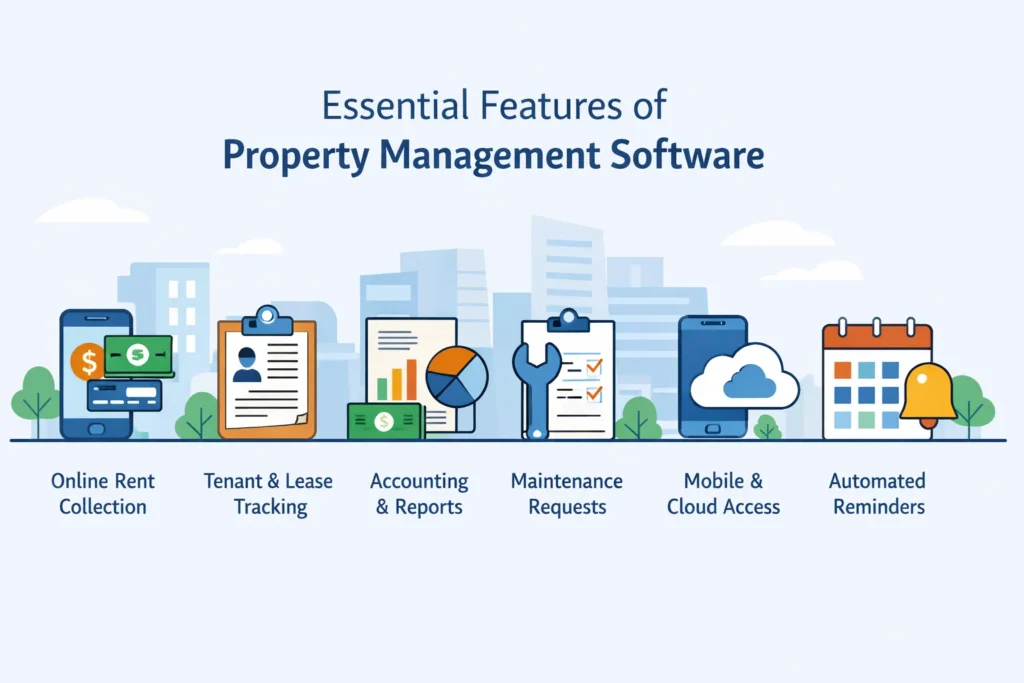
Online rent collection: is non-negotiable in . Tenants should be able to pay rent through the software using bank transfers, cards, or other digital methods. Manual collection is outdated and inconvenient.
Tenant database and lease tracking: keeps all tenant information organized. Contact details. Lease start and end dates. Security deposit amounts. Emergency contacts. Lease documents.
Accounting and financial reports: turn transaction data into useful information. Income statements. Expense tracking. Owner statements if you have partners. Tax reports.
Maintenance request tracking: manages repairs systematically. Tenants submit requests through the software. You assign them to vendors or handle them yourself. Track completion and costs.
Cloud access and mobile support: means you can manage properties from anywhere. Check rent status from your phone. Approve maintenance requests while traveling. Access reports from any device.
Advanced features separate good software from great software.
Automated reminders: send rent reminders before due dates. Late payment notices after due dates. Lease renewal alerts months before expiry. Automation reduces your mental load.
Late fee calculation: happens automatically based on your policies. The software knows when payment is late and calculates fees according to your rules.
Owner statements: matter if you have investment partners or manage properties for others. The software generates regular statements showing income, expenses, and net proceeds.
Integrations: connect your property management software to your bank accounts, accounting software, or tax preparation tools. Data flows automatically instead of requiring manual entry.
Don’t get distracted by flashy features you’ll never use. Focus on the basics done well.
Top 10 Rental Property Management Software in
Let’s compare the actual tools. We’ll look at what each does well, what it doesn’t, and who should use it.
1. Housewise.in
Best for: Indian landlords who want a local, hands-on solution
Housewise.in is built specifically for the Indian rental market. It focuses less on heavy software dashboards and more on practical, end-to-end property management support.
Key features include tenant sourcing and verification, rent collection follow-ups, maintenance coordination, documentation support, and dedicated relationship managers. In many cities, they also offer on-ground assistance.
Pros: It’s tailored for India, which makes a real difference. Tenant verification, local compliance, and market understanding are strong. You don’t need to learn complex software. A human team handles most of the work. Ideal if you live outside the city or outside India.
Cons: It’s not a self-serve software like Buildium or TenantCloud. Reporting and dashboards are limited compared to global SaaS tools. Availability and service depth can vary by city.
Pricing is service-based rather than flat software pricing. Costs typically depend on the city, number of properties, and level of involvement required.
Ideal use-case: You own rental property in India and want peace of mind rather than software control. You’re an NRI or a busy professional. You prefer a managed service over learning and maintaining property management software.
2. Buildium
Best for: Growing landlords and small property managers
Buildium sits in the sweet spot between beginner tools and professional software.
Key features include comprehensive online rent collection, robust accounting and reporting, maintenance management with vendor portals, tenant and owner portals, and document storage.
Pros: The accounting features are strong. You can track income and expenses across multiple properties easily. Financial reports are detailed and useful for tax preparation. The interface is professional without being overwhelming.
Cons: Pricing can add up for very small landlords. The learning curve is steeper than simpler tools. Some features feel like overkill if you only manage one or two properties.
Pricing starts around $50 per month for up to 20 units. It scales up from there based on unit count.
Ideal use-case: You manage 5 to 50 units and need professional-grade accounting. You plan to grow your portfolio. You want software you won’t outgrow quickly.
3. AppFolio
Best for: Professional property managers
AppFolio is powerful. Maybe too powerful for most small landlords.
Key features include advanced automation and workflows, comprehensive tenant portals, online leasing and applications, maintenance coordination, and integrated accounting.
Pros: The automation is impressive. Lease renewals, rent increases, and routine communications happen automatically. The mobile app is excellent. Tenants love the portal experience.
Cons: It’s expensive. There’s a minimum unit requirement, typically 50 units or more. The feature set is overkill for small landlords. Setup and learning take significant time.
Pricing starts at several hundred dollars per month with minimum unit requirements.
Ideal use-case: You’re a professional property manager handling 50-plus units. You need enterprise-grade features. Budget isn’t your primary concern.
4. TenantCloud
Best for: Small landlords and beginners
TenantCloud offers a free plan that actually works. That’s rare.
Key features include online rent payments, basic accounting, tenant screening, maintenance requests, and lease templates.
Pros: The free plan is genuinely useful, not just a teaser. The interface is clean and beginner-friendly. Setup takes minutes, not hours. It covers the essential needs of small landlords.
Cons: Advanced features require paid plans. Financial reporting is basic compared to professional tools. Customer support can be slow.
Pricing offers a free plan for up to 75 units. Paid plans start around $15 per month with additional features.
Ideal use-case: You’re just starting with one or two properties. You want to try software before committing serious money. You need basic functionality without complexity.
5. Rentec Direct
Best for: Accounting-focused landlords
If you care deeply about financial tracking, Rentec Direct delivers.
Key features include strong financial reports, owner statements for investors, detailed expense tracking, online rent collection, and tenant portals.
Pros: The accounting capabilities rival dedicated accounting software. Reports are comprehensive and customizable. Tax preparation becomes much easier. Owner statements are professional quality.
Cons: The interface feels dated compared to newer tools. Some features are buried in menus. It’s not the most intuitive for beginners.
Pricing starts around $35 per month for up to 15 properties or 70 units.
Ideal use-case: You have investment partners who need regular financial statements. Tax preparation is a priority. You value substance over style in software.
6. Avail
Best for: DIY landlords
Avail is designed for hands-on landlords who want to stay involved in every detail.
Key features include lease templates, tenant screening services, online rent collection, expense tracking, and state-specific lease agreements.
Pros: It’s simple and straightforward. The tenant screening integration is convenient. Lease templates cover legal basics well. The free version offers real value.
Cons: Advanced features are limited. Accounting isn’t as robust as dedicated tools. It’s not built for scaling to large portfolios.
Pricing offers a free basic plan. Premium plans add features like unlimited tenant screening for about $5 per property per month.
Ideal use-case: You manage a handful of properties yourself. You don’t want to hire a property manager. You need reliable basics without enterprise complexity.
7. DoorLoop
Best for: User-friendly interface
DoorLoop wins on ease of use. The interface makes sense immediately.
Key features include intuitive dashboard design, quick property and tenant setup, online payments, maintenance tracking, and accounting reports.
Pros: The onboarding process is smooth. You can be up and running in under an hour. The interface looks modern and clean. Customer support is responsive.
Cons: It’s relatively new, so long-term reliability is less proven. Some advanced features are still being developed. Pricing can increase with add-ons.
Pricing starts around $49 per month for up to 20 units.
Ideal use-case: You’re not particularly tech-savvy. You want software that doesn’t require a manual to understand. Clean design matters to you.
8. Hemlane
Best for: Remote landlords
Managing properties from another city or country creates unique challenges. Hemlane addresses them.
Key features include leasing support services, maintenance coordination with local vendors, online rent collection, tenant screening, and remote property management tools.
Pros: The maintenance coordination is excellent. They help find local vendors if needed. Communication tools keep you connected from anywhere. Leasing support reduces your workload.
Cons: Additional services increase costs. You’re relying on their vendor network. It’s not ideal if you prefer direct control.
Pricing has a free basic plan. Premium services like leasing support and maintenance coordination add fees.
Ideal use-case: You manage properties in a different city. You’re an NRI managing Indian properties remotely. You want local support without hiring a full property manager.
9. Landlord Studio
Best for: Mobile-first landlords
Landlord Studio assumes you manage properties from your phone. Because you probably do.
Key features include mobile expense tracking with receipt photos, mileage tracking for property visits, online rent collection, tax-ready reports, and property analytics.
Pros: The mobile app is genuinely excellent. Taking photos of receipts for instant expense tracking is brilliant. Tax reports are comprehensive. The interface is modern.
Cons: Desktop features are more limited. It’s better for expense tracking than comprehensive property management. Tenant communication tools are basic.
Pricing starts around $8 per month per property.
Ideal use-case: You’re always on the go. You want to track expenses immediately, not later. Mobile convenience is more important than desktop power.
10. Innago
Best for: Free property management software seekers
Innago’s business model is unique. No monthly subscription. They charge small fees on rent transactions instead.
Key features include online rent collection with transaction fees, tenant and owner portals, maintenance requests, basic accounting, and unlimited properties on free plan.
Pros: No monthly subscription fee removes a barrier. You can manage unlimited properties. Basic features cover essential needs. It’s genuinely free for landlords.
Cons: Transaction fees add up if you have many tenants. Advanced accounting is limited. Some features feel basic compared to paid tools.
Pricing is free for landlords. Small transaction fees apply to online rent payments.
Ideal use-case: You have several properties but limited budget. You prefer transaction fees over monthly subscriptions. Your needs are basic but real.
Quick Comparison Table: Best Rental Property Management Software
| Software | Best For | Free Plan | Online Rent Collection | Accounting & Reports |
|---|---|---|---|---|
| Housewise.in | Indian landlords & NRIs | No | Assisted | Service-based |
| TenantCloud | Small landlords | Yes | Yes | Basic |
| Buildium | Growing portfolios | No | Yes | Advanced |
| Innago | Budget-conscious landlords | Yes (fees apply) | Yes | Limited |
| AppFolio | Professional property managers | No | Yes | Advanced |
| Avail | DIY landlords | Yes (basic) | Yes | Basic |
| Rentec Direct | Financial tracking focus | No | Yes | Advanced |
| DoorLoop | Easy-to-use interface | No | Yes | Good |
| Hemlane | Remote management | Yes (basic) | Yes | Basic |
| Landlord Studio | Mobile-first landlords | No | Yes | Tax-focused |
| Yardi Breeze | Mid-size portfolios | No | Yes | Professional |
Best Software for Different Landlord Needs
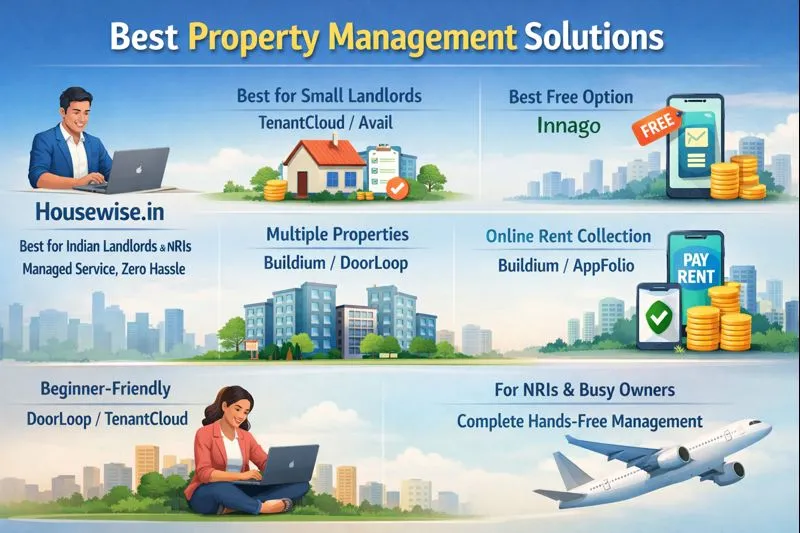
Best overall option for Indian landlords and NRIs: Housewise.in
If your property is in India and you want zero operational hassle, Housewise stands out. It’s not software. It’s a managed service. Rent follow-ups, tenant coordination, maintenance, and local compliance are handled by a real team. For NRIs or busy owners, this is often the most practical choice.
Best software for small landlords: TenantCloud or Avail.
Both offer free plans that cover the basics. They’re simple to learn, quick to set up, and don’t overwhelm you with features you won’t use.
Best rental property management software for multiple properties: Buildium or DoorLoop.
These tools handle complexity well without becoming confusing. They scale as your portfolio grows, and the accounting stays clean across multiple properties.
Best free rental property management software: Innago takes this category.
The free plan genuinely works for unlimited properties. TenantCloud is a close second with strong free features.
Best option for online rent collection: Most modern tools do this well, but Buildium and AppFolio offer the widest payment options and the smoothest tenant experience. That said, if you don’t want to chase payments at all, Housewise.in removes the problem entirely by handling follow-ups for you.
Best beginner-friendly property management software: DoorLoop wins on ease of use. TenantCloud is also excellent for beginners. Both have intuitive interfaces that don’t require training.
FAQs
Which is the best rental property management software for small landlords?
TenantCloud and Avail are excellent for small landlords. Both offer free plans with essential features. They’re simple to learn and use. They cover rent collection, tenant tracking, and basic accounting.
Is free property management software reliable?
Yes, when it comes from established companies. Innago, TenantCloud, and Avail all offer reliable free plans. The limitation is features, not reliability. Free plans work well for basic needs.
Can landlords collect rent online using these tools?
Absolutely. Online rent collection is a core feature of all modern property management software. Tenants can pay via bank transfer, debit card, or credit card directly through the software.
Do these tools replace accountants or property managers?
Not entirely. Software handles routine tasks and organization. But it doesn’t provide expert advice. You might still need an accountant for tax strategy or a lawyer for legal questions.
What software is best for managing multiple rental properties?
Buildium and DoorLoop excel at managing multiple properties. They organize information clearly across portfolios. Financial reporting separates income and expenses by property while showing overall performance.
Are these tools suitable for NRIs or remote landlords?
Yes. Cloud-based software works perfectly for remote management. Hemlane specifically focuses on remote landlord needs. But any cloud-based tool allows you to manage properties from anywhere.
Also Read: What Are the Duties and Responsibilities of a Property Management Company?

Pryank Agrawal is the Founder and CEO of Housewise, a leading property management startup serving customers across 45 countries with operations in 22 Indian cities, including Pune, Bengaluru, Hyderabad, Chennai, Delhi NCR, and Mumbai. An engineering graduate from IIT Roorkee, Pryank brings extensive experience from the software industry. His passion for leveraging technology to solve real estate challenges led him to establish Housewise, simplifying property management for homeowners worldwide. After persistent requests from existing customers to address other challenges faced by Non-Resident Indians, he founded MostlyNRI, a dedicated portal assisting NRIs with taxation and financial asset management in India.